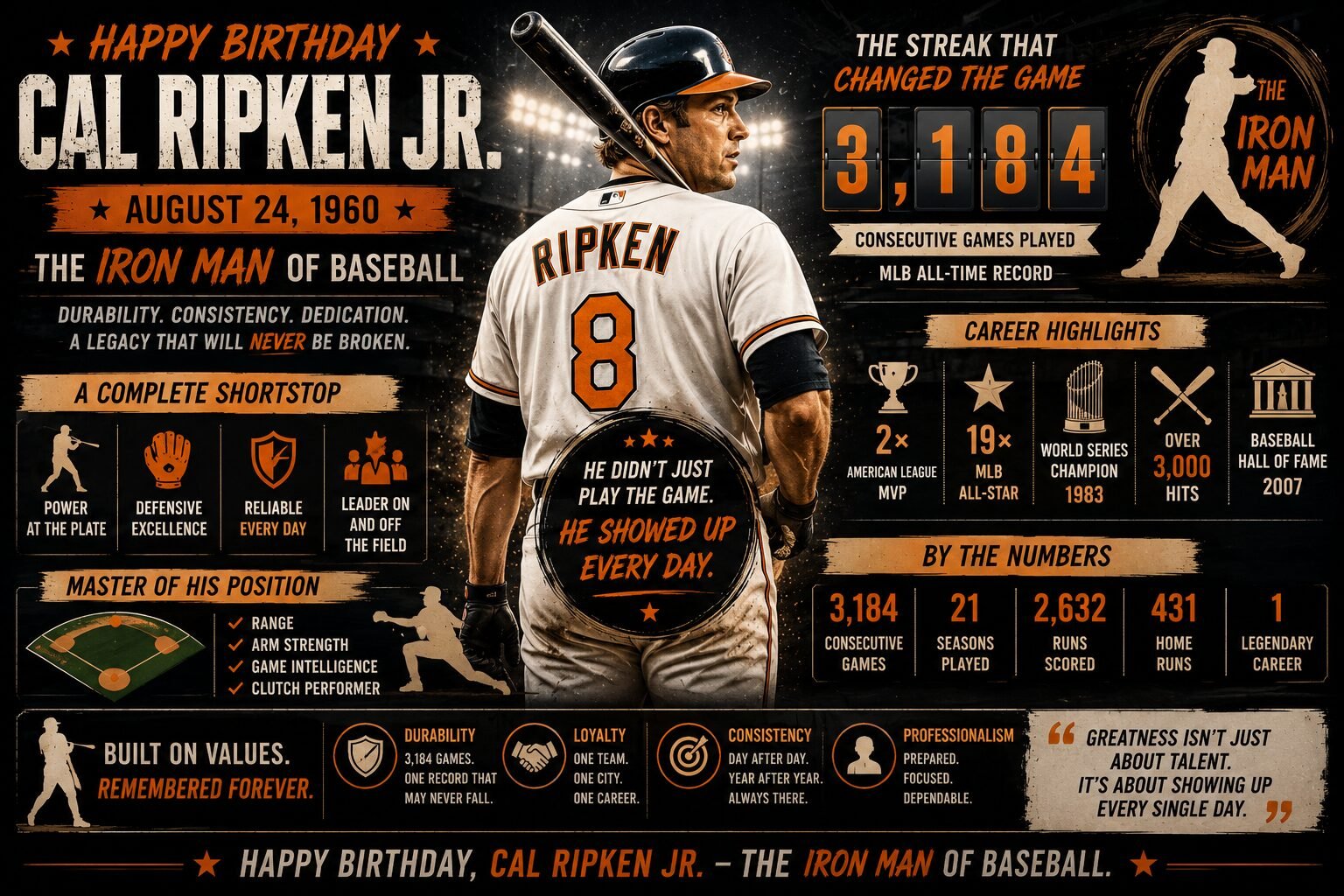

Some players shine for a few seasons. Others build Hall of Fame careers. And then there are those who redefine what it means to show up every single day.
Cal Ripken Jr. was that kind of player.
Born on August 24, 1960, Ripken didn’t just become the face of the Baltimore Orioles — he became a symbol of consistency, durability, and dedication in Major League Baseball. On his birthday, fans celebrate more than stats. They celebrate commitment, professionalism, and a record that may never be broken.
Affiliate Disclosure: This article may contain affiliate links and banner advertisements. If you make a purchase through these links, we may earn a small commission at no additional cost to you. Thank you for supporting our platform.
From Maryland Roots to MLB Stardom
Cal Ripken Jr. was born in Havre de Grace, Maryland, and raised in a family where baseball was more than a game—it was a way of life. His father, Cal Ripken Sr., spent decades working in professional baseball as a minor-league player, coach, manager, and instructor within the Baltimore Orioles organization. Because of that connection, young Cal was surrounded by the routines, language, and expectations of the sport from an early age.
While other children watched professional baseball from the stands or on television, Ripken often observed the game from much closer. He saw how players prepared before games, how coaches taught fundamentals, and how successful teams depended on discipline and attention to detail. Those experiences gave him a deeper understanding of baseball long before he became a professional player himself.
Growing up around the Orioles organization also taught Ripken that major-league success was not glamorous every day. He witnessed the long bus rides, extended practices, difficult slumps, and constant adjustments that came with professional baseball. He learned that talent might attract attention, but preparation and consistency were what allowed a player to build a lasting career.
His father became one of his most important teachers. Cal Ripken Sr. emphasized proper fundamentals, responsibility, and respect for the game. He taught his son to prepare carefully, perform each assignment correctly, and avoid making excuses when things went wrong. Those lessons shaped the dependable approach that later became the defining quality of Ripken Jr.’s career.
As a young player, Ripken developed his game around:
- Strong fundamentals, learning the proper footwork, throwing mechanics, positioning, and decision-making required to play dependable defense.
- Baseball intelligence, understanding situations, anticipating what might happen next, and recognizing how one decision could affect an entire inning.
- A disciplined work ethic, treating practice as an opportunity to improve rather than something to complete as quickly as possible.
- Physical durability, taking care of his body and building the strength needed to handle the demands of a long baseball season.
- Consistency, believing that a player’s value came from being prepared to contribute every day, not only when circumstances were perfect.
Ripken attended Aberdeen High School in Maryland, where he developed into one of the region’s most talented young players. His size, arm strength, defensive ability, and understanding of the game made him an intriguing prospect. Although he possessed clear natural talent, his maturity and preparation often separated him from other players his age.
The Baltimore Orioles selected Ripken in the second round of the 1978 Major League Baseball Draft. Joining the organization his family knew so well created both excitement and pressure. He carried a familiar name, but he understood that his father’s reputation could not earn him a place in the majors.
He would have to build his own identity.
Ripken began that process in the minor leagues, where he continued developing as an infielder and learning how to handle professional competition. The daily demands of travel, practice, and long seasons tested his discipline, but the lessons he had absorbed from his father prepared him for those challenges.
Rather than focusing only on reaching the majors quickly, Ripken worked on becoming a complete player. He improved his hitting, strengthened his defense, studied opposing pitchers, and learned how to remain productive through the natural highs and lows of a baseball season.
His unusual size for a shortstop eventually became one of the most important parts of his story. At 6 feet 4 inches, Ripken did not resemble the smaller, quicker players who traditionally occupied the position. Some observers questioned whether someone with his frame could remain at shortstop over the long term.
Ripken responded by mastering the position through preparation and intelligence.
He relied on positioning, anticipation, efficient footwork, and a powerful throwing arm. Instead of trying to play like a smaller shortstop, he developed a style that maximized his own strengths. His success later helped change how baseball evaluated players at the position, opening the door for future generations of bigger, more powerful shortstops.
Ripken made his major-league debut with the Orioles in 1981 and soon established himself as a central part of the franchise’s future. He combined offensive production with reliable defense and quickly demonstrated the maturity of a player who understood the game far beyond his years.
His rise was not based on one spectacular skill alone. It came from the combination of talent, knowledge, discipline, and a willingness to prepare for every situation. The habits he developed in Maryland would eventually support one of the most extraordinary records in sports history.
He wasn’t just talented.
He was prepared.
Cal Ripken Jr. understood that becoming a great player required more than appearing when everything felt right. It required learning the game, respecting the routine, and being ready to perform every single day.
Those Maryland roots shaped more than his path to Major League Baseball.
They created the foundation for a career defined by reliability, durability, leadership, and an unmatched commitment to showing up.
Buy Yours: Cal Ripken Jr. Baltimore Orioles Nike Home Retired Player Replica Jersey – White
The Rise with the Orioles
Cal Ripken Jr. spent his entire 21-season Major League career with the Baltimore Orioles, becoming one of the most important and recognizable players in franchise history. From the time he established himself in the lineup, Ripken represented the stability, professionalism, and discipline that had long defined Orioles baseball.
He quickly proved that he was more than the son of a respected coach. Ripken earned his own place through production, preparation, and dependable play. In 1982, his first full major-league season, he won the American League Rookie of the Year Award and began developing into the cornerstone around which Baltimore could build.
Ripken brought a different type of athlete to shortstop. Traditionally, teams expected players at the position to be smaller defenders who contributed limited power. At 6 feet 4 inches, Ripken challenged that assumption. He possessed the size and strength of a power hitter while maintaining the intelligence, footwork, instincts, and arm strength needed to handle one of baseball’s most demanding defensive positions.
He brought:
- Power hitting for a shortstop, giving the Orioles significant offensive production from a position not traditionally associated with home runs and run production. Ripken finished his career with more than 400 home runs and helped redefine what teams could expect from a shortstop.
- Defensive reliability, using positioning, anticipation, strong hands, and an accurate throwing arm to make difficult plays appear routine. He rarely relied on unnecessary flash because he understood that dependable execution was more valuable than spectacle.
- Leadership, setting an example through his preparation, accountability, and respect for the game. Ripken did not need to be the loudest player in the clubhouse to influence his teammates. His habits communicated the standard.
- Consistency every single day, arriving prepared regardless of fatigue, minor injuries, slumps, weather, or the team’s place in the standings. His dependability gave managers and teammates confidence that one of the game’s best players would always be ready.
Ripken’s rise reached another level in 1983. He won the American League Most Valuable Player Award and helped lead the Orioles to a World Series championship. His combination of offense, defense, and composure made him one of the central figures on the final Baltimore team of the twentieth century to capture the title.
That championship season demonstrated the complete value he brought to the franchise. Ripken could drive in an important run, make a difficult defensive play, and provide steady leadership during the pressure of a postseason race. He was still a young player, but he already carried himself like a veteran who understood what winning required.
As the Orioles changed around him, Ripken remained the organization’s constant. Teammates, coaches, and managers came and went, but his preparation rarely changed. He followed the same routines, studied opponents, cared for his body, and treated every game as worthy of his full attention.
That consistency eventually developed into one of the most celebrated records in sports history. Ripken played in 2,632 consecutive games, surpassing Lou Gehrig’s long-standing record and earning the nickname “The Iron Man.” The streak was not merely a demonstration of physical durability. It reflected years of discipline, recovery, mental toughness, and respect for the responsibility of being in the lineup.
He didn’t just play the game.
He showed up—always.
For Ripken, being available was part of leadership. He believed teammates should know they could depend on him, whether the Orioles were playing before a national audience or during an ordinary game in the middle of a long season.
That reliability made him the face of Baltimore baseball for an entire generation. Fans watched him grow from a promising rookie into a champion, MVP, veteran leader, and Hall of Famer. His connection to Maryland and the Orioles organization made that journey especially meaningful.
Cal Ripken Jr. did more than spend his entire career with one franchise.
He gave the Baltimore Orioles an identity built on loyalty, preparation, durability, and quiet excellence.
Buy Yours: Cal Ripken Jr. Baltimore Orioles Nike City Connect Limited Jersey – Black
Career Highlights & Achievements
Cal Ripken Jr.’s résumé is legendary:
- 2× American League MVP
- 19× MLB All-Star
- World Series Champion (1983)
- 3,184 consecutive games played (MLB record)
- Over 3,000 hits
- Baseball Hall of Fame (2007)
His durability record remains one of the most iconic in sports history.
The Iron Man Streak
Cal Ripken Jr.’s consecutive games streak became one of the most extraordinary achievements in the history of professional sports. Playing in 2,632 consecutive Major League games, Ripken redefined what durability, reliability, and commitment looked like in baseball. His streak was not simply about avoiding injuries—it was about preparing his body and mind every single day so he could answer the call for his teammates, regardless of the circumstances.
For more than sixteen consecutive seasons, Ripken took the field without interruption. Through the heat of summer, the cold of early spring and late fall, winning seasons, rebuilding years, minor aches, bruises, and the physical demands of a 162-game schedule, he remained in the Orioles’ lineup. Fans came to Camden Yards knowing they would see one constant: number 8 taking his position at shortstop or third base.
Night after night, season after season, he took the field.
What made the streak even more remarkable was the physical and mental challenge behind it. Baseball may not involve constant collisions like football, but playing every day places tremendous strain on the body. Long road trips, late-night travel, doubleheaders, nagging injuries, and the pressure of performing over a six-month season test every player’s endurance. Most athletes eventually need days off to recover.
Ripken rarely did.
His remarkable consistency was built on:
- Exceptional physical conditioning, maintaining his strength, flexibility, and endurance so he could withstand the demands of playing virtually every day for more than sixteen years.
- Mental toughness, refusing to let temporary discomfort, slumps, or fatigue affect his preparation or commitment to his team.
- Professional discipline, following detailed routines before and after games, taking care of his body, and understanding that recovery was just as important as performance.
- Unwavering accountability, believing that if he was physically capable of playing, his teammates deserved to see him in the lineup.
Every day presented a new challenge. Some games were played in extreme heat, others in cold rain. Some came after exhausting overnight flights or extra-inning contests that stretched deep into the evening. Ripken understood that the grind of a baseball season often tested character more than talent.
His answer was always the same.
Show up.
As the streak grew, it became one of baseball’s biggest storylines. Fans across the country tracked every game, wondering how long it could continue. Opposing players, managers, and even rivals expressed admiration because they understood the extraordinary level of commitment required to remain available every single day.
The defining moment came on September 6, 1995, when Ripken appeared in his 2,131st consecutive game, surpassing the legendary mark established by Lou Gehrig. The game at Baltimore’s Camden Yards became one of the most emotional nights in baseball history. After the record became official, play stopped as teammates, opponents, fans, and baseball legends celebrated Ripken’s incredible accomplishment. He took a memorable victory lap around the field, shaking hands with fans who understood they were witnessing history.
He didn’t just break Lou Gehrig’s record.
He honored it.
Ripken always spoke respectfully about Gehrig and viewed the achievement not as replacing a legend but as building upon one of baseball’s most cherished traditions. His humility throughout the pursuit of the record earned him even greater admiration throughout the sports world.
Yet Ripken wasn’t finished.
Rather than stopping after breaking the record, he continued playing until his streak eventually reached 2,632 consecutive games, a mark many believe may never be surpassed. Modern roster management, increased attention to rest and recovery, and the physical demands of today’s game have made such a streak even more difficult to imagine.
More importantly, Ripken’s achievement represented something larger than numbers.
It symbolized dependability.
His teammates knew he would be there. His managers never had to wonder about his availability. Fans purchased tickets with confidence that one of baseball’s greatest players would be on the field. He demonstrated that being consistently available was one of the greatest ways a player could contribute to his team.
He set a new standard for commitment.
The Iron Man streak became a lesson in perseverance, discipline, and professionalism for athletes in every sport. It showed that greatness is often built not through one spectacular performance but through thousands of small decisions made correctly over many years.
Cal Ripken Jr. didn’t simply play baseball every day.
He showed the sports world what true commitment looks like.
His consecutive games streak remains one of the most respected accomplishments in the history of athletics—a record built not on extraordinary talent alone, but on extraordinary dedication to teammates, the game, and the responsibility of always being ready to play.
Changing the Shortstop Position
Cal Ripken Jr. permanently changed the way baseball viewed the shortstop position. Before Ripken entered the major leagues, most teams believed that shortstops needed to be smaller, quick-fielding players whose primary responsibility was defense. Offensive production was considered a bonus rather than an expectation. Ripken challenged that traditional thinking and proved that a shortstop could become one of the best all-around players on the field.
Standing 6 feet 4 inches tall, Ripken possessed a frame that many scouts once believed was too large for the position. Rather than moving him to third base or another infield spot early in his career, the Baltimore Orioles trusted his instincts, athleticism, and work ethic. Ripken rewarded that confidence by becoming one of the greatest defensive shortstops in baseball history while simultaneously providing middle-of-the-order offensive production.
He brought:
- Size and strength, using his powerful build to generate extra-base hits while still maintaining the agility, footwork, and range needed to excel at one of baseball’s most demanding defensive positions.
- Power hitting, changing expectations for what teams could receive offensively from a shortstop. Ripken combined consistent run production with home run power, finishing his career with 431 home runs, 3,184 hits, and more than 1,600 runs batted in, remarkable numbers for a player at his position.
- Defensive excellence, winning two American League Gold Glove Awards while displaying exceptional instincts, reliable hands, strong positioning, and one of the most accurate throwing arms among infielders. His consistency made difficult plays appear routine.
- Exceptional baseball intelligence, anticipating hitters’ tendencies, positioning himself before pitches were thrown, and understanding situations that allowed him to make smart defensive decisions throughout every game.
Ripken’s success proved that a shortstop could contribute in every phase of the game without sacrificing defense. Rather than choosing between offense and reliability, teams began searching for players who could provide both. His combination of durability, power, and defensive consistency established a completely new model for evaluating the position.
His influence extended throughout baseball.
Young players who once believed they were too tall to play shortstop suddenly had a role model proving otherwise. Coaches became more willing to leave bigger athletes at the position, recognizing that proper footwork, instincts, and preparation could often outweigh traditional assumptions about body type.
That change helped pave the way for future generations of star shortstops.
Players such as Alex Rodriguez, Derek Jeter, Nomar Garciaparra, Miguel Tejada, Troy Tulowitzki, Carlos Correa, Corey Seager, Francisco Lindor, and many others benefited from the expanded expectations Ripken created. Each brought his own style to the game, but all played in an era where teams expected their shortstop to contribute offensively while remaining a dependable defensive leader.
Ripken also demonstrated that consistency and preparation could be just as valuable as raw athleticism. His defensive success was built not only on physical ability but also on studying hitters, understanding game situations, refining his footwork, and placing himself in the best possible position before the ball was hit. He showed that intelligence and preparation could help a player maximize every physical tool.
His impact changed roster construction throughout Major League Baseball. Organizations began placing greater value on complete infielders who could anchor a defense while producing in the middle of the lineup. The shortstop position evolved from being viewed primarily as a defensive role into one of the game’s premier leadership positions.
He proved that shortstops could be both defensive anchors and offensive threats.
More importantly, he proved that tradition should never limit innovation.
Cal Ripken Jr. did not simply redefine what a shortstop looked like.
He redefined what a shortstop could become.
His success reshaped scouting philosophies, influenced player development across every level of baseball, and inspired generations of young infielders to believe they could excel in every aspect of the game. Today, many of baseball’s biggest stars at shortstop continue to build upon the standard that Ripken established—a standard of versatility, intelligence, power, and defensive excellence that forever changed one of the sport’s most important positions.
Why Orioles Fans Still Revere Him
In Baltimore, Ripken represents:
- Loyalty
- Consistency
- Leadership
- A connection between player and city
He became more than a player.
He became a symbol.
Buy Yours: Cal Ripken Jr. Baltimore Orioles Autographed 1983 World Series Logo Baseball
A Lasting Impact on the Game
Cal Ripken Jr.’s impact on baseball reaches far beyond his impressive statistics, MVP Awards, World Series championship, and record-breaking consecutive games streak. While those accomplishments alone secured his place among the greatest players in Major League Baseball history, his greatest contribution may have been changing how athletes, coaches, and fans define professionalism, dependability, and commitment.
Ripken demonstrated that greatness is built over thousands of small decisions made consistently throughout a career. He believed that preparation, accountability, and showing respect for teammates, fans, and the game itself were just as important as talent. Every practice, every workout, every inning, and every game reflected his belief that excellence was not an occasional achievement—it was a daily responsibility.
He changed baseball by:
- Redefining durability, proving that elite performance could be maintained over an extraordinary period through discipline, conditioning, and smart preparation. His record of 2,632 consecutive games played remains one of the most respected achievements in all of sports.
- Setting a new standard for professionalism, showing that preparation, accountability, and consistency could make a player just as valuable as natural athletic ability. Ripken became the model for how a professional should approach every season.
- Changing expectations for the shortstop position, demonstrating that a player could combine power hitting, defensive excellence, leadership, and durability while playing one of baseball’s most demanding positions.
- Leading by example, earning the respect of teammates, opponents, coaches, and fans through his actions rather than his words. His quiet leadership became one of the defining characteristics of his remarkable career.
Ripken’s influence extended well beyond the Baltimore Orioles. Young players throughout baseball began studying not only his swing and defensive technique but also his preparation, work ethic, and daily routine. Coaches pointed to Ripken as the example of what it meant to be dependable, teaching future generations that talent alone would never replace consistency and commitment.
His impact also reached across professional sports. Athletes in football, basketball, hockey, soccer, and countless other sports admired the discipline required to maintain excellence over such a long period. His Iron Man streak became a symbol of perseverance, inspiring competitors everywhere to place greater value on preparation, recovery, and personal responsibility.
Perhaps most importantly, Ripken reminded athletes that showing up matters.
He believed that teammates deserved to know they could count on one another every day. Fans deserved the opportunity to see players give their best effort whenever they purchased a ticket. Organizations deserved professionals who respected the privilege of wearing the uniform. Those principles helped make Ripken one of the most admired figures in sports history.
His influence continues today in players who prepare meticulously, value consistency over excuses, and understand that leadership begins with reliability. Many modern stars openly acknowledge the importance of being available for their teams, a philosophy that Ripken embodied throughout his entire career.
He showed that greatness isn’t just about talent—it’s about showing up every day.
That simple idea became one of the most powerful lessons in professional sports. Ripken proved that extraordinary careers are not built solely through unforgettable moments but through thousands of ordinary days approached with extraordinary commitment.
His legacy continues to inspire athletes across all sports.
More than four decades after his major league debut, Cal Ripken Jr. remains the gold standard for durability, professionalism, humility, and dedication. Records may eventually be challenged, but the example he set through his preparation, consistency, and respect for the game continues to shape how athletes pursue excellence.
Cal Ripken Jr. didn’t simply leave behind remarkable statistics.
He left behind a blueprint for sustained greatness.
And every athlete who chooses discipline over shortcuts, preparation over excuses, and commitment over convenience continues to build upon the standard that baseball’s Iron Man established.
A Birthday Worth Celebrating in Baltimore
Cal Ripken Jr. didn’t just play baseball.
He defined consistency.
On August 24, we celebrate more than a Hall of Famer.
We celebrate durability.
Happy Birthday, Cal Ripken Jr. — the Iron Man of baseball.