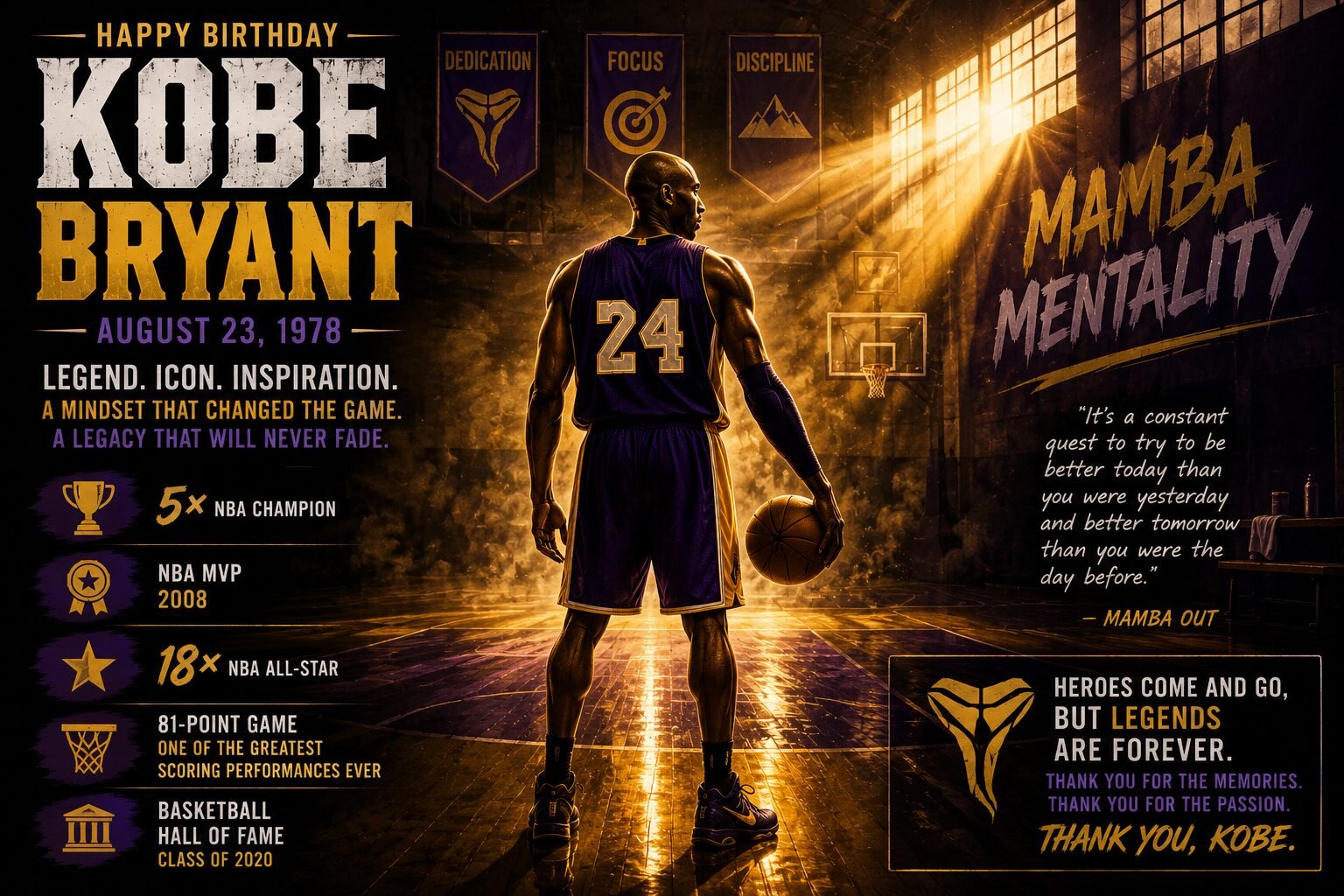


Some players score. Others win championships. And then there are those who redefine what it means to pursue greatness.
Kobe Bryant was that kind of player.
Born on August 23, 1978, Bryant didn’t just become a superstar for the Los Angeles Lakers — he became one of the most iconic and influential athletes in sports history. On his birthday, fans celebrate more than points. They celebrate mindset, dedication, and a legacy that transcends the game.
Affiliate Disclosure: This article may contain affiliate links and banner advertisements. If you make a purchase through these links, we may earn a small commission at no additional cost to you. Thank you for supporting our platform.
From Italy to NBA Stardom
Kobe Bryant was born in Philadelphia, Pennsylvania, into a family already connected to professional basketball. His father, Joe “Jellybean” Bryant, played in the NBA before continuing his career overseas. When Kobe was still young, the Bryant family moved to Italy, beginning a childhood experience that would shape his personality, worldview, and approach to the game.
Living in Italy exposed Kobe to a culture and lifestyle very different from the one he had known in the United States. He learned to speak Italian, adapted to unfamiliar surroundings, and developed an appreciation for international basketball. Those years also taught him how to become comfortable standing apart from others—a quality that later helped him handle the pressure and isolation that often accompanied superstardom.
Basketball remained at the center of his life. Kobe spent hours studying the sport, practicing fundamentals, and watching recordings of NBA stars. He did not simply admire great players; he examined their footwork, timing, balance, and decision-making. Even at a young age, he approached basketball as a craft that could be mastered through repetition and attention to detail.
His years in Europe helped him understand the game from a broader perspective. Italian basketball emphasized fundamentals, passing, movement, and team organization. Kobe absorbed those lessons while also developing the one-on-one creativity and confidence that would eventually define his playing style.
When his family returned to the Philadelphia area, Bryant attended Lower Merion High School in Ardmore, Pennsylvania. He arrived with extraordinary potential but still had to prove that he could become an elite American basketball prospect. Through relentless practice and rapidly improving performances, he developed into one of the most celebrated high school players in the country.
Bryant led Lower Merion through a remarkable rise, helping transform the program into a championship contender. His scoring ability, defensive intensity, athleticism, and confidence attracted national attention. By the end of his high school career, he had established himself as one of Pennsylvania’s greatest scholastic players and a prospect capable of competing at the professional level.
He built his early game on:
- Advanced footwork, using balance, pivots, fakes, and changes of direction to create space against defenders.
- Scoring versatility, attacking the basket, shooting from the perimeter, and developing moves from the post and mid-range areas.
- Competitive confidence, believing he could compete against older, stronger, and more experienced players.
- Relentless preparation, spending countless hours improving weaknesses and repeating moves until they became instinctive.
- A deep understanding of basketball, studying great players and recognizing the strategic details behind successful possessions.
Rather than attending college, Bryant made the bold decision to enter the 1996 NBA Draft directly from high school. At the time, very few guards had attempted to make that leap. The decision brought enormous risk because he would be competing against established professionals while still only a teenager.
Kobe welcomed the challenge.
He understood that natural ability might help him reach the NBA, but it would not guarantee success once he arrived. He would need to become stronger, adjust to the speed of the professional game, earn the trust of veteran teammates, and prove that a high school player could eventually thrive under the league’s brightest lights.
His confidence was never based solely on talent. It came from the work he had already invested and his belief that he was willing to prepare harder than the players competing against him. Every early setback became another reason to train. Every mistake became material for study. Every opportunity became a test of how badly he wanted to improve.
He entered the NBA with skill, ambition, and an almost intimidating level of determination. While many young players dreamed of becoming stars, Kobe wanted something greater. He wanted to be remembered among the finest players basketball had ever produced.
He wasn’t just talented.
He was obsessed with greatness.
From his Philadelphia roots to his formative years in Italy and his emergence as a high school sensation, Kobe Bryant’s early journey prepared him for an extraordinary career. The international perspective, disciplined training, and fearless ambition he developed before reaching the NBA became the foundation of the mentality that would eventually define his legacy.
The Rise with the Lakers
When Kobe Bryant arrived in Los Angeles as an 18-year-old rookie in 1996, few could have imagined the legacy he would eventually build with the Lakers. Acquired on draft night and paired with newly signed superstar Shaquille O’Neal, Bryant entered one of the NBA’s most iconic franchises with enormous expectations. Although he began his career coming off the bench, his talent, confidence, and relentless work ethic quickly made it clear that he was destined for a much larger role.
Kobe embraced every challenge. Rather than becoming discouraged by limited playing time early in his career, he used every practice and every game as an opportunity to improve. He studied veteran players, refined his footwork, strengthened his body, and spent countless extra hours in the gym perfecting every aspect of his game. His determination to become the best player in the league became evident to teammates and coaches alike.
As his role expanded, Bryant developed into the face of the Los Angeles Lakers and one of the NBA’s biggest global superstars. His spectacular performances, relentless competitiveness, and unforgettable moments helped restore the Lakers to championship prominence while inspiring millions of basketball fans around the world.
He brought:
- Elite scoring ability, possessing one of the most complete offensive arsenals in NBA history. Bryant could score from anywhere on the floor using fadeaway jumpers, post moves, three-point shooting, explosive drives, and acrobatic finishes around the basket. His ability to create his own shot against even the toughest defenders made him nearly impossible to contain.
- Competitive fire, approaching every game, every practice, and every possession with unmatched intensity. Kobe viewed every opponent as a challenge to overcome and believed that preparation and effort could always provide an advantage.
- Clutch performances, earning a reputation as one of basketball’s greatest late-game performers. Whether hitting game-winning shots, taking over fourth quarters, or delivering in playoff battles, Bryant consistently wanted the ball when everything was on the line.
- Leadership, setting the standard through preparation, discipline, and accountability. While his demanding style sometimes challenged teammates, it reflected his unwavering belief that championship teams required extraordinary commitment from every player.
Bryant’s rise coincided with one of the NBA’s greatest dynasties. Alongside Shaquille O’Neal, he helped lead the Lakers to three consecutive NBA championships in 2000, 2001, and 2002. The duo became one of basketball’s most dominant combinations, overwhelming opponents with Shaq’s interior power and Kobe’s explosive perimeter scoring.
As Bryant matured, he continued expanding his game. Already known as an elite scorer, he became a stronger defender, a better playmaker, and a more complete leader. His dedication earned him 12 NBA All-Defensive Team selections, proving that he valued stopping opponents just as much as scoring against them.
Following the breakup of the Shaq-Kobe partnership, Bryant accepted the challenge of carrying the Lakers on his own. He produced some of the most remarkable individual performances in league history, including his legendary 81-point game against the Toronto Raptors in 2006, the second-highest single-game scoring performance in NBA history. Night after night, he demonstrated an ability to take over games through skill, determination, and an unmatched will to win.
His leadership reached another level later in his career when he guided a new Lakers core featuring Pau Gasol, Lamar Odom, Derek Fisher, and Andrew Bynum. Bryant led Los Angeles to three consecutive NBA Finals appearances from 2008 through 2010, winning championships in 2009 and 2010. He was named NBA Finals MVP both years, cementing his legacy as the unquestioned leader of a championship team.
Throughout his twenty seasons with the Lakers, Bryant remained loyal to one franchise, a rarity in modern professional sports. He became the face of Lakers basketball for an entire generation, joining legends such as Magic Johnson, Kareem Abdul-Jabbar, Jerry West, Elgin Baylor, and Wilt Chamberlain as one of the organization’s greatest players.
His relentless preparation eventually became known around the world as the “Mamba Mentality.” More than a nickname, it represented an unwavering commitment to self-improvement, discipline, resilience, and refusing to accept anything less than excellence. Athletes from every sport embraced that philosophy, making Bryant’s influence extend far beyond basketball.
He didn’t just play the game.
He attacked it.
Every possession became a battle. Every practice became an opportunity to improve. Every season became another step toward greatness.
By combining extraordinary talent with an unmatched work ethic, Kobe Bryant transformed himself into one of the greatest players in NBA history. His rise with the Los Angeles Lakers was not simply the story of a superstar.
It was the story of a player who refused to stop chasing greatness, ultimately becoming one of the defining athletes of his generation.
Buy Yours: Kobe Bryant 2012 Playoffs Game Used Los Angeles Lakers Jersey Photo Matched COA
Career Highlights & Achievements
Kobe Bryant’s résumé is legendary:
- 5× NBA Champion
- NBA MVP (2008)
- 18× NBA All-Star
- 2× NBA Finals MVP
- 81-point game (second-highest in NBA history)
- Basketball Hall of Fame (2020)
His accomplishments place him among the greatest of all time.
The Mamba Mentality
Kobe Bryant’s mindset became one of the most influential parts of his legacy. While his championships, scoring records, and unforgettable performances established him as an NBA legend, the philosophy behind those accomplishments inspired people far beyond basketball. His approach became known as the “Mamba Mentality”—a relentless commitment to preparation, discipline, improvement, and performing without fear.
Kobe believed greatness was not something a person simply possessed. It had to be pursued every day through consistent effort and a willingness to confront discomfort. Talent could create an opportunity, but only discipline, focus, and repetition could transform that opportunity into lasting success.
He was known for:
- Relentless work ethic, often arriving at the gym before teammates and continuing to practice after formal workouts ended. Kobe repeated shots, footwork patterns, and game situations until his movements became instinctive under pressure.
- A fearless approach to big moments, welcoming the responsibility of taking important shots and making difficult decisions when games were on the line. He understood that failure was possible, but he refused to let that fear prevent him from acting.
- Constant self-improvement, studying game film, analyzing opponents, refining weaknesses, and searching for new ways to expand his abilities. Even after reaching superstar status, he approached the game as though he still had something to prove.
- Mental toughness, competing through pain, criticism, disappointment, and personal setbacks. Kobe viewed adversity as a test of commitment rather than a reason to stop moving forward.
The Mamba Mentality was never limited to working hard when motivation was high. It was about maintaining the same standard on difficult days, when fatigue, frustration, or doubt made improvement uncomfortable. Kobe believed those moments often separated people who merely wanted success from those willing to earn it.
His mindset also involved preparation for the unexpected. Bryant studied defenders, rehearsed difficult shots, and imagined pressure situations before they occurred. When a major moment arrived, he wanted to feel as though he had already experienced it through practice. That preparation allowed him to remain composed when others might have hesitated.
“Mamba Mentality” became a philosophy embraced far beyond basketball.
Athletes in football, baseball, soccer, tennis, and other sports adopted the phrase to describe total dedication to improvement. Business leaders, artists, students, coaches, and entrepreneurs also connected with the idea because its central lesson applied to almost any goal: excellence requires daily effort, honest self-evaluation, and the courage to keep progressing through failure.
Kobe’s philosophy did not promise perfection.
It demanded persistence.
It meant accepting mistakes without allowing them to become excuses. It meant studying failure, learning from it, and returning better prepared for the next opportunity. It meant refusing to become satisfied simply because others already considered you successful.
The Mamba Mentality ultimately became larger than Kobe Bryant’s basketball career. It represented the belief that limits could be challenged through preparation and that a person’s greatest opponent was often the temptation to stop improving.
Kobe did not simply tell people to pursue greatness.
He showed them what that pursuit looked like every day.
Buy Yours: KOBE BRYANT Autographed ’81 Point Game’ Emb. Authentic Lakers Jersey UDA LE 5/8
Clutch and Competitive
Kobe Bryant built his reputation on performing when the pressure was at its highest. While many players embraced the spotlight, Bryant actively sought it. He believed that the defining moments of a game were opportunities to prove the countless hours he had invested in preparation. Whether it was the final possession of a regular-season game or the closing minutes of an NBA Finals contest, Kobe wanted the basketball in his hands.
His confidence in those situations was never based on arrogance. It came from preparation. Bryant believed that if he had practiced a shot thousands of times, there was no reason to fear taking it with the game on the line. That mindset allowed him to remain calm while arenas erupted, defenders closed in, and millions of fans watched every possession.
He delivered:
- Game-winning shots, becoming one of the NBA’s most feared late-game scorers. Throughout his career, Bryant hit numerous buzzer-beaters and clutch baskets that secured victories for the Lakers, earning a reputation as one of basketball’s most dependable closers.
- Playoff dominance, consistently elevating his performance when championships were at stake. Bryant appeared in seven NBA Finals, winning five NBA championships, while repeatedly delivering memorable performances against the league’s best teams.
- Leadership in crucial moments, inspiring teammates through his confidence, composure, and determination. Even when facing double-teams or difficult defensive matchups, Bryant welcomed the responsibility of leading his team through adversity.
- An unrelenting competitive spirit, refusing to back down from any opponent or situation. Whether playing through injuries, battling Hall of Fame defenders, or facing elimination games, Bryant competed with the same relentless intensity from opening tip to the final buzzer.
Some of Kobe’s greatest performances came when everything was on the line. During the Lakers’ championship runs, he repeatedly produced dominant scoring performances while also making the defensive stops, rebounds, and key passes that often determined the outcome of games. His ability to perform in high-pressure situations helped establish Los Angeles as one of the NBA’s premier franchises throughout the 2000s.
Perhaps no championship better illustrated Bryant’s competitive nature than the 2010 NBA Finals against the Boston Celtics. Facing the Lakers’ longtime rivals in a winner-take-all Game 7, Bryant struggled with his shooting but refused to let frustration define his performance. Instead, he attacked the game in other ways—collecting rebounds, playing aggressive defense, drawing fouls, and leading through determination. The Lakers captured the championship, and Bryant earned his second consecutive NBA Finals MVP Award, demonstrating that true greatness is measured by finding ways to win even when everything is not going perfectly.
Bryant’s competitiveness also extended beyond games. Every practice became a competition. Every offseason became an opportunity to improve. He challenged teammates to raise their level of play while demanding even more from himself. That relentless pursuit of excellence became one of the defining characteristics of his career and inspired countless athletes to embrace a similar approach.
Opposing players often spoke about Bryant’s intensity. They knew he would attack every weakness, compete on every possession, and never allow the score, fatigue, or pressure to diminish his effort. He respected great competitors, but he never feared them. Instead, he viewed matchups against the league’s best players as opportunities to test himself against the highest level of competition.
His confidence became contagious. When the Lakers entered close games, teammates believed they always had a chance because Bryant was on the floor. His willingness to embrace responsibility gave confidence to everyone around him, creating a championship mentality that carried Los Angeles through some of the most memorable playoff runs in franchise history.
He wanted the moment.
He welcomed the pressure that others tried to avoid.
When the game was on the line, Kobe Bryant expected to be the difference-maker—not because he believed success was guaranteed, but because he trusted the preparation that had brought him to that moment.
And more often than not…
He delivered.
That fearless competitiveness became one of the defining elements of the Mamba Mentality and helped cement Bryant’s place among the greatest clutch performers in NBA history. His ability to rise when the stakes were highest ensured that his most unforgettable moments came when the entire basketball world was watching.
Buy Yours: Kobe Bryant 81 Points 1/22/2006 Signed Inscribed NBA Game Basketball Panini JSA
Why Lakers Fans Still Revere Him
In Los Angeles, Kobe represents:
- Excellence
- Loyalty
- Championship success
- A global icon
He became synonymous with Lakers greatness.
Buy Yours: Kobe Bryant Photomatched 2008 NBA Finals Game Used Signed Sneakers Shoes PSA DNA
A Lasting Impact on the Game
Kobe Bryant’s impact on basketball extends far beyond his championships, scoring achievements, All-Star appearances, and unforgettable performances. While his accomplishments secured his place among the greatest players in NBA history, his most enduring contribution may be the way he changed how athletes think about preparation, improvement, and the pursuit of excellence.
Bryant showed that greatness was not simply a product of talent. He possessed extraordinary natural ability, but he refused to depend on it. Instead, he built his career around discipline, repetition, study, and a willingness to confront his weaknesses. Every detail mattered—from footwork and conditioning to film study, recovery, and mental preparation.
That approach inspired athletes to examine their own habits more honestly. Kobe challenged competitors to ask whether they were merely participating in their craft or truly committing themselves to mastering it. His example made countless players reconsider how much preparation was required to reach their full potential.
His influence can be seen through:
- A higher standard of preparation, encouraging athletes to treat practice with the same seriousness as competition. Kobe believed that pressure situations became manageable when a player had already rehearsed them repeatedly.
- A commitment to constant improvement, demonstrating that even accomplished stars could continue refining their skills. He studied weaknesses, added new moves, adjusted his game as his body changed, and never assumed he had learned enough.
- Fearlessness in the face of failure, teaching that missed shots, painful losses, criticism, and setbacks could become tools for growth rather than reasons to retreat.
- Mental discipline, showing that confidence was created through preparation, not simply positive thinking. Bryant trusted himself in difficult moments because he knew how much work he had completed before they arrived.
- Respect for the craft, treating basketball as something that deserved years of careful study. He examined the techniques of past legends, learned from opponents, and looked beyond raw athleticism to understand why certain movements and strategies succeeded.
The philosophy that became known as the Mamba Mentality reached far beyond NBA locker rooms. Athletes across football, baseball, hockey, soccer, tennis, boxing, and Olympic competition embraced its message. For many, the phrase came to represent a refusal to become comfortable and a willingness to keep working when others were satisfied.
Young basketball players imitated Kobe’s footwork, fadeaway jumper, competitive intensity, and late-game confidence. Yet his deeper influence was visible in the hours they spent practicing when no audience was present. Bryant helped make preparation itself part of the story of greatness.
His impact also crossed generations.
Kobe studied the legends who came before him, including Michael Jordan, Magic Johnson, Larry Bird, and other great competitors. He borrowed lessons from their games, adapted those lessons to his own abilities, and then passed his knowledge to the players who followed him. In that way, he became a bridge between different eras of basketball.
Many modern stars grew up watching Bryant and later sought his advice. He became a mentor to established NBA players, rising prospects, and young athletes who wanted to understand the mentality required to compete at the highest level. He shared details about scoring, footwork, defense, leadership, and preparation, but he also challenged players to develop identities of their own rather than merely copying his game.
His influence became especially important in women’s basketball. Bryant strongly supported the growth of the women’s game and invested time in coaching and encouraging his daughter Gianna and other young players. He attended games, highlighted the talent of WNBA stars, and used his platform to promote greater recognition for female athletes.
That support introduced some fans to women’s basketball while helping young girls see that their goals deserved the same seriousness, preparation, and respect as anyone else’s. His enthusiasm for coaching youth players showed another side of his legacy—one focused not on what he had achieved, but on what he could help others become.
Bryant’s influence also expanded into storytelling and creativity after his playing career. He approached writing, filmmaking, and business with the same curiosity and discipline he had brought to basketball. His success in those areas reinforced the idea that the Mamba Mentality was not limited to athletic performance.
The philosophy could be applied anywhere.
For students, it meant studying with purpose and refusing to be discouraged by difficult material. For entrepreneurs, it meant accepting setbacks while continuing to improve a product or idea. For artists, it meant respecting the creative process and revising their work until it matched their vision. For coaches and teachers, it meant challenging others while giving them the tools to grow.
His influence continues across sports and beyond.
It lives in athletes who arrive early to practice, stay late to refine a weakness, and accept responsibility after a poor performance. It appears in competitors who welcome difficult assignments because they recognize that challenge produces growth. It can be found in people from every profession who commit themselves to improvement without expecting immediate recognition.
Kobe Bryant also changed how many people viewed competitive ambition. His intensity could be demanding, but it revealed the sacrifices often required to reach extraordinary goals. He never pretended that greatness was easy, comfortable, or guaranteed.
It required choices.
It required repetition.
It required the willingness to continue after excitement disappeared and the work became difficult.
His career also demonstrated the importance of adaptation. The young Kobe relied heavily on athleticism, explosiveness, and speed. As he aged and faced injuries, he adjusted his footwork, developed his post game, refined his jump shot, and learned new ways to control the pace of a possession.
That evolution became another lesson for future athletes. Excellence was not about remaining the same forever. It was about understanding how to grow, adjust, and find new strengths when circumstances changed.
Bryant’s legacy is therefore larger than any single statistic or championship. Records may be broken, and future players may produce achievements that once seemed impossible. But his influence on preparation, competitive psychology, mentorship, and personal development cannot be captured by a box score.
He inspired a generation to work harder.
He challenged them to think differently.
He encouraged them to pursue greatness with discipline, courage, and purpose.
Kobe Bryant did not simply leave behind highlights for fans to remember.
He left behind a blueprint.
That blueprint teaches that talent creates potential, but habits determine how much of that potential is reached. It teaches that failure is information, pressure is an opportunity, and improvement is a responsibility that never truly ends.
The Mamba Mentality became his lasting gift to the game.
And every time someone chooses preparation over excuses, persistence over comfort, or growth over satisfaction, Kobe Bryant’s influence continues.
A Birthday Worth Celebrating Across the World
Kobe Bryant didn’t just play basketball.
He pursued greatness.
On August 23, we celebrate more than a Hall of Famer.
We celebrate a mindset.
Happy Birthday, Kobe Bryant — a legend whose legacy lives on forever.