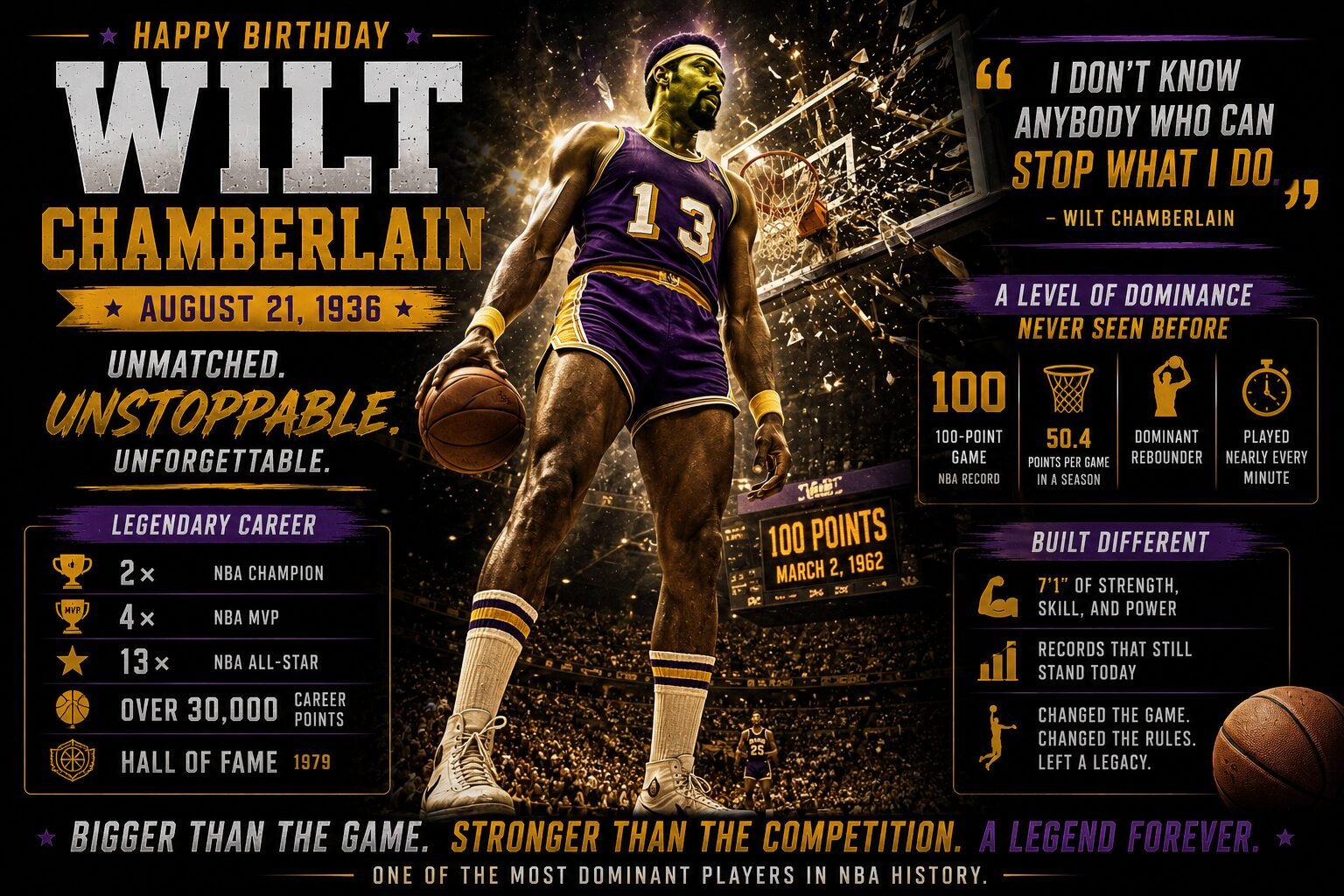


Some players dominate games. Others dominate seasons. And then there are those who dominate the record books in ways that may never be matched.
Wilt Chamberlain was that kind of player.
Born on August 21, 1936, Chamberlain didn’t just become a superstar — he became one of the most dominant athletes in sports history. On his birthday, fans celebrate more than points and rebounds. They celebrate greatness on a scale never seen before.
Affiliate Disclosure: This article may contain affiliate links and banner advertisements. If you make a purchase through these links, we may earn a small commission at no additional cost to you. Thank you for supporting our platform.
From Philadelphia to Basketball Greatness
Wilt Chamberlain was born in Philadelphia, Pennsylvania, where he quickly established himself as one of the most gifted athletes the city had ever produced. Growing up in a competitive environment, Chamberlain excelled in multiple sports, but it was basketball that revealed his truly extraordinary potential. Even as a teenager, his combination of height, strength, speed, and coordination made it clear that he was unlike any player the game had ever seen.
Standing well over seven feet tall, Chamberlain possessed physical tools that seemed almost impossible. Yet it wasn’t simply his size that separated him from everyone else. He combined elite athleticism with remarkable agility, allowing him to outrun smaller players, leap above defenders, and dominate games in ways basketball had rarely witnessed. His unique skill set forced opponents to rethink how the game could be played.
Before reaching the professional ranks, Chamberlain became a national sensation at Overbrook High School in Philadelphia. He routinely scored incredible point totals while leading his team to championships and attracting crowds eager to witness his dominance. Colleges across the country competed for the opportunity to recruit him, recognizing that they were watching a once-in-a-generation talent.
Chamberlain eventually chose the University of Kansas, where he continued to amaze basketball fans despite playing under rules specifically designed to limit his impact. Opposing teams packed the lane, double-teamed him relentlessly, and altered their entire defensive strategy just to slow him down. Even then, he remained virtually unstoppable, leading Kansas to the 1957 NCAA Championship Game and earning recognition as one of the greatest college players of his era.
His game was built on:
- Size and strength, allowing him to overpower defenders in the paint while controlling both ends of the floor. Few players could match his physical presence, making him nearly impossible to defend one-on-one.
- Extraordinary athleticism, combining speed, quickness, stamina, and leaping ability that were almost unheard of for someone his height. Chamberlain could sprint the floor, finish above the rim, and play virtually every minute of a game without slowing down.
- Historic scoring ability, possessing an unstoppable arsenal of hook shots, finger rolls, fadeaways, and powerful finishes around the basket. He could score from nearly every position on the floor and routinely overwhelmed entire defenses.
- Rebounding dominance, using his strength, timing, and relentless determination to control the glass. Offensive rebounds created countless second-chance opportunities, while defensive rebounds immediately ignited fast breaks for his team.
What made Chamberlain truly remarkable was that he continually expanded his game. As defenses adapted to stop his scoring, he improved as a passer and playmaker, demonstrating that he could dominate in whatever way his team needed. His basketball IQ matched his physical gifts, allowing him to recognize defensive schemes and exploit weaknesses before opponents could react.
He also possessed an unmatched competitive drive. Chamberlain approached every game determined to prove he was the best player on the court. Whether facing future Hall of Famers or lesser-known opponents, he competed with the same intensity, constantly pushing himself to achieve new levels of excellence.
By the time he entered professional basketball, expectations were enormous. Fans, coaches, and players all wondered whether anyone could live up to the hype surrounding the young superstar from Philadelphia. Chamberlain didn’t simply meet those expectations—he shattered them, rewriting record books and redefining what was possible for an NBA player.
He wasn’t just bigger.
He was better.
Wilt Chamberlain combined overwhelming physical ability with remarkable athleticism, intelligence, and determination, creating a player unlike anything basketball had ever seen. His journey from the playgrounds and high schools of Philadelphia to national stardom laid the foundation for one of the most extraordinary careers in sports history.
Long before he became an NBA legend, Wilt Chamberlain had already changed the conversation about greatness. He proved that extraordinary talent, relentless work ethic, and an unwavering desire to dominate could elevate a player beyond superstardom and into the realm of basketball immortality.
The Rise to Stardom
Wilt Chamberlain became a basketball sensation almost immediately after entering the professional ranks. From the beginning of his career, it was clear that he was not simply another talented young player. His combination of size, strength, speed, stamina, and skill made him unlike anyone the sport had seen before.
Opposing teams quickly realized that normal defensive strategies would not be enough to contain him. A single defender had little chance of stopping Chamberlain near the basket, so coaches often sent double-teams and triple-teams in an attempt to force the ball out of his hands. Even those tactics frequently failed because Wilt could finish over defenders, power through contact, or use his developing passing ability to create opportunities for teammates.
His arrival changed the way teams prepared for games.
He brought:
- Unstoppable scoring, using power, touch, footwork, and an expanding collection of post moves to score from nearly every angle around the basket. Chamberlain could finish with hook shots, finger rolls, bank shots, turnaround jumpers, and forceful dunks. His ability to score at such a high volume placed constant pressure on opposing defenses.
- Elite rebounding, controlling missed shots on both ends of the court. His timing, reach, strength, and relentless pursuit of the ball allowed him to dominate the glass, create second-chance points, and prevent opponents from generating additional possessions.
- A powerful defensive presence, protecting the rim and discouraging players from attacking the basket. Although blocked shots were not officially recorded during most of his career, Chamberlain’s height, reach, and athleticism altered countless attempts and forced opponents to change their offensive approach.
- Physical dominance, overpowering centers while still possessing the speed and coordination to run the floor. His unusual combination of power and athleticism made him a matchup problem that no team could fully solve.
Chamberlain’s scoring ability immediately separated him from the rest of the league. During his rookie season, he averaged more than 37 points and 27 rebounds per game, performances that earned him both Rookie of the Year and Most Valuable Player honors. Very few players in NBA history have entered the league and taken control so quickly.
His dominance only continued to grow.
The most famous example came during the 1961–62 season, when Chamberlain averaged an astonishing 50.4 points per game. That same season, he produced the most legendary scoring performance in basketball history by recording 100 points in a single game. The achievement became one of sports’ most iconic records and demonstrated the nearly unlimited offensive force he had become.
Yet the numbers alone do not fully explain his impact.
When Wilt was on the court, every possession revolved around his presence. Defenders crowded the paint to stop him. Teammates searched for ways to deliver the ball inside. Opposing players rushed shots because they feared his ability to challenge them near the rim. Even when he did not touch the ball, he influenced spacing, strategy, and decision-making.
His rebounding was equally overwhelming. Chamberlain did not merely collect missed shots; he controlled the entire area around the basket. Defensive rebounds allowed his team to begin fast breaks, while offensive rebounds often led to immediate points. His ability to dominate the glass gave his teams additional possessions while taking opportunities away from opponents.
He also possessed extraordinary endurance. Despite his massive frame, Chamberlain could play almost every minute of a game while maintaining his production. He regularly remained on the floor for long stretches and became known for rarely needing rest. His stamina made the challenge of defending him even more difficult because opponents had to battle his strength and athleticism for the entire game.
As his reputation grew, Chamberlain became one of basketball’s first true international celebrities. Fans attended games specifically to see him perform, while newspapers and television broadcasts followed his record-breaking accomplishments. Even people who did not regularly watch basketball became familiar with Wilt Chamberlain and the extraordinary numbers he produced.
He became larger than the game itself.
Chamberlain’s rise also forced basketball to evolve. Teams adjusted defensive systems, coaches changed roster construction, and league officials reconsidered rules because of the advantages created by his size and athleticism. His dominance helped accelerate changes to the lane, offensive goaltending rules, and other parts of the game designed to prevent one player from becoming completely unstoppable.
Those changes did not diminish his greatness.
They confirmed it.
He didn’t just compete.
He overwhelmed opponents.
Wilt Chamberlain entered professional basketball as a highly anticipated prospect and quickly became one of the most dominant athletes in sports history. His scoring, rebounding, defense, and physical power transformed every game into a display of unmatched ability.
He did not merely rise to stardom.
He redefined what stardom could look like.
Career Highlights & Achievements
Wilt Chamberlain’s résumé is legendary:
- 2× NBA Champion
- 4× NBA MVP
- 13× NBA All-Star
- 100-point game (NBA record)
- Over 30,000 career points
- Hall of Fame (1979)
His records remain unmatched.
Buy Yours: Wilt Chamberlain HOF Signed/Auto Spalding NBA Full Size Basketball PSA/DNA
A Statistical Phenomenon
Wilt Chamberlain didn’t simply rewrite the NBA record book—he created a standard of statistical dominance that has remained virtually untouchable for generations. Throughout his career, he produced numbers that seemed almost impossible, forcing fans, opponents, and even fellow Hall of Famers to reconsider what a single player could accomplish. Decades after his retirement, many of his records still stand as reminders of one of the greatest athletic careers in sports history.
What made Chamberlain’s achievements even more remarkable was the era in which he played. Opposing teams centered their entire defensive game plan around stopping him. Double-teams and triple-teams became routine, physical play was allowed to a much greater extent than in today’s NBA, and every opponent understood that slowing Wilt was their highest priority. Despite those challenges, he consistently delivered performances that defied logic.
He is known for:
- Averaging an astonishing 50.4 points per game during the 1961–62 season, one of the most incredible accomplishments in professional sports history. No player before or since has come close to matching that level of sustained scoring over an entire NBA season.
- Leading the NBA in scoring seven consecutive seasons, regularly averaging more than 30—and often more than 40—points per game while becoming the league’s most feared offensive weapon.
- Dominating the glass, winning 11 NBA rebounding titles and finishing his career with an incredible 23,924 rebounds, an average of 22.9 rebounds per game, one of the highest marks ever recorded.
- Playing nearly every minute, displaying endurance unlike any player in basketball history. During the 1961–62 season, Chamberlain averaged an unbelievable 48.5 minutes per game, possible only because he played every minute of regulation games and many overtime periods. It remains one of the most astonishing records in professional sports.
Those numbers alone would have guaranteed Chamberlain a place among basketball’s immortals, but his list of accomplishments extended even further.
On March 2, 1962, Chamberlain delivered perhaps the greatest individual performance the sport has ever witnessed by scoring 100 points against the New York Knicks. The achievement remains the NBA’s single-game scoring record and has become one of the most iconic moments in basketball history. Despite generations of elite scorers attempting to reach that milestone, no player has come close to surpassing it.
His dominance was never limited to scoring alone.
As his career progressed, Chamberlain proved he could adapt his game to whatever his team required. Critics often claimed he focused too heavily on offense, so he responded by becoming one of the league’s premier facilitators. During the 1967–68 season, he led the entire NBA in assists—an almost unimaginable accomplishment for a seven-foot center. It demonstrated that his basketball IQ matched his extraordinary physical gifts and that he could control games in far more ways than simply scoring points.
Defensively, Chamberlain was equally imposing. Although blocked shots were not officially recorded during most of his playing career, countless teammates, opponents, and coaches described him as one of the greatest shot blockers the game has ever seen. His size, reach, timing, and athleticism transformed the paint into one of the most intimidating areas on the court, forcing opponents to alter shots or avoid attacking the basket altogether.
His stamina also became legendary.
Wilt rarely left the floor. While most players required regular rest, Chamberlain routinely played complete games while maintaining the same level of production from opening tip to the final buzzer. His conditioning, strength, and durability allowed him to dominate opponents deep into games when fatigue often became a deciding factor.
Throughout his career, Chamberlain accumulated an extraordinary collection of honors, including:
- 4 NBA Most Valuable Player Awards
- 2 NBA Championships
- 13 NBA All-Star selections
- 10 All-NBA First Team selections
- 7 scoring titles
- 11 rebounding titles
- 1 assists title
- More than 31,000 career points
- Nearly 24,000 career rebounds
Perhaps most impressive was the consistency with which he produced these numbers. Chamberlain did not dominate for a single season or brief stretch—he sustained historic excellence year after year against the best competition in the world.
Many of his records have survived multiple generations of basketball legends. Players such as Kareem Abdul-Jabbar, Michael Jordan, Shaquille O’Neal, Kobe Bryant, LeBron James, and countless other superstars have left their mark on the NBA, yet Chamberlain’s statistical achievements continue to stand among the most untouchable records in sports.
He didn’t just break records.
He shattered them.
Wilt Chamberlain transformed statistics into something almost mythical. Every season seemed to produce another unbelievable accomplishment, another impossible performance, or another record that experts believed would never be challenged.
His numbers remain more than impressive.
They remain almost unimaginable.
More than half a century later, basketball fans still measure extraordinary performances against the standard Wilt Chamberlain established, proving that his statistical dominance remains one of the greatest achievements in the history of professional sports.
Buy Yours: Wilt Chamberlain Hall Of Fame 1978 Signed 1960’s NBA Basketball JSA GEM MINT 10
A Force with the Lakers
When Wilt Chamberlain joined the Los Angeles Lakers in 1968, he entered a new stage of his legendary career. Los Angeles already featured established stars such as Jerry West and Elgin Baylor, so Chamberlain was no longer required to carry the entire offensive burden by himself. Instead, he adapted his game and focused more heavily on rebounding, defense, passing, and doing whatever was necessary to help the Lakers pursue a championship.
That adjustment demonstrated an important part of Chamberlain’s greatness. He had already proven that he could score at a level no player had ever matched, but with the Lakers, he showed that he could influence winning without needing to dominate every possession offensively. He became more selective with his shots, protected the paint, controlled the glass, and helped create opportunities for the talented scorers around him.
He brought:
- Interior dominance, controlling the area around the basket through his size, strength, positioning, and athletic ability. Chamberlain remained a dangerous scorer in the post while also creating second-chance opportunities with offensive rebounds.
- Leadership, providing championship experience and a veteran presence to a team facing enormous expectations. His willingness to change his role demonstrated that team success mattered more than maintaining his historic scoring averages.
- Defensive strength, protecting the rim, altering shots, and discouraging opponents from attacking the basket. Even though blocked shots were not officially recorded, his presence forced opposing players to reconsider nearly every attempt near the paint.
- Rebounding excellence, ending possessions on defense and beginning fast breaks with powerful outlet passes. His control of the boards gave the Lakers more opportunities to use their speed and offensive talent.
Chamberlain’s relationship with the Lakers was not without challenges. The roster contained several strong personalities, and expectations were immediate. Los Angeles had repeatedly come close to winning a championship, only to fall short against powerful opponents such as the Boston Celtics. Chamberlain was expected to become the final piece needed to push the franchise over the top.
His first season with the Lakers ended in disappointment when Los Angeles lost to Boston in a dramatic seven-game NBA Finals. Chamberlain continued producing at an elite level, but the defeat added to the criticism that followed him throughout his career. Some observers unfairly questioned whether his individual dominance could translate into championships.
Rather than allowing those doubts to define his time in Los Angeles, Chamberlain continued adjusting his game.
The Lakers returned to the NBA Finals in 1970 but again fell short, this time against the New York Knicks. Injuries also affected the team, including the retirement of Baylor early in the 1971–72 season. Yet those setbacks eventually helped shape one of the greatest teams in NBA history.
During the 1971–72 season, Chamberlain fully embraced a defense-first, team-centered role under head coach Bill Sharman. Instead of pursuing scoring titles, he concentrated on protecting the basket, rebounding, setting screens, making outlet passes, and creating space for teammates such as West and Gail Goodrich.
The result was extraordinary.
The Lakers won 69 regular-season games and produced a record-setting 33-game winning streak, one of the longest winning streaks in the history of major American professional sports. Chamberlain’s ability to anchor the defense and dominate the boards gave Los Angeles a foundation that allowed its offense to flourish.
The Lakers advanced to the 1972 NBA Finals against the New York Knicks, seeking revenge for their defeat two years earlier. Chamberlain played through a painful hand injury during the series and continued controlling the paint despite the physical discomfort.
In the championship-clinching Game 5, he delivered one of the defining performances of his career. Chamberlain scored 24 points, collected 29 rebounds, blocked numerous shots, and led the Lakers to victory. His courage and dominance earned him the NBA Finals Most Valuable Player Award as Los Angeles captured the franchise’s first championship since moving from Minneapolis.
That performance answered many of the criticisms that had followed him.
Chamberlain proved he could sacrifice personal statistics, accept a different role, and still dominate the most important games of the season. His championship with the Lakers was not built around scoring 50 points every night. It was built around defense, rebounding, leadership, and complete commitment to the team.
He proved he could win at the highest level.
More importantly, he proved that greatness could evolve.
The young Chamberlain had overwhelmed opponents through record-breaking scoring. The veteran Chamberlain controlled games through intelligence, defense, rebounding, passing, and experience. Both versions were equally dangerous.
With the Lakers, Wilt Chamberlain added a championship chapter to an already unmatched career. He showed that his value extended far beyond statistics and that one of basketball’s greatest individual forces could also become the defensive anchor and team-first leader of a historic champion.
Why Fans Still Revere Him
Chamberlain represents:
- Dominance
- Athletic excellence
- Record-breaking performance
- A larger-than-life legacy
He changed the game forever.
Buy Yours: Wilt Chamberlain Signed Authentic Philadelphia Warriors Jersey Upper Deck & JSA
A Lasting Impact on the Game
Wilt Chamberlain’s impact on basketball extends far beyond the incredible statistics that filled the NBA record book. While his scoring totals, rebounding numbers, and individual accomplishments remain among the greatest in sports history, perhaps his most remarkable achievement was how completely he transformed the game itself. Chamberlain was so physically dominant that the NBA was forced to adapt, changing rules, strategies, and even the way teams were built in order to compete against him.
Throughout his career, Chamberlain consistently challenged the limits of what seemed possible on a basketball court. His rare combination of size, strength, speed, endurance, and skill created matchup problems that had never existed before. Coaches developed entirely new defensive systems to slow him down, while league officials examined the rules to ensure competitive balance. Few athletes in any sport have influenced the evolution of their game as profoundly as Wilt Chamberlain.
His legacy includes:
- Revolutionizing the center position, proving that a big man could dominate every aspect of the game. Chamberlain showed that centers could score, rebound, defend, pass, and control the tempo of a game while serving as the foundation of a championship team.
- Changing NBA strategy, forcing opponents to design defenses specifically around stopping him. Double-teams, triple-teams, and defensive schemes built to collapse on dominant post players became increasingly common because of the challenges Chamberlain presented.
- Setting standards that still define greatness, with records that continue to serve as benchmarks for every generation of NBA players. His 100-point game, 50.4-point scoring average, and numerous rebounding records remain among the most iconic achievements in professional sports.
- Inspiring future generations of big men, demonstrating that elite centers could become the focal point of an offense while also anchoring the defense and leading their teams to championships.
Chamberlain’s dominance even resulted in several important rule changes. During his playing career, the NBA widened the lane—often referred to as “the paint”—to make it more difficult for him to establish deep post position near the basket. League officials also strengthened offensive goaltending rules and enforced regulations designed to prevent players from simply dropping the ball into the basket because of their overwhelming height and reach. At every level of basketball, coaches and administrators searched for ways to keep the game balanced in the face of Chamberlain’s extraordinary abilities.
His influence also changed how players trained.
Before Chamberlain, many centers relied primarily on size. Wilt demonstrated that elite conditioning, agility, and athleticism could be just as valuable as height. Despite standing over seven feet tall, he could sprint the floor, leap with remarkable explosiveness, and play virtually every minute of a game. His commitment to physical fitness inspired future stars to approach conditioning with greater seriousness, helping shape the modern era of versatile, athletic big men.
Many of basketball’s greatest centers have acknowledged Chamberlain’s influence. Legends such as Kareem Abdul-Jabbar, Hakeem Olajuwon, Shaquille O’Neal, David Robinson, Patrick Ewing, and countless others followed a path that Chamberlain helped create. While each developed his own style, they all benefited from the expanded role Wilt established for dominant interior players.
His impact extended beyond centers alone.
Modern superstars who combine size, skill, and versatility—including players capable of handling the ball, facilitating offense, and defending multiple positions—reflect many of the principles Chamberlain introduced decades earlier. He proved that physical gifts alone were not enough. Basketball intelligence, adaptability, and relentless preparation were equally essential to sustained greatness.
Chamberlain also helped elevate the NBA’s popularity during a transformative period in league history. His legendary battles against fellow Hall of Famers such as Bill Russell, Jerry West, Oscar Robertson, Elgin Baylor, and later Kareem Abdul-Jabbar became must-see events that attracted national attention. Those rivalries helped grow professional basketball into one of America’s premier sports and laid the foundation for the NBA’s future global success.
Perhaps most remarkable is how many of Chamberlain’s accomplishments remain unmatched despite dramatic changes in the game. Advances in training, nutrition, sports medicine, and analytics have helped today’s players reach extraordinary levels, yet Wilt’s most famous records continue to stand. That longevity highlights just how extraordinary his achievements truly were.
His influence is still felt today.
Every dominant center who controls the paint, every player who strives to impact every phase of the game, and every young athlete who dreams of redefining what is possible follows a path that Chamberlain helped pave.
Wilt Chamberlain didn’t simply dominate basketball.
He transformed it.
He changed the way coaches designed offenses and defenses. He forced the NBA to rewrite rules. He expanded expectations for what a center could accomplish. And he inspired generations of players to pursue greatness without limitations.
More than half a century after his retirement, his name remains synonymous with dominance, excellence, and innovation.
Records may eventually fall.
Legends may come and go.
But Wilt Chamberlain’s impact on the game of basketball remains one of the greatest and most enduring legacies in the history of sports.
A Birthday Worth Celebrating Across Basketball
Wilt Chamberlain didn’t just play basketball.
He redefined it.
On August 21, we celebrate more than a Hall of Famer.
We celebrate dominance.
Happy Birthday, Wilt Chamberlain — one of the most dominant players in NBA history.