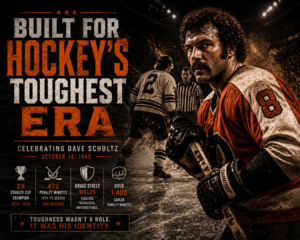
Some players score goals. Some defend. And then there are players who bring an edge that defines an entire team’s identity.
Dave Schultz was that player.
Born on October 14, 1949, Schultz became one of the most feared enforcers in NHL history and a key figure in the legendary “Broad Street Bullies” era of the Philadelphia Flyers. On his birthday, fans celebrate not just his stats, but the toughness and intimidation he brought to the ice.
Affiliate Disclosure: This article may contain affiliate links and banner advertisements. If you make a purchase through these links, we may earn a small commission at no additional cost to you. Thank you for supporting our platform.
From Canada to Philadelphia
Dave Schultz was born in Waldheim, Saskatchewan, Canada, and developed his hockey identity in an environment where toughness and physical play were deeply ingrained in the sport. Long before reaching the NHL, Schultz understood that determination, fearlessness, and a willingness to defend teammates could provide a player with an important role on a hockey team.
That mentality followed him into professional hockey and eventually made him an ideal fit for the Philadelphia Flyers. When Schultz joined the Flyers in the early 1970s, Philadelphia was developing a team identity built around physical pressure, intimidation, relentless effort, and the refusal to be pushed around by opponents.
Schultz embraced that philosophy completely. He was willing to challenge virtually anyone, protect his teammates, and make opposing players understand that taking liberties against the Flyers could bring an immediate response.
His willingness to fight quickly made him one of the NHL’s most recognizable enforcers. Schultz wasn’t simply accumulating penalty minutes; his presence became part of Philadelphia’s strategy, providing skilled teammates with someone willing to confront opponents who attempted to intimidate or physically target them.
As the Flyers evolved into the legendary “Broad Street Bullies,” Schultz became one of the players most closely associated with that intimidating identity. His aggressive style perfectly complemented a roster that also possessed tremendous skill, strong goaltending, leadership, and a determination to establish Philadelphia as one of hockey’s most difficult places to play.
The relationship between Schultz and Philadelphia also made sense culturally. Flyers fans appreciated players who competed fearlessly and defended their teammates, and Schultz’s willingness to sacrifice himself for the team made him an unforgettable figure during one of the most important periods in franchise history.
Schultz therefore did more than simply bring Canadian toughness to Philadelphia—he helped define an era. As the Flyers transformed from a young expansion franchise into back-to-back Stanley Cup champions, Dave “The Hammer” Schultz became one of the unmistakable faces of the Broad Street Bullies and a lasting symbol of the toughness that helped put Philadelphia Flyers hockey on the map.
Career Highlights & Achievements
Dave Schultz’s résumé reflects a unique and impactful role:
- 2× Stanley Cup Champion (1974, 1975)
- NHL single-season record for penalty minutes (472 in 1974–75)
- Key member of the “Broad Street Bullies”
- One of the most feared enforcers in NHL history
- Over 1,400 career penalty minutes
But numbers only tell part of the story.
The Enforcer Role
Dave Schultz wasn’t known primarily for scoring goals or creating highlight-reel offensive plays. His greatest value came from filling one of hockey’s most intimidating roles—the enforcer who protected his teammates and made opponents think carefully about how aggressively they wanted to challenge the Philadelphia Flyers.
If an opposing player took liberties with one of Philadelphia’s stars, Schultz was prepared to respond. His willingness to confront opponents sent a simple message throughout the league: targeting a Flyers player could mean eventually having to answer to “The Hammer.”
When games became physical, Schultz rarely backed away from the confrontation. Instead, he often embraced the rougher style of play, using his toughness and willingness to fight as another way for Philadelphia to establish control over the emotional tone of a game.
Schultz could also provide an immediate burst of energy when the Flyers needed it. A hard check, confrontation, or fight could ignite the Philadelphia crowd and energize his teammates, sometimes changing the atmosphere of a game even though Schultz never touched the scoresheet.
His role became especially important because the Flyers possessed talented offensive players who needed room to operate. Having Schultz in the lineup provided another layer of protection, allowing opponents to know that excessive physical treatment of Philadelphia’s skilled players was unlikely to go unanswered.
The numbers reflected just how completely Schultz embraced the enforcer role, most famously when he accumulated an NHL-record 472 penalty minutes during the 1974–75 season. That extraordinary total became one of the defining statistics of the Broad Street Bullies era and helped make Schultz one of the most recognizable tough guys in hockey history.
Most importantly, Schultz made sure opponents understood that the Flyers would not be intimidated or pushed around. During an era when physical intimidation played an enormous role in NHL hockey, Dave “The Hammer” Schultz gave Philadelphia an intimidating presence of its own—and that mattered to a Flyers team building a championship identity.
The Broad Street Bullies Era
The Philadelphia Flyers of the mid-1970s earned the unforgettable nickname “Broad Street Bullies” because they combined championship-level hockey talent with a physical, intimidating style that opponents could never ignore. Philadelphia wanted other teams to understand that every game against the Flyers could become a battle, and Dave Schultz became one of the clearest symbols of that philosophy.
Schultz was at the center of the intimidation factor that made the Broad Street Bullies famous. His willingness to fight, defend teammates, and confront virtually any opponent gave the Flyers an enforcer capable of making his presence felt even when he wasn’t scoring goals.
But the Broad Street Bullies were much more than a collection of tough players, and that distinction is important to understanding why they became champions. Philadelphia also featured elite talent such as captain Bobby Clarke, outstanding goaltender Bernie Parent, and a supporting cast capable of combining skill, defense, teamwork, and physical pressure.
Schultz’s role complemented those stars by helping establish the fearless personality surrounding the entire team. When opponents attempted to intimidate Philadelphia, the Flyers could respond immediately, and Schultz was frequently the player willing to make sure that response was impossible to overlook.
That combination helped Philadelphia capture back-to-back Stanley Cup championships in 1974 and 1975. The Flyers became the first NHL expansion franchise from the league’s 1967 expansion to win the Stanley Cup, transforming a relatively young organization into one of hockey’s most recognizable teams.
Their style certainly wasn’t pretty by conventional standards, and the enormous number of fights and penalties made the Broad Street Bullies both celebrated and despised depending on which team a fan supported. Yet underneath all of the intimidation was a team that knew how to win, combining toughness with enough skill, leadership, goaltending, and determination to defeat the NHL’s best.
For Flyers fans, Dave Schultz therefore remains inseparable from the Broad Street Bullies era. “The Hammer” represented the toughness, fearlessness, and refusal to be intimidated that helped define those championship teams, making him one of the most recognizable characters from one of the greatest periods in Philadelphia sports history.
Back-to-Back Stanley Cups
The Philadelphia Flyers captured back-to-back Stanley Cup championships in 1974 and 1975, giving the franchise its first two titles and establishing the Broad Street Bullies as one of the defining teams of the decade. For Dave Schultz, those championships provided the ultimate validation of the hard-nosed style he had helped bring to Philadelphia.
Schultz played an important role in those championship teams because opponents understood that facing the Flyers meant dealing with far more than their offensive talent. Philadelphia could score, defend, and receive outstanding goaltending, but the Flyers could also turn a game into an exhausting physical battle whenever necessary.
His presence helped create an intimidating environment for opposing teams. Schultz was willing to challenge players, defend teammates, deliver physical punishment, and make certain that Philadelphia would never be the team backing away when a game became rough.
That toughness complemented the tremendous talent surrounding him. Bobby Clarke provided elite leadership and two-way play, Bernie Parent delivered spectacular goaltending, and the Flyers possessed enough depth and skill to prove that the Broad Street Bullies were much more than simply a collection of fighters.
The 1974 championship was particularly historic because Philadelphia became the first of the NHL’s 1967 expansion teams to capture the Stanley Cup. When the Flyers defeated the Boston Bruins in the Final, they transformed themselves from an expansion franchise into champions and gave Philadelphia one of the greatest celebrations in the city’s sports history.
Winning again in 1975, this time defeating the Buffalo Sabres in the Stanley Cup Final, demonstrated that the first championship had been no accident. The Flyers had created a legitimate hockey powerhouse, and Schultz’s physical presence remained an important part of the identity that opponents struggled to match.
Schultz’s contribution to those championships cannot be measured simply through goals or assists. “The Hammer” helped give the Flyers their intimidating edge, ensuring that opponents understood every game against Philadelphia could come with a physical price while helping establish the fearless identity that remains inseparable from the franchise’s back-to-back Stanley Cup championships.
Why Flyers Fans Still Remember Him
In Philadelphia, Dave Schultz represents an era of Flyers hockey that remains unlike anything else in franchise history. His name immediately brings back memories of the Broad Street Bullies, when the Flyers developed a reputation for being one of the toughest, most intimidating, and most difficult teams to play against in the NHL.
Schultz represented the physical toughness at the heart of that identity. He wasn’t afraid to challenge opponents, defend teammates, or put himself directly into the middle of a confrontation when he believed someone wearing a Flyers sweater needed protection.
He also remains connected forever to championship hockey in Philadelphia. Schultz was part of the Flyers teams that captured consecutive Stanley Cups in 1974 and 1975, meaning his legacy is tied directly to the only two Stanley Cup championships in franchise history.
For many fans, his enormous penalty totals and countless fights tell only part of the story. What made Schultz important was the purpose behind his role: he helped establish the understanding that Philadelphia’s skilled players would have someone willing to stand up for them when games became particularly rough.
His nickname, “The Hammer,” perfectly captured the reputation he developed. Opposing players knew who Schultz was, knew what he was willing to do, and understood that attempting to intimidate the Flyers could quickly produce consequences.
Schultz also became representative of the larger physical identity that remained associated with Flyers hockey long after his departure. Later generations of Philadelphia players would be judged partly by qualities such as toughness, loyalty, fearlessness, and willingness to defend teammates—characteristics the Broad Street Bullies had helped make part of the franchise’s DNA.
Dave Schultz therefore wasn’t simply another player on two championship rosters. He helped define what the Broad Street Bullies were, becoming an unforgettable symbol of the toughness, intimidation, teamwork, and championship attitude that turned the Philadelphia Flyers into one of the most famous—and feared—teams of the 1970s.
A Birthday Worth Celebrating in the NHL
Dave Schultz didn’t just play hockey.
He enforced it.
He protected it.
He defined an era.
On October 14, we don’t just celebrate a Stanley Cup champion.
We celebrate one of the toughest players the game has ever seen.
Happy Birthday, Dave Schultz — the hammer of the Broad Street Bullies.