Affiliate Disclaimer: This post may contain affiliate links. If you make a purchase through one of these links, The Shopping Plaza may earn a commission at no additional cost to you.
Fear Is a Feeling, Not a Decision-Maker
Fear is one of the most powerful emotions we experience. It can make us hesitate before an opportunity, remain silent when we need to speak, avoid unfamiliar situations, and choose what feels safe even when safety keeps us stuck. Fear can be useful when it alerts us to genuine danger, but problems begin when every uncomfortable feeling receives the authority to decide our future.
You do not need to eliminate fear before making strong decisions. You need to change its role. Fear can be allowed into the conversation without being given the final vote.
When an important choice appears, notice the fear rather than automatically obeying it. Ask what it is responding to. Is there an actual danger? Are you worried about rejection, embarrassment, uncertainty, failure, change, or losing control? Once you name the concern, you can evaluate it alongside your goals, values, responsibilities, and available evidence.
A frightened mind often wants immediate relief. A wise decision asks a larger question: which choice will still make sense after the temporary discomfort has passed?
Recognize When Fear Is Quietly Choosing for You
Fear does not always announce itself dramatically. Sometimes it hides inside reasonable-sounding explanations. “I’ll wait until the timing is better.” “I need to research a little more.” “Maybe I’m not interested after all.” “I should stay where I am because at least I know what to expect.”
Any of those statements can be completely valid. They can also become disguises for avoidance.
Look for patterns. Do you repeatedly postpone the same meaningful action? Do you reject opportunities before anyone else can reject you? Do you keep preparing but never begin? Do you choose the familiar even when you know it is no longer helping you grow?
The goal is not to accuse yourself of cowardice. It is to become curious about your own decisions. Ask, “If I were not afraid, would I still make this choice?” If the answer changes immediately, fear may be influencing you more than you realized.
Awareness creates space between the feeling and the response. Inside that space, you can choose deliberately.
Separate Real Danger From Emotional Discomfort
One of the most important skills in managing fear is distinguishing danger from discomfort. They can feel similar inside the body, but they deserve very different responses.
If a situation threatens your safety, health, financial stability, legal well-being, or another serious responsibility, fear may be giving you valuable information. Slow down, gather facts, seek qualified help when necessary, and create safeguards.
But many life decisions are frightening because they involve vulnerability rather than danger. Applying for a better job may risk rejection. Sharing creative work may invite criticism. Starting a project may expose your inexperience. Setting a boundary may disappoint someone. These outcomes can hurt, but discomfort is not automatically a reason to retreat.
Ask yourself, “What exactly am I protecting myself from?” Then ask, “Is this something dangerous, or something difficult?”
Courage does not require ignoring real risk. It requires refusing to label every uncomfortable possibility as an emergency.
Do Not Make Permanent Choices to Escape Temporary Anxiety
Fear often creates urgency. When anxiety rises, we want the feeling to stop, and the fastest way to reduce it may be to cancel, quit, avoid, say no, or return to what is familiar.
That immediate relief can be deceptive.
Imagine turning down an opportunity because the interview scares you. The anxiety disappears, but so does the opportunity. Avoiding a difficult conversation may create a peaceful evening while allowing the underlying problem to grow. Abandoning a meaningful project may remove the pressure while also removing the possibility of completing something important.
Before making a major decision primarily to feel better right now, give yourself time. Let the emotional intensity settle if circumstances allow. Then examine the long-term consequences.
Ask, “Will I be grateful for this choice in six months, or am I simply trying to make tonight more comfortable?”
Temporary anxiety deserves compassion, but it should not automatically create permanent limitations.
Make Decisions From Your Values, Not Your Worst-Case Scenario
Fear asks what could go wrong. Values ask what matters.
When those two voices conflict, values can provide a stronger foundation for decision-making. If growth matters to you, a challenging opportunity may deserve consideration even though it is intimidating. If family matters, a difficult conversation may be necessary because avoiding it damages the relationship. If creativity matters, sharing your work may be worth the possibility of criticism.
Write down the principles you want your life to reflect: integrity, courage, stability, learning, kindness, independence, service, family, creativity, persistence, or whatever genuinely matters to you.
Then evaluate important decisions against those principles.
This does not mean choosing the riskiest option. Stability itself may be one of your values. The point is to choose because the decision aligns with the life you want to build, not merely because fear found the fastest exit.
Worst-case scenarios deserve consideration. They do not deserve exclusive control of the discussion.
Challenge the Predictions Fear Presents as Facts
Fear is an excellent storyteller. It can describe rejection before you apply, humiliation before you speak, failure before you begin, and regret before you make a change.
The problem is that predictions can feel like facts when repeated often enough.
When your mind says, “This will never work,” change the sentence to, “I am worried this might not work.” That small adjustment restores accuracy. One statement claims knowledge of the future. The other honestly describes a fear.
Then examine the evidence. What supports the concern? What evidence suggests another outcome is possible? What could you do to improve your chances? If the feared result happened, how would you respond?
You are not trying to guarantee success. You are trying to prevent imagination from impersonating certainty.
A decision based on accurate uncertainty is stronger than a decision based on a frightening future your mind invented and declared inevitable.
Give Yourself More Than Two Options
Fear often creates false choices: succeed or fail, stay or leave, speak perfectly or remain silent, take the enormous risk or do nothing.
Real life usually contains more possibilities.
If changing careers feels too risky, you might take a course, speak with someone in the field, apply selectively, or develop a side project before making a larger transition. If public speaking terrifies you, begin with a smaller audience. If launching a business feels overwhelming, test one product or service before expanding.
Instead of asking, “Do I do this or not?” ask, “What are five ways I could move toward this goal?”
More options reduce the feeling of being trapped. They allow courage and caution to cooperate.
Sometimes the strongest decision is not a dramatic leap. It is a smaller experiment that produces information. That information can make the next decision clearer.
Use Facts to Balance Feelings
Emotions matter. They can reveal concerns, values, and experiences that deserve attention. But important decisions become stronger when feelings are balanced with evidence.
Gather the information available to you. What will the choice cost? What resources do you have? What skills are required? What are the realistic benefits? What problems are likely? Which assumptions can be verified?
Writing the facts down can be especially helpful because fear tends to magnify uncertainty inside our heads.
You may discover that the risk is larger than you initially thought, and the responsible decision is to wait. You may discover the opposite: the terrifying step is actually manageable once the numbers, requirements, or process are visible.
The purpose of facts is not to silence emotion. It is to keep emotion from becoming the only source of information.
Strong decisions make room for both the heart and the evidence.
Stop Requiring Certainty Before You Act
Fear loves certainty because certainty feels safe. Unfortunately, many meaningful decisions cannot provide it.
You cannot know whether every application will lead to a job, every business idea will succeed, every creative project will find an audience, or every new direction will unfold exactly as planned.
If you require a guarantee before acting, fear receives an easy way to keep you motionless.
Replace the demand for certainty with a standard of reasonable readiness. Do you have enough information to make a responsible choice? Can you manage the likely risks? Does the opportunity align with your goals? Is there a sensible next step?
You do not need to know everything. You need to know enough to move wisely.
Uncertainty is not evidence that a decision is wrong. Sometimes it is simply evidence that the decision involves a future you have not lived yet.
Create a Pause Between Fear and Action
When fear spikes, build a pause before responding whenever the situation allows. That pause might be ten minutes, a night of sleep, a walk, a written pros-and-cons list, or a conversation with someone you trust.
The purpose is not endless delay. It is to prevent an emotional surge from becoming an automatic decision.
During the pause, ask several questions: What am I afraid of? What facts do I know? What would I choose if I were calm? Which option aligns with my values? What is the cost of acting? What is the cost of doing nothing?
This practice trains you to respond rather than react.
Over time, you may notice that fear still appears but loses some of its authority. You recognize the familiar rush of anxiety and know that you do not have to obey it immediately.
That is a major form of emotional freedom.
Borrow Perspective From Someone You Trust
Fear can make our world feel smaller. When we are anxious, we may focus intensely on one negative outcome and lose sight of alternatives.
A trusted outside perspective can help.
Talk with someone who understands your goals and will not simply tell you what you want to hear. Explain the decision, the facts, and the fear. Ask what they see that you might be missing.
The right person will not make the decision for you. They can help you test your assumptions.
Support is especially useful when you are dealing with unfamiliar territory. A mentor, experienced colleague, knowledgeable friend, or appropriate professional may identify risks you overlooked or reassure you that a challenge is normal and manageable.
Seeking perspective is not weakness. It is another way of gathering information before deciding.
Practice Making Small Brave Decisions
If fear has been making many of your decisions, changing the pattern does not require one enormous act of courage.
Start smaller.
Send the email you have been overthinking. Ask a question instead of pretending you understand. Share an idea in a meeting. Try a new routine. Submit an application. Set one reasonable boundary. Begin the project for thirty minutes.
Small brave decisions teach your nervous system that discomfort can be survived. They also give you evidence that action does not automatically produce catastrophe.
Each experience becomes part of a new identity: “I am someone who can feel afraid and still choose deliberately.”
The goal is not to become reckless. It is to strengthen the decision-making muscle through repetition.
Eventually, larger choices become easier because you have practiced separating fear from authority.
Accept That Some Decisions Will Not Work Out
Fear often controls us because we believe a good decision must guarantee a good outcome. But decisions and outcomes are not the same thing.
You can make a thoughtful decision with the information available and still encounter an unexpected problem. You can take a reasonable opportunity and discover that it is not the right fit. You can prepare carefully and still fail.
That does not automatically mean the decision was foolish.
Judge yourself by the quality of the process as well as the result. Did you gather information? Consider the risks? Act according to your values? Prepare responsibly? Adjust when new information appeared?
If so, an imperfect outcome can still produce valuable learning.
The ability to recover from a decision that does not work is one of the strongest antidotes to fear. You stop demanding perfect foresight because you trust your ability to respond.
Choose the Life You Want Fear to Help Protect
Fear is not going away completely, and it should not. It protects us from real danger and reminds us when something important is at stake.
The goal is to put fear in its proper position.
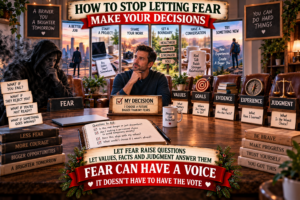
Let fear raise questions. Let it encourage preparation. Let it point out risks. Let it remind you that an opportunity matters. But after fear has spoken, invite your values, goals, evidence, experience, and judgment into the room.
Then make the decision yourself.
A life controlled entirely by fear may feel safer in the short term, but it can become increasingly narrow. The opportunities we avoid, conversations we postpone, ideas we never share, and goals we never attempt can create their own kind of regret.
You do not have to choose danger to choose courage. You do not have to ignore anxiety to move forward. You simply need to stop treating fear as the unquestioned authority over your future.
The next time fear tells you to retreat, listen carefully. Determine whether it is warning you or merely worrying you. Prepare where preparation is needed. Protect yourself where protection is necessary. Then, when the path is responsible and meaningful, make the choice that serves the person you are trying to become.
Fear can have a voice. It does not have to have the vote.