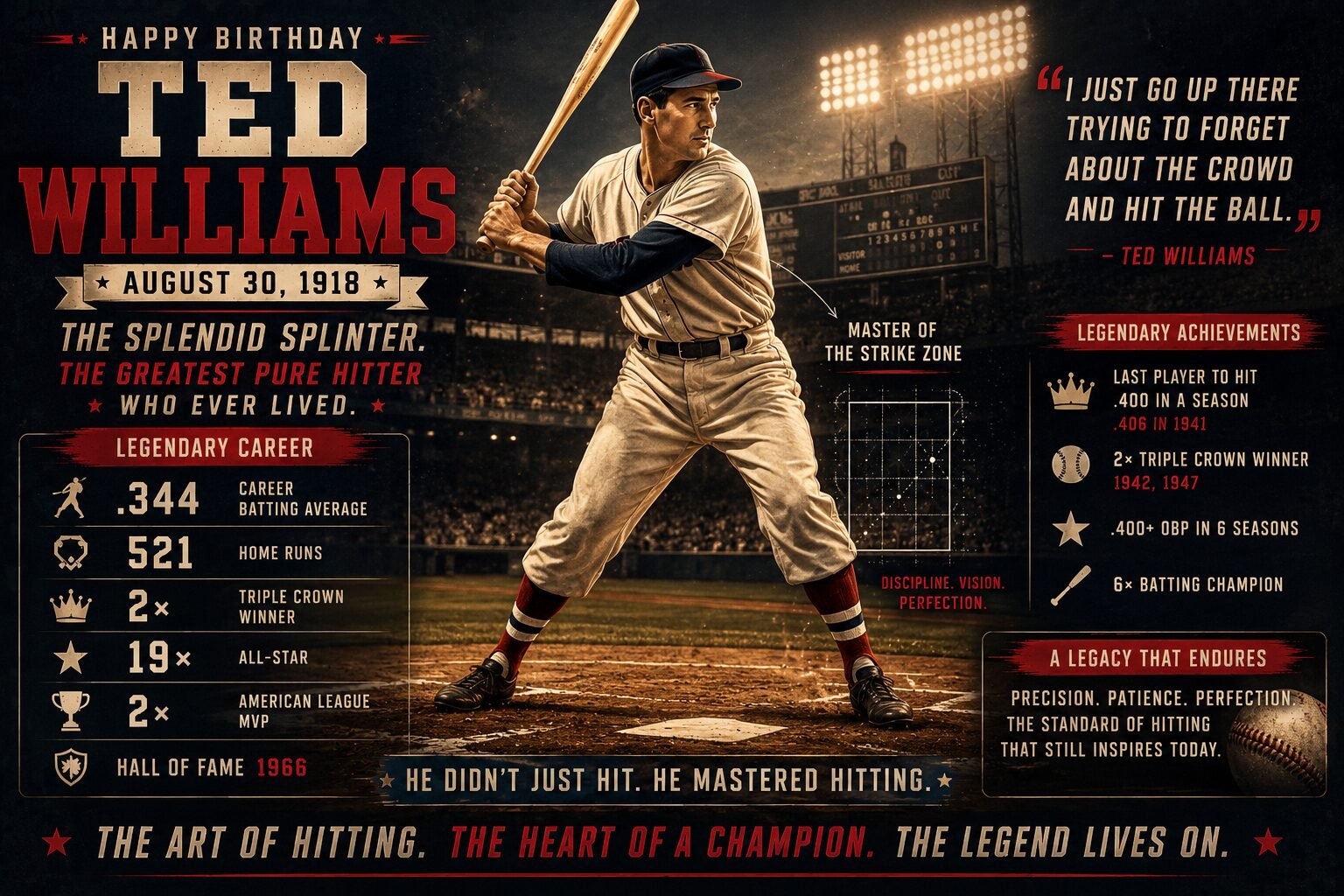


Some players hit for average. Others hit for power. And then there are those who redefine what it means to hit a baseball.
Ted Williams was that kind of player.
Born on August 30, 1918, Williams didn’t just become a star for the Boston Red Sox — he became one of the greatest hitters in baseball history. On his birthday, fans celebrate more than numbers. They celebrate precision, discipline, and a mastery of hitting that may never be matched.
Affiliate Disclosure: This article may contain affiliate links and banner advertisements. If you make a purchase through these links, we may earn a small commission at no additional cost to you. Thank you for supporting our platform.
From San Diego to MLB Greatness
Ted Williams was born in San Diego, California, where his remarkable journey toward baseball greatness began at an early age. Growing up in Southern California, Williams developed an intense passion for the game, spending countless hours practicing his swing, studying pitchers, and dreaming of one day becoming the greatest hitter in Major League Baseball. While many young players relied on natural talent, Williams believed that true greatness came from understanding every detail of the craft.
From the beginning, his dedication set him apart. He wasn’t satisfied with simply hitting the ball well. He wanted to know why certain swings produced better results, how pitchers tried to attack hitters, and what adjustments could be made in every situation. That curiosity became the foundation of one of the greatest offensive careers baseball has ever witnessed.
Williams also excelled in youth baseball throughout San Diego, quickly earning a reputation as one of the area’s brightest prospects. His natural hand-eye coordination, quick bat speed, and disciplined approach at the plate made him stand out against older competition. Scouts recognized that they were watching a player with rare offensive potential, but few could have imagined just how historic his career would become.
His game was built on:
- Exceptional plate discipline, refusing to chase pitches outside the strike zone and forcing pitchers to throw strikes. Williams possessed an extraordinary understanding of the strike zone, allowing him to draw walks while consistently putting himself in favorable hitting counts.
- Outstanding bat control, using a smooth, fundamentally sound swing to drive the baseball to every part of the field. He rarely wasted an at-bat and constantly adjusted to different pitchers and game situations.
- Tremendous power, combining remarkable bat speed with exceptional strength to become one of baseball’s greatest home run hitters. Williams could hit towering home runs while still maintaining one of the highest batting averages in the game.
- A deep understanding of hitting, approaching every plate appearance like a student studying a complex subject. He analyzed pitchers, recognized patterns, remembered previous at-bats, and constantly searched for ways to improve his approach.
Williams’ commitment to mastering hitting became legendary. Long before advanced analytics and video technology existed, he carefully studied pitching mechanics, defensive positioning, and hitting techniques. He believed that every at-bat contained valuable information that could help him become a better hitter in the future. That dedication eventually led him to write and teach about the science of hitting, influencing generations of players who followed.
His confidence was equally remarkable. Williams never doubted his ability to succeed against the best pitchers in baseball because he knew how thoroughly he had prepared. Every practice session, batting drill, and game situation became another opportunity to refine his craft. Rather than relying solely on instinct, he trusted the knowledge and preparation he had accumulated through years of relentless work.
As Williams progressed through amateur baseball and the minor leagues, it became increasingly clear that he possessed a rare combination of physical ability and baseball intelligence. His offensive skills continued to develop at an extraordinary rate, and by the time he reached the major leagues, expectations surrounding the young outfielder were enormous.
He would go on to exceed every one of them.
Throughout his career, Williams remained obsessed with becoming the best hitter he could possibly be. Even after winning batting titles, MVP Awards, and earning national recognition, he continued searching for ways to improve. He constantly refined his swing, studied opposing pitchers, and looked for even the smallest advantage at the plate.
He didn’t just swing.
He studied hitting.
That distinction became the defining characteristic of Ted Williams’ legendary career.
While many great hitters relied on instinct or athletic ability alone, Williams treated hitting like both a science and an art. He believed that understanding the game intellectually could elevate physical talent to an entirely different level.
His relentless pursuit of offensive perfection transformed him into one of the greatest hitters in baseball history and established a standard of preparation that continues to influence players, coaches, and hitting instructors more than half a century after his retirement.
The Rise with the Red Sox
Ted Williams spent his entire Major League Baseball career with the Boston Red Sox, becoming one of the most important and recognizable players in franchise history. From the moment he reached the major leagues in 1939, it was clear that Boston had found a hitter unlike almost anyone the game had seen before.
Williams arrived with confidence, ambition, and a carefully developed understanding of the strike zone. He did not need years to establish himself as an elite offensive player. During his rookie season, he drove in 145 runs, immediately demonstrating that he could produce against major-league pitching at an extraordinary level.
His smooth left-handed swing quickly became one of the most feared sights in baseball. Pitchers understood that careless mistakes over the plate could be punished with a line drive into the gap or a towering home run into the right-field seats at Fenway Park. Yet avoiding the strike zone created another problem because Williams possessed the patience to refuse pitches he could not drive.
He brought:
- An elite batting average, consistently making hard contact while using the entire field. Williams won six American League batting championships and finished his career with a remarkable .344 batting average.
- Power hitting, combining strength, bat speed, and precise mechanics to drive the ball with authority. He finished his career with 521 home runs despite losing several prime seasons to military service.
- Exceptional patience at the plate, forcing pitchers to challenge him rather than expanding the strike zone. Williams led the American League in walks eight times and developed one of the highest career on-base percentages in baseball history.
- Extraordinary consistency, remaining one of the league’s most dangerous hitters across multiple decades, even after long interruptions to his career and the natural effects of aging.
Williams did not approach every pitch as an opportunity to swing. He understood that disciplined hitting required waiting for a pitch he could handle. If a pitcher worked outside the zone, Williams was willing to take the walk rather than make weak contact simply to avoid striking out looking.
That patience gave him control of the confrontation.
Many hitters allowed pitchers to dictate the at-bat. Williams reversed that relationship. By refusing to chase poor pitches, he forced opponents to enter the areas of the strike zone where his swing was most dangerous. Pitchers often tried to work around him, but eventually they had to decide whether to challenge one of the greatest hitters alive or place another runner on base.
His most famous season came in 1941, when Williams entered the final day of the schedule batting just above .400. He could have protected his average by sitting out, but he chose to play both games of a doubleheader. He collected six hits in eight at-bats and finished the season with a .406 batting average.
He remains the last Major League player to hit .400 over a full season.
That achievement captured the confidence and competitiveness that defined his career. Williams did not want the milestone through caution or technicality. He wanted to earn it by stepping into the batter’s box and continuing to face major-league pitching.
His production went far beyond batting average. Williams won the American League Triple Crown twice, leading the league in batting average, home runs, and runs batted in during the same season. He also earned two Most Valuable Player Awards and repeatedly ranked among the league leaders in nearly every major offensive category.
What separated Williams from many other power hitters was the completeness of his approach. He could hit for average without sacrificing power. He could draw walks without becoming passive. He could wait patiently for the correct pitch and then attack it with tremendous force.
His knowledge of Fenway Park also became part of his success. Williams learned how the ball carried to different parts of the field and understood how opposing pitchers attempted to use the park against him. Rather than trying to pull every pitch toward the short right-field distance, he remained committed to disciplined hitting and drove the ball wherever it was pitched.
Defenses sometimes used dramatic shifts in an attempt to limit him, moving fielders heavily toward the right side because of his tendency to pull the ball. Williams could have altered his entire approach merely to defeat the alignment, but he remained focused on hitting the pitch with maximum authority.
That confidence made every plate appearance feel like a strategic battle.
Williams studied opposing pitchers closely. He remembered their fastballs, breaking pitches, release points, and preferred sequences. He paid attention to how they approached him with runners on base, in late innings, and during different counts. Each at-bat supplied information that could be used in the next one.
His connection to the Red Sox continued through changing rosters, managers, and eras. Although Boston did not capture a World Series championship during his career, Williams remained the franchise’s central figure and greatest offensive weapon. Fans came to Fenway Park specifically to watch him hit because every plate appearance carried the possibility of witnessing something exceptional.
His career was interrupted twice by military service, first during World War II and later during the Korean War. Those absences cost him nearly five full seasons during what could have been some of his most productive years. Despite the interruptions, he returned each time and continued hitting at an elite level, revealing both his natural ability and the depth of his preparation.
Williams did not simply accumulate hits.
He controlled at-bats.
He studied the strike zone, anticipated pitchers’ decisions, and waited for the precise moment to attack. His combination of patience, intelligence, bat control, and power made him one of the most complete offensive players baseball has ever known.
He didn’t just get hits.
He dominated pitchers.
Ted Williams turned hitting into an intellectual contest as much as a physical one. Every plate appearance became a demonstration of discipline, preparation, and confidence, helping him become not only the greatest Red Sox hitter of his generation but one of the most accomplished hitters in the entire history of baseball.
Career Highlights & Achievements
Ted Williams’ résumé is legendary:
- 2× American League MVP
- 19× MLB All-Star
- 2× Triple Crown winner
- .344 career batting average
- 521 home runs
- Last player to hit .400 in a season (.406 in 1941)
- Baseball Hall of Fame (1966)
His numbers remain among the greatest in MLB history.
The Art of Hitting
Ted Williams approached hitting differently than almost every player of his generation. While many great hitters relied primarily on natural instincts and experience, Williams treated every at-bat as a carefully studied science. He believed that hitting was a skill that could be mastered through preparation, observation, discipline, and constant refinement. Every pitch, every swing, and every result became an opportunity to learn something new.
His dedication to understanding hitting became legendary throughout baseball. Williams spent countless hours studying pitchers, analyzing the strike zone, reviewing his own mechanics, and thinking about the mental side of hitting. Long before advanced analytics and video technology became common, he was breaking down the game in ways that would later influence generations of hitters.
To Williams, stepping into the batter’s box wasn’t simply a physical challenge.
It was a chess match.
He believed the hitter should never allow the pitcher to control the at-bat. Instead, he patiently waited for a pitch he could drive while forcing pitchers to throw strikes. That disciplined philosophy helped make him one of the most feared offensive players in baseball history.
He excelled at:
- Pitch recognition, quickly identifying fastballs, curveballs, and off-speed pitches almost immediately after they left the pitcher’s hand. His exceptional vision and understanding of pitching mechanics allowed him to react with remarkable consistency.
- Strike zone discipline, refusing to swing at pitches outside his preferred hitting area. Williams believed that a walk was often just as valuable as a hit because it helped his team while forcing pitchers to work harder. His patience resulted in one of the highest on-base percentages in Major League Baseball history.
- Driving the ball with authority, combining perfect timing, tremendous bat speed, and outstanding mechanics to hit line drives and home runs to every part of the ballpark. Rather than merely making contact, Williams focused on making hard contact.
- Consistent contact, maintaining a smooth, repeatable swing that allowed him to produce elite offensive numbers year after year. His mechanics remained remarkably balanced, enabling him to adjust to different pitchers and different situations without sacrificing power.
Williams’ confidence came from preparation rather than guesswork. Before games, he studied opposing pitchers carefully, paying attention to their tendencies, favorite pitches, release points, and how they attacked hitters in different situations. During games, he remembered previous at-bats and adjusted accordingly, making him increasingly dangerous every time he faced the same pitcher.
One of his greatest strengths was understanding the strike zone better than almost anyone who ever played the game. Williams often spoke about waiting for “his pitch” instead of chasing the pitcher’s best offering. If a pitcher refused to challenge him, Williams was perfectly willing to take a walk rather than help the pitcher by swinging at bad pitches.
That patience frustrated opponents.
Pitchers frequently found themselves in a difficult position. If they threw strikes, Williams had the ability to drive the baseball with tremendous power. If they pitched too carefully, he simply accepted his walk and reached base anyway. Either outcome placed tremendous pressure on opposing teams.
His approach also emphasized quality over quantity. Williams did not believe every swing needed to produce immediate results. Instead, he focused on making solid contact, trusting that good decisions at the plate would eventually produce excellent statistics over the course of a season. That philosophy helped him remain one of baseball’s most consistent hitters for nearly two decades.
Williams later shared much of his knowledge in his classic book, “The Science of Hitting,” which became one of the most influential instructional books ever written about baseball. In it, he explained concepts such as dividing the strike zone into sections, understanding a hitter’s strengths, and recognizing which pitches offered the highest probability of success. Many professional hitters and coaches still study his ideas today because they remain remarkably relevant.
His influence can be seen throughout modern baseball. Today’s emphasis on plate discipline, on-base percentage, pitch selection, and controlling the strike zone reflects many of the principles Williams championed decades before advanced statistics became popular. He was truly ahead of his time in understanding the mathematics and strategy behind successful hitting.
Perhaps most impressive was his relentless desire to improve. Even after winning batting titles, MVP Awards, and Triple Crowns, Williams continued searching for ways to become a better hitter. He analyzed his own weaknesses, experimented with adjustments, and never believed he had completely mastered the craft.
He turned hitting into an art form.
Every at-bat reflected years of study, preparation, and discipline. Every swing demonstrated a balance between science and instinct, patience and aggression, intelligence and athletic ability.
Ted Williams didn’t simply become one of baseball’s greatest hitters.
He became its greatest student of hitting.
His remarkable approach transformed offensive baseball forever, leaving behind principles that continue to shape hitters at every level of the game. More than half a century after his retirement, his philosophy remains the gold standard for anyone seeking to understand what it truly means to be a complete hitter.
Serving Beyond Baseball
Ted Williams’ career is remarkable not only because of what he accomplished on the baseball field, but also because of what he willingly sacrificed away from it. At the height of his athletic prime, when he was already recognized as one of the greatest hitters in Major League Baseball, Williams stepped away from the game to serve his country as a military pilot. His decision demonstrated a level of patriotism, courage, and selflessness that elevated his legacy far beyond baseball.
Unlike many athletes whose careers follow a continuous path, Williams’ playing days were interrupted by two separate wars. These interruptions cost him nearly five full Major League seasons, years in which many historians believe he would have added hundreds of hits, dozens of home runs, and perhaps even more Most Valuable Player Awards to an already legendary résumé.
When the United States entered World War II, Williams answered the call to military service. Rather than seeking ways to remain in baseball, he joined the United States Marine Corps, where he trained as a fighter pilot. The same dedication that made him one of baseball’s greatest hitters became evident in his military career. He approached flight training with the same discipline, preparation, and relentless pursuit of excellence that defined his time at the plate.
Williams quickly proved himself as an exceptional pilot. Military instructors praised his focus, intelligence, and ability to master difficult flying techniques. Although baseball had made him a national celebrity, in uniform he was expected to meet the same demanding standards as every other Marine pilot.
His service reflected:
- Extraordinary patriotism, willingly putting his baseball career on hold to serve his country during one of the most challenging periods in world history.
- Remarkable courage, completing rigorous pilot training and preparing to fly dangerous military aircraft while accepting the risks that accompanied military service.
- Selfless sacrifice, giving up seasons that would have added significantly to his already remarkable career statistics and historical accomplishments.
- An unwavering sense of duty, believing that representing his country was more important than personal achievements on the baseball field.
After returning from World War II, Williams resumed his baseball career as though he had never been away. Despite missing years of competition, he quickly reestablished himself as the game’s premier hitter, winning batting titles and continuing to dominate American League pitching.
Then history repeated itself.
When the Korean War began, Williams was called back into military service.
This time, his responsibilities became even more dangerous.
Serving once again as a Marine aviator, Williams flew combat missions in Korea alongside another future American hero—John Glenn, who would later become the first American to orbit the Earth. Williams served as Glenn’s wingman during several missions, placing himself in situations where split-second decisions could determine life or death.
During one combat mission, Williams’ aircraft was struck by enemy anti-aircraft fire. Despite suffering significant damage to the plane, he successfully managed to fly it back to safety, demonstrating extraordinary composure and flying skill under intense pressure. The experience highlighted the same calm decision-making that baseball fans had admired during his greatest moments on the field.
His military service permanently changed the trajectory of his baseball career.
Historians estimate that Williams missed approximately five seasons because of World War II and the Korean War. Had those seasons been played instead of spent serving his country, many believe he would have finished with well over 600 home runs, more than 3,000 hits, and career totals that would rank among the greatest in baseball history.
Yet Williams never expressed regret about his service.
He understood that some responsibilities were larger than sports.
His willingness to sacrifice personal milestones for the good of his country earned him admiration that extended well beyond baseball fans. Fellow players respected not only his extraordinary talent but also his commitment to serving something greater than himself.
When he returned from military duty after each conflict, Williams showed remarkable resilience. Most athletes struggle after extended absences from professional competition, but Williams quickly regained his elite form. His ability to return from years away and immediately become one of baseball’s best hitters again demonstrated both his extraordinary natural ability and his relentless work ethic.
His military service also reflected the character that defined his entire life. Williams believed in preparation, discipline, accountability, and giving his best effort regardless of the challenge before him. Those principles served him equally well in the cockpit of a fighter jet and in the batter’s box at Fenway Park.
He sacrificed years of his prime to serve his country.
That sacrifice remains one of the most remarkable aspects of his legacy.
Ted Williams could have been remembered solely as perhaps the greatest hitter who ever lived.
Instead, he chose to become something even greater.
He became an American hero who demonstrated that true greatness is measured not only by records and championships but also by the willingness to place duty above personal success. His courage in military service stands alongside his accomplishments on the baseball field, making him one of the most respected figures in the history of American sports.
Get Yours Today: The Finest 1955 Ted Williams Game Used Signed Louisville Slugger Bat PSA DNA 10
Why Red Sox Fans Still Revere Him
In Boston, Williams represents:
- Excellence
- Dedication
- Loyalty
- A standard of greatness
He remains one of the most iconic players in franchise history.
A Lasting Impact on the Game
Ted Williams’ influence on baseball extends far beyond his remarkable statistics and Hall of Fame career. While his accomplishments at the plate established him as one of the greatest hitters in Major League Baseball history, his greatest contribution may have been changing how players, coaches, and instructors think about the art and science of hitting. Williams transformed batting from something many believed relied primarily on natural ability into a discipline that could be studied, analyzed, and continuously improved.
His career demonstrated that success at the plate was not simply about quick reflexes or raw power. Williams believed that great hitting required preparation, patience, knowledge, and a complete understanding of the strike zone. Those principles became the foundation of modern hitting instruction and continue to influence players at every level of baseball.
His lasting impact includes:
- Helping define the modern approach to hitting, proving that disciplined pitch selection and understanding the strike zone were just as important as swing mechanics and physical talent.
- Revolutionizing offensive strategy, showing hitters that drawing walks, working deep counts, and forcing pitchers into mistakes could be just as valuable as collecting base hits.
- Establishing a standard of preparation, encouraging players to study opposing pitchers, analyze tendencies, and approach every at-bat with a clear plan rather than relying solely on instinct.
- Demonstrating the value of continuous learning, reminding athletes that no matter how successful they became, there was always another adjustment to make and another lesson to learn.
Williams’ remarkable understanding of hitting was so advanced that many of his ideas remain central to today’s game. Long before statistics such as on-base percentage, slugging percentage, and OPS became widely discussed, Williams understood their importance. He recognized that reaching base consistently helped teams win games and believed that chasing bad pitches only benefited the pitcher.
His philosophy challenged conventional thinking.
Rather than swinging aggressively at every strike, Williams taught that the hitter should control the at-bat by waiting for a pitch that could be driven with authority. His willingness to accept walks frustrated opposing pitchers while creating additional opportunities for his teammates. Today, that patient, disciplined approach is taught throughout professional baseball, college programs, and youth organizations around the world.
Williams also left a permanent educational legacy through his classic instructional book, “The Science of Hitting.” The book remains one of baseball’s most respected resources, explaining concepts such as pitch selection, strike-zone awareness, swing mechanics, and offensive strategy in remarkable detail. Decades after its publication, players, coaches, and hitting instructors continue to study his teachings because they remain just as relevant today as when Williams first shared them.
His influence can be seen in many of baseball’s greatest hitters who followed. Legends such as Tony Gwynn, Wade Boggs, George Brett, Barry Bonds, Albert Pujols, Joey Votto, and countless others embraced many of the same principles that Williams championed—patience, preparation, discipline, and a commitment to understanding the strike zone.
Beyond statistics and technique, Williams also inspired players through his relentless pursuit of improvement. Even after winning batting titles, Triple Crowns, MVP Awards, and becoming widely recognized as baseball’s finest hitter, he continued studying pitchers, refining his swing, and searching for new ways to improve. His curiosity never disappeared because he believed mastery was something to pursue rather than something to declare complete.
That mindset became one of his greatest gifts to the game.
Williams taught that greatness was not achieved through talent alone.
It was earned through preparation, discipline, and an unwavering commitment to learning.
His influence also extends into modern baseball analytics. Many of the concepts now supported by advanced statistical analysis reflect ideas Williams understood decades earlier. His appreciation for controlling the strike zone, maximizing quality contact, and reaching base efficiently demonstrated that he was years ahead of his time in understanding offensive baseball.
Even after his playing career ended, Williams remained an ambassador for hitting. Young players sought his advice, coaches respected his insights, and baseball historians continued studying his extraordinary approach to offense. His willingness to share his knowledge ensured that future generations could benefit from everything he had learned during his remarkable career.
His discipline and understanding of the strike zone influenced generations of hitters.
More importantly, they changed the way baseball teaches offense.
Ted Williams did not simply become one of the greatest hitters who ever lived.
He became the game’s greatest teacher of hitting.
His legacy lives on every time a young player works a full count instead of chasing a bad pitch, every time a coach teaches the value of patience at the plate, and every time a hitter studies the game with the same relentless curiosity that defined Williams throughout his life.
More than half a century after his retirement, his philosophy continues to shape baseball.
His records inspire admiration.
His knowledge continues to educate.
And his relentless pursuit of offensive perfection ensures that Ted Williams will forever be remembered not only as one of baseball’s greatest players, but also as one of its greatest thinkers.
Get Yours Today: Ted Williams Signed Personal Model Baseball Glove Beckett COA
A Birthday Worth Celebrating Across Baseball
Ted Williams didn’t just hit.
He mastered hitting.
On August 30, we celebrate more than a Hall of Famer.
We celebrate perfection at the plate.
Happy Birthday, Ted Williams — the greatest pure hitter in baseball history.







Absolutely. It’s amazing how he consistently focused on hitting, unlike many players of his era. What a remarkable career.