Affiliate Disclaimer: This post may contain affiliate links. If you make a purchase through one of these links, The Shopping Plaza may earn a commission at no additional cost to you.
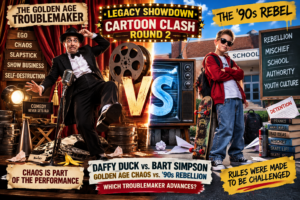
Round 2 of Legacy Showdown: Cartoon Clash begins with a matchup worthy of the deeper tournament field. Daffy Duck and Bart Simpson survived the opening round, but advancement now requires defeating another character with a legitimate claim to animation greatness. Daffy represents the Golden Age theatrical tradition: explosive physical comedy, elastic animation, rapid-fire personality shifts, and one of the most fascinating rivalries in cartoon history through his relationship with Bugs Bunny. Bart represents a different revolution. As the rebellious eldest child of the Simpson family, he became one of the defining television characters of the early 1990s and helped turn prime-time animation into a mainstream cultural force. Both are troublemakers, both are driven by enormous personalities, and both can create chaos simply by entering a scene. Yet their comedy comes from different places. Daffy’s ego frequently destroys his own plans, while Bart’s mischief often challenges parents, teachers, authority figures, and the expectations placed on children. With first-round underdogs eliminated and the bracket becoming more competitive, every category now carries even greater weight. Only one of these animated rebels can earn a place in the next round.
Round 1: Animation Quality
Daffy Duck was shaped by some of the greatest artists and directors of the Golden Age of American theatrical animation. His body can stretch, squash, twist, explode, flatten, recoil, and transform with a freedom perfectly suited to his volatile personality. Different directors interpreted him differently, from the wild, uncontrollable early Daffy to the increasingly jealous and self-important rival of Bugs Bunny, yet the animation consistently used movement as characterization. Shorts such as the famous hunting-season confrontations and self-aware theatrical experiments demonstrate how timing, staging, facial expression, and impossible physical transformations could become part of the joke itself. Bart Simpson has one of television’s most recognizable silhouettes, and The Simpsons developed a visual language capable of supporting slapstick, family comedy, fantasy sequences, elaborate parodies, and decades of changing production technology. Bart’s skateboard scenes, physical gags, exaggerated reactions, and action-oriented stories give him plenty of visual energy. Still, television production rarely gives Bart the same sustained frame-by-frame physical freedom that Daffy’s best theatrical shorts enjoyed. Judged relative to their eras rather than by modern technical polish, Daffy’s peak animation is the more extraordinary artistic achievement. Winner: Daffy Duck.
Round 2: Character Cast
Daffy belongs to the extraordinary Looney Tunes ensemble. Bugs Bunny is both colleague and rival, Porky Pig can serve as partner or straight man, Elmer Fudd and Yosemite Sam provide conflict, and characters such as Marvin the Martian and Speedy Gonzales have shared memorable stories with him. Daffy’s relationships are especially entertaining because his personality changes depending on whom he wants to impress, defeat, manipulate, or outshine. His rivalry with Bugs may be the most important connection of all, exposing Daffy’s jealousy, ambition, insecurity, and desperate need for attention. Bart, however, lives inside one of television’s deepest fictional communities. Homer, Marge, Lisa, and Maggie give him distinct family dynamics, while Milhouse supplies friendship, Nelson can be bully or ally, Principal Skinner represents institutional authority, Krusty is Bart’s entertainment idol, and characters such as Sideshow Bob create long-running personal rivalries. Springfield contains hundreds of recurring personalities capable of changing the type of story Bart inhabits. Daffy’s ensemble is legendary, but Bart’s family, school, friendships, enemies, and community create a broader web of sustained relationships around him. Winner: Bart Simpson.
Round 3: Humor & Entertainment
This category places two elite comedy characters against each other. Bart’s prank calls, classroom rebellion, sarcastic remarks, sibling conflicts, schemes with Milhouse, battles with Skinner, and unpredictable relationship with Homer have generated decades of television comedy. He can function as a mischievous child, action hero, emotional son, troublemaking student, or parody of youth culture. Daffy’s comedy is even more concentrated around personality. He can be manic, greedy, jealous, cowardly, arrogant, desperate, theatrical, or completely convinced that the universe has failed to recognize his greatness. His greatest jokes often come from watching him create his own disaster through ego and persistence. Daffy also excels at physical comedy in a way few characters can match, repeatedly surviving impossible punishment only to charge back into the same mistake. He can carry dialogue-heavy satire, silent reactions, fourth-wall comedy, musical performance, or explosive slapstick. Bart has tremendous range, but Daffy’s ability to generate comedy through movement, voice, personality, and self-destruction gives him the narrow advantage. Winner: Daffy Duck.
Round 4: Cultural Impact
Daffy Duck became one of the central faces of Looney Tunes and has remained recognizable across theatrical shorts, television packages, movies, merchandise, advertising, games, and later Warner Bros. productions. His rivalry with Bugs, distinctive voice, explosive temperament, and constantly frustrated ambition made him far more than a supporting character. He helped define the personality-driven style associated with Warner Bros. animation. Bart Simpson, however, became a cultural phenomenon on a scale that extended well beyond animation. During the early years of The Simpsons, Bart’s catchphrases, T-shirts, merchandise, rebellious attitude, and instantly recognizable spiky silhouette became symbols of an entire pop-cultural moment. The controversy surrounding his behavior only increased his visibility, while the show’s success helped prove that prime-time animation could become mainstream television rather than a niche format. Bart appeared on magazine covers, music releases, games, clothing, advertisements, and countless parodies. Daffy has the longer historical legacy, but Bart’s explosive influence on television culture and the public image of animated rebellion gives him the slightest edge here. Winner: Bart Simpson.
Round 5: Iconic Episodes & Moments
Daffy’s career contains some of the most celebrated individual shorts and sequences in animation history. His escalating conflict with an unseen animator in a self-referential cartoon remains a landmark example of breaking the fourth wall, while his hunting-season arguments with Bugs and Elmer transformed a simple rivalry into endlessly quoted comedy. His attempts to become the hero while Bugs receives the applause repeatedly reveal the insecurity beneath his ego. Bart also possesses an enormous collection of defining television episodes and moments. His conflicts with Sideshow Bob, relationship with Milhouse, school pranks, emotional struggles with Homer and Lisa, daredevil ambitions, and moments when his bravado collapses into genuine childhood vulnerability have produced memorable stories across decades. Bart’s strongest episodes often give him more emotional development than a theatrical short could attempt. Yet this category rewards memorable episodes, scenes, arcs, and defining moments rather than depth alone. Daffy’s greatest shorts are not merely nostalgic favorites; several are routinely treated as landmark works of animated comedy and formal experimentation. Their influence and precision give Daffy a narrow victory. Winner: Daffy Duck.
Round 6: Creativity & Originality
Bart Simpson was a striking television character when The Simpsons exploded into popular culture. Rather than presenting an idealized sitcom child, Bart was rebellious, sarcastic, academically unmotivated, skeptical of authority, and often openly responsible for the family’s problems. Yet the writing allowed him to be more than a stereotype. He could show loyalty, fear, guilt, affection, creativity, and vulnerability, making the rebellious-child premise more human than the merchandise image suggested. Daffy’s originality developed through an unusual evolution. He began as an almost uncontrollable embodiment of cartoon lunacy, but later creators transformed him into a vain, jealous, ambitious performer whose awareness of Bugs Bunny’s greater popularity became part of the comedy. That shift allowed Daffy to satirize celebrity, competition, ego, show business, and even the cartoon medium itself. He can recognize that he is performing and still be trapped by his own personality. Bart helped redefine the animated television child, but Daffy’s combination of anarchic roots, self-aware performance, and psychologically comic rivalry is the more unusual creative construction. Winner: Daffy Duck.
Round 7: Era Difficulty
Daffy emerged in the late 1930s and developed through the Golden Age of theatrical cartoons, an era crowded with characters from Disney, MGM, Fleischer, Walter Lantz, and Warner Bros. itself. Within his own studio, Daffy had to remain distinctive alongside Bugs Bunny, Porky Pig, Tweety, Sylvester, Road Runner, Wile E. Coyote, Foghorn Leghorn, Yosemite Sam, and other characters capable of carrying theatrical shorts. The competition for audience attention and creative excellence was extraordinary. Bart entered another difficult environment. Prime-time animation had a long history of failed or short-lived experiments, and The Simpsons had to convince a mass television audience that an animated family could sustain adult satire week after week. Once the show succeeded, Bart also had to survive the backlash against his rebellious image and the emergence of countless new animated competitors. Both helped flourish in transformative periods. Bart played a major role in opening doors for later prime-time cartoons, but Daffy’s need to distinguish himself within perhaps the deepest field of theatrical cartoon talent gives him the narrow edge. Winner: Daffy Duck.
Round 8: Legacy Endurance
Daffy Duck has survived for nearly nine decades through theatrical exhibition, television reruns, compilation shows, feature films, merchandise, games, streaming, and repeated Looney Tunes revivals. Importantly, different generations have been able to reinterpret him without erasing the central personality: Daffy still wants attention, still believes he deserves more than he receives, and still turns frustration into comedy. Bart Simpson has also achieved exceptional longevity. He has remained an active character in new episodes for decades, and early stories continue circulating through reruns and streaming while new audiences encounter Springfield. His rebellious image is permanently connected to the history of 1990s popular culture, yet the character also continues to function inside contemporary episodes rather than existing only as nostalgia. Bart therefore has one of television animation’s strongest endurance cases. Daffy, however, has crossed more generations, distribution systems, animation eras, and cultural shifts while remaining immediately recognizable. The fact that a character created before television became America’s dominant medium can still compete directly with modern icons gives Daffy the advantage. Winner: Daffy Duck.
Final Verdict
Round 2 begins with a battle that is much closer than a simple classic-versus-modern comparison might suggest. Bart Simpson wins Character Cast and Cultural Impact. Springfield gives him an unmatched network of family, school, friendship, and community relationships, while his early rise became one of the defining pop-cultural explosions in television animation history. Daffy Duck answers with Animation Quality, Humor & Entertainment, Iconic Episodes & Moments, Creativity & Originality, Era Difficulty, and Legacy Endurance. His Golden Age animation, extraordinary comic performance, landmark theatrical shorts, unusual evolution from anarchic lunatic to insecure show-business rival, survival within a historically stacked era, and nearly nine decades of continued recognition create an exceptionally complete tournament resume. Several rounds are narrow. Bart has the stronger long-form character world, and his role in the rise of prime-time animation deserves enormous respect. But Daffy’s best work operates at the highest level of cartoon comedy while also carrying historical influence that has survived multiple generations. That combination gives the veteran duck the first major victory of Round 2.
Final Result: Daffy Duck defeats Bart Simpson 6-2 and advances to the next round of Legacy Showdown: Cartoon Clash. Bart exits after winning two major categories and demonstrating why he remains one of television animation’s most influential rebellious characters.
Audience Challenge
Did Daffy Duck deserve the 6-2 victory, or should Bart Simpson’s television influence and decades of character-driven storytelling have made this matchup closer? Would you award Humor & Entertainment, Creativity & Originality, or Legacy Endurance differently? Cast your vote, defend your choice, and continue following Legacy Showdown: Cartoon Clash as Round 2 raises the competition.