
MLB Region — Round 2
Affiliate Disclaimer
This blog may contain affiliate links or banner advertisements. If you click on one of these links or advertisements and make a purchase, The Shopping Plaza may earn a small commission at no additional cost to you. These commissions help support our work and allow us to continue creating free sports content, rankings, tournament features, and Legacy Showdown matchups like Gametime Gauntlet. We only recommend products, services, or merchandise that we believe may be of interest to our readers. Thank you for supporting The Shopping Plaza and Gametime Gauntlet.
Round 2: The Big Red Machine Meets the Miracle-Making Mets
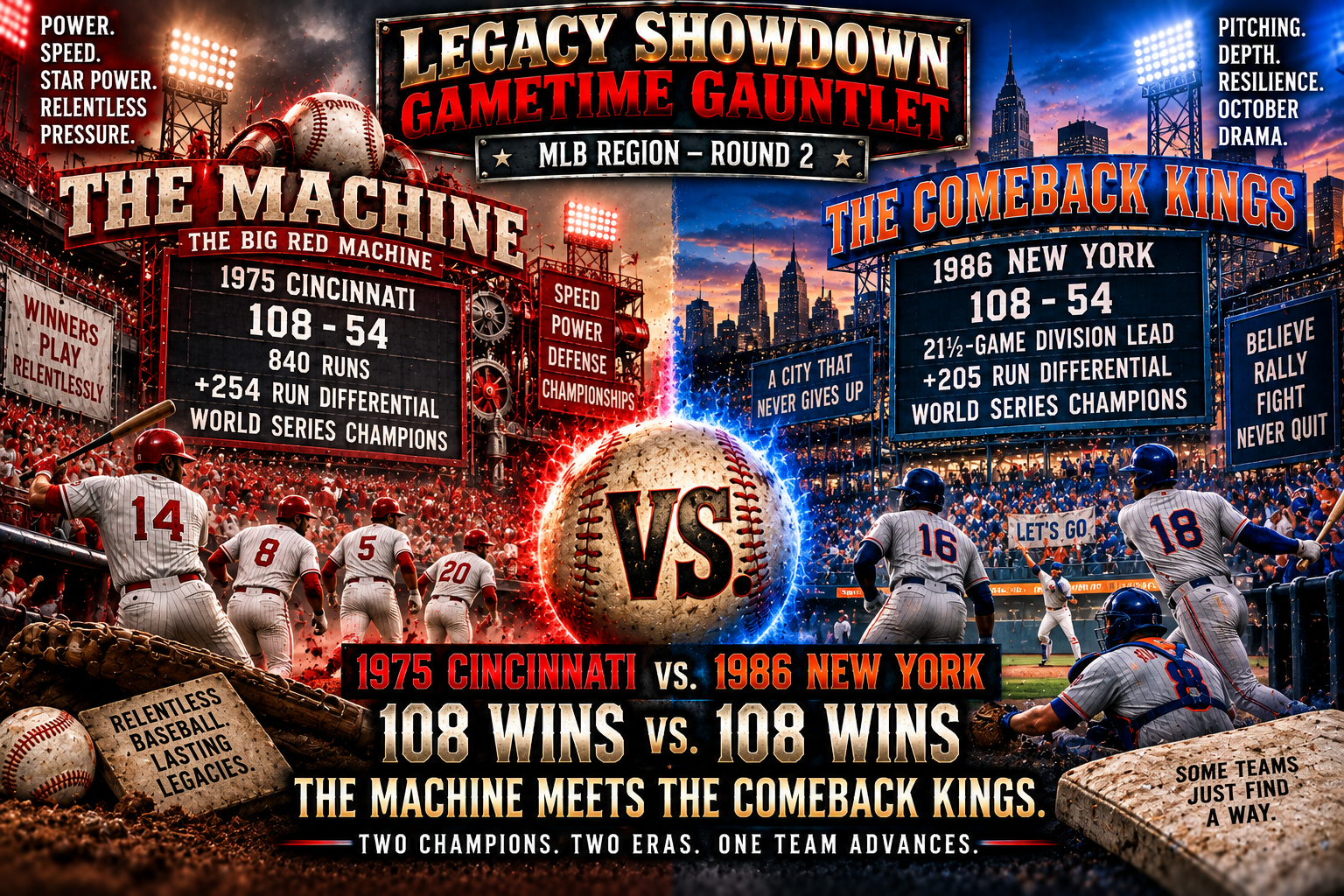
Round 2 of the MLB Region continues with two 108-win champions separated by eleven years and connected by a remarkable coincidence: both finished the regular season 108–54 and both ultimately defeated the Boston Red Sox in seven-game World Series. Beyond those similarities, however, these teams built greatness in very different ways. The 1975 Cincinnati Reds represented the Big Red Machine at full force, combining an elite offense, speed, defense, depth, and relentless pressure under manager Sparky Anderson.
Joe Morgan won the National League MVP, Johnny Bench remained baseball’s premier power-hitting catcher, Pete Rose reached base and set the tone, Tony Pérez drove in runs, George Foster supplied additional power, and Dave Concepción and César Gerónimo strengthened the defense up the middle. Cincinnati scored 840 runs while allowing 586 and swept Pittsburgh in the NLCS before surviving one of the most famous World Series ever played.
The 1986 New York Mets were a different kind of powerhouse. Davey Johnson’s club also went 108–54, scored 783 runs while allowing 578, and won the NL East by 21½ games. Keith Hernandez, Gary Carter, Darryl Strawberry, Dwight Gooden, Ron Darling, Sid Fernandez, Ray Knight, Lenny Dykstra, Mookie Wilson, Jesse Orosco, and Roger McDowell gave New York a roster with star power, pitching depth, defensive quality, and late-game flexibility. The Mets survived a brutal six-game NLCS against Houston and then escaped elimination against Boston in a World Series that became permanently associated with one of baseball’s most dramatic comebacks.
Because this Round 2 matchup is being created from scratch, every criterion is judged independently. Neither seed position nor the results of earlier Gametime Gauntlet matchups determine a category. With identical regular-season records and championship credentials on both sides, this is exactly the type of matchup Round 2 was designed to produce.
1. Dominance Over Competition
The identical 108–54 records make this category immediately difficult. New York won the NL East by an enormous 21½ games, a larger divisional margin than Cincinnati’s 20-game victory in the NL West. The Mets also posted a +205 run differential, reflecting excellent balance between an offense that scored 783 runs and a staff that allowed 578. Cincinnati, however, produced an even larger +254 differential by scoring 840 runs and allowing 586. The Reds’ Pythagorean record of 107–55 nearly matched their actual record, underscoring how consistently they controlled games. Cincinnati also went 64–17 after May 31, turning a 20–20 start into one of the most overwhelming sustained runs of the decade. New York’s division margin is extraordinary, but Cincinnati created greater run separation while finishing with the same number of victories. By the narrowest margin, Dominance Over Competition goes to the Reds.
Winner: 1975 Cincinnati Reds
2. Championship Achievement
Both champions needed seven games to defeat Boston in the World Series, and both demonstrated enormous resilience. New York survived an exhausting NLCS against Houston, including a 16-inning clincher in Game 6, before overcoming a two-games-to-none World Series deficit and later escaping elimination in the famous tenth inning of Game 6. Cincinnati’s championship path began with a three-game NLCS sweep of Pittsburgh and ended against a 95-win Red Sox team in one of the most celebrated World Series ever played. The Reds lost the unforgettable 12-inning Game 6 after Carlton Fisk’s home run but returned the next night and won Game 7 in Boston, 4–3. That response is a major part of Cincinnati’s championship case: the Reds absorbed one of the most emotionally crushing losses imaginable and immediately finished the job on the road. The Mets’ escape in Game 6 is equally historic, but Cincinnati paired its seven-game Finals victory with a perfect NLCS. Championship Achievement goes narrowly to the Reds.
Winner: 1975 Cincinnati Reds
3. Strength of Competition
Cincinnati faced strong opponents. Pittsburgh won 92 games and featured Willie Stargell, Al Oliver, Dave Parker, and a club accustomed to postseason baseball, yet the Reds swept the Pirates in three games. Boston won 95 games and fielded a dangerous lineup led by Fred Lynn, Jim Rice, Carlton Fisk, and Carl Yastrzemski. New York’s path was even more demanding. Houston won 96 games and possessed one of baseball’s most intimidating pitching staffs, led by Cy Young winner Mike Scott, Nolan Ryan, and Bob Knepper. The Mets needed six games, two extra-inning classics, and a 16-inning road clincher to survive that NLCS. Boston then brought another 95-win club into the World Series behind Roger Clemens, Wade Boggs, Jim Rice, Dwight Evans, and a deep lineup. The Mets did not dominate October as cleanly as Cincinnati, but the difficulty of the pitching and opponents they had to solve gives New York the edge in Strength of Competition.
Winner: 1986 New York Mets
4. Star Power
The 1986 Mets were filled with stars. Keith Hernandez was one of the game’s best all-around first basemen, Gary Carter was a future Hall of Fame catcher, Darryl Strawberry was a feared young slugger, and Dwight Gooden remained one of baseball’s premier pitchers after his historic 1985 season. Cincinnati’s lineup, however, contains an extraordinary concentration of established greatness. Joe Morgan won the 1975 National League MVP and produced one of the finest all-around seasons ever by a second baseman. Johnny Bench was already a two-time MVP and one of the greatest catchers in baseball history, while Pete Rose was a former MVP and one of the era’s defining hitters. Tony Pérez supplied Hall of Fame-level run production, and the supporting lineup included Concepción, Foster, Griffey, and Gerónimo. The Mets may have the superior collection of frontline pitchers, but the Reds possess more historically accomplished position-player stars simultaneously near championship form. Star Power goes to Cincinnati.
Winner: 1975 Cincinnati Reds
5. Depth and Supporting Cast
Cincinnati’s depth was one of the defining features of the Big Red Machine. Beyond Morgan, Bench, Rose, and Pérez, the Reds had Ken Griffey, George Foster, Dave Concepción, César Gerónimo, and a flexible roster that allowed Sparky Anderson to mix matchups aggressively. The Mets answer with exceptional depth on both sides of the ball. Their everyday group included Hernandez, Carter, Strawberry, Wilson, Dykstra, Knight, Wally Backman, and Kevin Mitchell, while the rotation featured Gooden, Darling, Fernandez, and Bob Ojeda. The bullpen gave Davey Johnson both Jesse Orosco and Roger McDowell as high-leverage weapons, and the roster’s positional flexibility became particularly valuable during the postseason. New York could win with starting pitching, bullpen length, power, speed, defense, or a deep bench. Cincinnati’s lineup depth is arguably superior, but the Mets distribute their depth more evenly across the lineup, rotation, bullpen, and bench. Depth and Supporting Cast goes to New York.
Winner: 1986 New York Mets
6. Historical Impact
The 1986 Mets became one of baseball’s most unforgettable champions. Their personalities, dominance, dramatic postseason, and World Series comeback created a team that remains culturally recognizable decades later. Game 6 against Boston is permanently embedded in postseason history, and the Mets became the defining team of their franchise’s 1980s era. The 1975 Reds carry an even broader historical identity. The Big Red Machine became shorthand for sustained excellence, and the 1975 championship validated a core that had reached the World Series in 1970 and 1972 but had not yet won it. Morgan’s MVP season, the lineup’s combination of power and speed, and the famous World Series against Boston placed Cincinnati at the center of baseball history. The Reds then repeated in 1976, reinforcing 1975 as the breakthrough championship of a genuine dynasty. New York produced one of baseball’s most memorable single seasons; Cincinnati’s title helped define one of baseball’s most celebrated multi-year teams. Historical Impact goes to the Reds.
Winner: 1975 Cincinnati Reds
7. Statistical Excellence
The Mets’ statistical résumé is excellent. New York went 108–54, scored 783 runs, allowed 578, and finished with a +205 run differential. The pitching staff combined power arms, depth, and bullpen quality, while the offense drew walks, hit for power, and stole 118 bases. Cincinnati matched the Mets’ 108 victories but scored 840 runs, 57 more than New York, while allowing only eight more runs. That produced a +254 run differential and a Pythagorean record of 107–55. Morgan’s individual season was spectacular: a .327 average, .466 on-base percentage, .508 slugging percentage, 17 home runs, 94 RBI, 107 runs, and 67 stolen bases. Cincinnati also stole 168 bases as a team and led the National League in numerous offensive categories. The Mets have the stronger pitching-centric statistical case, but Cincinnati’s larger overall run differential with the same win-loss record provides the clearer team-level separation. Statistical Excellence goes to the Reds.
Winner: 1975 Cincinnati Reds
8. Longevity of Greatness
The Mets were built for more than one season. They won 90 games in 1984, 98 in 1985, 108 in 1986, 92 in 1987, and 100 in 1988, reaching another NLCS in 1988. That five-year stretch confirms that the 1986 championship emerged from a legitimate contender rather than a one-season accident. Yet Cincinnati’s championship core achieved more at the highest postseason level. The Reds reached the World Series in 1970 and 1972, won 99 games and the division in 1973, won 98 games in 1974, captured championships in 1975 and 1976, and remained a strong club afterward. Their 1976 team followed the first title with 102 wins and a perfect 7–0 postseason, giving the Big Red Machine back-to-back championships. Several central players remained together through much of the era. New York sustained regular-season excellence, but Cincinnati converted its window into multiple pennants and consecutive titles. Longevity of Greatness goes to the Reds.
Winner: 1975 Cincinnati Reds
9. Clutch Performance
The 1975 Reds were unquestionably clutch. They swept Pittsburgh, won three one-run World Series games, survived Boston’s legendary Game 6 victory, and then came from behind to win Game 7 at Fenway Park. Cincinnati deserves enormous credit for responding immediately after Fisk’s iconic home run. The Mets’ 1986 postseason, however, may be one of the richest collections of pressure moments ever assembled by a champion. They won a 12-inning Game 5 against Houston, survived a 16-inning Game 6 in the Astrodome, and repeatedly rallied after falling behind. In the World Series, New York trailed Boston two games to none, then later faced elimination in Game 6 with two outs and nobody on in the tenth inning. Three straight singles, a wild pitch, and the famous ground ball through Bill Buckner’s legs completed a comeback that forced Game 7. The Mets then erased a 3–0 deficit in the deciding game to win the championship. Cincinnati’s clutch résumé is superb, but New York repeatedly survived situations in which its season appeared seconds from ending. Clutch Performance goes to the Mets.
Winner: 1986 New York Mets
10. Legacy Endurance
The 1986 Mets have one of the strongest legacies of any single-season champion. Their 108 wins, colorful personalities, dominant regular season, grueling NLCS, and unforgettable World Series ensure that the team remains prominent in baseball culture. The fact that the Mets did not win another championship with that core has arguably made 1986 stand out even more distinctly. Cincinnati’s 1975 team, however, occupies a larger place in the traditional discussion of baseball’s greatest clubs. The Big Red Machine remains synonymous with the franchise’s golden era, and the 1975 championship is inseparable from Morgan, Bench, Rose, Pérez, and one of the deepest lineups ever assembled. The seven-game World Series against Boston supplies iconic drama, while the 1976 repeat confirms that the breakthrough title belonged to an enduring powerhouse. Both teams are still instantly recognizable to baseball historians and fans. But Cincinnati’s identity as the centerpiece of a back-to-back champion and an era-defining machine gives the Reds the narrow advantage in Legacy Endurance.
Winner: 1975 Cincinnati Reds
Round 2 Scorecard
- Dominance Over Competition: 1975 Cincinnati Reds
- Championship Achievement: 1975 Cincinnati Reds
- Strength of Competition: 1986 New York Mets
- Star Power: 1975 Cincinnati Reds
- Depth and Supporting Cast: 1986 New York Mets
- Historical Impact: 1975 Cincinnati Reds
- Statistical Excellence: 1975 Cincinnati Reds
- Longevity of Greatness: 1975 Cincinnati Reds
- Clutch Performance: 1986 New York Mets
- Legacy Endurance: 1975 Cincinnati Reds
FINAL SCORE: 1975 Cincinnati Reds 7 — 1986 New York Mets 3
Final Verdict
A 7–3 score makes this matchup appear more comfortable than many of the category decisions actually were. These teams had identical 108–54 records, won their divisions by enormous margins, and defeated the Boston Red Sox in seven-game World Series. The Mets earn meaningful victories in Strength of Competition, Depth and Supporting Cast, and Clutch Performance. Their pitching depth, difficult path through Houston, and extraordinary ability to survive elimination situations make them one of the most dangerous champions in the entire Gametime Gauntlet field.
Cincinnati advances because the 1975 Reds present a slightly more complete historical résumé across the tournament’s broader criteria. Their +254 run differential exceeded New York’s +205 despite identical win totals, their lineup contained a remarkable collection of established stars, and the championship served as the breakthrough of a team that would repeat in 1976. Morgan’s MVP season, Bench’s presence behind the plate, Rose’s table-setting, Pérez’s run production, and the depth around them gave the Big Red Machine multiple ways to control a game.
The Mets may have been more dramatic in October, and their pitching staff gives them advantages that the final score cannot fully express. But Gametime Gauntlet is not decided solely by which team produced the most unforgettable comeback. Cincinnati wins more of the categories tied to full-season excellence, historical stature, sustained championship success, and statistical separation. The Big Red Machine survives a heavyweight Round 2 challenge and moves forward.
Final Result: 1975 Cincinnati Reds advance to the next round by a score of 7–3.
Audience Challenge
Does Cincinnati deserve the 7–3 victory, or should the Mets’ pitching depth and more difficult postseason path have tightened the score? Would the 1986 Mets’ rotation and bullpen have been the ideal antidote to Morgan, Bench, Rose, Pérez, Foster, and the Big Red Machine? And when two champions finish with the exact same 108–54 record, should Cincinnati’s larger run differential and back-to-back-title context outweigh New York’s extraordinary October resilience?