
Affiliate Disclaimer: This post may contain affiliate links. If you make a purchase through one of these links, The Shopping Plaza may earn a commission at no additional cost to you.
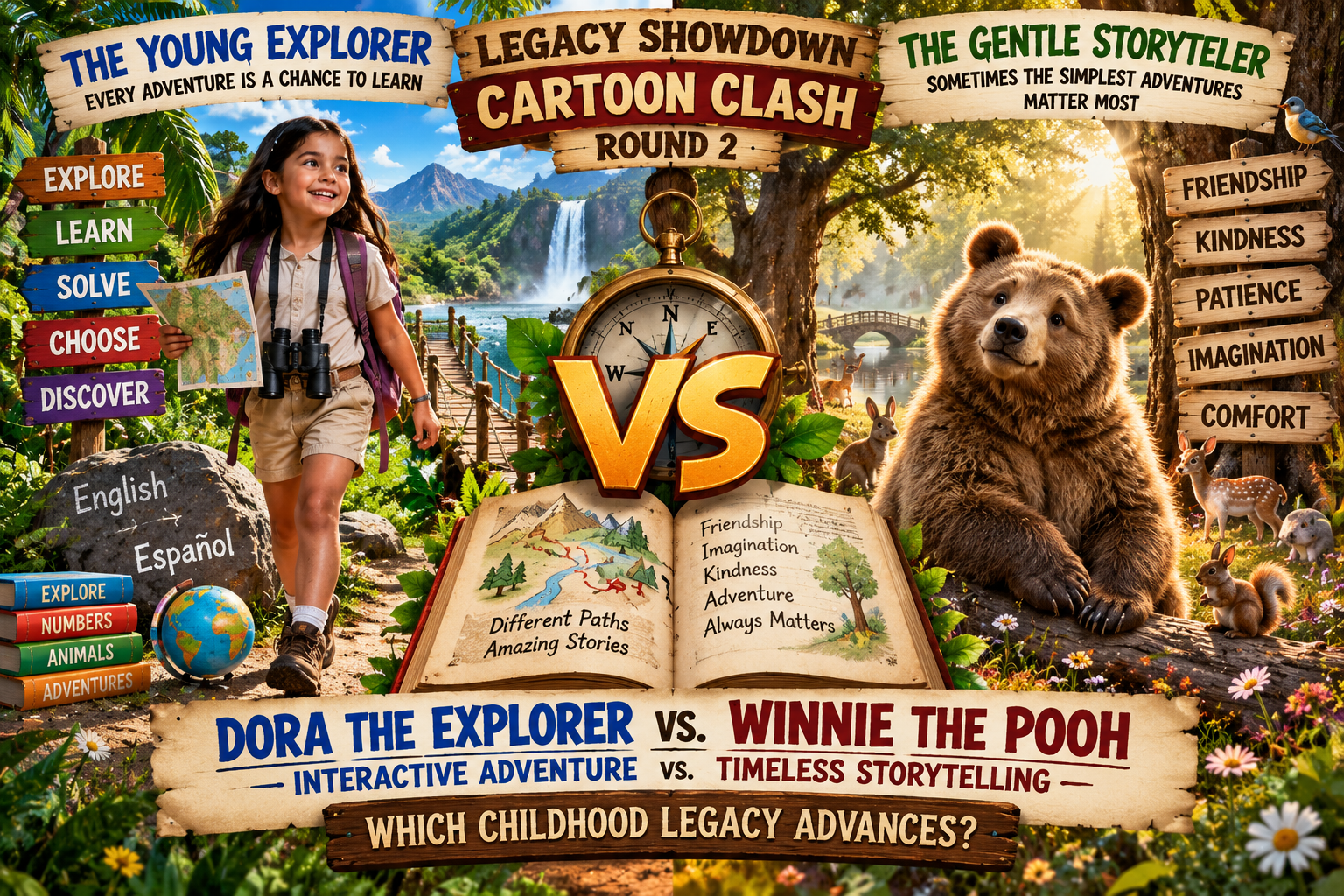
Round 2 of Legacy Showdown: Cartoon Clash brings together two characters whose greatest strengths come from reaching young audiences in very different ways. Dora the Explorer advanced from Round 1 by proving that educational influence, interactivity, and global recognition can compete directly with traditional cartoon comedy. Winnie the Pooh survived his own difficult opening matchup through warmth, character depth, creativity, and extraordinary longevity. Dora turns every adventure into an invitation for viewers to participate. She asks questions, solves problems, introduces Spanish vocabulary to English-speaking audiences, and treats the child watching at home as part of the journey. Pooh offers almost the opposite experience. His stories slow the audience down, allowing friendship, imagination, humor, mistakes, patience, and simple emotional truths to become the adventure. One character helped redefine interactive preschool television; the other became one of the most enduring symbols of childhood storytelling. Neither should receive an automatic advantage because of age, educational purpose, or franchise size. Across eight categories, Cartoon Clash must determine which character has built the stronger overall animated legacy.
Round 1: Animation Quality
Dora the Explorer developed a bright, clean visual style designed for immediate comprehension by young viewers. Characters, landmarks, paths, objects, and obstacles are presented clearly so children can follow the adventure and respond to Dora’s questions. The series also uses visual pauses, maps, transformations, and direct-to-viewer staging as functional parts of its educational structure. Its animation succeeds because clarity is more important than elaborate movement. Winnie the Pooh has benefited from a much wider range of animation craftsmanship across decades of Disney productions. The Hundred Acre Wood combines soft backgrounds, expressive character acting, gentle physical comedy, musical sequences, and storybook-inspired imagery that supports the warmth of the material. Pooh’s simple design can communicate confusion, contentment, worry, hunger, and affection through very small movements and expressions. Characters such as Tigger also allow for energetic animation that contrasts beautifully with Pooh’s slower physicality. Dora’s visuals are highly effective for their intended audience, but Pooh’s strongest animated productions demonstrate greater artistic range and character performance. Winner: Winnie the Pooh.
Round 2: Character Cast
Dora has a memorable group surrounding her. Boots is an enthusiastic and loyal companion, Backpack and Map transform useful objects into characters, Swiper creates recurring conflict, and family members and friends broaden Dora’s world. The cast works especially well because each character has a clear function that preschool viewers can quickly understand. Winnie the Pooh’s supporting ensemble is one of the great strengths of the entire franchise. Piglet brings anxiety and courage, Tigger brings explosive confidence, Eeyore contributes dry pessimism and vulnerability, Rabbit supplies organization and frustration, Owl offers long-winded certainty, Kanga provides warmth, Roo represents youthful curiosity, and Christopher Robin connects the group through friendship and imagination. These characters are not merely helpers in Pooh’s adventures; their contrasting personalities generate the stories themselves. Pooh can be paired with almost any member of the Hundred Acre Wood and create a different emotional or comic dynamic. Dora’s ensemble is effective and recognizable, but Pooh’s cast possesses greater personality depth, chemistry, and long-term individual popularity. Winner: Winnie the Pooh.
Round 3: Humor & Entertainment
Dora’s entertainment is built around participation. She asks the audience to identify objects, repeat words, choose routes, count, solve simple problems, and help stop Swiper. For preschool viewers, that structure can make watching feel like playing along with the story rather than passively observing it. Music, repetition, celebration, and adventure keep the educational format lively. Winnie the Pooh uses a quieter but remarkably durable form of entertainment. Humor comes from misunderstandings, Pooh’s literal thinking, his devotion to honey, Rabbit’s exasperation, Tigger’s enthusiasm, Eeyore’s gloomy observations, and the affectionate contradictions among friends. The stories can be funny without becoming frantic and emotional without becoming heavy. They also work for adults because the characters’ personalities and dialogue often contain gentle observations about human behavior. Dora is exceptionally engaging for her target age group, but Pooh’s combination of comedy, adventure, emotion, music, and multigenerational appeal gives him the broader entertainment range. Winner: Winnie the Pooh.
Round 4: Cultural Impact
Dora the Explorer made an enormous cultural impact, particularly in children’s television. Her direct interaction with viewers helped popularize a format in which preschool audiences were expected to answer, repeat, count, identify, and participate. The series also brought regular Spanish vocabulary and Latino representation into millions of homes, giving many children an early exposure to bilingual learning through mainstream entertainment. Dora became a global merchandising figure and expanded into games, books, live entertainment, adaptations, and later screen projects. Winnie the Pooh’s cultural footprint is even larger and considerably older. Pooh and the Hundred Acre Wood characters became international symbols of childhood, friendship, comfort, and gentle storytelling. Their images appear across books, animation, toys, clothing, nursery products, theme-park experiences, gifts, and generations of family traditions. Pooh’s phrases and personality are referenced far beyond the specific stories in which they originated. Dora changed preschool television in meaningful ways, but Pooh’s extraordinary cross-generational and international presence gives him the narrow cultural advantage. Winner: Winnie the Pooh.
Round 5: Iconic Episodes & Moments
Dora’s most recognizable moments are strongly tied to her recurring format. Viewers remember consulting Map, using Backpack, choosing routes, crossing obstacles, repeating Spanish words, celebrating successful journeys, and warning Swiper with a familiar repeated response. These routines became defining pieces of preschool television and created a shared viewing experience for a generation of children. Winnie the Pooh possesses a much deeper collection of individually memorable story moments. Pooh becoming stuck after eating too much honey, blustery adventures in the Hundred Acre Wood, Tigger’s bouncing, Eeyore repeatedly losing his tail, Piglet finding courage despite fear, and Pooh’s quiet exchanges with Christopher Robin have endured across books and animated adaptations. Many of these moments reveal character as much as plot, which allows them to remain emotionally meaningful long after childhood. Dora’s repeated interactive rituals are iconic, but Pooh’s catalog contains more distinct scenes and stories with lasting emotional recognition. Winner: Winnie the Pooh.
Round 6: Creativity & Originality
This is Dora’s strongest opportunity to take control of the matchup. Her series did not merely tell preschool adventures; it built audience participation into the structure of nearly every episode. Dora looks toward the viewer, asks for help, pauses for an answer, encourages repetition, uses Map to plan a route, and incorporates language learning and problem solving into the narrative. That approach helped make the television screen feel interactive before touchscreen children’s entertainment became commonplace. Winnie the Pooh is also creatively distinctive. The Hundred Acre Wood transforms ordinary childhood concerns into gentle adventures, and Pooh’s personality proves that a hero does not need exceptional intelligence, strength, or ambition to carry a story. His simplicity is itself unusual. However, much of Pooh’s core creative foundation originated in literature before animation, whereas Cartoon Clash is evaluating what the animated characters and productions contribute. Dora’s fusion of education, bilingual vocabulary, direct address, repetition, and interactive storytelling created a particularly distinctive television format. Winner: Dora the Explorer.
Round 7: Era Difficulty
Dora entered a crowded children’s television landscape in which preschool programming had to compete with established educational brands, cable channels, home video, and a rapidly expanding number of entertainment choices. Her creators also faced the difficult task of making learning objectives feel entertaining enough that children would willingly participate. The series succeeded so strongly that its interactive techniques became instantly recognizable. Winnie the Pooh faced a different challenge. Animated Pooh productions had to translate beloved literary characters into motion, voices, music, and visual comedy without losing the gentle tone that made the original world special. Over subsequent decades, Pooh also had to remain relevant while children’s entertainment moved through theatrical shorts, television, VHS and DVD, cable, digital media, and streaming. Both succeeded under meaningful pressure. Dora helped distinguish herself during a competitive era of educational television, but Pooh repeatedly crossed major changes in children’s media while preserving a remarkably consistent identity. That sustained adaptation gives Pooh the slight edge. Winner: Winnie the Pooh.
Round 8: Legacy Endurance
Dora has already demonstrated substantial endurance. Children who watched the original series are now adults, while the character has continued through reruns, streaming, merchandise, new adaptations, and franchise revivals. Her basic concept remains understandable because exploration, problem solving, language learning, and audience participation do not depend on one specific generation of technology. Winnie the Pooh operates on an even longer timeline. Animated versions of Pooh and his friends have remained prominent for generations through featurettes, television series, movies, home media, merchandise, theme parks, and streaming. Parents and grandparents can recognize the same central personalities that children encounter today. Pooh’s appeal also survives changing trends because his defining qualities – kindness, curiosity, loyalty, simplicity, and love of friends and honey – require little cultural translation. Dora has a strong multigenerational future and has already earned a lasting place in preschool history. Pooh, however, has demonstrated that endurance across a substantially longer period and remains one of the world’s most recognizable childhood characters. Winner: Winnie the Pooh.
Final Verdict
Dora the Explorer deserves considerably more respect in this matchup than the final score might suggest. Her victory in Creativity & Originality is significant because her interactive structure, bilingual learning elements, and direct relationship with preschool viewers helped reshape expectations for educational children’s television. She also makes Cultural Impact and Era Difficulty genuinely competitive. Winnie the Pooh nevertheless builds the stronger all-around Cartoon Clash résumé. He wins Animation Quality through greater artistic and performance range, Character Cast through the exceptional depth of the Hundred Acre Wood ensemble, and Humor & Entertainment through storytelling that works for children and adults alike. His cultural presence stretches across generations, his catalog contains more individually iconic story moments, and his ability to adapt through repeated changes in children’s media strengthens both Era Difficulty and Legacy Endurance. The matchup ultimately demonstrates the difference between innovation and total legacy. Dora introduced a highly influential way of engaging preschool audiences, but Pooh combines creative storytelling with emotional depth, ensemble strength, international recognition, and proven longevity on a scale that few children’s characters can match. Dora leaves Round 2 as one of the tournament’s most important educational characters. Pooh moves forward because his strengths cover nearly every dimension of the competition.
Final Result: Winnie the Pooh defeats Dora the Explorer 7-1 and advances to the next round of Legacy Showdown: Cartoon Clash. Dora earns a major victory in Creativity & Originality and exits with her influence on interactive preschool television firmly recognized.
Audience Challenge
Is 7-1 too wide a margin for a character as influential as Dora the Explorer? Should Dora also receive Cultural Impact or Era Difficulty because of her bilingual educational influence and role in reshaping interactive preschool television? Or does Winnie the Pooh’s extraordinary cast, emotional storytelling, worldwide recognition, and multigenerational endurance justify the decisive score? Cast your vote, defend your choice, and continue following Legacy Showdown: Cartoon Clash as Round 2 continues.