
MLB Region — Round 2
Affiliate Disclaimer
This blog may contain affiliate links or banner advertisements. If you click on one of these links or advertisements and make a purchase, The Shopping Plaza may earn a small commission at no additional cost to you. These commissions help support our work and allow us to continue creating free sports content, rankings, tournament features, and Legacy Showdown matchups like Gametime Gauntlet. We only recommend products, services, or merchandise that we believe may be of interest to our readers. Thank you for supporting The Shopping Plaza and Gametime Gauntlet.
Round 2 Begins
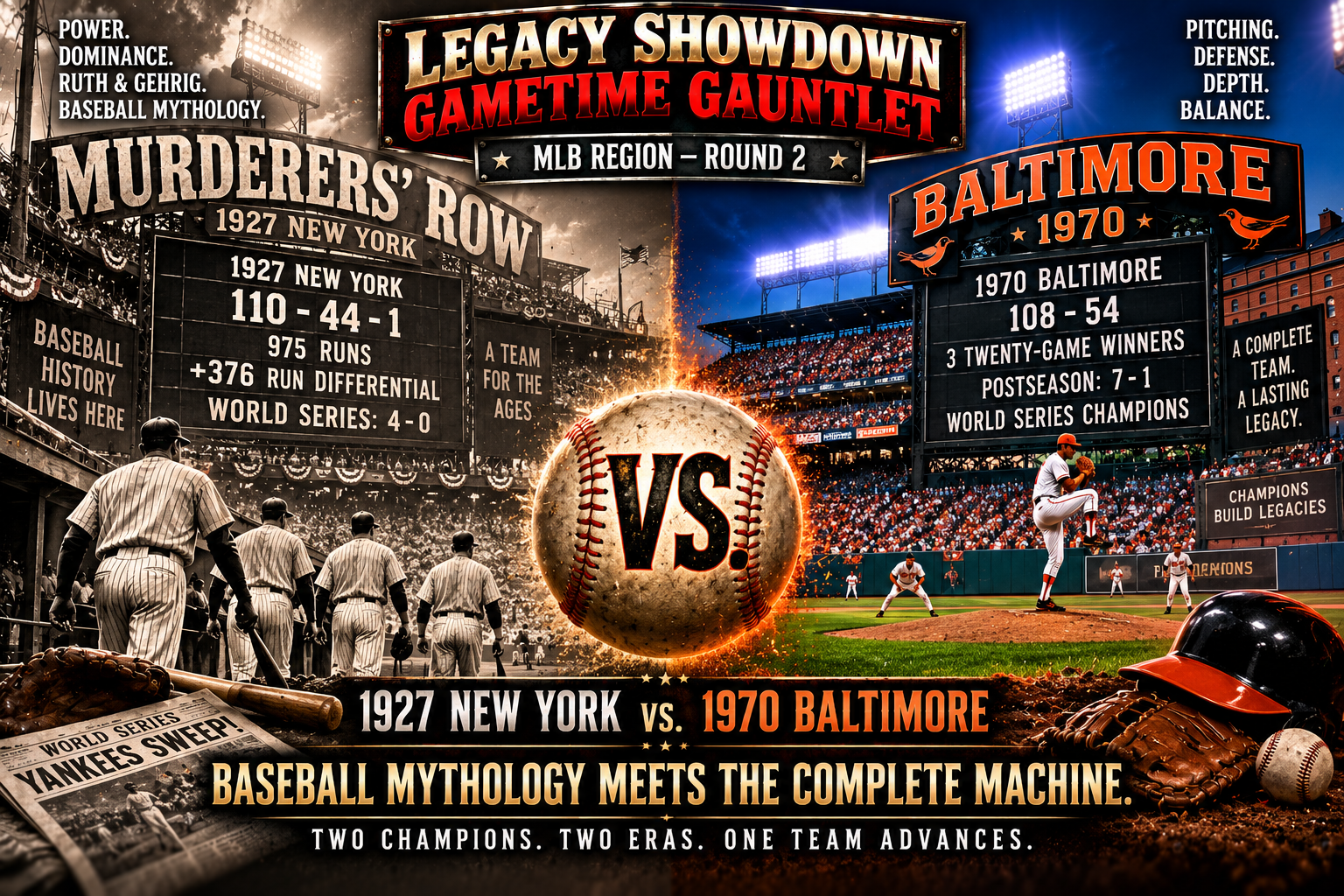
Gametime Gauntlet has reached Round 2, and the margin for survival is getting smaller. The opening matchup brings together two baseball champions that dominated their leagues in very different eras. The 1927 New York Yankees arrive as one of the most famous teams in sports history, powered by Babe Ruth, Lou Gehrig, Earle Combs, Tony Lazzeri, and a lineup immortalized as Murderers’ Row. New York finished 110–44–1, scored 975 runs while allowing only 599, won the American League by 19 games, and swept the Pittsburgh Pirates in the World Series.
The 1970 Baltimore Orioles counter with one of the most complete championship teams of the expansion era. Earl Weaver’s club went 108–54, won the AL East by 15 games, swept a 98-win Minnesota team in the ALCS, and defeated Cincinnati four games to one in the World Series. Boog Powell won the American League MVP, Brooks Robinson produced a legendary World Series and won Series MVP, and the rotation featured three 20-game winners in Jim Palmer, Mike Cuellar, and Dave McNally.
Round 2 demands more than reputation. Every category is judged independently and relative to each team’s own era. The Yankees bring unmatched mythology, historic offensive separation, and a World Series sweep. Baltimore brings greater roster balance, a deeper modern postseason path, elite defense, and one of baseball’s strongest pitching rotations. One legendary champion will advance; the other will see its Gametime Gauntlet run end here.
1. Dominance Over Competition
The Orioles were a powerhouse from April through October, winning 108 games and finishing 15 games ahead of second-place New York in the AL East. Baltimore also outscored opponents 792–574 and entered the postseason as the clear class of the American League. The 1927 Yankees were even more overwhelming relative to their league. New York went 110–44–1 for a .714 winning percentage, finished 19 games ahead of the Philadelphia Athletics, and outscored opponents by 376 runs. Their 975 runs were an extraordinary total, but the Yankees also allowed the fewest runs in the American League, demonstrating that Murderers’ Row was supported by excellent pitching. New York then swept the National League champion Pirates in four games. Baltimore’s dominance would win this category against many champions, but the Yankees created a larger regular-season separation while finishing the year without a postseason loss. The Round 2 opening point goes to New York.
Winner: 1927 New York Yankees
2. Championship Achievement
Baltimore’s championship run was exceptional. The Orioles swept the 98-win Minnesota Twins in three ALCS games and then defeated Cincinnati four games to one, finishing the postseason 7–1. That path required Baltimore to win an additional playoff round that did not exist in 1927, and the Orioles answered with almost complete control. New York’s championship was shorter but no less emphatic within the structure of its era. The Yankees won the American League by 19 games and then swept a 94-win Pittsburgh Pirates club in the World Series, never allowing the National League champion to extend the series. They won Games 1 and 4 by one run and Games 2 and 3 by comfortable margins, showing that they could survive close games as well as overwhelm opponents. Because both clubs were nearly perfect in October, the category comes down to how completely the championship validated the season that preceded it. New York’s 110-win pennant and four-game World Series sweep complete one of baseball’s cleanest championship résumés. Championship Achievement narrowly goes to the Yankees.
Winner: 1927 New York Yankees
3. Strength of Competition
The Yankees played in an eight-team American League and faced a strong Philadelphia Athletics club that won 91 games, but New York finished 19 games ahead of it. Pittsburgh won 94 games and the National League pennant, yet the Pirates were swept in the World Series. Baltimore operated in a larger, more structurally demanding major-league environment and had to survive an additional postseason round. The Orioles’ ALCS opponent, Minnesota, won 98 games and featured a powerful lineup led by Harmon Killebrew and Tony Oliva. Cincinnati won 102 games, scored more runs than any National League club, and represented an emerging version of the Big Red Machine. Baltimore went 7–1 against those two postseason opponents. The Yankees deserve credit for making strong competition look ordinary, but the Orioles faced more layers of high-level opposition on the road to the championship. Strength of Competition goes to Baltimore.
Winner: 1970 Baltimore Orioles
4. Star Power
Baltimore possessed extraordinary star talent. Boog Powell was the 1970 AL MVP, Brooks Robinson was already a defensive legend and became World Series MVP, Frank Robinson remained a dangerous middle-of-the-order force, and Jim Palmer anchored a rotation filled with 20-game winners. Paul Blair and Davey Johnson added Gold Glove-level defensive value, making the Orioles much more than a collection of a few famous names. The Yankees, however, featured two offensive giants at or near the peak of their powers. Babe Ruth hit 60 home runs, setting a single-season major-league record that stood for 34 years, while Lou Gehrig hit .373 with 47 home runs and 175 RBI and won the American League MVP award. Earle Combs hit .356 and collected 231 hits, while Tony Lazzeri drove in 102 runs. Waite Hoyt led the pitching staff with 22 victories. Baltimore’s star group is deeper across positions, but Ruth and Gehrig give the 1927 Yankees a level of peak historical star power that is almost impossible to match. New York takes the category.
Winner: 1927 New York Yankees
5. Depth and Supporting Cast
The Yankees were far deeper than the Ruth-and-Gehrig shorthand suggests. Combs, Lazzeri, Bob Meusel, Joe Dugan, Mark Koenig, and a strong pitching staff made New York capable of beating opponents in numerous ways. Hoyt, Herb Pennock, Urban Shocker, and Wilcy Moore gave manager Miller Huggins dependable pitching behind the famous offense. Baltimore’s roster, however, is one of the strongest examples of complete championship construction. The Orioles could build offense around Powell and Frank Robinson, defend at an elite level with Brooks Robinson, Blair, and Johnson, and hand the ball to Palmer, Cuellar, or McNally in a major game. All three of those starters won at least 20 games, while the lineup featured useful production throughout rather than a dependence on one or two hitters. Earl Weaver also had enough roster flexibility to maximize platoons, power, defense, and pitching matchups. New York had excellent support around its superstars, but Baltimore’s balance from the top of the rotation through the defense and everyday lineup gives the Orioles the edge in Depth and Supporting Cast.
Winner: 1970 Baltimore Orioles
6. Historical Impact
The 1970 Orioles occupy an important place in baseball history. They were the middle pennant winner in Baltimore’s run of three consecutive American League championships from 1969 through 1971, and their World Series victory helped define the Orioles as one of the model organizations of the era. Brooks Robinson’s defensive performance against Cincinnati became one of the most celebrated individual World Series displays ever seen. The 1927 Yankees, however, transcended their own season. Murderers’ Row became a permanent phrase in American sports culture, Babe Ruth’s 60 home runs became one of baseball’s defining records, and the Ruth-Gehrig pairing helped turn the Yankees into the sport’s most recognizable dynasty. The team became a reference point against which later champions were measured for generations. Even people far removed from the 1920s still encounter the 1927 Yankees in discussions of the greatest teams ever assembled. Baltimore helped define an organizational golden age; New York helped define the mythology of Major League Baseball itself. Historical Impact goes decisively to the Yankees.
Winner: 1927 New York Yankees
7. Statistical Excellence
Baltimore’s numbers are outstanding. The Orioles won 108 games, scored 792 runs, allowed 574, and received 20-win seasons from Palmer, Cuellar, and McNally. Powell supplied MVP-level power, Frank Robinson hit .306, and the defense converted run prevention into a complete team strength. New York’s statistical separation from its competition is even more extreme. The Yankees won 110 games in a 154-game schedule, posted a .714 winning percentage, scored 975 runs, and allowed 599 for a run differential of +376. Ruth’s 60 home runs and Gehrig’s 175 RBI were historic individual totals, while Combs led the club with 231 hits. The pitching staff led the American League in several major run-prevention measures despite the lineup receiving most of the attention. Cross-era raw totals must be treated carefully, but Gametime Gauntlet judges teams relative to their own environments, and the Yankees towered over the 1927 American League statistically. Statistical Excellence goes to New York.
Winner: 1927 New York Yankees
8. Longevity of Greatness
The Orioles have an excellent dynasty argument. Baltimore won the American League pennant in 1969, 1970, and 1971, posting 109, 108, and 101 regular-season victories, and the broader core had already won the 1966 World Series. Palmer, Brooks Robinson, Frank Robinson, Powell, and other contributors helped sustain one of baseball’s strongest multi-year organizations. The 1927 Yankees were also situated inside an extended championship window. New York won the American League pennant in 1926, 1927, and 1928, captured back-to-back World Series championships in 1927 and 1928, and remained a major force as Ruth and Gehrig continued to anchor the lineup. The Yankees returned to the championship summit again in 1932, with Ruth and Gehrig still central figures. Baltimore’s three straight pennants make this one of the closest categories in the matchup. But the 1927 club sits inside the formative stretch of a Yankees dynasty whose championship identity extended beyond a single three-year run. By the narrowest margin, Longevity of Greatness goes to New York.
Winner: 1927 New York Yankees
9. Clutch Performance
The Yankees were perfect in the 1927 World Series, and two of their four victories were decided by one run. Game 4 ended 4–3, demonstrating that New York could win when its famous offense did not simply bury an opponent. Baltimore’s postseason provides a larger sample of high-pressure moments. The Orioles swept Minnesota, then opened the World Series with consecutive one-run victories in Cincinnati, 4–3 and 6–5. Those road wins immediately placed the 102-win Reds in a deep series hole. Brooks Robinson repeatedly changed innings with his glove while also batting .429 in the Series, and Baltimore answered its lone postseason defeat by winning the clinching Game 5 by a comfortable 9–3 score. The Orioles’ 7–1 postseason combined close-game execution, road success, elite defense, and a decisive response when Cincinnati finally won a game. New York never blinked in October, but Baltimore faced more postseason pressure points and consistently delivered. Clutch Performance goes to the Orioles.
Winner: 1970 Baltimore Orioles
10. Legacy Endurance
The 1970 Orioles remain one of the greatest teams in franchise history and a centerpiece of Earl Weaver’s championship era. Their 108 wins, three 20-game pitchers, Powell’s MVP season, and Brooks Robinson’s World Series performance ensure that the club will always command respect in serious baseball history discussions. The 1927 Yankees occupy an even rarer historical position. Nearly a century later, they remain shorthand for overwhelming baseball greatness. Murderers’ Row, Ruth’s 60 home runs, Gehrig’s MVP season, 110 victories, a 19-game pennant margin, and a World Series sweep create a collection of achievements that has survived multiple transformations of the sport. Later teams have won more games or produced different statistical records, yet the 1927 Yankees continue to appear near the beginning of greatest-team debates. Their legacy is not dependent on nostalgia alone; their dominance relative to their era supports the mythology. Baltimore’s reputation has endured for more than half a century, but New York’s has become part of the permanent language of baseball greatness. Legacy Endurance belongs to the Yankees.
Winner: 1927 New York Yankees
Round 2 Scorecard
- Dominance Over Competition: 1927 New York Yankees
- Championship Achievement: 1927 New York Yankees
- Strength of Competition: 1970 Baltimore Orioles
- Star Power: 1927 New York Yankees
- Depth and Supporting Cast: 1970 Baltimore Orioles
- Historical Impact: 1927 New York Yankees
- Statistical Excellence: 1927 New York Yankees
- Longevity of Greatness: 1927 New York Yankees
- Clutch Performance: 1970 Baltimore Orioles
- Legacy Endurance: 1927 New York Yankees
FINAL SCORE: 1927 New York Yankees 7 — 1970 Baltimore Orioles 3
Final Verdict
The 7–3 score does not mean Baltimore was overmatched. The 1970 Orioles make one of the strongest losing cases in Gametime Gauntlet so far. They won 108 games, possessed three 20-game starting pitchers, featured the American League MVP and the World Series MVP, swept a 98-win opponent in the ALCS, and went 7–1 in the postseason. Their victories in Strength of Competition, Depth and Supporting Cast, and Clutch Performance reflect genuine advantages rather than consolation points.
New York advances because the 1927 Yankees combine statistical separation, championship perfection, historic star power, and cultural endurance at a level that few teams in any sport can equal. Their 110–44 record came in a shorter schedule, their +376 run differential reflected superiority on both sides of the ball, and their 19-game pennant margin left little uncertainty about the best team in the American League. Ruth and Gehrig supplied two of the most extraordinary offensive seasons of their generation, but the Yankees were also deep enough in the lineup and strong enough on the mound to avoid being a two-man team.
Round 2 raises the standard, and Baltimore forces the Yankees to prove that their legend is supported by more than famous names. It is. The Orioles are the more balanced modern roster and faced the more layered postseason path, but the Yankees own too many categories tied to peak dominance, statistical separation, historical influence, and enduring legacy. Murderers’ Row survives a serious challenge and moves one step closer to the Gametime Gauntlet championship.
Final Result: 1927 New York Yankees advance to the next round by a score of 7–3.
Audience Challenge
Did the 1927 Yankees deserve the 7–3 victory, or should Baltimore’s deeper postseason path and complete pitching staff have earned another category? Would three 20-game Orioles starters have been enough to contain Ruth, Gehrig, Combs, and the rest of Murderers’ Row over a championship series? And when comparing teams separated by more than four decades, should the Yankees’ enormous dominance relative to 1927 outweigh the greater depth of competition and postseason structure that Baltimore faced in 1970?