
Affiliate Disclaimer
This blog may contain affiliate links or banner advertisements. If you click one of these links or advertisements and make a purchase, The Shopping Plaza may earn a small commission at no additional cost to you. These commissions help support The Shopping Plaza and allow us to continue creating free entertainment, sports, shopping, and lifestyle content. Thank you for supporting The Shopping Plaza.
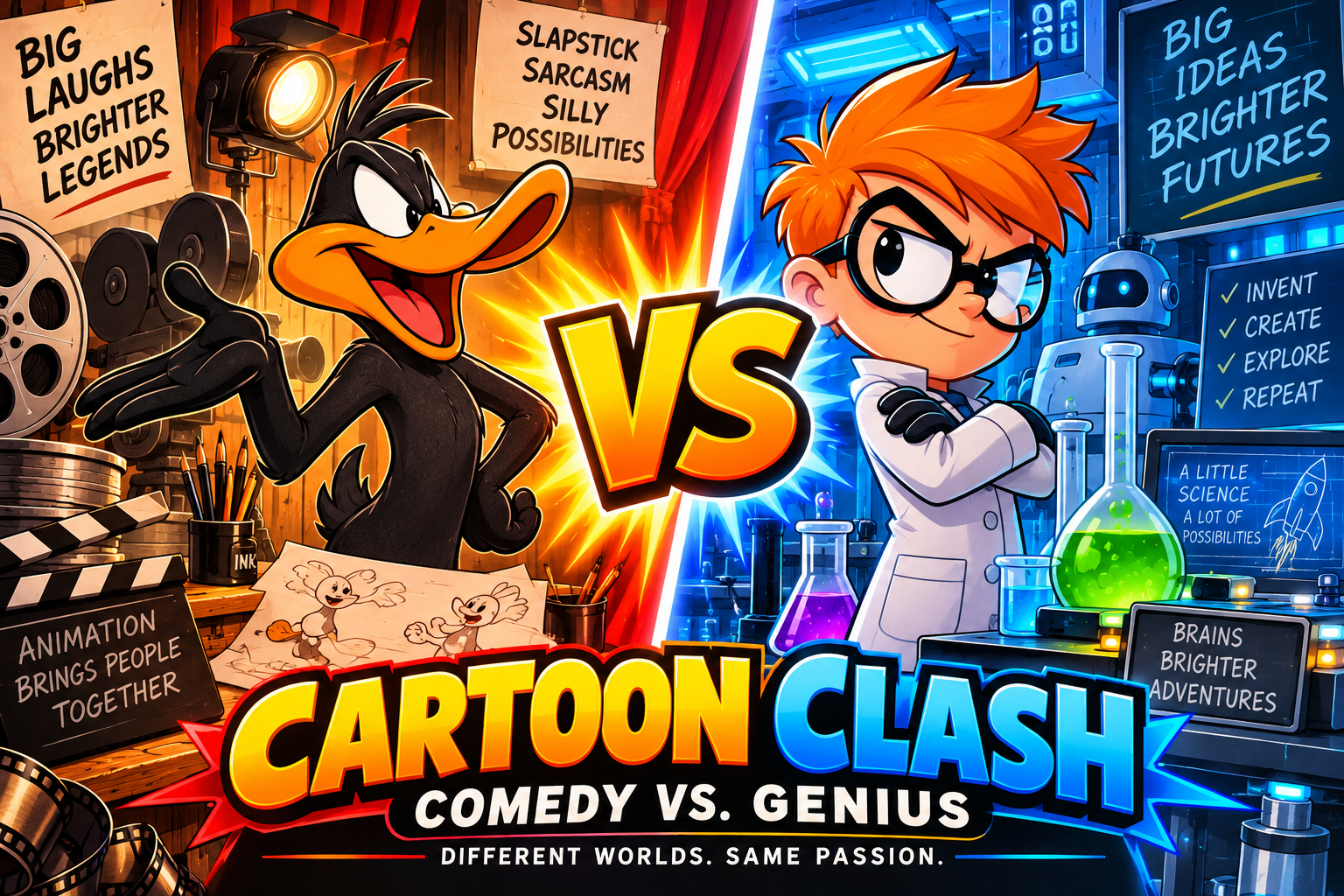
Daffy Duck vs. Dexter
The next first-round battle in Region B delivers one of the most entertaining clashes in the entire Cartoon Clash tournament. The #7 seed Daffy Duck enters as one of animation’s greatest comedic personalities, while the #10 seed Dexter represents one of Cartoon Network’s defining stars from the late 1990s.
This matchup pits classic cartoon chaos against scientific genius. Daffy built his reputation through outrageous comedy, enormous confidence, jealousy, ambition, and spectacular failures, while Dexter became famous for his hidden laboratory, impossible inventions, secret experiments, and constant frustration with his sister Dee Dee.
The two characters also represent very different periods of animation history. Daffy emerged from theatrical cartoons during the Golden Age of American animation, while Dexter helped establish the identity of Cartoon Network’s original-programming era.
Both are driven by oversized personalities. Daffy desperately wants recognition and frequently creates his own disasters while chasing it, whereas Dexter wants control over his experiments and repeatedly discovers that genius cannot eliminate chaos.
That similarity creates a surprisingly strong thematic connection. Each character believes he understands the situation better than everyone around him, and each is frequently humbled by circumstances he cannot completely control.
Cartoon Clash will judge them across eight categories: Animation Quality, Character Cast, Humor & Entertainment, Cultural Impact, Iconic Episodes & Moments, Creativity & Originality, Era Difficulty, and Legacy Endurance. Dexter has the tools to make this competitive, but defeating Daffy’s decades of animation history will require a major upset.
Round 1: Animation Quality
Dexter’s Laboratory featured vibrant colors, bold shapes, imaginative machinery, exaggerated expressions, and a distinctive visual language that immediately separated it from many other television cartoons of its period. The laboratory itself gave artists nearly unlimited opportunities to invent robots, control panels, weapons, portals, vehicles, and strange scientific environments.
The show’s design was intentionally stylized rather than realistic. Dexter’s compact proportions, Dee Dee’s long limbs, and the geometric environments made the characters easy to recognize while giving animators room for extreme poses and visual comedy.
The series also benefited from the creative energy surrounding Cartoon Network’s original-programming expansion. Its visual identity helped demonstrate that television cartoons could develop strong auteur-driven styles rather than looking interchangeable.
Daffy Duck’s strongest animation, however, came from theatrical shorts created when major studios invested heavily in hand-drawn cartoon production. His elastic body language, explosive reactions, facial expressions, and physical transformations could become part of the joke itself.
Still, this tournament’s original scoring gives Dexter the advantage because his series combined a cohesive modern television style with imaginative technological design and visual experimentation that became central to the show’s identity.
Winner: Dexter.
Round 2: Character Cast
Dexter has a compact but memorable supporting cast. Dee Dee is the perfect disruptive force because her carefree personality collides directly with Dexter’s obsession with order, secrecy, and scientific control.
Mandark gives Dexter an intellectual rival capable of challenging his ego and technological superiority. Mom and Dad add another layer of comedy because Dexter’s extraordinary hidden life exists beneath an otherwise ordinary family environment.
Recurring characters and one-off experiments allow the series to expand beyond the family whenever the story requires it. Even so, most of the show’s strongest relationships ultimately orbit Dexter’s home, laboratory, school life, and scientific rivalries.
Daffy operates within the much larger Looney Tunes universe. Bugs Bunny, Porky Pig, Elmer Fudd, Yosemite Sam, Marvin the Martian, Tweety, Sylvester, Foghorn Leghorn, and many others form one of animation’s most recognizable collections of characters.
Daffy also changes depending on who shares the screen with him. His relationship with Porky can differ dramatically from his rivalry with Bugs, and that flexibility gives writers numerous ways to use his insecurity, ego, impatience, and comic desperation.
Dexter’s supporting cast is excellent for the needs of his series, but Daffy’s surrounding universe offers greater historical depth, variety, and character chemistry.
Winner: Daffy Duck.
Round 3: Humor & Entertainment
Few animated characters have built a longer reputation for comedy than Daffy Duck. His humor can come from confidence, greed, jealousy, theatricality, panic, physical pain, verbal outbursts, or the widening gap between how important he thinks he is and how the world actually treats him.
Daffy’s exaggerated reactions are especially valuable because even a simple frustration can escalate into a complete comic meltdown. His willingness to embarrass himself gives animators and writers enormous freedom.
He can function as a wild agent of chaos, an ambitious performer, a frustrated rival, an unlucky victim, or an antagonist who accidentally makes the audience sympathize with him. That versatility allows different eras to emphasize different parts of his personality.
Dexter is also extremely funny. Much of his comedy comes from the contrast between his intellectual confidence and the fact that Dee Dee, family life, or his own inventions can destroy his carefully constructed plans in seconds.
The laboratory setting provides excellent opportunities for visual gags and absurd escalation, but Daffy’s comic range stretches across more decades, formats, creative teams, and styles of storytelling.
Under this category, Daffy’s ability to remain funny through slapstick, dialogue, rivalry, self-sabotage, and personality-driven comedy gives him the advantage.
Winner: Daffy Duck.
Round 4: Cultural Impact
Dexter’s Laboratory occupies an important place in Cartoon Network history. It became one of the network’s signature original series and helped demonstrate the potential of creator-driven animated programming on a channel that was building its own identity.
Dexter became a recognizable figure for viewers who grew up during the late 1990s and early 2000s. The show’s secret-laboratory premise, Dexter’s distinctive speech, Dee Dee’s interruptions, and the rivalry with Mandark became familiar parts of that generation’s cartoon culture.
The series also belongs to a broader creative wave that helped make Cartoon Network an important destination for original animation. Its success helped create an environment in which additional original series could find large audiences.
Daffy’s cultural footprint extends much farther back. He became a major personality within Looney Tunes, appeared across theatrical shorts, television packages, films, merchandise, advertising, comics, games, and later animated productions.
His rivalry with Bugs Bunny became one of animation’s defining comic relationships, while his personality evolved enough to remain useful to different generations of writers. Daffy is recognizable not merely as a character from one program but as part of a globally familiar animation tradition.
Dexter helped define an important network era, but Daffy’s influence spans generations of popular culture and a much longer portion of animation history.
Winner: Daffy Duck.
Round 5: Iconic Episodes & Moments
Dexter’s Laboratory generated memorable stories from an exceptionally flexible premise. Every invention could become the beginning of a new problem, allowing episodes to involve robots, dimensional experiments, rival geniuses, monsters, transformations, school problems, and Dee Dee accidentally interfering with technology.
The recurring conflict between Dexter and Dee Dee produced many of the show’s most recognizable situations. Viewers knew that Dexter could build something impossibly advanced and still be powerless to prevent his sister from entering the laboratory at exactly the wrong moment.
Mandark episodes added another memorable dimension by forcing Dexter to compete with someone who could challenge him intellectually. The show’s experimental segments and stylistic detours also helped make its catalog distinctive.
Daffy, however, has a body of classic material stretching across decades. His appearances in famous Looney Tunes shorts gave audiences enduring images of rivalry, frustration, performance, and comic destruction.
His battles with Bugs, his partnerships with Porky, and his starring roles in genre parodies allowed Daffy to occupy radically different scenarios while remaining unmistakably himself. Individual sequences and expressions have continued circulating through television, home video, streaming, clips, memes, and popular references.
Dexter owns many beloved episodes, but Daffy’s catalog contains a larger collection of moments that have survived across multiple generations of animation audiences.
Winner: Daffy Duck.
Round 6: Creativity & Originality
A child genius secretly operating an enormous advanced laboratory beneath an ordinary family home remains an exceptionally strong animated premise. The concept immediately creates a comic contradiction: Dexter can manipulate extraordinary technology, yet he still has to deal with parents, school, sibling frustration, and childhood limitations.
The laboratory functions as an almost unlimited storytelling engine. A single invention can send Dexter into space, alter reality, create a monster, trigger a rivalry, shrink someone, enlarge something, or produce consequences he never expected.
Dee Dee makes the premise even stronger because she introduces unpredictable human chaos into a world Dexter wants to control scientifically. Mandark adds the possibility of technological competition, while Dexter’s parents keep the extraordinary premise connected to mundane family comedy.
Daffy Duck is an extraordinary character, but his earliest identity developed within the broader tradition of wild theatrical cartoon personalities. His originality comes heavily from performance, personality evolution, and the specific ways writers and animators used him rather than from one singular high-concept premise.
Dexter’s combination of childhood, secrecy, scientific fantasy, sibling comedy, and futuristic invention gave the series a remarkably expandable foundation. It could parody science fiction one week and tell a family comedy the next without abandoning its central idea.
For the tournament’s Creativity & Originality category, Dexter’s core concept earns the point.
Winner: Dexter.
Round 7: Era Difficulty
Dexter emerged during an unusually competitive period in American television animation. By the late 1990s, young viewers had access to established broadcast cartoons, cable networks, syndicated programming, anime imports, and a rapidly growing collection of original animated series.
Cartoon Network itself was developing multiple distinctive properties, meaning Dexter had to stand out even among other ambitious programs sharing the same channel. Building a recognizable identity in that environment was a significant accomplishment.
The series succeeded because its concept and visual style were immediately understandable. Dexter’s personality, Dee Dee’s disruptive energy, the secret laboratory, and the scientific adventures gave the show an identity that could survive in a crowded field.
Daffy faced an earlier but equally formidable competitive environment: the Golden Age of theatrical animation. Cartoon shorts competed for movie audiences while studios employed exceptionally talented directors, writers, animators, composers, voice performers, and artists.
Characters had only minutes to make an impression, and studios were producing memorable competitors across multiple banners. Daffy not only survived this environment but became one of the defining personalities of the Looney Tunes roster.
Dexter’s era deserves substantial credit, but Daffy’s rise during one of the most creatively competitive periods in American animation gives him the edge.
Winner: Daffy Duck.
Round 8: Legacy Endurance
Dexter remains fondly remembered by viewers who grew up with Cartoon Network’s early original programming. The character continues to represent an important chapter in the network’s development and in the broader history of late-1990s television animation.
The show’s visual style and premise remain distinctive enough that fans can recognize Dexter, Dee Dee, Mandark, and the laboratory years after the original run. Nostalgia has helped keep discussion of the series alive among animation fans.
That is a meaningful legacy, especially in a medium where many once-popular programs gradually disappear from public conversation. Dexter’s Laboratory has retained a place in discussions about influential Cartoon Network originals.
Daffy’s endurance, however, operates on a much larger historical scale. The character has survived enormous changes in entertainment technology, audience habits, animation styles, distribution methods, and cultural tastes.
He has moved from theatrical shorts to television reruns, compilation programs, feature films, merchandise, streaming libraries, games, and new animated interpretations. Each generation has had opportunities to encounter some version of Daffy.
Dexter has already shown strong staying power, but Daffy’s multigenerational visibility and continuing adaptability make this category decisive.
Winner: Daffy Duck.
Final Verdict
Dexter made this matchup competitive by winning two categories that fit his greatest strengths: Animation Quality and Creativity & Originality. Those victories recognize the distinctive visual identity and remarkably flexible concept that helped make Dexter’s Laboratory one of Cartoon Network’s defining original programs.
Daffy Duck claimed the remaining six rounds: Character Cast, Humor & Entertainment, Cultural Impact, Iconic Episodes & Moments, Era Difficulty, and Legacy Endurance. His advantage came from the sheer breadth of a career that has crossed generations of animation.
The 6-2 score should not be interpreted as a dismissal of Dexter. A #10 seed taking two categories from a character with Daffy’s history demonstrates how strong Dexter’s concept and artistic identity remain.
The matchup also illustrates one of Cartoon Clash’s central challenges. A later television character may benefit from a focused series, modern production possibilities, and a highly developed concept, while a Golden Age character can bring decades of cultural history and an enormous supporting universe.
Dexter’s greatest argument is that originality should matter enormously in animation. His hidden laboratory created storytelling possibilities that helped distinguish him from the crowded cartoon field of his era.
Daffy’s response is longevity combined with versatility. He has succeeded as a chaotic comedian, jealous rival, desperate performer, adventure hero, sidekick, antagonist, and self-defeating egotist without losing the personality that makes him recognizable.
Under the established eight-category system, that broader résumé produces the stronger overall performance.
Final Result: Daffy Duck advances to the second round with a 6-2 category victory. Dexter exits the tournament after a strong showing worthy of one of animation’s smartest and most inventive underdogs.
Audience Challenge
Now it is your turn to judge the matchup. Should Dexter’s scientific creativity and distinctive visual world have earned him another category?
Could an argument be made that the late-1990s animation boom was every bit as difficult to conquer as the Golden Age environment Daffy faced? Or does Daffy’s extraordinary longevity make the historical comparison too difficult for Dexter to overcome?
Consider how much weight you place on originality compared with cultural impact. Dexter may have the more tightly defined high-concept premise, while Daffy has accumulated decades of iconic performances and relationships.
Also consider whether a character should receive extra credit for remaining adaptable. Daffy’s personality has changed across eras, yet the core comic energy has remained recognizable.
Cartoon Clash is designed to make those disagreements part of the fun. The official bracket records the category result, but fans are free to value the criteria differently.
Cast your vote, defend your pick, and continue following Legacy Showdown: Cartoon Clash as Region B moves toward its next first-round battle.