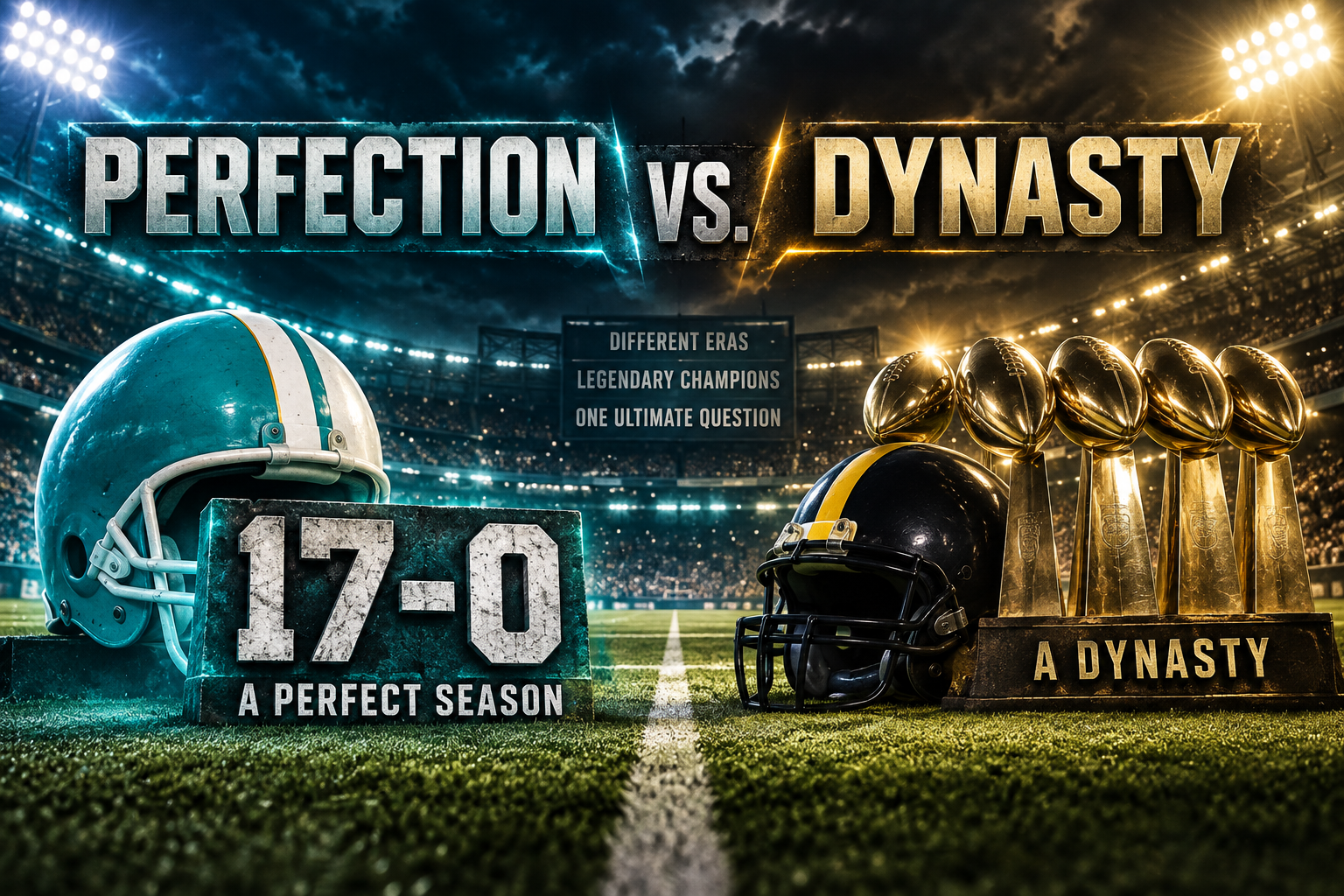

Perfection vs. dynasty: the NFL’s only undefeated champion meets the Steel Curtain at full force.
Affiliate Disclaimer
This blog may contain affiliate links or banner advertisements. If you click on one of these links or advertisements and make a purchase, The Shopping Plaza may earn a small commission at no additional cost to you. These commissions help support our work and allow us to continue creating free sports content, rankings, tournament features, and Legacy Showdown matchups like Gametime Gauntlet. We only recommend products, services, or merchandise that we believe may be of interest to our readers. Thank you for supporting The Shopping Plaza and Gametime Gauntlet.
The Matchup
The second matchup of the NFL Region Second Round is the kind of collision Gametime Gauntlet was built to produce. The #2 seed 1972 Miami Dolphins arrive with an achievement no other Super Bowl-era champion has duplicated: a perfect season. Miami went 17-0, survived every challenge placed in front of it, and finished the journey by winning Super Bowl VII. That flawless record has made the Dolphins a permanent measuring stick whenever an NFL team begins threatening an undefeated season.
The #6 seed 1978 Pittsburgh Steelers counter with the peak force of one of professional football’s defining dynasties. Pittsburgh combined a feared defense with an increasingly explosive offense and a roster filled with players whose names became synonymous with championship football. The Steelers captured their third Super Bowl in five seasons in 1978 and would ultimately make the larger dynasty even more imposing. This matchup therefore asks a fascinating historical question: should one unmatched perfect season outweigh the deeper star power, roster depth, and sustained championship greatness of the Steel Curtain era?
As always, Gametime Gauntlet does not ask which team would literally win a game under one era’s rules. Each club is judged relative to its own time across the same ten categories. With two legendary champions this close, every point carries enormous weight.
- Dominance Over Competition
There is no cleaner expression of season-long dominance than finishing without a loss. Miami’s 17-0 record means every opponent, every difficult week, every postseason test, and the Super Bowl itself ended with the Dolphins still standing. Perfection does not require a team to win every game by a massive margin; it requires the ability to solve every kind of challenge without allowing one bad afternoon to become a defeat. That consistency is what separates the 1972 Dolphins from virtually every other championship team in NFL history. The 1978 Steelers were a powerhouse and possessed advantages that would win several categories in this matchup, but even they experienced losses during their championship season. Miami’s record leaves no blemish to explain away. In a category built specifically around controlling competition, the only perfect champion earns the edge.
Winner: 1972 Miami Dolphins
- Championship Achievement
Both teams finished their seasons by lifting the Lombardi Trophy, so neither side can claim an advantage simply for becoming champion. Pittsburgh’s 1978 title carried enormous weight because it reinforced a dynasty and added another championship to a remarkable run. Miami’s title, however, completed something rarer: an undefeated championship season. The Dolphins could not afford a single slip if they wanted perfection to survive, and they carried that burden all the way through Super Bowl VII. Championship Achievement rewards the ultimate result, but it also considers what made that result historically distinctive. Pittsburgh’s dynasty is stronger when multiple seasons are considered, yet the 1972 Dolphins produced a one-season championship achievement that still stands alone. Perfection gives Miami the point.
Winner: 1972 Miami Dolphins
- Strength of Competition
Pittsburgh earns its first category by the quality and difficulty of the championship environment surrounding the 1978 team. The Steelers were competing in an era filled with physical, talented clubs and established contenders capable of turning postseason football into a weekly test of survival. By this point, Pittsburgh was no surprise; opponents understood the Steel Curtain identity and treated the Steelers as a championship standard to be knocked off. Repeating success under those circumstances is especially difficult because every rival is preparing for the defending power rather than overlooking an emerging team. Miami’s perfect season deserves enormous respect, but the source matchup gives Pittsburgh the advantage for repeatedly overcoming championship-caliber competition during one of the NFL’s most demanding periods. The Steelers’ route existed inside a broader dynasty in which elite opponents had multiple opportunities to adjust to them. Pittsburgh takes Strength of Competition.
Winner: 1978 Pittsburgh Steelers
- Star Power
Few championship rosters can match the collection of legendary names associated with the 1978 Steelers. Terry Bradshaw commanded the offense, Franco Harris gave Pittsburgh a championship-caliber running presence, and Lynn Swann and John Stallworth supplied dangerous receiving weapons. On defense, Mean Joe Greene, Jack Lambert, and Mel Blount helped define the intimidating identity of the Steel Curtain. The remarkable part is not simply that Pittsburgh had famous players; elite talent was distributed across offense and defense. Miami had outstanding players and Hall of Fame-level greatness of its own, but the concentration of iconic Steelers on one roster is difficult to overcome in a category devoted to star power. Several of those Pittsburgh names remain shorthand for excellence at their positions and for the dynasty itself. The Steelers take this category convincingly.
Winner: 1978 Pittsburgh Steelers
- Depth and Supporting Cast
Pittsburgh’s advantage extends beyond the biggest names on the roster. A dynasty cannot win repeatedly through stars alone; it needs quality throughout the lineup, dependable specialists, coaching, and players capable of maintaining the standard when attention is focused elsewhere. The 1978 Steelers possessed championship strength on both sides of the football, allowing the team to survive games in different ways. Their defense could dictate contests, while the offense had enough variety to punish opponents who focused too heavily on one weapon. Miami’s 1972 team was exceptionally balanced as well, and no perfect season happens without outstanding depth. Still, the source matchup awards Pittsburgh the edge because the Steelers’ roster was loaded from top to bottom during the peak of a multi-title dynasty. When star power and supporting quality are separated into two categories, Pittsburgh proves that its greatness ran deeper than the Hall of Fame headlines.
Winner: 1978 Pittsburgh Steelers
- Historical Impact
The 1972 Dolphins own an achievement that has become part of the language of every NFL season. Whenever an undefeated team advances deep into a schedule, Miami’s perfect champions immediately return to the conversation. That recurring comparison gives the 1972 team an unusual form of historical immortality: modern contenders are measured against them before they have even finished their own seasons. Pittsburgh’s Steel Curtain dynasty had enormous influence on the image of championship football, defensive toughness, and the identity of the Steelers franchise. Yet Miami’s 17-0 season occupies a singular space because it represents a standard the rest of the league has spent more than half a century trying to match. The accomplishment transcends the Dolphins fan base and functions as an NFL-wide benchmark. Historical Impact therefore goes to Miami.
Winner: 1972 Miami Dolphins
- Statistical Excellence
Pittsburgh’s 1978 team was excellent across the roster and could make a strong statistical argument through its balance of offense and defense. But Gametime Gauntlet ultimately has to account for the most important number attached to Miami’s season: zero losses. A perfect record is not a complete statistical analysis by itself, yet it summarizes an extraordinary level of weekly consistency. Miami found enough offense, defense, special-teams execution, and situational football to make sure every final score favored the Dolphins. That record also survived the transition from the regular season to the playoffs, where the margin for error becomes even smaller. Pittsburgh may have been more overwhelming in particular phases, but Miami’s total season produced the cleanest possible win-loss result. Under the source matchup’s judgment, the unmatched statistical finality of 17-0 earns the Dolphins the category.
Winner: 1972 Miami Dolphins
- Longevity of Greatness
This is the category where Pittsburgh’s dynasty becomes impossible to ignore. The 1978 championship was not a magnificent season standing by itself; it was part of a run in which the Steelers captured four Super Bowls in six seasons. That sustained success required the organization to survive injuries, changing opponents, increasing expectations, and the natural difficulty of keeping a championship roster together. Miami’s perfect season remains the more singular accomplishment, and the Dolphins of the early 1970s were themselves an elite championship force. But Longevity of Greatness asks whether excellence remained at the highest level across multiple seasons, and Pittsburgh’s dynasty provides one of the strongest answers in NFL history. The Steelers repeatedly returned to the sport’s biggest stage and repeatedly finished as champions. Pittsburgh takes this category decisively.
Winner: 1978 Pittsburgh Steelers
- Clutch Performance
A perfect season creates its own form of pressure because every close game carries the possibility that history will disappear with one mistake. Miami handled that pressure from the opening weeks through the postseason and never allowed a defeat to enter the record. The Dolphins also had to complete the journey after perfection itself had become part of the story, meaning the burden grew as the season advanced. Pittsburgh’s championship teams were filled with clutch performers and had extensive experience winning important postseason games. Still, the 1972 Dolphins faced the ultimate all-or-nothing standard and answered every time. They did not merely reach the Super Bowl undefeated; they won it and converted a remarkable regular season into an immortal championship. For maintaining composure through the entire perfect run, Miami earns Clutch Performance.
Winner: 1972 Miami Dolphins
- Legacy Endurance
More than fifty years later, the 1972 Dolphins remain relevant in a way that is almost built into the NFL calendar. As long as one team remains undefeated, broadcasters, fans, and historians inevitably invoke Miami’s perfect season. That annual renewal keeps the team’s legacy active rather than confined to retrospectives about the distant past. The 1978 Steelers also possess extraordinary endurance because the Steel Curtain dynasty is permanently included among professional football’s greatest championship runs. Pittsburgh’s Hall of Fame talent and four-title era ensure that the team will never disappear from historical debate. But the Dolphins own a record that creates a direct comparison with every future contender chasing perfection. That unique recurring relevance gives Miami the narrow edge in Legacy Endurance.
Winner: 1972 Miami Dolphins
Gametime Gauntlet Scorecard
- Dominance Over Competition: 1972 Miami Dolphins
- Championship Achievement: 1972 Miami Dolphins
- Strength of Competition: 1978 Pittsburgh Steelers
- Star Power: 1978 Pittsburgh Steelers
- Depth and Supporting Cast: 1978 Pittsburgh Steelers
- Historical Impact: 1972 Miami Dolphins
- Statistical Excellence: 1972 Miami Dolphins
- Longevity of Greatness: 1978 Pittsburgh Steelers
- Clutch Performance: 1972 Miami Dolphins
- Legacy Endurance: 1972 Miami Dolphins
FINAL SCORE: 1972 Miami Dolphins 6 – 1978 Pittsburgh Steelers 4
Final Verdict
This matchup is exactly what the second round should look like: an argument with no easy answer. Pittsburgh wins Strength of Competition, Star Power, Depth and Supporting Cast, and Longevity of Greatness. Those four categories reveal why the 1978 Steelers were not simply a great champion but one of the defining teams inside one of the NFL’s defining dynasties. Their roster was loaded, their championship environment was demanding, and their greatness proved repeatable across seasons.
Miami wins for a different reason. The Dolphins take Dominance Over Competition, Championship Achievement, Historical Impact, Statistical Excellence, Clutch Performance, and Legacy Endurance because the 1972 season produced something professional football still has not duplicated: a perfect champion. Every week ended without a loss, every postseason challenge was survived, and Super Bowl VII completed the only undefeated championship season in NFL history.
The 6-4 score should not be read as an argument that Miami had the deeper roster or the stronger dynasty. Pittsburgh wins those parts of the debate. The deciding factor is that Gametime Gauntlet also rewards singular dominance, historical rarity, clutch completion, and enduring legacy. In those categories, perfection becomes an extraordinarily powerful advantage. The Steel Curtain pushes Miami to the limit, but the zero in the loss column survives another round.
Final Result: 1972 Miami Dolphins advance by a score of 6-4.
Audience Challenge
If you could choose only one legacy, which would you take: the NFL’s only perfect championship season or the peak of a dynasty that won four Super Bowls in six seasons? Does Miami’s 17-0 finish deserve to outweigh Pittsburgh’s superior Hall of Fame depth and sustained championship run, or would you flip one of the six Dolphins categories and change the outcome? Make your case for which legendary team belongs in the next round of Gametime Gauntlet.