
Affiliate Disclaimer
This blog may contain affiliate links or banner advertisements. If you click one of these links or advertisements and make a purchase, The Shopping Plaza may earn a small commission at no additional cost to you. These commissions help support The Shopping Plaza and allow us to continue creating free entertainment, sports, shopping, and lifestyle content. Thank you for supporting The Shopping Plaza.
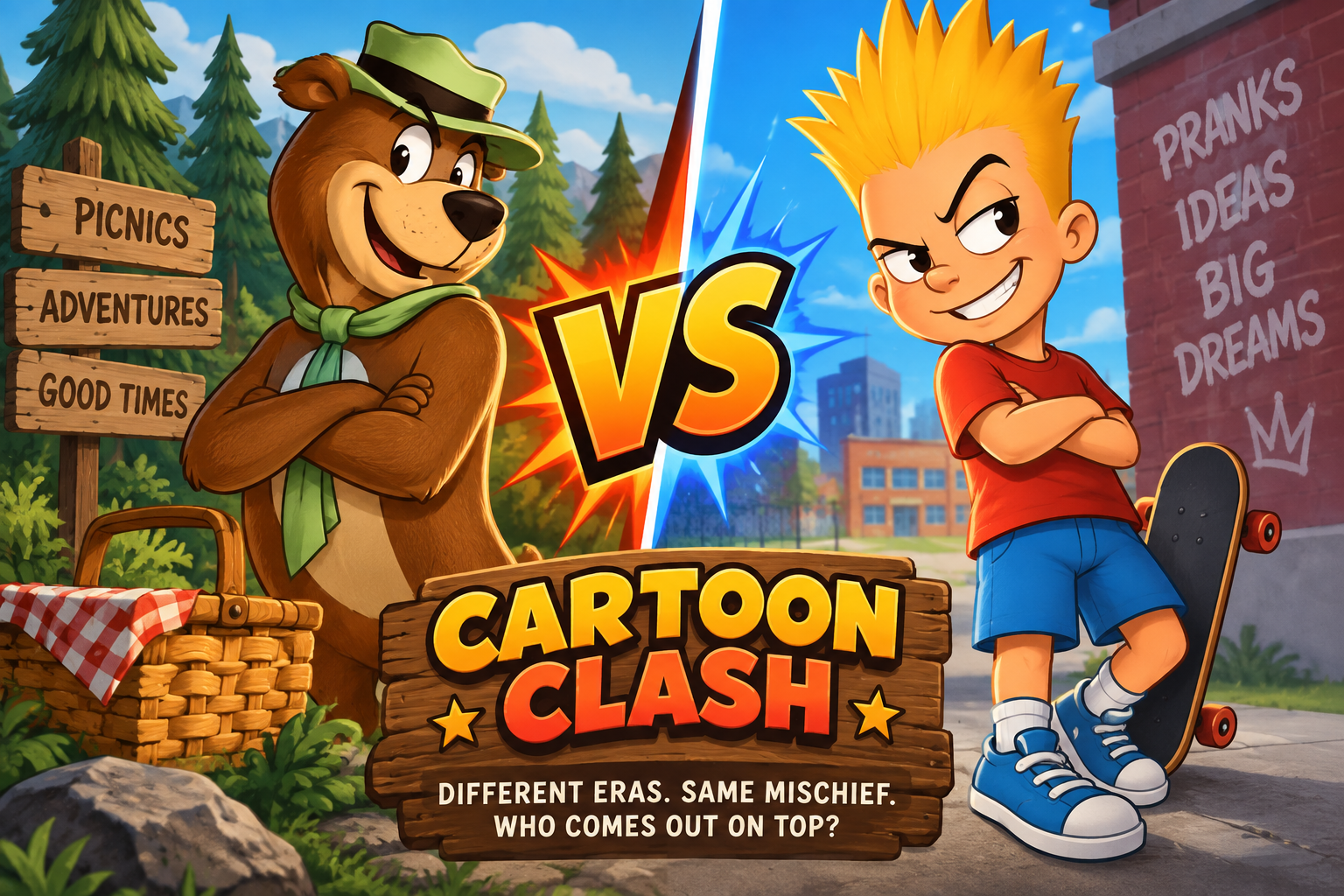
Bart Simpson vs. Yogi Bear
The second matchup in Region B presents a fascinating battle between two iconic troublemakers from very different eras of animation. The #8 seed Bart Simpson enters the tournament as one of television’s most recognizable cartoon characters, while the #9 seed Yogi Bear carries the legacy of one of Hanna-Barbera’s greatest stars.
Both competitors built their reputations through mischief, humor, confidence, and personalities that could take over a scene. Bart represents the sharper, more satirical style of modern prime-time animation, while Yogi comes from an earlier period when television cartoons were establishing their own identity outside theatrical shorts.
Their similarities make the matchup more interesting. Both characters frequently challenge authority, devise schemes, and create problems for the people around them, yet audiences continue to root for them because their troublemaking is paired with charm.
The differences are just as important. Bart developed within the enormous world of Springfield and a program built around family and social satire. Yogi became famous through a simpler comedic formula centered on Jellystone Park, Boo Boo, Ranger Smith, and Yogi’s never-ending attempts to outsmart the rules.
That contrast makes this more than a popularity contest. Cartoon Clash judges each competitor across eight categories designed to reward artistic quality, supporting characters, entertainment, cultural influence, memorable moments, originality, era difficulty, and long-term staying power.
Only one character can advance, but both enter the matchup with legitimate claims to animation greatness.
Round 1: Animation Quality
Bart Simpson benefits from decades of television production improvements and animation refinement. The Simpsons began with a deliberately rough visual identity, but its animation became cleaner and more technically sophisticated as production methods evolved.
Springfield also gives the animators tremendous visual variety. Episodes can move from the Simpson home to school, downtown Springfield, fantasy sequences, travel stories, elaborate parodies, musical numbers, and cinematic set pieces without abandoning the show’s recognizable visual language.
Yogi Bear’s classic cartoons were produced under very different conditions. Hanna-Barbera became famous for developing limited-animation techniques that made original television cartoons economically practical at a time when television budgets could not match the resources of theatrical animation.
That historical context deserves respect because Yogi’s simpler movement and repeated backgrounds were partly products of the production realities of his era rather than a lack of creativity. The character designs were expressive enough to communicate personality efficiently, and the visual identity remains instantly recognizable.
However, this category evaluates the animation presented on screen, not merely the difficulty of producing it. Bart’s world ultimately offers greater fluidity, visual range, staging possibilities, and decades of technical refinement.
Winner: Bart Simpson.
Round 2: Character Cast
Yogi Bear has a memorable supporting group led by Boo Boo and Ranger Smith. Boo Boo provides the cautious counterweight to Yogi’s confidence, frequently warning his friend that another picnic-basket scheme may end badly.
Ranger Smith gives Yogi a natural authority figure to challenge. Their conflict creates an easy comedic engine: Yogi wants freedom and food, while the ranger wants order in Jellystone Park.
Those relationships are effective, but Bart exists inside Springfield, one of the deepest supporting ensembles in television animation. Homer, Marge, Lisa, Maggie, Milhouse, Principal Skinner, Nelson, Krusty, Moe, Mr. Burns, Chief Wiggum, Sideshow Bob, and dozens of other recurring personalities can all become central to a story.
That enormous cast gives Bart access to many different types of comedy and conflict. He can be a mischievous son at home, an underachieving student at school, Milhouse’s best friend, Lisa’s irritating brother, Skinner’s nemesis, or Sideshow Bob’s recurring adversary.
Yogi’s supporting cast is iconic and perfectly suited to his original format, but Springfield provides considerably more depth, variety, and storytelling combinations.
Winner: Bart Simpson.
Round 3: Humor & Entertainment
Both characters were created to make audiences laugh, but they operate through different comedic traditions. Yogi’s humor often comes from verbal confidence, repeated schemes, and the gap between how clever he believes a plan is and how quickly that plan can create trouble.
His relationship with Boo Boo gives the comedy an effective rhythm. Yogi proposes the idea, Boo Boo raises the obvious objection, and Yogi moves forward anyway.
Bart’s humor has a wider range because The Simpsons can shift between family comedy, school rebellion, parody, satire, slapstick, pop-culture references, and surprisingly emotional storytelling. His prank calls to Moe, chalkboard gags, conflicts with Principal Skinner, and elaborate schemes helped establish his mischievous identity.
Bart was also central to the rebellious attitude that made the early years of The Simpsons feel different from conventional television family comedies. He could be selfish, clever, reckless, funny, vulnerable, and occasionally thoughtful within the same broader character.
Yogi remains enormously entertaining, particularly when judged within the concise comedy style of his era. Bart receives the advantage because his character has been able to function successfully across a broader range of comedic situations and storytelling tones.
Winner: Bart Simpson.
Round 4: Cultural Impact
Yogi Bear was one of television animation’s early breakout stars and became an important symbol of Hanna-Barbera’s success. His popularity helped demonstrate that animated characters created specifically for television could develop large audiences and lasting identities.
Yogi’s voice, speech patterns, picnic-basket obsession, and Jellystone setting became recognizable pieces of American popular culture. His success also contributed to a larger Hanna-Barbera universe that dominated children’s television for years.
Bart Simpson’s cultural explosion, however, reached an extraordinary level. During the early years of The Simpsons, Bart appeared on merchandise, clothing, posters, school supplies, advertisements, magazine covers, and countless other products while his catchphrases became part of everyday pop culture.
He also became a symbol of youthful rebellion and helped push prime-time animation into a new era. The enormous success of The Simpsons demonstrated that an animated television series could attract a broad audience, sustain social satire, and occupy a major place in mainstream entertainment.
Yogi deserves enormous historical credit as an early television-animation superstar. Bart takes the category because his influence expanded beyond animation into a worldwide cultural phenomenon and became part of a major shift in American television.
Winner: Bart Simpson.
Round 5: Iconic Episodes & Moments
Yogi Bear has an instantly recognizable premise, and generations of viewers remember the familiar rhythm of Jellystone Park adventures. Picnic baskets, Ranger Smith’s frustration, Boo Boo’s warnings, and Yogi’s confidence created a dependable collection of classic moments.
Yogi’s strength is consistency. Audiences do not need a complicated setup to understand what makes a Yogi Bear adventure work, and that simplicity helped the character survive through reruns and later adaptations.
Bart has the advantage of appearing in a much larger body of long-form television storytelling. His history includes school adventures, family conflicts, pranks, friendships, rivalries, emotional episodes, Halloween stories, musical moments, and encounters with an enormous collection of Springfield residents and guest characters.
His chalkboard sequences and prank calls became recurring traditions, while stories involving characters such as Sideshow Bob created some of the show’s most memorable Bart-centered conflicts. Even viewers who have not watched every season can usually identify multiple images, phrases, or situations associated with him.
Yogi’s classic moments are important to animation history, but Bart’s sheer volume and variety of memorable television material give him the stronger case in this category.
Winner: Bart Simpson.
Round 6: Creativity & Originality
Yogi Bear’s concept was remarkably effective for early television animation. A clever bear living in a national-park-inspired setting, constantly attempting to outwit a ranger and acquire visitors’ picnic baskets, gave the series an immediately understandable comic premise.
The character’s personality elevated that premise. Yogi was not simply an animal chasing food; he was confident, verbal, scheming, and convinced that he could outthink the system around him.
Boo Boo and Ranger Smith completed a compact character triangle that could generate stories repeatedly without requiring an enormous cast. The format was simple enough for television production but distinctive enough to become iconic.
Bart is also a strong creation, but the mischievous child and rebellious schoolboy archetypes existed long before The Simpsons. What made Bart exceptional was the execution and the satirical world surrounding him rather than the complete novelty of the basic archetype.
Yogi’s particular combination of setting, personality, verbal style, and picnic-basket schemes created one of the most identifiable formulas in classic television cartoons. In a category specifically rewarding originality of concept, the pioneering Hanna-Barbera star earns the point.
Winner: Yogi Bear.
Round 7: Era Difficulty
Yogi Bear emerged during the formative years of television animation, when studios were still learning how to produce successful animated programming on television schedules and budgets. The economic model was dramatically different from the theatrical-cartoon system that had produced lavish animated shorts for movie audiences.
Hanna-Barbera’s limited-animation approach was partly a practical answer to that challenge. Fewer drawings, reusable backgrounds, strong poses, memorable voices, and character-driven dialogue allowed studios to create animation specifically for television at sustainable cost.
That meant characters needed to succeed without relying on constant fluid movement. Personality, voice performance, writing, timing, and recognizable designs carried enormous weight.
Yogi became a major star under those constraints and helped prove that television animation could create enduring franchises. His success came while the medium itself was still developing the production methods that later generations would inherit.
Bart’s era brought its own pressures, including prime-time expectations, network scrutiny, competition, and the challenge of sustaining a series over decades. Nevertheless, Yogi receives the edge because his success came during a pioneering stage when the basic model for television animation was still being built.
Winner: Yogi Bear.
Round 8: Legacy Endurance
Yogi Bear has demonstrated extraordinary staying power. The character survived far beyond the original television era through reruns, new animated productions, films, merchandise, home video, streaming availability, and continued use of the Jellystone identity.
That endurance matters because many successful characters from early television animation faded from mainstream awareness. Yogi remained recognizable enough for later generations to understand the basic character even if they had never watched the earliest episodes when they originally aired.
Bart Simpson has also achieved exceptional longevity. He remains one of the central members of the Simpson family, and The Simpsons has continued producing new television episodes across multiple decades.
Bart’s image remains closely tied to the show’s identity, while earlier episodes continue circulating through syndication and streaming. His longevity therefore includes both a massive historical catalog and continuing participation in new material.
Yogi’s ability to endure from the early television-animation era is remarkable and makes this category competitive. Bart receives the narrow advantage because he has remained a central character in one continuously influential television franchise while also retaining the enormous cultural recognition created during the show’s earliest years.
Winner: Bart Simpson.
Final Verdict
Yogi Bear claimed important victories in Creativity & Originality and Era Difficulty, and those wins are not consolation prizes. They recognize his role as an important pioneer from a period when television animation was still developing its identity and production model.
Bart Simpson controlled the other six categories: Animation Quality, Character Cast, Humor & Entertainment, Cultural Impact, Iconic Episodes & Moments, and Legacy Endurance. His greatest advantage is the enormous world surrounding him and the range of storytelling opportunities that The Simpsons has provided.
The 6-2 score can look decisive, but the matchup reveals how difficult it is to compare characters separated by animation eras. Yogi helped build part of the television-cartoon foundation on which later animated programs could stand, while Bart became a defining figure in the evolution of prime-time animated comedy.
Yogi’s originality and pioneering success deserve to remain central to any discussion of his legacy. Without characters that proved television animation could generate durable stars, the medium’s later expansion would have followed a different path.
Bart nevertheless has the stronger overall performance under this tournament’s eight-category system. His cultural reach, supporting cast, storytelling depth, comedic flexibility, and continued relevance allow him to accumulate more category victories.
Final Result: Bart Simpson advances to the second round with a 6-2 category victory. Yogi Bear leaves the tournament with his reputation as one of television animation’s foundational stars fully intact.
Audience Challenge
Now the bracket turns to the audience. Should Yogi Bear’s role in helping establish successful television animation have carried even more weight in this matchup?
Would you have awarded him Legacy Endurance because of how long the character has survived across changing generations and formats? Or does Bart’s enormous cultural footprint and continuing presence make the 6-2 result feel appropriate?
Consider the hardest question in Legacy Showdown: how much should pioneering influence count when a later character has more episodes, a larger supporting world, and broader modern visibility? There is no requirement that fans value every category in exactly the same way.
That disagreement is part of what makes Cartoon Clash fun. One fan may prioritize innovation and historical importance, while another may care more about entertainment range and cultural reach.
Cast your vote, defend your reasoning, and keep following Cartoon Clash as the tournament continues. The bracket may record one official result, but the debate belongs to the audience.