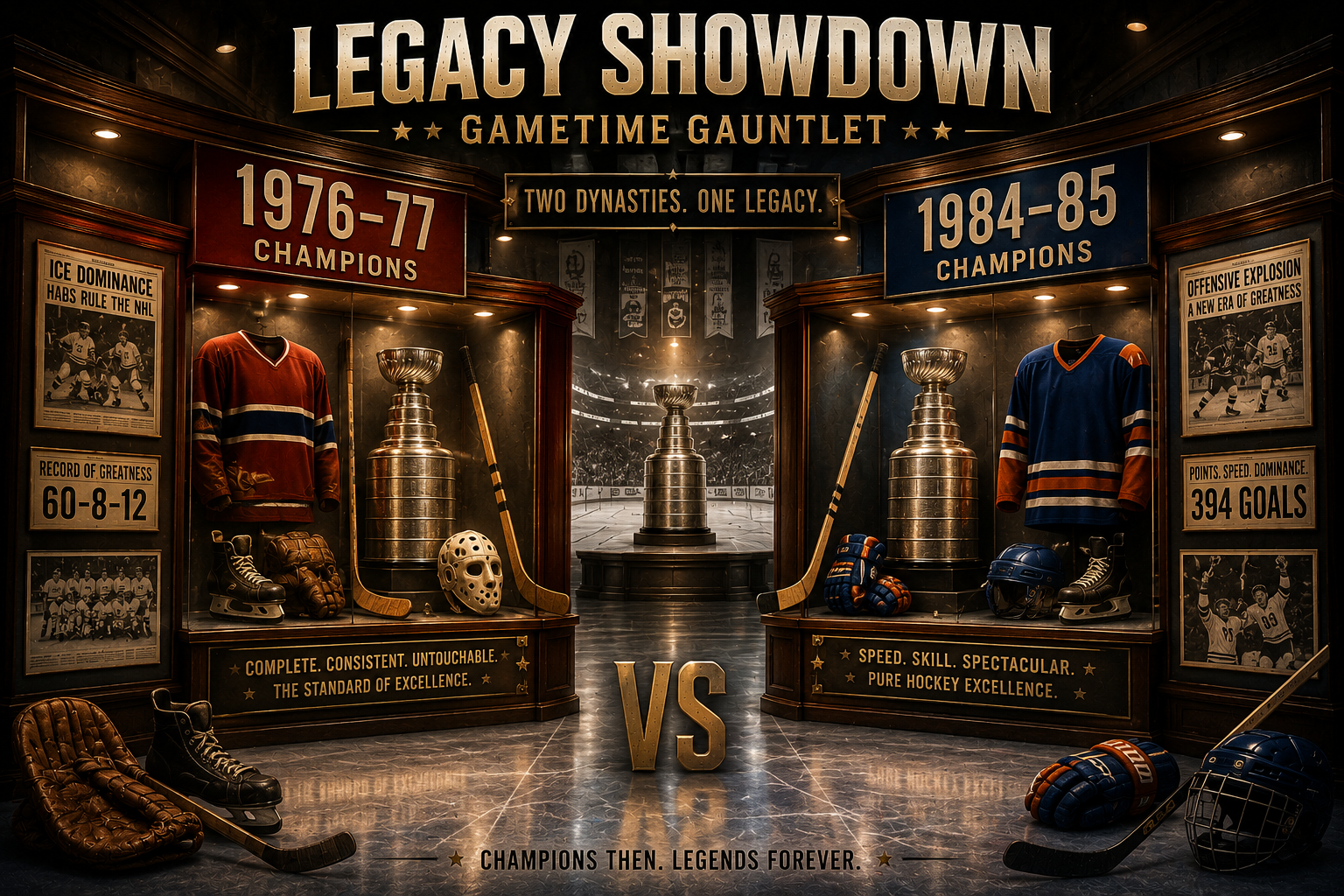

Hockey’s ultimate benchmark collides with the explosive peak of the Gretzky Oilers.
Affiliate Disclaimer
This blog may contain affiliate links or banner advertisements. If you click on one of these links or advertisements and make a purchase, The Shopping Plaza may earn a small commission at no additional cost to you. These commissions help support our work and allow us to continue creating free sports content, rankings, tournament features, and Legacy Showdown matchups like Gametime Gauntlet. We only recommend products, services, or merchandise that we believe may be of interest to our readers. Thank you for supporting The Shopping Plaza and Gametime Gauntlet.
The Matchup
The NHL Region Quarterfinals deliver a matchup that feels worthy of the tournament championship itself. The #1 seed 1976-77 Montreal Canadiens represent one of the most complete expressions of team dominance professional hockey has ever produced. Montreal finished 60-8-12, lost only eight times in an 80-game regular season, and then completed the campaign by capturing the Stanley Cup. With elite scoring, defensive structure, goaltending, depth, and coaching, the Canadiens created a standard that still appears in greatest-team debates.
The #6 seed 1984-85 Edmonton Oilers offer perhaps the most dangerous possible challenger. Edmonton was in the heart of the Wayne Gretzky era, surrounded by Mark Messier, Jari Kurri, Paul Coffey, Grant Fuhr, and a collection of talent capable of turning games into offensive avalanches. The Oilers combined speed, creativity, transition play, and star power in a way that made conventional defensive plans feel temporary. Their championship confirmed that the spectacular offense was not merely entertaining; it was capable of ruling the league.
Gametime Gauntlet does not attempt to decide which club would literally win under one era’s rules. Instead, each team is measured relative to its own competition across ten categories of greatness. Montreal brings historic balance and almost unbelievable regular-season control. Edmonton brings unmatched offensive imagination and one of the greatest concentrations of superstar talent in hockey history.
- Dominance Over Competition
Montreal’s 1976-77 regular season is the foundation of its argument as one of hockey’s greatest teams. The Canadiens finished 60-8-12, meaning opponents managed to defeat them only eight times across an 80-game schedule. That level of week-to-week control is difficult to separate from the larger mythology surrounding the team because Montreal did not depend on one narrow strength to survive. The Canadiens could score, defend, control possession, receive elite goaltending, and impose structure on opponents who were often forced to play from behind. Edmonton’s 1984-85 team was tremendously dominant in its own right and could overwhelm clubs with scoring bursts few teams could match. But Montreal’s regular-season record reflects a level of sustained superiority that remains extraordinary even by dynasty standards. Dominance Over Competition belongs to the Canadiens.
Winner: 1976-77 Montreal Canadiens
- Championship Achievement
Both clubs completed their seasons by winning the Stanley Cup, so neither can claim an advantage simply for reaching the sport’s ultimate destination. The distinction comes from how Montreal connected its championship to an historically dominant regular season. A team can dominate for months and still be remembered differently if it fails in the playoffs, but the Canadiens eliminated that possibility by completing the entire journey. Their Stanley Cup transformed a remarkable 60-win campaign into a fully realized championship season. Edmonton’s title was equally legitimate and helped establish the Oilers as the defining offensive dynasty of their era. Yet the source matchup gives Montreal the edge because the Canadiens paired the Cup with a regular season that still functions as a benchmark for excellence. Championship Achievement goes narrowly to Montreal.
Winner: 1976-77 Montreal Canadiens
- Strength of Competition
Edmonton earns its first point because the mid-1980s NHL presented a fast, offensively aggressive environment filled with elite players and dangerous playoff opponents. The Oilers were not simply scoring against passive competition; they were operating in a league with high-end talent throughout the postseason field and with opponents increasingly focused on finding ways to contain Edmonton’s speed. By 1984-85, the Oilers were no longer an emerging surprise. They were a championship target, and teams understood that slowing Gretzky, Messier, Kurri, Coffey, and the rest of the attack was essential. Montreal’s era featured excellent clubs and legendary players of its own, and Gametime Gauntlet does not penalize earlier teams for playing under different conditions. Still, the source matchup gives Edmonton the edge for navigating a deeper, faster environment in which opponents were specifically trying to solve the league’s most explosive team. Strength of Competition goes to the Oilers.
Winner: 1984-85 Edmonton Oilers
- Star Power
Few teams in hockey history can place a collection of names beside Edmonton’s 1984-85 core and feel comfortable. Wayne Gretzky was operating at a level that made record-breaking production seem routine, while Mark Messier gave the Oilers another franchise-caliber force at center. Jari Kurri was an elite finisher, Paul Coffey added extraordinary offensive ability from the blue line, and Grant Fuhr gave Edmonton a championship goaltender capable of surviving the high-event style the team often played. Montreal counters with Guy Lafleur, Steve Shutt, Larry Robinson, Ken Dryden, and numerous other outstanding players, so this is not a case of a star-filled roster against an anonymous one. The difference is the concentration of generational offensive brilliance on the Edmonton side, led by a player widely placed at or near the top of hockey history. Star Power goes to the Oilers.
Winner: 1984-85 Edmonton Oilers
- Depth and Supporting Cast
Montreal’s greatness becomes even more impressive once the conversation moves beyond its biggest names. The Canadiens possessed quality throughout the lineup, allowing them to maintain structure and production even when the stars were not deciding every shift. Guy Lafleur and Steve Shutt provided elite offense, Larry Robinson anchored the blue line, and Ken Dryden supplied stability in goal, but the team’s identity was built around a complete organization rather than a handful of headline performers. That depth allowed Montreal to control different styles of games and made it difficult for opponents to identify one matchup that could change an entire series. Edmonton was also deep, particularly through its forward group and puck-moving defensemen. Still, the source matchup gives Montreal the advantage because Hall of Fame-level quality and dependable supporting talent appeared throughout the roster. Depth and Supporting Cast belongs to the Canadiens.
Winner: 1976-77 Montreal Canadiens
- Historical Impact
The 1976-77 Canadiens became a standard against which later hockey greatness would be measured. Montreal already possessed one of professional sports’ richest traditions, but this particular team represented dynasty hockey at an almost ideal level: stars, depth, coaching, defense, goaltending, regular-season dominance, and a Stanley Cup all aligned in the same campaign. Later teams seeking inclusion in the greatest-ever conversation are frequently compared with this Montreal season because it provides such a complete reference point. Edmonton’s historical impact is enormous as well, especially because the Gretzky Oilers helped redefine offensive possibility and made speed and transition hockey central to an unforgettable era. But Montreal’s influence reaches beyond style and into the very definition of team excellence. The Canadiens established a benchmark rather than merely a trend. Historical Impact goes to Montreal.
Winner: 1976-77 Montreal Canadiens
- Statistical Excellence
Edmonton’s offensive statistics provide one of the strongest arguments against Montreal in any category. The Oilers could generate goals at a breathtaking pace, and Gretzky’s individual production helped push the limits of what seemed possible in NHL offense. Yet Statistical Excellence is broader than scoring alone. Montreal’s 1976-77 resume combines an extraordinary 60-8-12 record with elite performance at both ends of the ice, creating statistical dominance that reflects complete control rather than one overwhelming phase. The Canadiens’ ability to score while simultaneously suppressing opponents makes their profile especially difficult to attack. Edmonton owns the more spectacular offensive numbers, but Montreal’s statistical case is more balanced across the entire game. For Gametime Gauntlet purposes, that complete numerical superiority earns the Canadiens the point.
Winner: 1976-77 Montreal Canadiens
- Longevity of Greatness
Both teams belong to dynasties, which makes this category a comparison of sustained greatness rather than a question of whether either club was a one-year wonder. Edmonton’s mid-1980s run produced multiple Stanley Cups and established the Oilers as one of hockey’s defining dynasties. Montreal, however, places the 1976-77 team inside an even broader period of sustained championship excellence. The Canadiens were not simply great for one season or one short cycle; their organizational dominance extended across the decade and included repeated championships. That continuity strengthens the 1976-77 team’s historical position because its brilliance was both an exceptional peak and part of a larger tradition of winning. Edmonton’s dynasty makes this close, but the source matchup gives Montreal the edge. Longevity of Greatness belongs to the Canadiens.
Winner: 1976-77 Montreal Canadiens
- Clutch Performance
The Oilers earn their third point because championship pressure became a familiar environment for their core. Edmonton’s stars repeatedly entered playoff series carrying enormous expectations and still found ways to produce when opponents were specifically constructed to slow them. Gretzky and Messier could change the direction of a game quickly, while Fuhr’s goaltending often became especially valuable when Edmonton’s aggressive style created dangerous chances at both ends. Montreal obviously proved its own clutch credentials by completing a dominant season with the Stanley Cup, so the Canadiens have no meaningful weakness in this category. The source matchup, however, gives Edmonton the advantage for the repeated championship performances of a dynasty that learned how to convert spectacular talent into postseason results. The Oilers were not merely an offensive show; they repeatedly delivered when the stakes were highest. Clutch Performance goes to Edmonton.
Winner: 1984-85 Edmonton Oilers
- Legacy Endurance
Nearly half a century later, the 1976-77 Canadiens remain one of the first teams mentioned whenever hockey fans, historians, or analysts debate the greatest NHL club ever assembled. That staying power is remarkable because every generation produces new champions, new statistical achievements, and new tactical innovations that could push older teams from the conversation. Montreal has resisted that erosion. The 60-win season, only eight losses, championship finish, Hall of Fame talent, and complete two-way identity have allowed the Canadiens to remain a permanent benchmark. Edmonton’s 1984-85 Oilers possess enormous legacy endurance as well, especially through Gretzky and the Greatest-Offense-style mythology surrounding the dynasty. But the source matchup gives Montreal the final point because this specific Canadiens team continues to function as the measuring stick itself. Legacy Endurance belongs to Montreal.
Winner: 1976-77 Montreal Canadiens
Gametime Gauntlet Scorecard
- Dominance Over Competition: 1976-77 Montreal Canadiens
- Championship Achievement: 1976-77 Montreal Canadiens
- Strength of Competition: 1984-85 Edmonton Oilers
- Star Power: 1984-85 Edmonton Oilers
- Depth and Supporting Cast: 1976-77 Montreal Canadiens
- Historical Impact: 1976-77 Montreal Canadiens
- Statistical Excellence: 1976-77 Montreal Canadiens
- Longevity of Greatness: 1976-77 Montreal Canadiens
- Clutch Performance: 1984-85 Edmonton Oilers
- Legacy Endurance: 1976-77 Montreal Canadiens
FINAL SCORE: 1976-77 Montreal Canadiens 7 – 1984-85 Edmonton Oilers 3
Final Verdict
A 7-3 score makes this matchup appear more comfortable than the actual debate. Edmonton wins three categories that speak directly to why the Oilers remain terrifying in any historical comparison: Strength of Competition, Star Power, and Clutch Performance. With Gretzky, Messier, Kurri, Coffey, Fuhr, and a championship-tested core, the 1984-85 Oilers possess enough offensive brilliance to challenge virtually any team in tournament history.
Montreal advances because its greatness is distributed across nearly every dimension of team evaluation. The Canadiens take Dominance Over Competition, Championship Achievement, Depth and Supporting Cast, Historical Impact, Statistical Excellence, Longevity of Greatness, and Legacy Endurance. The 60-8-12 regular season is the centerpiece, but the real strength of the argument is that Montreal paired those results with elite offense, defense, goaltending, depth, and a Stanley Cup.
Edmonton may possess the more explosive collection of offensive talent and the single greatest player in the matchup. Montreal, however, offers fewer places for an opponent to find an advantage. The 1976-77 Canadiens were not simply spectacular in one dimension; they were historically complete. That balance allows the tournament’s #1 NHL seed to survive one of the most dangerous challengers imaginable and move forward.
Final Result: 1976-77 Montreal Canadiens advance by a score of 7-3.
Audience Challenge
Would Wayne Gretzky and the 1984-85 Oilers’ breathtaking speed and offense have found enough openings to crack Montreal’s structure, depth, and goaltending? Or does the Canadiens’ 60-8-12 championship season make them the stronger all-around team regardless of Edmonton’s offensive ceiling? If you could flip one category in this 7-3 decision, which one would it be? Make your case for the team that deserves the NHL Region semifinal spot.







That specific era had a distinct difference in team philosophy. A slower pace in the early seventies created a different type of challenge.