

Affiliate Disclosure
Some of the links on this page may be affiliate links. This means that if you click through and make a purchase, The Shopping Plaza may earn a small commission at no additional cost to you.
These commissions help support the operation of this website and allow us to continue creating free content, contests, rankings, and entertainment features like Sitcom Showdown.
We only recommend products, services, and merchandise that we believe may be of interest to our readers. Your support through these affiliate links is greatly appreciated and helps keep The Shopping Plaza growing.
Thank you for supporting The Shopping Plaza!
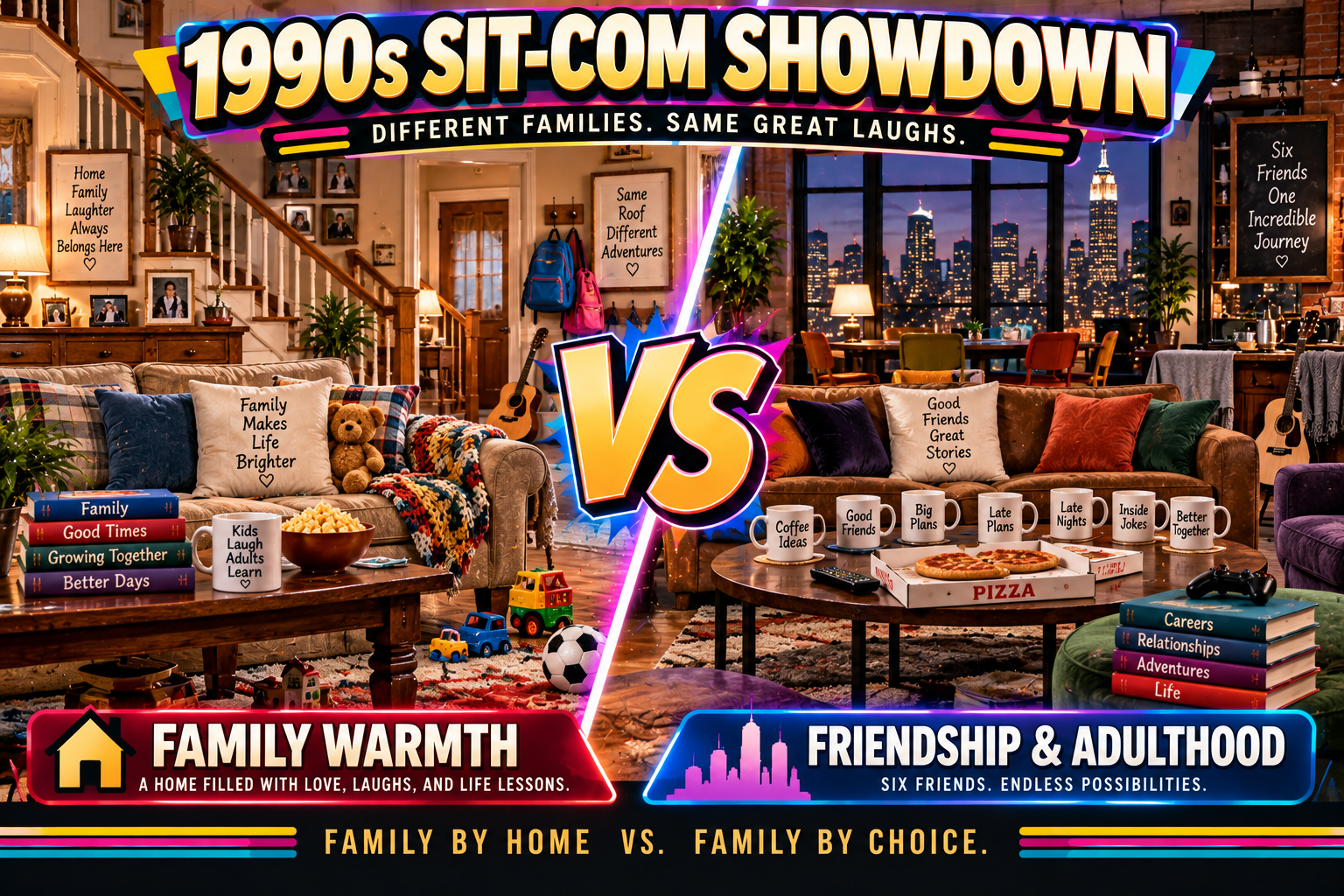
The final second-round matchup in our 1990s Sit-Com Showdown bracket brings together two series built around one powerful idea: sometimes the people who become your family are not defined only by traditional roles. Full House created an unconventional household in San Francisco after widowed father Danny Tanner turned to his brother-in-law Jesse Katsopolis and best friend Joey Gladstone for help raising D.J., Stephanie, and Michelle. Friends built its family by choice around six young adults navigating careers, relationships, breakups, marriages, mistakes, and adulthood together in New York City.
Full House became a cornerstone of family television, mixing broad comedy with heartfelt lessons and creating characters who became inseparable from late-1980s and 1990s pop culture. Friends arrived later and became a defining ensemble comedy of the 1990s, turning Rachel, Ross, Monica, Chandler, Joey, and Phoebe into internationally recognizable characters.
This matchup pits family warmth and multigenerational nostalgia against one of the most influential ensemble sitcoms ever made. Full House has an enduring audience and a legacy strong enough to produce a successful continuation decades later. Friends possesses enormous cultural reach, replay value, and character recognition. Eight categories will decide which show earns the final place among the surviving 1990s contenders.
The Legacy Showdown Rules
- Comedy Quality
- Character Chemistry
- Cultural Impact
- Longevity & Replay Value
- Iconic Moments
- Supporting Cast
- Era Difficulty
- Legacy Endurance
Round 1: Comedy Quality
Full House used an accessible mixture of family comedy, misunderstandings, physical humor, catchphrases, sibling conflict, and the contrasting personalities of the three adult men. Danny’s obsession with cleanliness, Jesse’s cool confidence, and Joey’s impressions gave the household three very different comic energies. The children added their own rhythms, particularly Stephanie’s blunt reactions and Michelle’s increasingly prominent one-liners. The comedy was intentionally broad and family-friendly, which helped make the show easy for multiple generations to watch together.
Friends operated with a more sophisticated ensemble comedy structure. Chandler’s sarcasm, Joey’s innocence and confidence, Phoebe’s eccentric worldview, Monica’s competitiveness, Ross’s insecurity, and Rachel’s evolving independence created six distinct sources of humor. The writers could pair almost any two characters and produce a different comic dynamic, while multi-story episodes frequently allowed jokes to build across the entire ensemble. Full House was extremely effective within its family audience, but Friends delivered greater comic variety and consistency.
Winner: Friends.
Round 2: Character Chemistry
Full House depended on chemistry because its premise required viewers to believe that Danny, Jesse, and Joey would willingly build a household together for the Tanner girls. That bond became increasingly convincing as Jesse matured, Joey became a dependable parental figure, and the girls grew from children into teenagers. Jesse and Rebecca added another family unit, while D.J., Stephanie, and Michelle developed recognizable sisterly relationships. The affection at the center of the show was never difficult to understand.
Friends made ensemble chemistry its defining advantage. The six central characters could function as a complete group, three pairs of roommates, romantic couples, siblings, exes, or countless smaller combinations. Monica and Ross brought an actual sibling relationship into the group, while Chandler and Joey created one of sitcom television’s great friendships. Rachel and Monica had their own history, Phoebe could disrupt any pairing with an unexpected perspective, and the Ross-Rachel relationship supplied years of romantic tension. The ensemble became so convincing that the group itself was the show’s central character.
Winner: Friends.
Round 3: Cultural Impact
Full House became a major part of the family-sitcom culture associated with ABC and the era of TGIF programming. Catchphrases, the Tanner house, Uncle Jesse’s hair and music, Michelle’s one-liners, and the Olsen twins became deeply associated with the period. The show’s wholesome identity also made it an enduring reference point for a particular style of late-20th-century family television.
Friends reached a different level of cultural saturation. The hairstyles, coffeehouse setting, romances, clothing, apartment life, catchphrases, and character personalities influenced popular culture well beyond television. Central Perk became one of television’s most recognizable fictional gathering places, while “We were on a break!” and Joey’s “How you doin’?” became widely understood references. The show also helped define the image of young-adult friendship and urban life in 1990s television.
Winner: Friends.
Round 4: Longevity & Replay Value
Full House produced eight seasons and developed enormous nostalgia value. Because most episodes are self-contained and built around family problems, viewers can easily return to the Tanner household without remembering a complicated story arc. The show also gained new life through reruns and later through Fuller House, which reintroduced many characters and the original setting to another generation.
Friends ran ten seasons and became one of the most persistent rerun and streaming sitcoms of the modern era. Viewers can watch individual episodes for comedy while longer storylines involving Ross and Rachel, Monica and Chandler, careers, marriages, and changing living arrangements reward chronological viewing. Its central themes of friendship, work, dating, and uncertainty about adulthood remain relatable even as technology and fashions age. Both shows have demonstrated impressive afterlives, but Friends has maintained broader replay power.
Winner: Friends.
Round 5: Iconic Moments
Full House has a long list of recognizable signatures: Jesse’s “Have mercy,” Joey’s “Cut it out,” Stephanie’s “How rude,” Michelle’s catchphrases, Danny’s cleaning obsession, family talks accompanied by emotional music, and Jesse’s musical performances. Weddings, graduations, relationship milestones, and the girls growing up gave longtime viewers emotional memories beyond the recurring jokes. The Tanner home itself became an iconic sitcom location.
Friends possesses an extraordinary collection of scenes that can be identified by a word or image. Ross shouting “Pivot!” while moving a couch, Monica dancing with a turkey on her head, the Thanksgiving football game, Joey wearing Chandler’s clothes, the prom video, the trivia game that costs Monica and Rachel their apartment, and countless Ross-and-Rachel moments became part of the show’s mythology. The series repeatedly produced episodes that fans still quote and revisit independently.
Winner: Friends.
Round 6: Supporting Cast
Full House had a strong extended ensemble. Rebecca Donaldson grew from Jesse’s romantic interest into a major family member, while Kimmy Gibbler became D.J.’s unforgettable best friend and a dependable source of disruption. Steve Hale, Jesse and Becky’s twins, classmates, relatives, and recurring friends helped the household expand as the girls aged. Because the core premise was family-centered, recurring characters often became absorbed into the Tanner orbit.
Friends assembled an exceptional supporting universe around the six leads. Gunther became inseparable from Central Perk, Janice could transform an episode with her arrival, and recurring parents, siblings, coworkers, romantic partners, and neighbors gave each central character a larger world. Characters such as Jack and Judy Geller, Carol and Susan, Mike Hannigan, Richard Burke, and others contributed to major storylines without displacing the core six. The depth and recognizability of that supporting bench gives Friends another advantage.
Winner: Friends.
Round 7: Era Difficulty
Full House deserves substantial credit for succeeding in a crowded family-sitcom marketplace. Its sentimental style and moral lessons were easy targets for critics, yet audiences embraced the Tanner family strongly enough to sustain eight seasons and decades of nostalgia. The series also had to evolve as its child actors grew older, requiring the writers to shift stories from childhood problems toward teenage relationships and independence while preserving the original family identity.
Friends premiered in 1994 amid an exceptionally strong period for network sitcoms and had to distinguish itself among numerous comedies about young adults, dating, careers, and relationships. Its six-person ensemble created another challenge because no single character could permanently dominate without upsetting the balance. The show not only survived that environment but became one of the decade’s signature programs and remained a major hit through changing television trends into the 2000s.
Winner: Friends.
Round 8: Legacy Endurance
Full House has demonstrated impressive legacy endurance. Its characters remained recognizable long after the original finale, the Olsen twins became major cultural figures, and nostalgia for the Tanner family eventually helped produce Fuller House. That continuation lasted multiple seasons and showed that viewers still wanted to return to the characters and household decades later. Full House may never have been a critical favorite, but audience affection has proven remarkably durable.
Friends has achieved an even greater level of endurance. The six characters continue to attract viewers who were not alive when the series premiered, and the show remains a fixture of streaming, syndication, merchandise, trivia, online discussion, and popular references. Its ensemble structure influenced later friendship-based comedies, while its major relationships and episodes remain part of mainstream television conversation. Few sitcoms from any decade have maintained such a large global cultural footprint.
Winner: Friends.
Final Verdict
The score is decisive: Friends wins all eight categories and takes the final surviving position from this stage of the 1990s bracket. Yet the 8-0 result should not erase what Full House accomplished. The Tanner family became a defining part of family television, produced characters and catchphrases that survived for decades, and generated enough enduring affection to support an entire continuation series.
Friends simply enters this tournament operating at an unusually high level across every category. Its six-person chemistry is among the strongest in sitcom history, its supporting cast is deep, its iconic moments are plentiful, and its cultural vocabulary remains recognizable across generations. Even categories where Full House is genuinely strong – particularly Longevity & Replay Value and Legacy Endurance – ultimately favor Friends because of the extraordinary scale of its continued audience and influence.
With an 8-0 victory, Friends advances deeper into the Sit-Com Showdown. Full House exits as a beloved family-television institution, while Friends joins the other surviving 1990s heavyweights and closes out this portion of the bracket with a commanding performance.
Audience Challenge
Do you agree with the sweep? Should Full House have captured a category for family chemistry, longevity, or legacy endurance, or is Friends simply too powerful across the complete Legacy Showdown scorecard? Cast your vote, defend your favorite, and get ready for the next stage of the 1990s Sit-Com Showdown bracket.