
Affiliate Disclosure: This article may contain affiliate links. If you purchase flashlights, cameras, audio recorders, EMF meters, books, or other ghost-hunting equipment through links on our website, we may earn a small commission at no additional cost to you. Your support helps us continue creating helpful Halloween resources, paranormal travel guides, and seasonal inspiration.
For centuries, people have reported mysterious voices, unexplained footsteps, strange shadows, cold spots, and encounters they believed involved spirits. While science has not confirmed the existence of ghosts, interest in the paranormal continues to grow through television shows, podcasts, books, documentaries, and local ghost tours.
Ghost hunting has become a popular hobby for people who enjoy history, mystery, photography, and investigating places with legendary reputations. Some participants approach ghost hunting hoping to experience something paranormal, while others simply enjoy exploring historic locations and attempting to explain unusual events through careful observation.
If you’re thinking about trying ghost hunting for the first time, it’s important to approach the hobby with curiosity, respect, and realistic expectations. This guide explains the basics of ghost hunting, the equipment commonly used, safety considerations, and how beginners can get started responsibly.
What Is Ghost Hunting?
Ghost hunting is the investigation of locations where people have reported unexplained or paranormal experiences.
These locations may include:
- Historic homes
- Hotels
- Battlefields
- Cemeteries
- Abandoned buildings
- Theaters
- Hospitals
- Prisons
- Ships
- Lighthouses
Ghost hunters often collect photographs, audio recordings, environmental readings, and personal observations while attempting to determine whether reported experiences have ordinary explanations or remain unexplained.
It is important to remember that unusual experiences are not automatically paranormal. Many can result from environmental conditions, wildlife, building materials, weather, lighting, acoustics, or human perception.
Why People Enjoy Ghost Hunting
People participate for many different reasons.
Some enjoy:
- Local history
- Historic architecture
- Photography
- Adventure
- Mystery
- Scientific investigation
- Nighttime exploration
- Storytelling
- Spending time with friends
Many ghost hunters consider the historical research just as interesting as the investigation itself.
Keep an Open but Critical Mind
One of the most important qualities of a good investigator is balance.
Avoid two extremes:
- Assuming every unusual event is paranormal.
- Refusing to consider any unusual possibility before gathering evidence.
Instead:
- Observe carefully.
- Document accurately.
- Look for ordinary explanations first.
- Record facts rather than assumptions.
Good investigations focus on evidence rather than expectations.
Research Before You Visit
Learning about a location beforehand makes the experience much more meaningful.
Research:
- Construction dates
- Former owners
- Historic events
- Newspaper articles
- Local legends
- Renovations
- Fires
- Floods
- Known wildlife
- Current ownership
Understanding a building’s history helps you separate documented facts from folklore.
Always Obtain Permission
Never enter private property without permission.
Ghost hunters should investigate only:
- Public locations
- Guided tours
- Museums
- Hotels
- Businesses that welcome visitors
- Historic sites
- Locations where permission has been granted
Trespassing is illegal and dangerous.
Many abandoned buildings contain hidden hazards that make unauthorized exploration extremely risky.
Never Investigate Alone
Ghost hunting should always be a group activity.
Bring at least one other person.
A group provides:
- Additional observations
- Emergency assistance
- Better documentation
- Greater safety
- Different perspectives
If an emergency occurs, someone should always be available to call for help.
Tell Someone Your Plans
Before leaving:
Tell a family member or friend:
- Where you’re going
- Who is with you
- When you expect to return
- Your phone number
- Emergency contact information
Safety should always come before the investigation.
Start With Public Ghost Tours
Beginners often benefit from joining organized ghost tours before attempting independent investigations.
Tours provide:
- Historical information
- Local legends
- Safe access
- Experienced guides
- Interesting locations
- Opportunities to ask questions
Many cities offer excellent walking ghost tours that focus on history rather than sensationalism.
Common Ghost Hunting Equipment
Many beginners believe they need expensive equipment.
In reality, you can begin with only a few basic items.
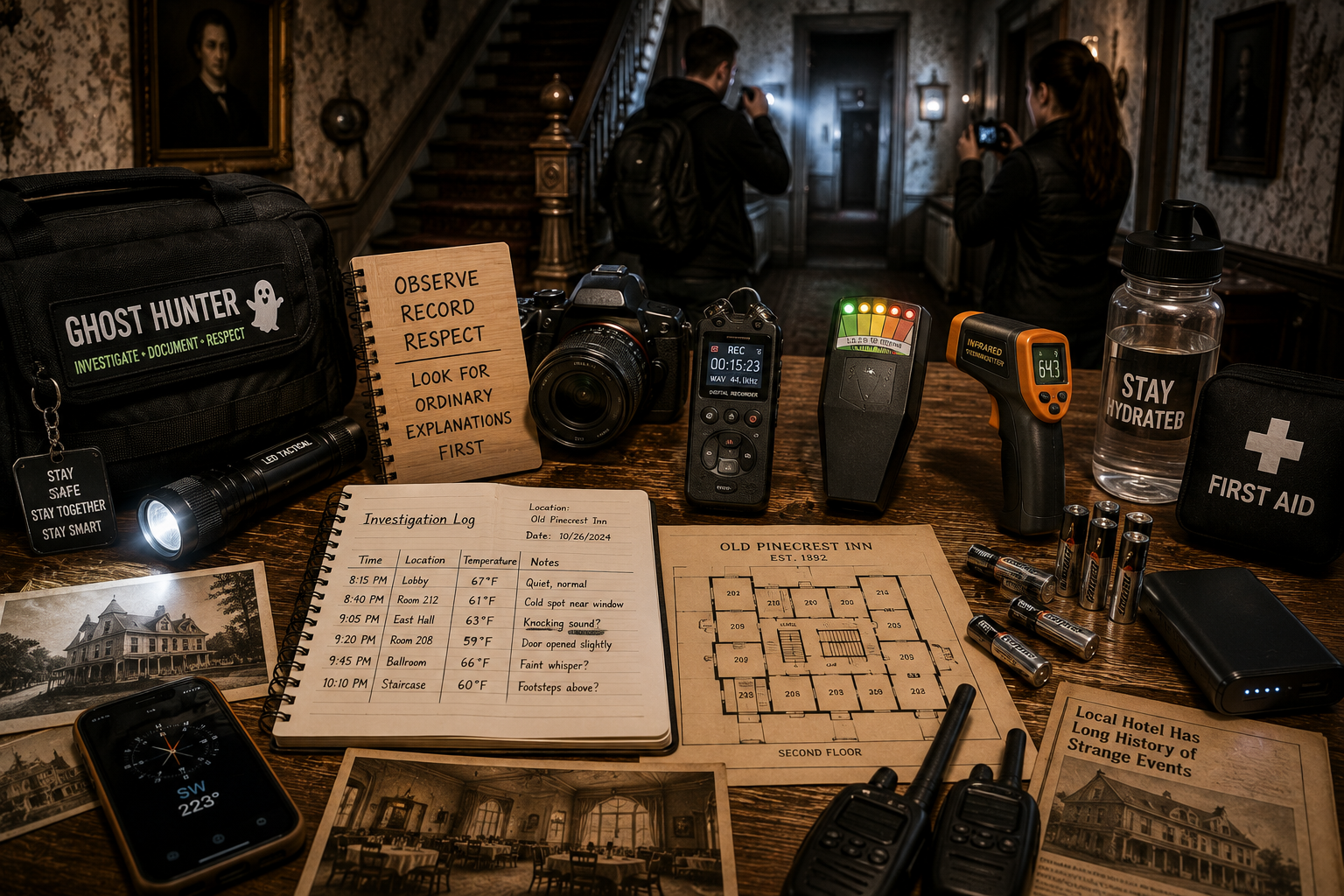
Useful equipment includes:
- Flashlight
- Fully charged phone
- Notebook
- Pen
- Camera
- Audio recorder
- Comfortable shoes
- Water
- Small first aid kit
Simple documentation is often more valuable than expensive gadgets.
Flashlights
Bring more than one flashlight.
Consider:
- Primary flashlight
- Backup flashlight
- Extra batteries
Hands-free headlamps are also useful for walking safely in dark environments.
Never rely solely on your phone’s flashlight.
Camera
A digital camera allows you to document:
- Rooms
- Hallways
- Building conditions
- Objects
- Lighting
- Environmental changes
Take photographs before and after your investigation.
Avoid assuming every unusual light spot or reflection is paranormal.
Dust, insects, moisture, lens flare, and camera settings frequently create unexpected effects.
Audio Recorder
Many investigators use digital voice recorders.
They sometimes conduct short question-and-answer sessions while recording ambient sound.
Later they review the recording for unexplained noises.
However, audio recordings should always be evaluated carefully.
Background sounds may include:
- Air conditioning
- Plumbing
- Traffic
- Wildlife
- Wind
- Other visitors
Avoid jumping to conclusions.
Notebook
Write observations immediately.
Record:
- Time
- Location
- Weather
- Temperature
- Equipment used
- Sounds
- Smells
- Personal observations
- Witnesses
Good notes are often more valuable than memory.
EMF Meters
Electromagnetic Field (EMF) meters are among the most recognizable ghost-hunting tools.
They measure electromagnetic fields produced by electrical equipment.
Common sources include:
- Wiring
- Appliances
- Power lines
- Electrical panels
- Electronic devices
Some paranormal investigators believe unusual EMF changes may accompany paranormal activity.
However, there is no scientific consensus supporting that conclusion, and elevated readings are often explained by ordinary electrical sources.
Use EMF meters as environmental measuring tools rather than proof of ghosts.
Infrared Thermometers
Infrared thermometers measure surface temperatures without physical contact.
Some investigators document sudden temperature changes.
Possible ordinary explanations include:
- Air conditioning
- Drafts
- Open windows
- Weather
- Insulation differences
- Building materials
Record temperatures objectively rather than assuming every cold spot has a paranormal cause.
Motion Sensors
Motion sensors may alert investigators to movement.
Remember that movement may result from:
- Animals
- Air currents
- Vibrations
- Mechanical systems
- Other visitors
Always investigate possible natural explanations first.
Walkie-Talkies
Large buildings sometimes interfere with cell phone signals.
Walkie-talkies help teams remain in communication while working in separate areas.
Agree on communication procedures before beginning.
Extra Batteries
Ghost hunting often lasts several hours.
Bring extra batteries or portable power banks for:
- Flashlights
- Cameras
- Recorders
- Phones
Running out of power can become both frustrating and unsafe.
Dress Appropriately
Wear:
- Closed-toe shoes
- Long pants
- Comfortable clothing
- Weather-appropriate layers
- Reflective gear when outdoors
- Light jacket
Avoid loose clothing that catches on old structures.
Stay Aware of Your Surroundings
Many investigation sites are old buildings.
Watch for:
- Uneven floors
- Broken stairs
- Low ceilings
- Loose boards
- Wet surfaces
- Wildlife
- Sharp objects
- Poor lighting
Your personal safety should always come before collecting evidence.
Respect Historic Locations
Many investigation sites are historically significant.
Treat them with care.
Never:
- Remove artifacts
- Write on walls
- Damage buildings
- Move fragile objects
- Enter restricted areas
Leave every location exactly as you found it.
Respect Cemeteries
If visiting a cemetery:
- Stay on pathways.
- Follow posted rules.
- Speak quietly.
- Respect visitors.
- Do not climb on monuments.
- Never remove flowers or decorations.
- Observe visiting hours.
Remember that cemeteries are places of remembrance, not entertainment.
Be Respectful During Investigations
Whether or not ghosts exist, respectful behavior is always appropriate.
Avoid:
- Mocking
- Yelling
- Destroying property
- Provoking alleged spirits
- Using offensive language
Professional investigators generally maintain calm, respectful conduct throughout an investigation.
Ask Simple Questions
If conducting an audio session, ask clear questions.
Examples include:
- “Is anyone here?”
- “Would you like to communicate?”
- “Can you tell us your name?”
- “How old is this building?”
- “Is there something you’d like us to know?”
Leave several seconds of silence between questions.
Do not expect immediate answers.
Control Background Noise
Reduce unnecessary sounds.
Turn off:
- Music
- Notifications
- Loud conversations
Avoid talking over one another.
Label any accidental noises during recording so they are not mistaken later.
Avoid Suggesting Answers
Instead of asking:
“Were you a soldier?”
Try:
“Can you tell us who you are?”
Open-ended questions reduce the chance of unintentionally influencing interpretations.
Photograph Methodically
Rather than taking random pictures:
Photograph:
- Every room
- Hallways
- Staircases
- Windows
- Doors
- Basements
- Attics
- Exterior views
Systematic photography creates useful documentation.
Review Evidence Carefully
After returning home:
Review:
- Photos
- Audio
- Video
- Notes
- Weather reports
- Historical information
Take your time.
Most unusual findings have ordinary explanations.
Avoid Confirmation Bias
Confirmation bias occurs when we notice only information that supports what we already believe.
Remain objective.
Ask:
“What else could explain this?”
Good investigators try to disprove their own conclusions before accepting them.
Keep a Ghost Hunting Journal
Record every investigation.
Include:
- Date
- Location
- Participants
- Equipment
- Conditions
- Findings
- Personal impressions
Over time your journal becomes a valuable research record.
Understand Pareidolia
Pareidolia is the human tendency to recognize familiar patterns where none intentionally exist.
Examples include:
- Faces in shadows
- Voices in random sounds
- Figures in reflections
- Shapes in fog
Knowing about pareidolia helps investigators evaluate evidence more carefully.
Learn Basic Photography
Photography knowledge helps identify:
- Lens flare
- Dust reflections
- Motion blur
- Long exposure effects
- Digital noise
- Compression artifacts
Learning these concepts reduces false paranormal conclusions.
Learn About Sound
Old buildings naturally produce sounds.
Common sources include:
- Expanding wood
- Heating systems
- Water pipes
- Wind
- Wildlife
- Traffic
- Nearby people
Understanding acoustics helps explain many mysterious noises.
Visit Multiple Locations
Every investigation teaches something new.
Good beginner locations include:
- Historic hotels
- Museums
- Guided ghost tours
- Historic battlefields
- Public landmarks
- Preserved historic homes
Avoid dangerous abandoned buildings.
Join Local Paranormal Groups
Many communities have organized paranormal societies.
Joining experienced investigators can help you learn:
- Safety procedures
- Equipment use
- Documentation methods
- Historical research
- Investigation ethics
Choose groups that emphasize evidence, history, and professionalism.
Be Skeptical of Television Shows
Ghost-hunting television programs are created primarily for entertainment.
Real investigations usually involve:
- Long periods of waiting
- Careful note-taking
- Equipment setup
- Historical research
- Reviewing recordings
- Many ordinary explanations
Most investigations do not involve constant dramatic events.
Respect Different Beliefs
People hold many different beliefs about ghosts.
Some believe strongly in paranormal activity.
Others remain skeptical.
Still others view ghost stories as folklore.
Respect these different perspectives.
You do not need everyone to agree with your conclusions.
Stay Calm
If something surprises you:
- Stop.
- Observe carefully.
- Check your surroundings.
- Look for natural explanations.
- Record what happened.
Panic often leads to poor decisions.
Know When to Leave
End the investigation if:
- Weather becomes dangerous.
- Someone is injured.
- The building becomes unsafe.
- You lose permission to remain.
- Equipment fails.
- Anyone feels seriously uncomfortable.
There is always another opportunity to investigate.
Common Beginner Mistakes
Avoid these common errors:
- Investigating alone
- Trespassing
- Ignoring safety hazards
- Assuming every sound is paranormal
- Buying expensive equipment too soon
- Forgetting spare batteries
- Poor note-taking
- Disrespecting historic sites
- Rushing to conclusions
- Depending only on television techniques
Patience and careful observation are your greatest tools.
Frequently Asked Questions
Do I need expensive equipment to begin ghost hunting?
No. A flashlight, notebook, camera, audio recorder, comfortable shoes, and good observational skills are enough to begin learning about the hobby safely.
Are EMF meters proof of paranormal activity?
No. EMF meters measure electromagnetic fields produced by electrical sources. Some paranormal investigators include them in investigations, but elevated readings alone do not demonstrate the presence of ghosts.
Is ghost hunting dangerous?
It can be if basic safety precautions are ignored. The greatest risks usually involve dark environments, old buildings, uneven terrain, weather, wildlife, and trespassing—not paranormal activity.
What is the best location for beginners?
Guided ghost tours, historic hotels, museums, and public historic sites are excellent places to begin because they provide safe access, historical context, and structured environments.
What if I don’t experience anything unusual?
That is completely normal. Many investigations result in no unexplained findings. Enjoy the history, architecture, photography, and experience itself rather than expecting guaranteed paranormal encounters.
Final Thoughts
Ghost hunting combines history, curiosity, photography, and careful observation into a hobby that continues to fascinate people around the world. Whether you believe in ghosts, remain skeptical, or simply enjoy exploring historic places, the best investigations are built on preparation, patience, and respect.
Start with safe, public locations, research the site’s history, document your observations carefully, and look for ordinary explanations before considering extraordinary ones. You’ll not only become a better investigator but also gain a deeper appreciation for the stories, architecture, and history behind the places you visit.
Remember that the true excitement of ghost hunting is not proving the paranormal—it is exploring the unknown with an open but thoughtful mind. Every investigation offers an opportunity to learn something new, even if the only spirits you encounter are the echoes of history.