
Affiliate Disclaimer
This blog may contain affiliate links or banner advertisements. If you click on one of these links or advertisements and make a purchase, The Shopping Plaza may earn a small commission at no additional cost to you. These commissions help support our work and allow us to continue creating free sports content, rankings, tournament features, and Legacy Showdown matchups like Gametime Gauntlet. We only recommend products, services, or merchandise that we believe may be of interest to our readers. Thank you for supporting The Shopping Plaza and Gametime Gauntlet.
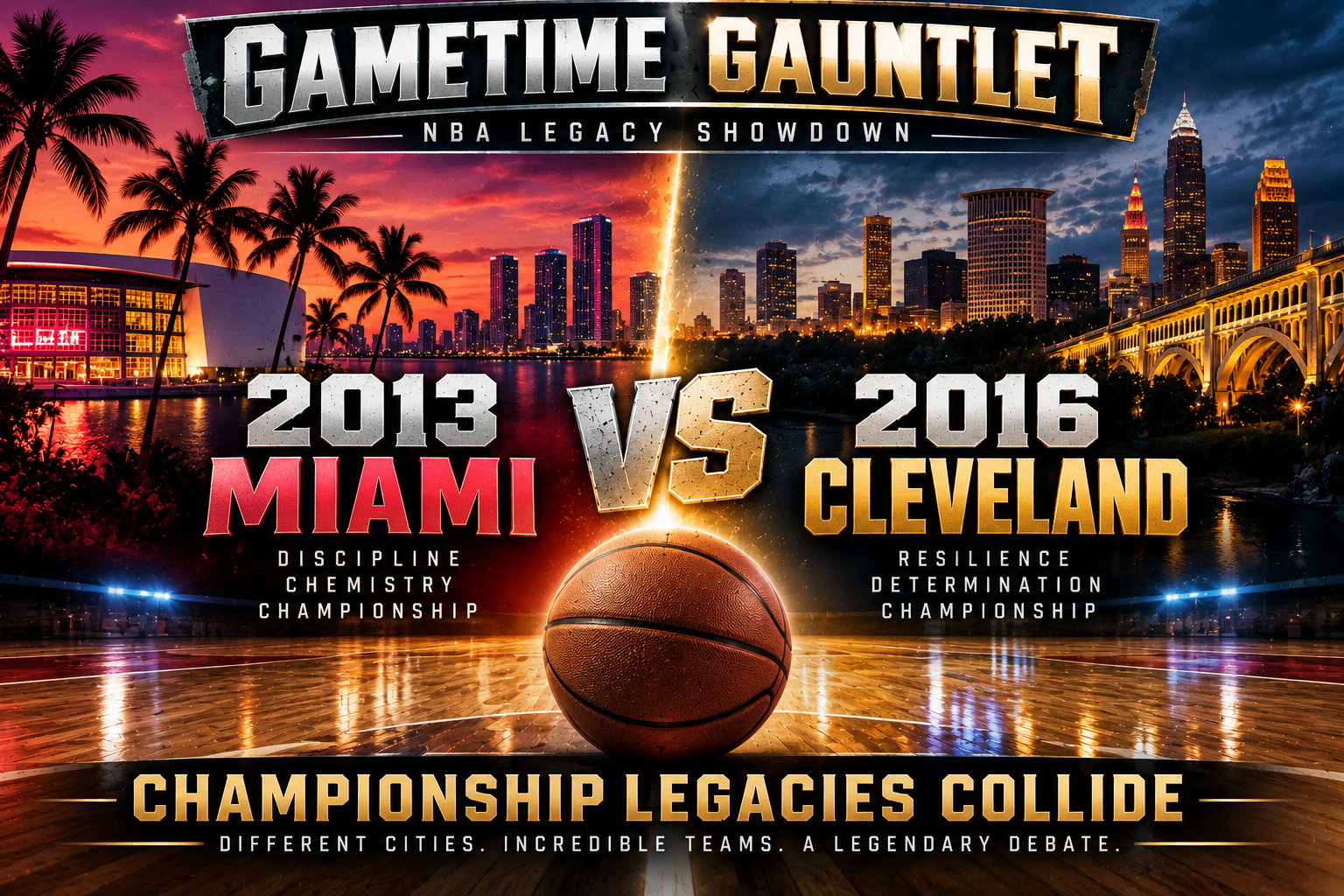
The Matchup
This NBA Region matchup places LeBron James against another championship version of himself. The 2012–13 Miami Heat represented the peak of the celebrated Big Three era. Miami finished 66–16, produced a remarkable 27-game winning streak, and combined LeBron’s MVP season with Dwyane Wade, Chris Bosh, Ray Allen, Shane Battier, Mario Chalmers, Udonis Haslem, and a roster constructed around spacing, versatility, and aggressive defense. The Heat survived two seven-game series and repeated as NBA champions by defeating the San Antonio Spurs.
Three years later, LeBron led a very different contender to an even more dramatic championship. The 2015–16 Cleveland Cavaliers went 57–25, changed coaches during the season, and reached the Finals after losing only two games through the Eastern Conference playoffs. Kyrie Irving and Kevin Love gave Cleveland a star trio of its own, while J.R. Smith, Tristan Thompson, Richard Jefferson, Matthew Dellavedova, Iman Shumpert, and Channing Frye supplied shooting, defense, rebounding, and lineup flexibility.
Then came the defining challenge: a 73–9 Golden State Warriors team that took a 3–1 lead in the NBA Finals. Cleveland won three consecutive games, including Games 5 and 7 on the road, to become the first team in NBA Finals history to overcome a 3–1 deficit. Because this Gametime Gauntlet matchup is being created from scratch, every criterion is judged independently. The result becomes one of the closest comparisons in the NBA bracket: Miami’s superior full-season dominance against Cleveland’s historically unmatched championship comeback.
1. Dominance Over Competition
Cleveland was excellent when the 2016 postseason arrived. The Cavaliers swept Detroit and Atlanta, defeated Toronto in six games, and entered the Finals with a 12–2 playoff record. Over the complete season, however, Miami established a clearly stronger level of dominance. The 2012–13 Heat went 66–16 compared with Cleveland’s 57–25, and Miami’s +8.6 net rating exceeded Cleveland’s +6.4. Most memorably, the Heat won 27 consecutive games, the second-longest winning streak in NBA history at the time. Miami also finished the regular season by winning 37 of its final 39 games, turning a strong defending champion into an overwhelming one. The playoffs became more difficult against Indiana and San Antonio, but Miami still finished the job and repeated as champion. Cleveland’s postseason surge makes the comparison respectable, yet Dominance Over Competition belongs to the Heat.
Winner: 2012–13 Miami Heat
2. Championship Achievement
Miami’s 2013 championship was extraordinary in its own right. The Heat survived a rugged seven-game Eastern Conference Finals against Indiana and then faced a San Antonio team that came within seconds of winning the title in Game 6. Ray Allen’s corner three extended that game, and Miami won Game 7 behind LeBron’s 37 points to secure back-to-back championships. Cleveland’s title, however, required something no previous Finals team had accomplished. The Cavaliers fell behind Golden State 3–1 against a Warriors club that had just set the NBA regular-season record with 73 victories. Cleveland then won Game 5 in Oakland, Game 6 at home, and Game 7 back in Oakland to complete the first 3–1 comeback in NBA Finals history. LeBron produced consecutive 41-point games in Games 5 and 6 before recording a triple-double in Game 7. Miami repeated as champion; Cleveland completed one of the most difficult and historically significant title victories the league has ever seen. Championship Achievement goes to the Cavaliers.
Winner: 2015–16 Cleveland Cavaliers
3. Strength of Competition
Miami’s road included meaningful resistance. Indiana pushed the Heat to seven games with size, defense, and a rising Paul George, while San Antonio won 58 games and possessed the Duncan-Parker-Ginobili championship core under Gregg Popovich. The Spurs were an elite Finals opponent and nearly ended Miami’s reign. Cleveland’s Eastern Conference path was less punishing, as Detroit and Atlanta were swept before Toronto took two games in the conference finals. The decisive factor is the opponent waiting in the championship round. Golden State went 73–9, had the league MVP in Stephen Curry, and entered the Finals as the defending champion. Defeating a historically successful regular-season team after falling behind 3–1 creates an opponent-quality argument that overwhelms Cleveland’s easier early rounds. Miami faced the deeper challenge before the Finals, but Cleveland faced the more historically imposing final obstacle. Strength of Competition narrowly goes to the Cavaliers.
Winner: 2015–16 Cleveland Cavaliers
4. Star Power
Both teams were built around LeBron James, but the version of LeBron in Miami was at perhaps the most complete point of his physical prime. He won the 2012–13 MVP after averaging 26.8 points, 8.0 rebounds, and 7.3 assists while shooting 56.5 percent from the field. Dwyane Wade remained an All-NBA-level second star, averaging 21.2 points in the regular season, while Chris Bosh gave Miami a third perennial All-Star whose shooting and mobility were essential to the team’s small-ball identity. Cleveland countered with Kyrie Irving, who became a brilliant championship scorer and hit the defining three-pointer of Game 7, plus Kevin Love, an elite rebounder and floor-spacing big man. Irving’s 2016 Finals performance gives Cleveland a stronger second-star postseason peak than Wade produced in the 2013 Finals. Still, Miami’s trio entered the season with greater collective stature, more established accolades, and a LeBron season that ended one vote short of a unanimous MVP. Star Power goes narrowly to the Heat.
Winner: 2012–13 Miami Heat
5. Depth and Supporting Cast
Cleveland had an excellent championship rotation. J.R. Smith provided high-volume three-point shooting, Tristan Thompson supplied offensive rebounding and switchable defense, Richard Jefferson gave the Cavaliers valuable veteran minutes, and Channing Frye added frontcourt spacing. Matthew Dellavedova and Iman Shumpert provided defensive options, while Tyronn Lue could alter lineups around the LeBron-Irving-Love core. Miami’s supporting cast was even more precisely designed for its stars. Ray Allen, the NBA’s all-time three-point leader at the time, accepted a reserve role and ultimately hit one of the most famous shots in Finals history. Shane Battier defended larger players and stretched the floor, Mario Chalmers could score in bursts, Udonis Haslem supplied physicality and leadership, and Mike Miller remained another dangerous shooter. Miami could surround LeBron and Wade with shooting or use Bosh as a mobile center to create difficult defensive matchups. Cleveland’s role players were championship-worthy, but Miami’s combination of experience, specialization, and historic shot-making earns Depth and Supporting Cast.
Winner: 2012–13 Miami Heat
6. Historical Impact
The 2013 Heat mattered enormously to NBA history. Their 27-game winning streak became one of the signature achievements of the decade, their championship validated the Big Three experiment with consecutive titles, and their positionless style helped demonstrate the value of spacing and mobile frontcourts. LeBron’s Miami years also accelerated the modern era of superstar-driven roster construction. Cleveland’s 2016 championship, however, carried a historical meaning extending beyond basketball strategy. The Cavaliers delivered the franchise’s first NBA championship and ended Cleveland’s 52-year drought without a major professional sports title. They also became the first team to overcome a 3–1 deficit in the NBA Finals, and they did it against a 73-win defending champion. The Block by LeBron, Kyrie Irving’s go-ahead three, and the final defensive stand instantly entered championship mythology. Miami helped reshape the league; Cleveland produced a singular sports moment for an entire city. Historical Impact goes to the Cavaliers.
Winner: 2015–16 Cleveland Cavaliers
7. Statistical Excellence
The Cavaliers’ statistical résumé is strong. Cleveland finished 57–25, ranked third in offensive rating, and posted a +6.4 net rating before going 16–5 in the postseason. Their three-point volume and LeBron-centered offense became increasingly dangerous as the playoffs progressed. Miami’s numbers are superior across the complete season. The Heat went 66–16, posted a +8.6 net rating, ranked second in offensive rating, and paired efficient offense with a top-ten defense. LeBron shot a career-best 56.5 percent from the field and 40.6 percent from three while producing MVP-level all-around numbers. Miami’s 27-game winning streak and 37–2 closing stretch also demonstrate how consistently the statistical advantages translated into victories. Cleveland owns the slightly cleaner postseason record, but Miami’s regular-season superiority is too substantial to ignore. Statistical Excellence goes to the Heat.
Winner: 2012–13 Miami Heat
8. Longevity of Greatness
Cleveland’s 2016 championship belonged to a four-year run in which the Cavaliers reached the NBA Finals every season from 2015 through 2018. That is remarkable sustained conference dominance, even though Golden State limited Cleveland to one championship during the stretch. The 2012–13 Heat were also part of a four-year Finals run, but Miami converted that run into consecutive championships in 2012 and 2013. The Heat reached the Finals in every season of the LeBron-Wade-Bosh partnership from 2011 through 2014, winning two titles and coming within one series of additional championships. The 2013 team sits at the exact center of that run and represents its regular-season peak. Cleveland deserves credit for returning to the Finals repeatedly after 2016, but the Miami core combined comparable Finals longevity with more championships. Because Gametime Gauntlet values sustained greatness rather than only repeated appearances, Miami receives the point.
Winner: 2012–13 Miami Heat
9. Clutch Performance
Miami’s clutch résumé would win this category against many champions. The Heat survived Game 6 of the 2013 Finals when San Antonio was seconds away from the title, with Chris Bosh securing the offensive rebound that preceded Ray Allen’s game-tying three. Miami then won in overtime and returned two nights later to take Game 7, where LeBron delivered 37 points. Cleveland somehow produced an even more extreme pressure performance. Facing a 3–1 deficit against a 73-win team, the Cavaliers had no margin for error for three consecutive games. LeBron and Kyrie combined for 82 points in Game 5, LeBron scored 41 again in Game 6, and Game 7 remained tied entering the final minute. LeBron’s chase-down block on Andre Iguodala and Irving’s three over Stephen Curry became defining clutch moments. Both teams proved extraordinary under pressure, but Cleveland’s three straight elimination-game victories give the Cavaliers the edge.
Winner: 2015–16 Cleveland Cavaliers
10. Legacy Endurance
The 2013 Heat remain one of the signature teams of LeBron’s career and one of the best champions of the modern era. Their 66 wins, 27-game streak, back-to-back championship, and unforgettable Game 6 ensure that the team will remain prominent in NBA history. Yet Cleveland’s 2016 championship has an even more self-contained and instantly recognizable legacy. Mention the 3–1 comeback, the 73-win Warriors, The Block, Kyrie’s three, or Cleveland’s 52-year title drought, and the entire story immediately returns. The championship also occupies a unique place in LeBron’s personal legacy because it fulfilled the promise attached to his return to Northeast Ohio. Miami’s 2013 team is remembered as the peak of an excellent champion; Cleveland’s 2016 team is remembered for accomplishing something that had never been done in the Finals. That singular identity gives the Cavaliers the advantage in Legacy Endurance.
Winner: 2015–16 Cleveland Cavaliers
Gametime Gauntlet Scorecard
- Dominance Over Competition: 2012–13 Miami Heat
- Championship Achievement: 2015–16 Cleveland Cavaliers
- Strength of Competition: 2015–16 Cleveland Cavaliers
- Star Power: 2012–13 Miami Heat
- Depth and Supporting Cast: 2012–13 Miami Heat
- Historical Impact: 2015–16 Cleveland Cavaliers
- Statistical Excellence: 2012–13 Miami Heat
- Longevity of Greatness: 2012–13 Miami Heat
- Clutch Performance: 2015–16 Cleveland Cavaliers
- Legacy Endurance: 2015–16 Cleveland Cavaliers
FINAL SCORE: 2012–13 Miami Heat 5 — 2015–16 Cleveland Cavaliers 5
TIEBREAKER: Championship Achievement — 2015–16 Cleveland Cavaliers
Final Verdict
This matchup produces the closest possible result: a 5–5 tie between two championship teams built around LeBron James but defined by very different kinds of greatness. Miami owns the stronger full-season résumé. The Heat won nine more regular-season games, produced the 27-game winning streak, posted the better net rating, surrounded LeBron with an accomplished Big Three and a veteran shooting corps, and turned a four-year Finals run into consecutive championships. On dominance, statistics, depth, and sustained title success, the 2013 Heat have the stronger case.
Cleveland wins a different collection of categories, and they are the categories most closely connected to the extraordinary circumstances of the championship itself. The Cavaliers defeated a 73-win defending champion, became the first team ever to erase a 3–1 deficit in the NBA Finals, ended a 52-year Cleveland major-sports championship drought, and produced several of the most recognizable clutch moments in Finals history. Those achievements give Cleveland Championship Achievement, Strength of Competition, Historical Impact, Clutch Performance, and Legacy Endurance.
Under Gametime Gauntlet rules, a 5–5 tie is decided first by Championship Achievement. That category belongs to Cleveland. Miami’s repeat title was an enormous accomplishment, but the Cavaliers’ comeback against a 73-win Golden State team is one of the most difficult championship feats in NBA history. The bracket therefore produces a dramatic result: the 2012–13 Heat may have been the better team across the full season, yet the 2015–16 Cavaliers advance because their championship achievement wins the tournament’s first tiebreaker.
Final Result: 2015–16 Cleveland Cavaliers advance after a 5–5 tie on the Championship Achievement tiebreaker.
Audience Challenge
Which LeBron-led champion has the stronger claim to greatness? Should Miami’s 66 wins, 27-game streak, superior net rating, deeper supporting cast, and back-to-back championship carry more weight than Cleveland’s historic comeback? Or does defeating a 73-win team after falling behind 3–1 create a championship achievement so extraordinary that it deserves to decide a deadlocked matchup? And if you could choose one version of LeBron for a single championship run, would you take the physical and statistical peak of 2013 Miami or the relentless elimination-game force who brought Cleveland its long-awaited title in 2016?