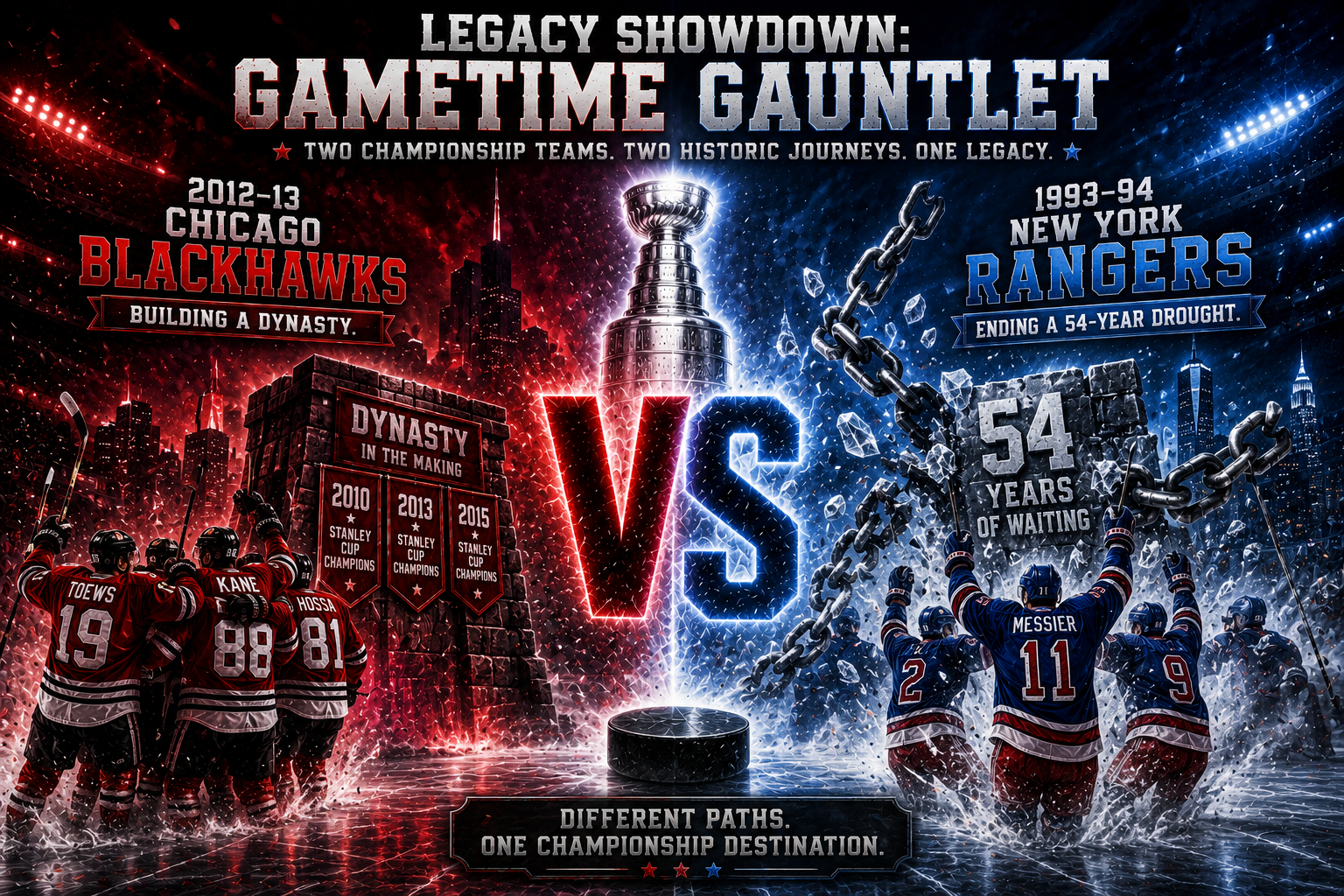


A modern dynasty at full strength meets one of hockey’s most unforgettable drought-breaking champions.
Affiliate Disclaimer
This blog may contain affiliate links or banner advertisements. If you click on one of these links or advertisements and make a purchase, The Shopping Plaza may earn a small commission at no additional cost to you. These commissions help support our work and allow us to continue creating free sports content, rankings, tournament features, and Legacy Showdown matchups like Gametime Gauntlet. We only recommend products, services, or merchandise that we believe may be of interest to our readers. Thank you for supporting The Shopping Plaza and Gametime Gauntlet.
The Matchup
The next first-round matchup in the NHL Region brings together two Stanley Cup champions whose seasons are remembered for very different reasons. The #5 seed 2012-13 Chicago Blackhawks dominated the lockout-shortened campaign from the opening weeks, beginning the season with a record-setting run of games without a regulation loss and eventually finishing atop the NHL standings. Chicago then completed the season by winning the Stanley Cup, adding another championship to a core that was establishing itself as the defining NHL dynasty of the early 2010s.
The #12 seed 1993-94 New York Rangers carry one of the most emotional championship stories in league history. New York entered the season burdened by a Stanley Cup drought stretching back to 1940, then produced the league’s best regular-season record and survived a postseason filled with pressure, drama, and elimination threats. Mark Messier, Brian Leetch, Mike Richter, Adam Graves, and a deep veteran roster finally delivered the championship Rangers fans had waited 54 years to celebrate.
The source matchup awards Chicago seven of the ten categories and New York three, but the 7-3 score should not obscure how formidable the Rangers were. New York’s advantages come in categories where championship pressure and historical meaning matter enormously. Chicago’s case rests on exceptional regular-season control, roster depth, statistical balance, and the fact that this championship sits squarely inside a three-Cup dynasty. Each category below preserves the original winner while giving both teams a full comparison.
1. Dominance Over Competition
Chicago’s shortened 2012-13 regular season offered very little time for a team to recover from a poor start, which made the Blackhawks’ immediate control even more impressive. They opened the campaign with a historic points streak and went weeks before suffering their first regulation loss. Chicago ultimately finished 36-7-5, captured the Presidents’ Trophy, and established itself as the league’s standard over the 48-game schedule. The 1993-94 Rangers were hardly ordinary competition; New York also finished first overall in the NHL and built a championship season on consistency. Yet Chicago’s ability to avoid regulation defeats for such an extended opening stretch created an aura of superiority that defined the entire campaign. The Blackhawks were not simply surviving a compressed season—they were setting its pace. Dominance Over Competition remains with Chicago.
Winner: 2012-13 Chicago Blackhawks
2. Championship Achievement
Both teams won the Stanley Cup after finishing first overall, so this category begins nearly even. New York’s title carries extraordinary emotional weight because it ended a 54-year drought and removed one of the most famous burdens in North American sports. Chicago’s championship, however, followed an exceptionally dominant regular season and required the Blackhawks to survive several very different playoff challenges. They overcame Detroit in a seven-game series after falling behind 3-1, defeated the defending champion Los Angeles Kings, and then beat Boston in a demanding Stanley Cup Final. The title also became the middle championship of Chicago’s three-Cup run from 2010 through 2015. The Rangers’ Cup may be the more emotionally transformative championship, but the source matchup gives Chicago the edge for pairing the trophy with greater season-long dominance and dynasty context. Championship Achievement goes to the Blackhawks.
Winner: 2012-13 Chicago Blackhawks
3. Strength of Competition
New York earns its first category because its path to the 1994 Stanley Cup repeatedly demanded survival under intense postseason pressure. The Rangers faced physical opponents, experienced stars, and a New Jersey Devils team that pushed them to the edge in an unforgettable seven-game Eastern Conference Final. New York then met Vancouver in another seven-game series for the Stanley Cup, meaning the Rangers’ final two rounds required the maximum number of games. Chicago’s 2013 path was also extremely difficult, including a seven-game comeback against Detroit, a series against the defending champion Kings, and a Final against a rugged Boston club. This category is therefore much closer than a simple era comparison suggests. The source matchup favors the Rangers because their championship run became a succession of grueling tests in which the season repeatedly approached the brink. Strength of Competition goes to New York.
Winner: 1993-94 New York Rangers
4. Star Power
Chicago’s core reads like the foundation of an era: Jonathan Toews, Patrick Kane, Duncan Keith, Marian Hossa, and Patrick Sharp gave the Blackhawks elite talent across multiple positions. Toews provided two-way leadership, Kane supplied game-breaking creativity, Keith controlled enormous minutes from the blue line, and Hossa gave Chicago a rare combination of skill, strength, and defensive responsibility. The Rangers counter with Mark Messier, Brian Leetch, Mike Richter, Adam Graves, and other accomplished veterans, so New York certainly does not lack star quality. Leetch’s postseason performance and Messier’s leadership became inseparable from the mythology of the championship. Chicago nevertheless possesses the deeper collection of players whose careers became central to a modern dynasty. With elite names spread across forward and defense and several players still near their primes, Star Power goes to the Blackhawks.
Winner: 2012-13 Chicago Blackhawks
5. Depth and Supporting Cast
The 2012-13 Blackhawks were particularly difficult to solve because their strength continued well beyond the first line. Chicago could roll multiple forward combinations, receive offense from secondary scorers, trust responsible two-way players in difficult situations, and rely on defensive pairings capable of moving the puck without sacrificing structure. That balance meant opponents could not simply neutralize Toews or Kane and expect the entire attack to disappear. The 1993-94 Rangers also possessed a deep veteran roster and received important contributions from players outside their biggest stars throughout the postseason. New York’s championship could not have happened without that collective support. Chicago, however, had fewer visible weak points from line to line and pairing to pairing. The Blackhawks’ ability to attack in waves while maintaining defensive responsibility earns Depth and Supporting Cast.
Winner: 2012-13 Chicago Blackhawks
6. Historical Impact
No statistical comparison can fully capture what the 1994 Stanley Cup meant to the Rangers and their supporters. New York had not won the championship since 1940, and the 54-year drought had become part of the franchise’s identity. Ending it transformed the 1993-94 team from an excellent champion into a permanent piece of hockey folklore. Messier’s leadership, the dramatic series against New Jersey, Leetch’s brilliance, Richter’s goaltending, and the final victory over Vancouver became cultural memories that extended far beyond a normal championship season. Chicago’s 2013 title is historically important as the middle championship of a modern dynasty and as one of the strongest performances of the salary-cap era. But the Rangers changed the emotional history of an Original Six franchise in a single spring. Historical Impact belongs decisively to New York.
Winner: 1993-94 New York Rangers
7. Statistical Excellence
Chicago’s statistical profile reinforces why the team felt so complete during the shortened season. The Blackhawks finished with the NHL’s best record, lost only seven games in regulation, and combined strong scoring with excellent goal prevention. Their early points streak was not a novelty detached from the larger season; it was the opening expression of a team that remained elite throughout the schedule. Chicago also benefited from strong puck-possession play and the ability to spend long stretches controlling where games were played. The Rangers’ 1993-94 numbers were outstanding as well, including a first-place finish in the league standings and a strong overall goal differential. Yet Chicago’s combination of record, two-way efficiency, and possession strength gives it the broader statistical case. Statistical Excellence goes to the Blackhawks.
Winner: 2012-13 Chicago Blackhawks
8. Longevity of Greatness
The 2012-13 championship cannot be separated from the larger run that made Chicago one of the signature NHL teams of its generation. The Blackhawks had already won the Stanley Cup in 2010 and would win again in 2015, giving the core three championships in six seasons. That surrounding success proves that 2013 was neither a one-year peak nor a fortunate postseason run. Toews, Kane, Keith, Hossa, Brent Seabrook, and other central pieces repeatedly demonstrated that their style could survive roster changes, different opponents, and changing postseason circumstances. New York’s 1994 team produced an unforgettable championship but did not turn that season into a comparable multi-title dynasty. The Rangers remained relevant, yet the specific championship core never reproduced the same ultimate result. Longevity of Greatness clearly belongs to Chicago.
Winner: 2012-13 Chicago Blackhawks
9. Clutch Performance
Few championship teams have a clutch narrative as dramatic as the 1993-94 Rangers. New York’s season repeatedly reached moments when decades of frustration seemed capable of returning all at once. The Rangers faced elimination against New Jersey in the Eastern Conference Final before Mark Messier publicly guaranteed a Game 6 victory and then backed the moment with a famous performance. New York survived that series in double overtime of Game 7 and then endured another seven-game test against Vancouver in the Stanley Cup Final. Chicago’s 2013 team was extremely clutch as well, especially in overcoming a 3-1 series deficit against Detroit and scoring two late goals in 17 seconds to win the Cup in Boston. But the source matchup gives New York the edge because the Rangers repeatedly performed with both elimination pressure and a 54-year historical burden hanging over every critical moment. Clutch Performance goes to the Rangers.
Winner: 1993-94 New York Rangers
10. Legacy Endurance
Both teams have enduring legacies, but they endure for different reasons. The Rangers remain immortal because they ended the 54-year drought, and the phrase associated with the championship still carries enormous meaning for New York hockey fans. Chicago’s 2012-13 team, however, is remembered both as an exceptional individual champion and as a central piece of a larger dynasty. The Blackhawks’ three championships in six seasons give the 2013 team a permanent role in discussions about the strongest clubs of the salary-cap era. Its historic start, Presidents’ Trophy, deep roster, comeback against Detroit, and dramatic Cup-clinching finish all provide memorable details beyond the dynasty label. As time passes, that combination of single-season excellence and multi-year success strengthens rather than narrows the team’s place in hockey history. Legacy Endurance goes to Chicago.
Winner: 2012-13 Chicago Blackhawks
Gametime Gauntlet Scorecard
- Dominance Over Competition: 2012-13 Chicago Blackhawks
- Championship Achievement: 2012-13 Chicago Blackhawks
- Strength of Competition: 1993-94 New York Rangers
- Star Power: 2012-13 Chicago Blackhawks
- Depth and Supporting Cast: 2012-13 Chicago Blackhawks
- Historical Impact: 1993-94 New York Rangers
- Statistical Excellence: 2012-13 Chicago Blackhawks
- Longevity of Greatness: 2012-13 Chicago Blackhawks
- Clutch Performance: 1993-94 New York Rangers
- Legacy Endurance: 2012-13 Chicago Blackhawks
FINAL SCORE: 2012-13 Chicago Blackhawks 7 – 1993-94 New York Rangers 3
Final Verdict
The 7-3 final score reflects two very different forms of hockey greatness. New York wins Strength of Competition, Historical Impact, and Clutch Performance. Those categories capture the heart of the 1994 Rangers: a championship run defined by difficult series, elimination pressure, unforgettable leadership moments, and the emotional release of ending a 54-year Stanley Cup drought.
Chicago advances because its advantages are spread across the categories that measure roster quality and sustained competitive strength. The Blackhawks win Dominance Over Competition, Championship Achievement, Star Power, Depth and Supporting Cast, Statistical Excellence, Longevity of Greatness, and Legacy Endurance. Their 36-7-5 regular season, historic start, complete lineup, and place within a three-Cup dynasty create a profile that is extraordinarily difficult to defeat.
The Rangers may own the more dramatic story, and their 1994 championship remains one of the NHL’s most emotionally resonant seasons. The Blackhawks, however, offer the stronger overall combination of peak performance, depth, statistical balance, and sustained greatness. That makes Chicago the deserving 7-3 winner under the established Gametime Gauntlet criteria.
Final Result: 2012-13 Chicago Blackhawks advance by a score of 7-3.
Audience Challenge
Would Mark Messier, Brian Leetch, Mike Richter, and the pressure-tested 1994 Rangers have found a way to turn Chicago’s smooth, balanced game into another emotional seven-game battle? Or does the Blackhawks’ depth, two-way excellence, and dynasty pedigree make the 7-3 result the right call? If you could flip one category for New York, which one would it be—and why?