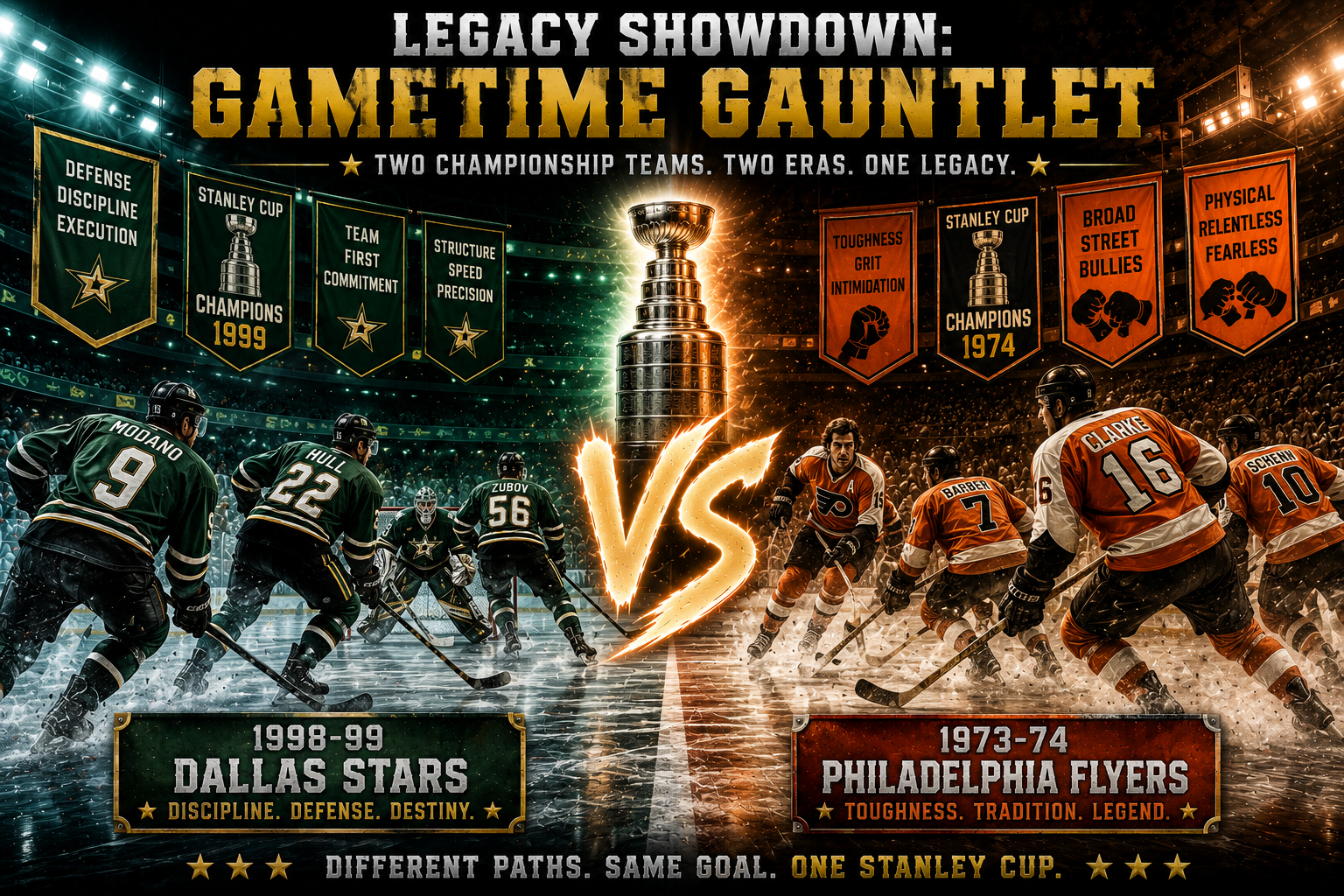


Defensive structure and star talent collide with the intimidating legacy of the Broad Street Bullies.
Affiliate Disclaimer
This blog may contain affiliate links or banner advertisements. If you click on one of these links or advertisements and make a purchase, The Shopping Plaza may earn a small commission at no additional cost to you. These commissions help support our work and allow us to continue creating free sports content, rankings, tournament features, and Legacy Showdown matchups like Gametime Gauntlet. We only recommend products, services, or merchandise that we believe may be of interest to our readers. Thank you for supporting The Shopping Plaza and Gametime Gauntlet.
The Matchup
The next first-round matchup in the NHL Region brings together two Stanley Cup champions whose identities were built on toughness, discipline, and making opponents uncomfortable. The #4 seed 1998-99 Dallas Stars finished with 114 points and captured the first Stanley Cup in franchise history. Dallas combined a demanding two-way system with high-end skill, veteran experience, excellent goaltending, and the patience to win games that were decided by one mistake or one timely goal.
The #14 seed 1973-74 Philadelphia Flyers occupy a very different but equally memorable place in hockey history. Philadelphia became the first expansion-era franchise to win the Stanley Cup, breaking through a championship landscape that had been dominated by the NHL’s established powers. The Broad Street Bullies became famous for physical intimidation, but reducing them to fighting misses the quality of the team: Bobby Clarke was an elite leader and two-way force, Bernie Parent provided championship goaltending, and the roster blended skill with a relentless collective identity.
Gametime Gauntlet judges greatness relative to each team’s own era rather than imagining a literal cross-era series. Dallas enters with the stronger regular-season point total, a deep roster, and a highly structured championship formula. Philadelphia counters with breakthrough historical importance, a distinctive identity, and a championship that altered the league’s balance of power. The result is a matchup between a late-1990s defensive powerhouse and one of hockey’s most culturally influential champions.
1. Dominance Over Competition
Dallas earns the opening point because its 114-point regular season demonstrated sustained control over a long schedule. The Stars were built to win consistently rather than simply overwhelm opponents in occasional scoring bursts. Their defensive structure, goaltending, veteran forwards, and puck-moving talent gave them multiple ways to protect an advantage and grind through difficult nights. Philadelphia was also an elite team in 1973-74 and proved its quality by completing the season as champion. Yet the source matchup specifically identifies Dallas’ regular-season performance as the stronger season-long display of control. The Stars combined that record with a style designed to minimize volatility, which made extended losing stretches difficult to produce against them. Dominance Over Competition goes to Dallas.
Winner: 1998-99 Dallas Stars
2. Championship Achievement
Both teams reached the same ultimate destination: the Stanley Cup. Philadelphia’s championship carries enormous historical importance because it was the first Cup won by an expansion-era franchise and demonstrated that the old order could be broken. Dallas’ title, however, was paired with one of the strongest regular seasons of its era and completed the franchise’s rise into a league power. The Stars entered the playoffs carrying the burden that comes with being an elite regular-season team and still survived the pressure of a long postseason. Their championship required disciplined execution through close games and culminated in an exhausting Cup Final. Philadelphia’s breakthrough makes this exceptionally close, but the source matchup gives Dallas the category for combining its championship with superior season-long dominance. Championship Achievement goes to the Stars.
Winner: 1998-99 Dallas Stars
3. Strength of Competition
Philadelphia earns its first point because its championship represented a direct challenge to the NHL’s established hierarchy. Expansion franchises had entered the league only several years earlier, and the sport’s traditional powers still carried enormous institutional and competitive advantages. The Flyers had to prove that an expansion team could develop enough talent, identity, and resilience to defeat clubs with much deeper championship traditions. Their eventual Stanley Cup victory therefore changed more than Philadelphia’s own history; it changed assumptions about who could realistically rule the league. Dallas faced a difficult late-1990s NHL filled with elite clubs and highly structured defensive hockey, so this is not an easy category. But the source matchup rewards Philadelphia for breaking through against established powers and altering the competitive balance of the league. Strength of Competition goes to the Flyers.
Winner: 1973-74 Philadelphia Flyers
4. Star Power
Dallas possessed an exceptional collection of recognizable, high-level talent. Mike Modano gave the Stars a franchise centerpiece with speed and offensive skill, Brett Hull brought one of hockey’s greatest goal-scoring reputations, Sergei Zubov supplied elite puck movement from the blue line, and Ed Belfour gave Dallas a championship-caliber presence in goal. The roster also included veteran leaders and accomplished contributors who made the Stars more than a four-name team. Philadelphia counters with Bobby Clarke, Bernie Parent, and other essential pieces of the Broad Street Bullies, giving the Flyers genuine top-end quality. But the source matchup awards Dallas the point because its star talent was distributed across forward, defense, and goaltending and included several players with major individual reputations. The Stars could place elite ability into virtually every important phase of the game. Star Power belongs to Dallas.
Winner: 1998-99 Dallas Stars
5. Depth and Supporting Cast
The 1998-99 Stars were constructed to survive a postseason in which matchups, checking, special teams, and depth become increasingly important. Dallas had star names, but the team’s effectiveness depended on the supporting roster accepting specialized roles and maintaining the same demanding two-way standard. The Stars could use veteran forwards in difficult situations, lean on a strong defensive group, and trust Belfour behind the structure when breakdowns occurred. Philadelphia’s 1973-74 championship was also a triumph of collective identity, and the Flyers’ physical approach only worked because the roster bought into it from top to bottom. Still, the source matchup gives Dallas the edge for possessing greater overall talent through the lineup. The Stars were capable of matching opponents physically without sacrificing the skill needed to create offense and move the puck. Depth and Supporting Cast goes to Dallas.
Winner: 1998-99 Dallas Stars
6. Historical Impact
Philadelphia’s victory in this category is decisive because the 1973-74 Flyers changed both competitive expectations and hockey culture. Becoming the first expansion-era franchise to win the Stanley Cup shattered the idea that the league’s traditional powers would automatically control the championship indefinitely. At the same time, the Broad Street Bullies developed an identity so distinctive that the nickname became part of hockey vocabulary. Their intimidation, physicality, emotional edge, and willingness to turn games into tests of nerve influenced how opponents built rosters and approached the Flyers. Dallas’ 1999 championship is historically important to the franchise and remains one of the defining achievements in Stars history. But Philadelphia’s impact extended beyond one organization and became part of the larger story of how NHL hockey could be played and won. Historical Impact goes to the Flyers.
Winner: 1973-74 Philadelphia Flyers
7. Statistical Excellence
Dallas’ statistical case reflects the same balance that made the team so difficult to defeat. The Stars finished with 114 points while excelling at preventing opponents from dictating games, and their success was not dependent on a single extraordinary scorer carrying the entire season. They combined enough offensive talent to capitalize on opportunities with a defensive system capable of limiting the number and quality of chances they surrendered. Philadelphia’s 1973-74 team produced excellent results in its own era and clearly possessed championship-level numbers. Yet the source matchup gives Dallas the advantage because the Stars ranked among the NHL’s best across multiple dimensions rather than relying on one statistical specialty. Their regular-season record provided measurable evidence of a complete team. Statistical Excellence goes to Dallas.
Winner: 1998-99 Dallas Stars
8. Longevity of Greatness
The 1973-74 championship did not stand alone as an isolated Philadelphia breakthrough. It helped launch a period in which the Flyers remained at the center of the Stanley Cup picture and established themselves as one of the defining teams of the decade. That continuity matters because Longevity of Greatness asks whether a championship season belongs to a sustained period of relevance. Dallas remained a formidable contender around its 1999 championship and reached the Stanley Cup Final again the following season, giving the Stars a strong argument of their own. Philadelphia, however, turned its first Cup into the foundation of repeated championship-level success and a lasting era identity. The source matchup therefore gives the Flyers the edge. Longevity of Greatness belongs to Philadelphia.
Winner: 1973-74 Philadelphia Flyers
9. Clutch Performance
Dallas’ championship run demanded comfort in close, pressure-filled hockey. The Stars were designed for games in which one goal, one defensive mistake, one special-teams opportunity, or one goaltending save could determine the outcome. Rather than needing ideal conditions, Dallas repeatedly found ways to remain patient and execute its system while postseason tension increased. That composure ultimately carried the Stars through the Stanley Cup Final and delivered the franchise’s first championship. Philadelphia obviously demonstrated outstanding clutch ability as well, especially by defeating established powers during its breakthrough run. But the source matchup gives Dallas the advantage for repeated execution in tight playoff contests and for maintaining discipline when margins became extremely small. Clutch Performance goes to the Stars.
Winner: 1998-99 Dallas Stars
10. Legacy Endurance
More than half a century later, the Broad Street Bullies remain one of the most recognizable team identities in hockey history. Fans who never watched the 1973-74 Flyers live can still understand what the nickname represents: toughness, intimidation, emotional intensity, and a team willing to impose its personality on an opponent. The championship also retains historical importance because Philadelphia was the first expansion-era club to break through and win the Stanley Cup. Dallas’ 1998-99 team is remembered fondly, especially by Stars fans, and its championship remains the defining achievement of that era of the franchise. But the source matchup correctly distinguishes between a memorable championship and a team identity that became part of the sport’s permanent mythology. Philadelphia’s style, nickname, and historical breakthrough continue to generate discussion decades later. Legacy Endurance goes to the Flyers.
Winner: 1973-74 Philadelphia Flyers
Gametime Gauntlet Scorecard
- Dominance Over Competition: 1998-99 Dallas Stars
- Championship Achievement: 1998-99 Dallas Stars
- Strength of Competition: 1973-74 Philadelphia Flyers
- Star Power: 1998-99 Dallas Stars
- Depth and Supporting Cast: 1998-99 Dallas Stars
- Historical Impact: 1973-74 Philadelphia Flyers
- Statistical Excellence: 1998-99 Dallas Stars
- Longevity of Greatness: 1973-74 Philadelphia Flyers
- Clutch Performance: 1998-99 Dallas Stars
- Legacy Endurance: 1973-74 Philadelphia Flyers
FINAL SCORE: 1998-99 Dallas Stars 6 – 1973-74 Philadelphia Flyers 4
Final Verdict
A 6-4 score accurately reflects how differently these teams built their greatness. Philadelphia wins Strength of Competition, Historical Impact, Longevity of Greatness, and Legacy Endurance. Those four categories capture why the Broad Street Bullies remain so important: they broke the championship barrier for expansion-era teams, created one of hockey’s most enduring identities, and turned their first Cup into a sustained period of contention.
Dallas advances because the Stars own the stronger combination of season-long dominance and roster completeness. They win Dominance Over Competition, Championship Achievement, Star Power, Depth and Supporting Cast, Statistical Excellence, and Clutch Performance. The 114-point regular season, deep two-way roster, high-end talent, and ability to execute in close playoff games create a profile with very few weaknesses.
Philadelphia may have the larger cultural footprint, and its historical influence makes the Flyers a dangerous opponent in any legacy-based tournament. Dallas, however, accumulates more advantages in categories that measure the quality and completeness of the specific championship team. The Stars therefore survive an exceptionally competitive first-round test and move forward in the NHL Region.
Final Result: 1998-99 Dallas Stars advance by a score of 6-4.
Audience Challenge
Which style would you trust more in a championship series: Philadelphia’s intimidation, physical pressure, and breakthrough confidence, or Dallas’ disciplined defensive structure, star talent, and patience? Do the Broad Street Bullies deserve another category because of their historical importance, or is the Stars’ 6-4 advantage the right reflection of the stronger all-around season? Choose the category you would flip first and make your case.