

Affiliate Disclaimer: This post may contain affiliate links. If you make a purchase through one of these links, The Shopping Plaza may earn a commission at no additional cost to you.
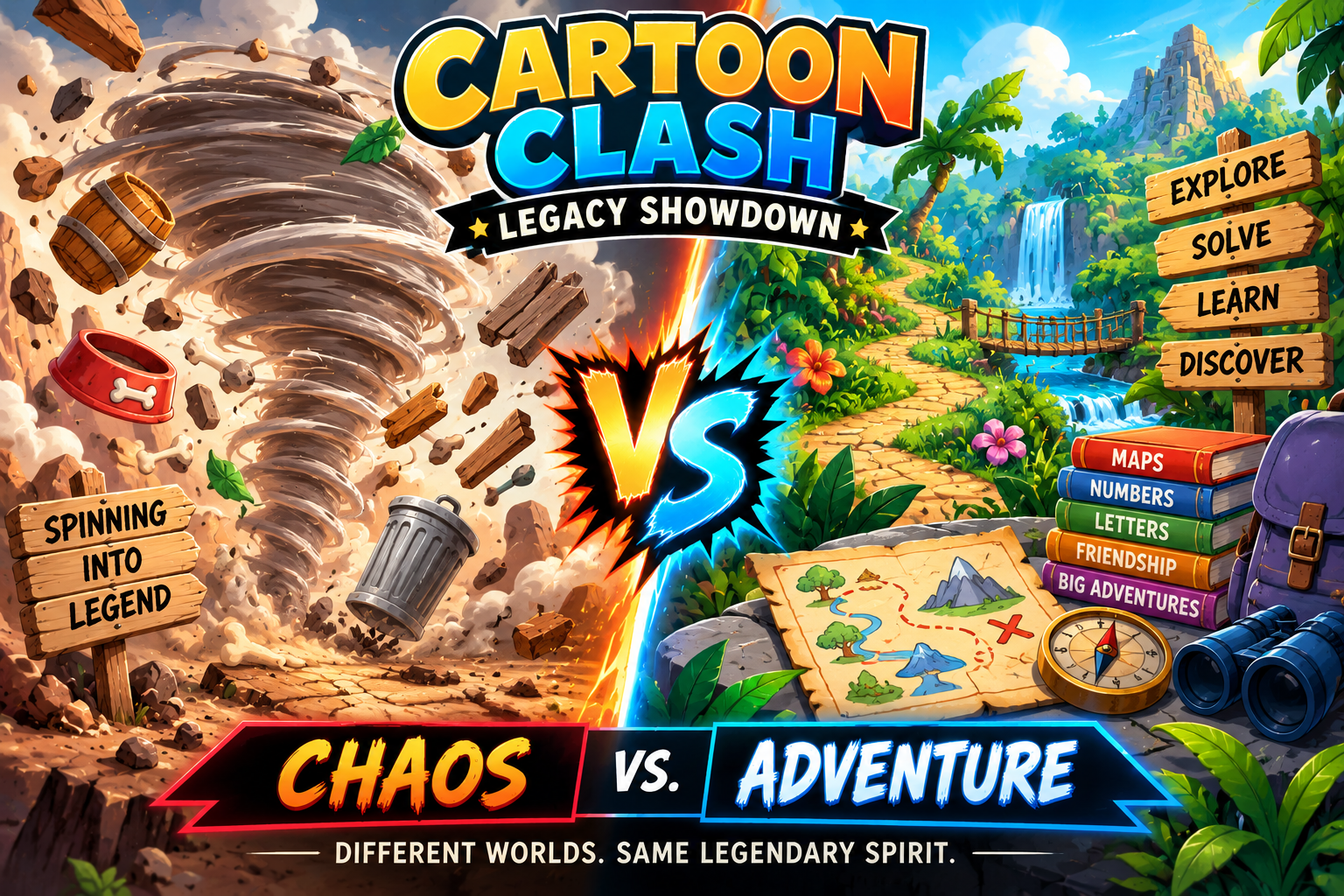
The next first-round matchup from Region B features a fascinating clash between two animated icons who could not be more different. The #8 seed Tasmanian Devil, better known as Taz, enters the tournament as one of the most chaotic and recognizable members of the Looney Tunes universe. Across the bracket stands the #9 seed Dora the Explorer, one of the most influential educational cartoon characters of the modern era. This showdown pits wild slapstick comedy against educational adventure. Taz built his reputation through destruction, frantic energy, an enormous appetite, and a personality that can turn a quiet scene into complete chaos within seconds. Dora built a very different legacy by speaking directly to young viewers and inviting them to solve problems, follow maps, learn words, and participate in each adventure. Both became merchandising powerhouses, both are recognizable beyond their original programs, and both found audiences far larger than their basic premises might have suggested. That makes this #8-versus-#9 matchup especially intriguing because there is no overwhelming favorite on paper. Taz carries the history and reach of Looney Tunes, but Dora can make a legitimate argument that her influence on preschool television is deeper than the influence of many traditional cartoon stars. Every category therefore needs to be earned rather than awarded on reputation.
Round 1: Animation Quality
Dora the Explorer benefited from colorful digital-era production designed to make environments, objects, and characters easy for young viewers to understand. The show’s bright landscapes and clear visual cues were important because children needed to identify paths, objects, numbers, and clues while participating in the adventure. Its visual simplicity was purposeful rather than accidental, and the style became instantly recognizable to its audience. Taz, however, originated in the hand-drawn Looney Tunes tradition, where exaggerated movement and physical comedy were central to the animation itself. His famous spinning tornado required animators to communicate speed, destruction, appetite, frustration, and personality through motion that often became the entire joke. His body could stretch, twist, accelerate, crash, and recover in ways perfectly suited to the elastic logic of classic cartoons. Later productions modernized his appearance without losing that visual identity. Dora’s animation is highly functional for interactive education, but Taz’s animation contributes more directly to character performance and comic spectacle. Winner: Tasmanian Devil.
Round 2: Character Cast
Dora has an unusually memorable supporting cast for a preschool adventure series. Boots is more than a sidekick; his enthusiasm, loyalty, and friendship with Dora give the show warmth and provide another character through whom young viewers can react to each adventure. Backpack and Map transform ordinary tools into personalities that are essential to the show’s structure, while Swiper gives the series a recurring antagonist whose appearances create immediate audience participation. Characters such as Benny, Isa, Tico, Dora’s family, and numerous recurring friends make her world feel larger than a simple two-character journey. Taz certainly benefits from existing within the extraordinary Looney Tunes universe, and interactions with Bugs Bunny, Daffy Duck, and other famous characters can instantly elevate a story. He also developed a more specific family and supporting world in later television interpretations. Still, many of Looney Tunes’ biggest stars are not fundamentally Taz supporting characters; they belong to a shared franchise. Dora’s ensemble was constructed around her adventures and is deeply integrated into the format of the series. That gives Dora the clearer advantage. Winner: Dora the Explorer.
Round 3: Humor & Entertainment
Taz’s greatest strength is that audiences often know what kind of chaos is coming the moment he enters a scene. His appetite, growling speech, explosive temper, and tornado-like movement make him a natural vehicle for physical comedy. He can destroy a room, chase another character, misunderstand a situation, or become distracted by food without needing an elaborate setup. The contrast between his intimidating appearance and the absurd situations surrounding him also keeps the character funny rather than genuinely threatening. Dora’s entertainment value comes from a completely different source. Her adventures combine songs, puzzles, repetition, travel, problem-solving, and direct interaction with the audience, giving preschool viewers something to do rather than simply something to watch. That approach has entertained millions of children precisely because participation becomes part of the fun. Yet when the category includes pure comedy and broad entertainment, Taz has a wider ability to generate immediate laughs across age groups and language barriers. His physical style remains understandable even without dialogue. Winner: Tasmanian Devil.
Round 4: Cultural Impact
This is one of the most difficult rounds in the matchup. Taz became one of Looney Tunes’ most successful merchandising personalities despite having a smaller classic-cartoon filmography than several of his franchise teammates. His snarling face, whirlwind spin, appetite, and rebellious attitude translated extraordinarily well to shirts, hats, collectibles, sports imagery, and other products, helping turn him into a worldwide pop-culture symbol. Dora, however, became something even larger than a successful preschool character. She helped normalize interactive educational television for a massive international audience and introduced countless young English-speaking viewers to basic Spanish vocabulary as part of ordinary entertainment. Her purple backpack, Map, Boots, Swiper, and repeated audience prompts became recognizable pieces of childhood culture. The franchise expanded through toys, books, games, live entertainment, spin-offs, and screen adaptations while reaching families across different countries and languages. Taz may have broader recognition among older generations, but Dora’s impact extends into education, language exposure, representation, and the structure of children’s television itself. On overall cultural influence rather than simple character recognition, Dora earns the narrow upset in this round. Winner: Dora the Explorer.
Round 5: Iconic Episodes & Moments
Dora created an enormous number of adventures built around destinations, obstacles, songs, and problems that children could help solve. Her most iconic material, however, often comes from recurring rituals rather than from individual episode titles. Viewers remember asking Map for directions, checking Backpack for needed items, warning Dora when Swiper appears, and repeating ‘Swiper, no swiping!’ as part of the experience. Those moments are genuinely iconic because the audience participates in them. Taz’s legacy works differently. His most memorable scenes center on the character himself: the tornado spin, the ravenous eating, the garbled growling, and the sudden destruction that follows his arrival. Classic encounters with other Looney Tunes characters helped establish those traits, while later television and film appearances repeatedly returned to them. Taz may not possess as many universally remembered individual shorts as Bugs Bunny or Daffy Duck, and that matters when judging him objectively. Dora’s recurring audience-participation moments are arguably more specifically identifiable with her franchise than many individual Taz stories are with his. In a very close call, Dora steals another category. Winner: Dora the Explorer.
Round 6: Creativity & Originality
Dora the Explorer earns a major advantage because the series built its identity around making the child at home an active participant in the story. Dora looks toward the audience, asks questions, pauses for responses, requests help finding objects, teaches words, and encourages viewers to repeat information needed to complete the adventure. Map turns navigation into a memorable sequence, Backpack turns problem-solving tools into a game, and Swiper’s appearances give children a repeated verbal role in stopping the antagonist. The bilingual element added another distinctive educational layer by weaving basic Spanish vocabulary into an English-language adventure format. Taz is unquestionably an original personality. A nearly unstoppable creature who communicates through growls, spins like a tornado, devours almost anything, and combines menace with comedy is an excellent cartoon concept. His exaggerated interpretation of a real Tasmanian devil became far more culturally famous than the animal itself for many viewers. Still, Dora’s combination of animation, direct address, participation, problem-solving, and language education helped reshape the possibilities of preschool television. That broader format innovation wins the category. Winner: Dora the Explorer.
Round 7: Era Difficulty
Dora entered children’s television at a time when preschool programming already included powerful educational brands and recognizable characters competing for the attention and trust of both children and parents. To become a global phenomenon, the series needed a format distinctive enough to stand apart while remaining simple enough for very young viewers to follow. Its success in that environment deserves substantial credit. Taz faced a different challenge during the Golden Age of American animation. He had to establish himself within Looney Tunes, a roster already filled with some of the strongest animated personalities ever created. Even more remarkably, his original theatrical appearances were comparatively limited, meaning he had fewer opportunities than many rivals to make an impression. Despite that, the character’s design, movement, appetite, and chaotic personality were memorable enough to survive alongside Bugs Bunny, Daffy Duck, Porky Pig, Tweety, Sylvester, and others. Becoming a lasting Looney Tunes icon under those circumstances demonstrates exceptional character efficiency and staying power. Taz earns the edge for succeeding in an extraordinarily competitive historical environment. Winner: Tasmanian Devil.
Round 8: Legacy Endurance
Taz has remained recognizable across many decades, surviving the transition from theatrical shorts to television reruns, merchandise, newer animated series, movies, games, and modern Looney Tunes productions. His visual identity is simple enough that audiences can recognize him immediately even when the animation style changes. That multigenerational survival gives him a formidable endurance résumé. Dora’s legacy is younger, but it has already crossed an important generational threshold. Children who watched Dora the Explorer during its early years are now adults, while newer versions and adaptations continue introducing the character to younger audiences. The franchise’s educational concept remains understandable even as technology and viewing habits change, and Dora’s influence can still be seen in the expectation that preschool programs directly involve their viewers. Unlike some children’s characters whose popularity disappears when the original audience ages out, Dora has remained an active franchise rather than simply a nostalgia property. Taz has the longer proven history, but Dora combines genuine multigenerational recognition with continued franchise activity and educational relevance. Because endurance measures more than raw age, this round is extremely close; Taz’s substantially longer record ultimately gives him the narrow edge. Winner: Tasmanian Devil.
Final Verdict
This matchup proves why an #8-versus-#9 pairing can be one of the most unpredictable battles in a tournament. Taz controls Animation Quality, Humor & Entertainment, Era Difficulty, and Legacy Endurance, using expressive physical animation, cross-generational slapstick, Golden Age competition, and decades of proven staying power to build a strong case. Dora answers with Character Cast, Cultural Impact, Iconic Episodes & Moments, and Creativity & Originality. Her supporting characters are more directly integrated into her own world, her influence reaches into education and language exposure, her recurring interactive moments became childhood rituals, and her format helped redefine how preschool television could communicate with viewers. That leaves the official category score tied 4-4. The tiebreaker therefore has to return to Cartoon Clash’s central question: which character possesses the stronger overall legacy, influence, entertainment value, and staying power? Taz has the longer history and remains an enduring Looney Tunes icon, but Dora’s résumé combines enormous global popularity with a measurable change in the way children’s television was structured and experienced. Her impact was not merely commercial; the audience-interaction and bilingual-learning elements became central parts of how millions of children engaged with the show. In an extremely close decision, that broader influence gives the #9 seed the tiebreaker.
Final Result: Dora the Explorer pulls off the #9-over-#8 upset after the eight categories finish tied 4-4. Dora advances to the second round on the overall-legacy tiebreaker, while Tasmanian Devil exits after proving that his chaotic comedy and extraordinary longevity still make him one of Looney Tunes’ most enduring icons.
Audience Challenge
Did Dora’s educational innovation and worldwide influence deserve to break the 4-4 tie, or should Taz’s longer history, physical comedy, and Looney Tunes legacy have carried him into the second round? Would you award Cultural Impact or Iconic Episodes & Moments differently? Cast your vote, defend your choice, and continue following Legacy Showdown: Cartoon Clash as Region B moves forward.