

Affiliate Disclaimer: This post may contain affiliate links. If you make a purchase through one of these links, The Shopping Plaza may earn a commission at no additional cost to you.
A Thanksgiving Meltdown Does Not Mean the Holiday Is Ruined
Thanksgiving can be a wonderful day for children. There may be favorite foods, cousins to play with, relatives they have not seen in a while, special traditions, desserts, games, and plenty of excitement.
It can also be a lot.
The normal routine changes. Meals happen at unusual times. The house may be crowded and noisy. Children may be expected to sit longer than usual, greet unfamiliar relatives, eat foods they do not normally eat, share toys, dress differently, travel, stay up late, and manage excitement for hours.
Eventually, a child who looked perfectly happy an hour earlier may begin crying, yelling, refusing to cooperate, hiding, arguing, or completely falling apart.
That moment can be stressful for everyone, especially when it happens in front of relatives.
But a Thanksgiving meltdown is not proof that your child is ungrateful, badly behaved, or deliberately trying to ruin the holiday.
Sometimes it simply means their ability to cope has run out.
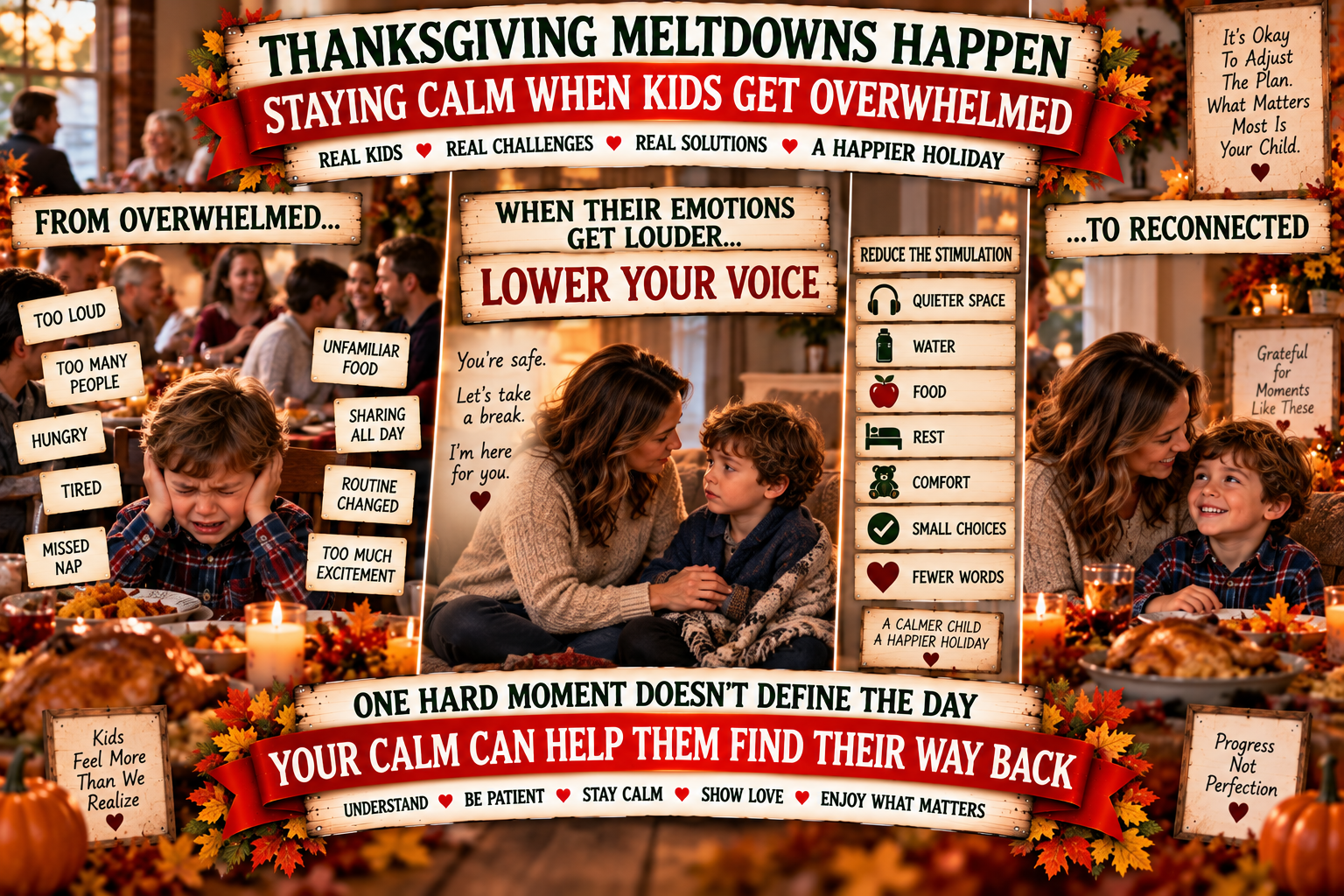
Your calm response can help them find their way back.
Look Beneath the Behavior
When a child melts down, the visible behavior is only part of the story.
Ask what may be happening underneath it.
Are they hungry?
Tired?
Overstimulated?
Disappointed?
Uncomfortable around unfamiliar people?
Frustrated because they have been sharing all afternoon?
A child who cannot clearly explain what is wrong may communicate distress through behavior.
Understanding the possible cause helps you respond to the need instead of only reacting to the noise.
Remember That Holidays Disrupt Routines
Children often depend on predictable routines more than adults realize.
Thanksgiving can change wake-up times, naps, meals, activities, locations, and bedtime all in one day.
Adults may see those changes as fun.
A child may experience them as exhausting.
When possible, preserve a few familiar parts of the day.
A normal snack, quiet time, favorite toy, familiar bedtime routine, or short rest can provide stability inside an unusual schedule.
Watch for Early Signs of Overwhelm
Meltdowns rarely appear completely without warning.
A child may become unusually clingy, irritable, loud, restless, withdrawn, or argumentative.
They may start refusing small requests or becoming upset over things they normally handle easily.
Notice those signals.
A ten-minute break before the meltdown may be far easier than trying to calm the child after they have reached their limit.
Lower Your Voice When Their Emotions Get Louder
When a child begins yelling, an adult’s instinct may be to raise their voice.
That often adds more stimulation to an already overwhelmed child.
Try lowering your voice.
Use short sentences.
Slow your movements.
Your calm does not guarantee immediate calm from the child.
It does communicate that the situation is safe enough to begin settling down.
Do Not Make the Audience the Priority
One of the hardest parts of a public meltdown is feeling watched.
Relatives may stare.
Someone may offer advice.
Another person may make a comment about discipline.
It is easy to become more focused on proving that you are handling the situation than on helping your child.
Try to forget the audience.
Your job is not to perform perfect parenting for the room.
Your job is to help the child regulate and address the behavior appropriately.
Move to a Quieter Space
A crowded dining room may be the worst place to solve an overwhelmed child’s problem.
If possible, move somewhere quieter.
A bedroom, hallway, porch, or another calm space can reduce noise and attention.
You are not rewarding the meltdown by providing space.
You are removing some of the stimulation that may be making it harder for the child to regain control.
Use Fewer Words
Adults sometimes respond to a meltdown with a long explanation.
An overwhelmed child may not be able to process it.
Keep language simple.
“You’re having a hard time.”
“Let’s take a break.”
“You’re safe.”
“We’ll talk when you’re calmer.”
Save the detailed conversation for later.
Regulation usually needs to come before reasoning.
Acknowledge the Feeling Without Approving Every Behavior
You can validate a child’s emotion without approving hitting, screaming at someone, throwing objects, or other inappropriate behavior.
“You’re angry that you had to stop playing. It is okay to be angry. It is not okay to hit.”
That distinction matters.
Children need to learn that feelings are allowed while some behaviors still have limits.
Check the Basics: Food, Water, Rest, and Comfort
Holiday excitement can cause basic needs to be overlooked.
A child may skip lunch because Thanksgiving dinner is coming later.
They may drink less water.
A younger child may miss a nap.
They may become uncomfortable in dress clothes they have worn for hours.
Before assuming the behavior is entirely emotional, check the basics.
Sometimes the solution is surprisingly ordinary.
Do Not Force Food Battles at the Thanksgiving Table
Thanksgiving meals often include foods children do not normally eat.
A holiday dinner is rarely the ideal moment to turn tasting vegetables into a major power struggle.
Offer reasonable choices and include at least something familiar when possible.
A child does not need to love every traditional dish to participate in Thanksgiving.
Protecting the atmosphere of the meal may matter more than winning a battle over one bite.
Prepare Children for What the Day Will Look Like
Children handle change better when they know what to expect.
Before the gathering, explain the basic plan.
“We’re going to Grandma’s house. There will be a lot of people. We’ll eat dinner, play for a while, and then go home.”
For younger children, keep it simple.
Knowing what comes next can make an unusual day feel more predictable.
Build in Quiet Time Before It Is Needed
Do not wait for complete exhaustion.
A short break in the afternoon can help children reset.
Read a book.
Watch something quietly.
Sit in another room.
Take a short walk.
Quiet time does not mean the child is missing Thanksgiving.
It may be what allows them to enjoy more of it.
Let Shy Children Warm Up Gradually
A child may be greeted by relatives who immediately want hugs, conversation, or attention.
Give shy or overwhelmed children time.
Encourage polite greetings without forcing physical affection.
A child who is allowed to warm up at their own pace may become much more comfortable later.
Respecting their need for space can prevent unnecessary stress.
Give Children Appropriate Choices
Too many demands can make children feel powerless.
Offer small choices where you can.
“Would you like to sit here or there?”
“Do you want carrots or corn?”
“Would you like to take your break now or after this game?”
The adult still sets the overall boundaries.
Small choices can help children feel some control inside a highly structured day.
Avoid Threats You Do Not Intend to Carry Out
In a stressful moment, adults sometimes make dramatic threats.
“If you do that one more time, we’re never coming here again.”
Threats made from frustration can increase fear without teaching the lesson you intended.
Use consequences that are calm, realistic, and connected to the behavior.
If a child cannot play safely, the game may need to stop for a while.
Keep the response proportionate.
Do Not Shame the Child in Front of Relatives
Public embarrassment may stop behavior temporarily, but it can also intensify distress.
Avoid calling the child a baby, spoiled, embarrassing, or ungrateful.
If correction is needed, handle as much of it privately as possible.
Children can be held accountable without being humiliated.
The goal is to teach, not to make the child feel small.
Handle Unwanted Parenting Advice Calmly
A child’s meltdown can attract advice from relatives.
Some suggestions may be useful.
Others may not fit your child or your approach.
You do not need to debate parenting philosophy while your child is overwhelmed.
Try, “Thanks. I’ve got it.”
Then focus on the child.
You can consider advice later when the immediate situation is over.
Remember That You May Be Overwhelmed Too
Parents and caregivers are not immune to Thanksgiving stress.
You may have cooked, traveled, cleaned, coordinated schedules, managed family tension, and tried to keep everyone happy.
Your own patience may be running low.
Notice that.
Take a breath.
If another trusted adult can safely step in for a few minutes, accept the help.
Regulating yourself is part of helping your child regulate.
Reconnect After the Meltdown
Once the child is calm, reconnect before turning the entire experience into a lecture.
Offer comfort.
Let the nervous system settle.
Later, talk briefly about what happened.
“What do you think made things feel too hard?”
“What could we do next time?”
This helps the child learn from the experience without making the meltdown their identity.
Do Not Let One Hard Moment Define the Day
A child may have a difficult twenty minutes and a wonderful rest of the Thanksgiving.
Do not mentally label the whole holiday a disaster.
Reset when you can.
Return to the meal, game, conversation, or tradition.
Children often recover faster than adults.
Give yourself permission to recover too.
Adjust the Plan When the Child Has Reached Their Limit
Sometimes the best strategy is changing the plan.
You may need to leave earlier than expected.
Skip one activity.
Move dessert sooner.
Let a tired child rest.
Holiday plans are supposed to serve the people participating in them.
If preserving the schedule requires everyone to become miserable, the schedule may be the thing that needs to change.
Notice What Helped for Next Time
After Thanksgiving, think about the patterns.
Did the meltdown happen after a missed nap?
Was the room too crowded?
Did hunger become a factor?
Did quiet time help?
Use that information for the next holiday.
Parenting becomes easier when difficult moments become useful data rather than simply bad memories.
Children Need Connection More Than a Perfect Holiday
Thanksgiving can create pressure to produce a beautiful family memory.
We imagine smiling children, peaceful meals, perfect pictures, and traditions everyone enjoys.
Real families are messier.
Children get tired.
They become overstimulated.
They argue.
They cry.
They refuse foods.
They melt down at inconvenient moments.
None of that automatically means the holiday failed.
A child will learn more from the way you respond to their hardest moment than from whether the dinner schedule stayed perfect.
When you remain as calm as you can, you teach them that big emotions can be survived.
When you acknowledge their feelings while maintaining limits, you teach them that emotions and responsibility can exist together.
When you move them somewhere quiet instead of humiliating them in front of relatives, you teach them dignity.
When you reconnect afterward, you teach them that a difficult moment does not end the relationship.
And when you adjust the holiday instead of demanding perfection, you teach them that people matter more than plans.
You will not handle every meltdown perfectly.
No parent or caregiver does.
You may become frustrated.
You may say something you wish you had phrased differently.
You may need your own reset.
That is part of being human too.
The goal is not perfect calm.
It is enough calm to keep the situation from becoming larger than it needs to be.
Thanksgiving meltdowns happen.
When they do, look beneath the behavior, reduce the stimulation, protect the child’s dignity, hold reasonable limits, and remember that one overwhelmed moment does not define your child or your holiday.
Years from now, the child may not remember that they cried before dessert.
But the repeated experience of having an adult help them through difficult emotions can become something much more lasting: the knowledge that even when their feelings become big, they do not have to face those feelings alone.






My toddler usually handles stressful transitions much better than my older child. This approach works well for my specific family dynamics.