
Affiliate Disclaimer: This blog may contain affiliate links or affiliate banner advertisements. If you click on these ads or make purchases through them, we may earn a small commission at no additional cost to you.
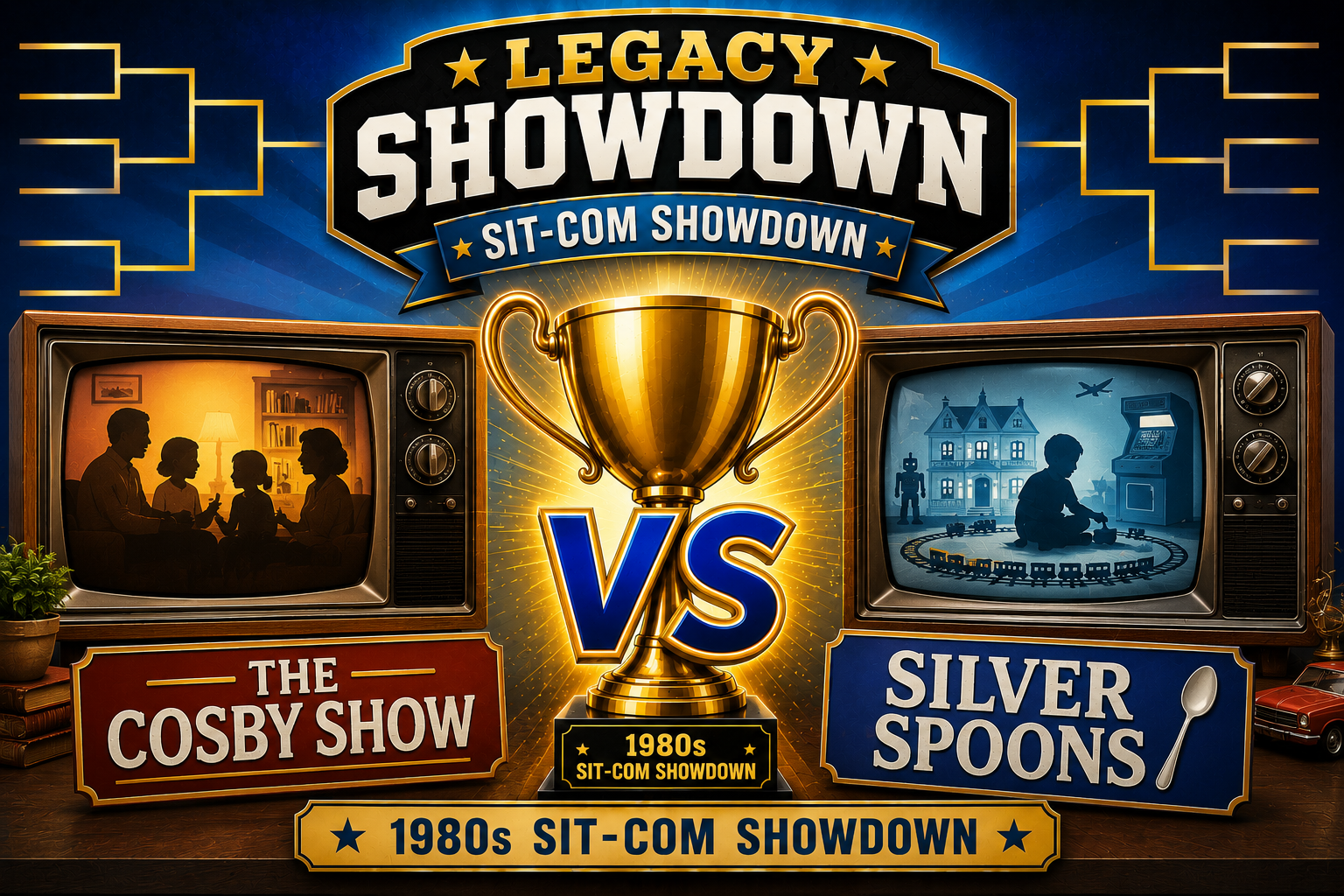
The 1980s region of the Sit-Com Showdown delivers a matchup between two beloved sitcoms that captured the attention of television audiences in very different ways. The Cosby Show became a cultural phenomenon that helped redefine the family sitcom, while Silver Spoons embraced fantasy, wealth, and youthful adventure through its unique father-son dynamic. This showdown pits one of television’s most influential family comedies against a lighthearted sitcom that became a favorite among younger viewers.
The Legacy Showdown Rules
Each matchup is judged using eight categories: Comedy Quality, Character Chemistry, Cultural Impact, Longevity & Replay Value, Iconic Moments, Supporting Cast, Era Difficulty, and Legacy Endurance.
Round 1: Comedy Quality
Both shows delivered successful family comedy, but The Cosby Show takes this round because its humor could emerge naturally from parenting, marriage, sibling rivalries, dating, school, and the everyday chaos surrounding the Huxtable household. One of the show’s greatest comedic strengths was turning an ordinary parent-child conversation into an extended routine, with Cliff Huxtable’s reactions to his children’s questionable decisions frequently becoming just as funny as the situation that caused the problem. A classic example comes from the premiere, when Theo explains to Cliff why he shouldn’t be expected to earn good grades, delivering an emotional speech about accepting him for who he is—only for Cliff to reject the argument and bluntly remind Theo that his parents expect him to try harder. Silver Spoons offered a different but enjoyable comedic style, particularly through the relationship between Ricky Stratton and his wealthy, fun-loving father Edward, whose mansion filled with toys—including the memorable miniature train—created an almost childlike fantasy world for the show’s humor. The comedy also benefited from the reversal within their relationship: Ricky could sometimes seem more responsible and mature than Edward, allowing the child to effectively become the sensible one while his father embraced his playful side. However, The Cosby Show had more comedic directions available because virtually every member of the Huxtable family could become the center of a story, allowing the humor to change depending on whether Cliff was dealing with Theo, Denise, Vanessa, Rudy, Clair, or the entire family at once. For combining relatable family situations, strong character comedy, memorable performances, and humor that could deliver a lesson without completely sacrificing the laughs, The Cosby Show earns the victory in Comedy Quality.
Round 1 Winner: The Cosby Show
Round 2: Character Chemistry
Both sitcoms were built around strong family relationships, but The Cosby Show takes this round because the chemistry extended throughout the entire Huxtable household rather than depending primarily on one central relationship, supporting the original blog’s verdict. At the center were Cliff and Clair Huxtable, whose playful teasing, disagreements, affection, and united approach to parenting created one of the show’s strongest relationships and gave the family a convincing foundation. Their chemistry became especially entertaining whenever one of the children tried to play one parent against the other, only to discover that Cliff and Clair could quickly unite when a parenting decision needed to be made. Silver Spoons had excellent chemistry of its own through Ricky and Edward Stratton, whose relationship reversed traditional expectations because Ricky was often the more responsible and practical one while his wealthy father maintained a playful, almost childlike enthusiasm for life. That unusual father-son dynamic gave the series considerable warmth, particularly as Edward gradually learned how to become a more responsible parent while Ricky discovered that growing up did not mean abandoning fun altogether. However, The Cosby Show could generate equally believable chemistry from Cliff and Theo, Clair and Denise, Rudy and her siblings, and the constantly changing combinations of family members gathered around the Huxtable home. For creating an ensemble in which the marriage, parent-child relationships, and sibling dynamics all contributed substantially to both the comedy and emotional heart of the series, The Cosby Show earns Round 2.
Round 2 Winner: The Cosby Show
Round 3: Cultural Impact
This round creates the clearest separation yet, because while Silver Spoons was a successful and memorable 1980s sitcom, The Cosby Show became a genuine television phenomenon whose popularity and influence extended far beyond the family-sitcom genre, matching the original blog’s verdict. The Huxtable family was especially significant because the series centered on an affluent Black family headed by two successful professionals—Cliff as a physician and Clair as an attorney—while allowing their stories to focus on universal experiences involving marriage, parenting, school, relationships, and growing up. Silver Spoons made its own contribution to 1980s popular culture through the wealthy Stratton household, Ricky and Edward’s unusual father-son relationship, and the fantasy-like mansion filled with extravagant toys that became instantly appealing to many younger viewers. The show also helped establish Ricky Schroder as one of the recognizable young television stars of the era and provided an early showcase for performers such as Jason Bateman. However, The Cosby Show reached a much broader level of cultural visibility, becoming appointment television for enormous audiences and helping demonstrate the continuing potential of the family sitcom at a time when the genre’s dominance was far from guaranteed. Its success also helped strengthen NBC’s sitcom lineup and contributed to a broader resurgence of family-centered television comedy during the decade. For becoming one of the defining television programs of the 1980s while influencing both the representation of Black families and the direction of the American family sitcom, The Cosby Show wins Cultural Impact decisively.
Round 3 Winner: The Cosby Show
Round 4: Longevity & Replay Value
Both shows remain recognizable pieces of 1980s television nostalgia, but The Cosby Show takes this round because its family-centered storytelling traditionally gave it broader replay appeal, matching the judgment in the original blog. At its strongest, the series built episodes around experiences that remain familiar across generations—parents worrying about their children, siblings irritating one another, teenagers pushing for independence, and married couples trying to maintain order while raising a large family. The early Cliff-and-Theo conversation about Theo’s grades and future, for example, works beyond its original decade because the conflict between a teenager’s expectations and a parent’s insistence on responsibility is not limited to the 1980s. Silver Spoons also offers considerable nostalgic replay value, particularly through Ricky and Edward Stratton’s father-son relationship and the wonderfully extravagant Stratton mansion, where arcade games, toys, and the famous indoor train created a childhood fantasy that immediately identifies the show with its era. Its lighter tone can make individual episodes easy to revisit, especially for viewers who remember Ricky’s attempts to bring responsibility into the life of his fun-loving father. The Cosby Show, however, traditionally offered a wider variety of family dynamics because stories could center on Cliff and Clair’s marriage, Theo’s adolescence, Denise’s independence, Vanessa’s growing pains, Rudy’s childhood, or combinations of the entire household. For building its comedy around broadly relatable family situations and an ensemble capable of generating many different kinds of stories, The Cosby Show earns the advantage in Longevity & Replay Value.
Round 4 Winner: The Cosby Show
Round 5: Iconic Moments
Both sitcoms produced memorable television moments, but The Cosby Show takes this round because its family interactions generated a larger collection of scenes that became strongly associated with 1980s television, matching the original blog’s verdict. One particularly memorable example is the Huxtable family’s elaborate lip-sync performance of Ray Charles’s “Night Time Is the Right Time” for Cliff’s parents, which brought the entire family together for a playful sequence that showcased the ensemble’s chemistry. Silver Spoons had unmistakable imagery of its own, especially the Stratton mansion and its miniature train, which became one of the show’s defining visual trademarks and perfectly captured the fantasy of a child suddenly living in a house filled with extravagant toys. The relationship between Ricky and Edward Stratton also generated memorable moments whenever their roles seemed reversed, with Ricky behaving like the responsible adult while Edward’s playful personality reminded his son that childhood should still contain some fun. The Cosby Show, however, could create standout scenes from nearly every Huxtable relationship, whether Cliff was confronting Theo, Clair was delivering a memorable parental response, Rudy was stealing a scene, or the entire family was participating in an elaborate celebration. Those moments succeeded because viewers had become invested not merely in individual characters but in the Huxtables functioning together as a family, allowing even relatively ordinary household events to become memorable television. For producing a larger collection of recognizable family scenes and ensemble moments that became closely associated with the show’s enormous popularity, The Cosby Show earns Round 5.
Round 5 Winner: The Cosby Show
Round 6: Supporting Cast
This round gives The Cosby Show another significant advantage because its supporting ensemble was deep enough that nearly every member of the Huxtable family could become the center of an episode without the series losing its identity, reinforcing the original blog’s verdict. Theo, Denise, Vanessa, and Rudy Huxtable each developed distinctive personalities, allowing the writers to explore very different stages of childhood and young adulthood while giving Cliff and Clair constantly changing parenting challenges. Clair Huxtable was especially important because she was never treated simply as the mother standing beside the show’s central father figure; her intelligence, career, confidence, humor, and formidable responses when the children crossed a line made her an essential part of the comedy and family dynamic. Silver Spoons had an entertaining supporting cast as well, with characters such as Derek Taylor providing Ricky with a mischievous friend whose personality could pull him toward adventures and trouble, while Kate Summers became increasingly important to Edward’s personal life. The series also featured young performers who would later become highly recognizable, including Jason Bateman as Derek and Alfonso Ribeiro as Alfonso Spears, adding an interesting dimension when the show is revisited today. However, Silver Spoons remained fundamentally centered on Ricky and Edward’s unusual father-son relationship, whereas The Cosby Show could shift attention among numerous family members and still produce stories that felt central to the series. For possessing an unusually deep ensemble in which the children, parents, grandparents, friends, and recurring characters could all contribute meaningfully to the comedy and storytelling, The Cosby Show comfortably takes Supporting Cast.
Round 6 Winner: The Cosby Show
Round 7: Era Difficulty
Both The Cosby Show and Silver Spoons competed during an exceptionally strong period for television comedy, but The Cosby Show takes this round because it did more than survive the competition—it became one of the dominant programs of the era, as the original blog argues. Silver Spoons deserves considerable credit because its Ricky-and-Edward Stratton father-son dynamic gave it a distinctive identity in a decade crowded with successful family sitcoms, while the extravagant Stratton mansion and its playful atmosphere helped the series appeal especially strongly to younger audiences. The Cosby Show, however, competed for viewers during a period that included major sitcom successes such as Cheers, Family Ties, The Golden Girls, Growing Pains, and Who’s the Boss?, yet still became a centerpiece of American prime-time television. The Huxtables stood apart because the series did not depend on an unusual fantasy premise; instead, it turned relatively ordinary experiences involving parenting, marriage, school, dating, sibling conflicts, and growing up into television that attracted an enormous mainstream audience. Its success was particularly impressive because virtually every member of the Huxtable family could drive a storyline, allowing the program to evolve as the children aged without abandoning the family chemistry at its center. Silver Spoons carved out a memorable place within the decade, but The Cosby Show reached a different competitive level by becoming one of the programs that other family sitcoms of the period had to measure themselves against. For achieving exceptional visibility and success during one of television’s deepest sitcom eras, The Cosby Show decisively takes Round 7.
Round 7 Winner: The Cosby Show
Round 8: Legacy Endurance
The final round goes decisively to The Cosby Show, because while Silver Spoons remains a fondly remembered piece of 1980s television, the Huxtable family’s place in television history is substantially larger, matching the original blog’s verdict. Silver Spoons retains a nostalgic legacy through Ricky and Edward Stratton’s unusual father-son relationship, its extravagant mansion setting, the famous indoor train, and its youthful fantasy of growing up surrounded by seemingly unlimited toys and adventures. The series also has an interesting place in television history for featuring young performers such as Jason Bateman and Alfonso Ribeiro, who would go on to have substantial careers of their own. The Cosby Show, however, had a much greater influence on the family-sitcom format, particularly through its portrayal of the Huxtables as an affluent Black family headed by two highly educated professionals, while allowing most stories to revolve around universal experiences such as marriage, parenting, school, sibling relationships, dating, and growing up. Its historical legacy is complicated by the later criminal convictions and allegations involving Bill Cosby, which profoundly changed how many viewers, networks, and critics regard the series and its central star; nevertheless, that does not erase the program’s enormous ratings success or its influence on American television during its original run. The performances of Phylicia Rashad, Malcolm-Jamal Warner, Lisa Bonet, Tempestt Bledsoe, Keshia Knight Pulliam, and the rest of the ensemble also remain an important part of evaluating the show’s television legacy rather than reducing its history solely to its lead actor. For its enormous original cultural reach, influence on subsequent family sitcoms, groundbreaking representation, and continuing importance—though now accompanied by a deeply complicated off-screen legacy—The Cosby Show takes Round 8 and advances in the Sit-Com Showdown.
Round 8 Winner: The Cosby Show
Final Verdict
Silver Spoons entered this matchup with charm, imagination, and a unique premise that resonated with younger audiences. However, The Cosby Show ultimately prevails through superior cultural impact, stronger ensemble chemistry, greater television influence, and a lasting legacy within sitcom history. The Cosby Show advances to the next round of the Sit-Com Showdown tournament.
Audience Challenge
Do you agree with the result? Should The Cosby Show move on, or does Silver Spoons deserve the upset victory? Cast your vote in the comments section. Remember: one vote per person, and the first sitcom to reach 10 valid votes advances.