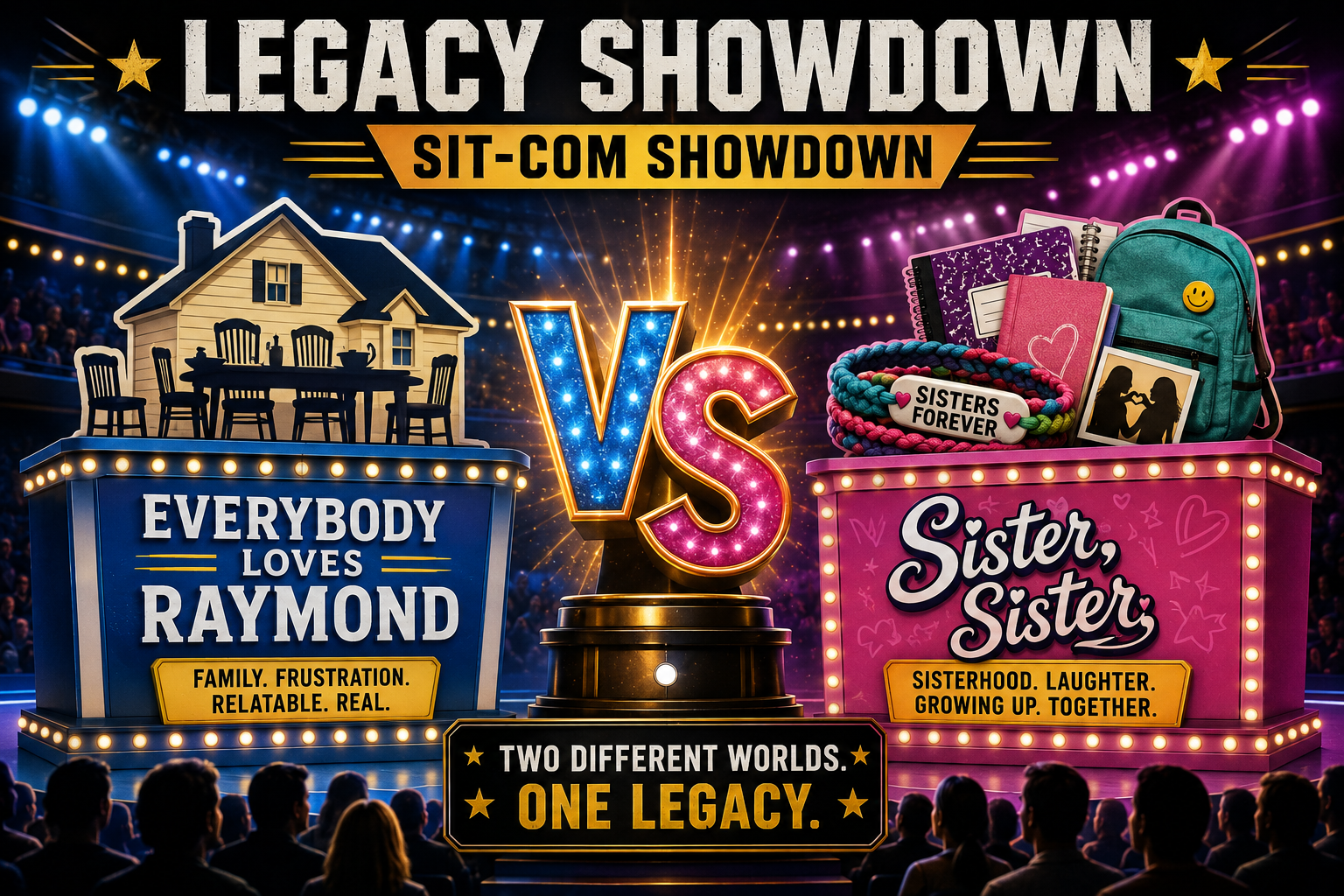


The Legacy Showdown tournament continues through the loaded 1990s bracket with a fascinating matchup between two sitcoms that represented very different styles of family comedy. On one side stands Everybody Loves Raymond, the sharply written suburban family sitcom built around marriage stress, family tension, and relatable everyday frustration. On the other side is Sister, Sister, the upbeat and energetic comedy that blended family warmth, teen humor, and twin-star chemistry into one of the decade’s most beloved youth-oriented sitcoms.
This showdown feels like a clash between adult relatability and youthful nostalgia. Everybody Loves Raymond thrived through realistic family dysfunction and elite sitcom writing, while Sister, Sister became a favorite among younger audiences through charm, positivity, and strong sibling chemistry. Can nostalgic family comfort overcome one of television’s smartest domestic comedies?
The Legacy Showdown Rules
- Comedy Quality
- Character Chemistry
- Cultural Impact
- Longevity & Replay Value
- Iconic Moments
- Supporting Cast
- Era Difficulty
- Legacy Endurance
Round 1: Comedy Quality
Both sitcoms were genuinely funny, but Everybody Loves Raymond takes the opening round because it mastered the difficult art of turning painfully ordinary family problems into comedy that could feel both exaggerated and completely believable. Much of the humor came from Ray Barone trying to avoid conflict, only for his attempts to escape responsibility or keep everyone happy to make situations dramatically worse, particularly when Debra and his mother Marie were on opposite sides of an argument. A perfect example is “The Toaster,” where Ray gives his parents an engraved toaster for Christmas, only to discover that Frank and Marie returned it without even opening the box, transforming something as insignificant as a household appliance into an escalating family disaster. Sister, Sister had a very different comedic strength, using Tia and Tamera’s contrasting personalities, teenage misunderstandings, dating problems, school situations, and the accidental confusion created by identical twins to produce an energetic and consistently charming style of humor. The constant interaction between Lisa Landry and Ray Campbell also gave the series another reliable comedy source, as Lisa’s larger-than-life personality frequently collided with Ray’s more controlled and conventional approach to parenting and everyday life. However, Everybody Loves Raymond possessed an additional layer of comedic precision because Ray, Debra, Robert, Marie, and Frank could turn a minor disagreement about food, parenting, marriage, chores, or visiting relatives into an entire episode without the conflict feeling completely manufactured. For its exceptionally sharp dialogue, uncomfortable realism, character-driven humor, and remarkable ability to find enormous laughs inside the smallest frustrations of everyday family life, Everybody Loves Raymond takes Round 1.
Round 1 Winner: Everybody Loves Raymond
Round 2: Character Chemistry
This is a much closer battle because Sister, Sister was built around the genuine chemistry between Tia and Tamera Mowry, but Everybody Loves Raymond earns the narrow victory because nearly every combination of its central characters could produce both comedy and believable family tension, matching the original blog’s verdict. Tia and Tamera were unquestionably the heart of Sister, Sister, with their contrasting personalities—Tia generally being more studious and cautious while Tamera was more impulsive and outgoing—allowing their real-life sisterly connection to translate naturally onto the screen. The show also benefited enormously from Lisa Landry and Ray Campbell, whose very different personalities created their own entertaining relationship while they attempted to raise the reunited twins together under one roof. Everybody Loves Raymond, however, created an extraordinary web of chemistry because Ray and Debra’s marriage, Ray and Robert’s sibling rivalry, Marie’s interference in Debra’s household, and Frank’s constant sarcastic commentary could all drive entire episodes. One of the strongest dynamics was between Debra and Marie, because their conflict went beyond simple mother-in-law jokes: Marie’s constant criticism of Debra’s cooking, housekeeping, and parenting created tension that felt painfully recognizable while still producing enormous laughs. Even Ray’s relationship with Robert added another layer, as Robert’s lifelong jealousy over Ray being the favored son mixed resentment with genuine brotherly affection, making their arguments both funny and believable. Sister, Sister deserves tremendous credit for the warmth and authenticity of its central sibling relationship, but for building an entire ensemble in which virtually every character pairing generated its own distinctive comedic chemistry, Everybody Loves Raymond narrowly takes Round 2.
Round 2 Winner: Everybody Loves Raymond
Round 3: Cultural Impact
This round goes to Everybody Loves Raymond, because while Sister, Sister became an important and beloved part of 1990s youth television, Everybody Loves Raymond ultimately achieved the broader cultural reach and became one of the defining domestic sitcoms of its era, matching the original blog’s verdict. Sister, Sister deserves significant recognition because Tia and Tamera Mowry became recognizable young television stars, and the series gave audiences a positive Black family comedy centered on two teenage girls navigating school, friendships, dating, sibling relationships, and their newly reunited family. Its influence is particularly evident in the lasting affection viewers have for Tia and Tamera, while the show’s fashion, catchphrases, upbeat tone, and family warmth make it a strong source of 1990s nostalgia today. Everybody Loves Raymond, however, connected with an exceptionally broad adult audience because the Barones’ conflicts involving marriage, in-laws, sibling rivalry, favoritism, parenting, and intrusive relatives reflected situations that many viewers recognized from their own families. Characters such as Marie Barone became cultural shorthand for the overbearing mother and mother-in-law, while Robert’s jealousy of Ray and Frank’s blunt personality gave the series additional family archetypes that audiences could immediately understand. The show’s influence also extended beyond American television, with its basic format and family dynamics eventually being adapted for audiences in numerous international markets, demonstrating how universally recognizable its central conflicts could be. For transforming everyday domestic frustrations into a style of family comedy that connected across generations and cultures while becoming one of the signature sitcoms of the late 1990s and early 2000s, Everybody Loves Raymond takes Round 3.
Round 3 Winner: Everybody Loves Raymond
Round 4: Longevity & Replay Value
Everybody Loves Raymond takes Round 4 because its comedy is built around family problems that remain recognizable regardless of when an episode originally aired, reinforcing the original blog’s argument that marriage stress, parents, and awkward family gatherings give the series tremendous replay value. The Barones rarely needed major events to create a story; something as ordinary as Marie criticizing Debra, Robert feeling overshadowed by Ray, or Ray desperately trying to avoid taking sides could generate an entire episode because those conflicts were rooted in established relationships. A particularly strong example is “Baggage,” where Ray and Debra become locked in a stubborn battle over who should move a suitcase that has been sitting on the staircase, turning an unbelievably minor household disagreement into a hilarious examination of marriage, pride, and passive-aggressive behavior. Sister, Sister also has considerable replay appeal, especially for viewers who grew up with Tia and Tamera, because its stories about teenage friendships, dating, school, sibling disagreements, and discovering independence capture much of the warmth and personality of 1990s youth television. Its fashion, music, slang, and overall atmosphere actually strengthen its nostalgic appeal, allowing viewers to revisit the show partly because it feels so distinctly connected to its era. Everybody Loves Raymond, however, is less dependent on nostalgia because arguments between spouses, competition between siblings, meddling parents, difficult in-laws, and disagreements over raising children remain relatable to new generations of adults. For creating comedy from universal family frustrations that can remain funny even when the cultural references surrounding them become dated, Everybody Loves Raymond comfortably earns Round 4.
Round 4 Winner: Everybody Loves Raymond
Round 5: Iconic Moments
Both shows created memorable scenes that fans still associate with their characters, but Everybody Loves Raymond takes Round 5 because its greatest moments could turn ridiculously small family disputes into unforgettable pieces of sitcom comedy, supporting the original blog’s verdict. Marie Barone was responsible for many of these moments, as her passive-aggressive comments, constant interference, and ability to criticize Debra while presenting herself as a concerned mother gave the series one of television’s most memorable sitcom mothers. One especially strong example comes from “The Canister,” when Debra believes she has finally proven Marie wrong about a missing kitchen canister, only for the situation to escalate into another wonderfully uncomfortable battle between the two women and demonstrate just how much comedy the show could extract from an insignificant household object. Sister, Sister produced plenty of memorable moments of its own, especially those built around Tia and Tamera switching places, navigating teenage relationships, or using their twin connection to escape difficult situations, while Lisa Landry’s outrageous personality regularly provided scene-stealing comedy. The show’s opening premise itself—two identical twins separated at birth accidentally discovering one another as teenagers—also gave the series an instantly recognizable identity and established the sisterly relationship that audiences would follow throughout the show. However, Everybody Loves Raymond accumulated a larger collection of standout situations involving Marie and Debra’s rivalry, Ray and Robert’s sibling competition, Frank’s brutally direct observations, and Ray’s increasingly desperate attempts to survive whatever family argument was unfolding around him. For producing memorable scenes that transformed everyday marriage and family frustrations into classic sitcom situations—and for creating a character as unforgettable as Marie Barone—Everybody Loves Raymond takes Round 5.
Round 5 Winner: Everybody Loves Raymond
Round 6: Supporting Cast
This round strongly favors Everybody Loves Raymond because, while Sister, Sister had an entertaining supporting ensemble, the Barone family featured secondary characters who became nearly as essential to the show’s identity as Ray and Debra themselves, exactly as the original blog argues. Marie Barone was arguably the ultimate supporting character, with her constant interference, passive-aggressive criticism of Debra, obvious favoritism toward Ray, and belief that nobody could cook or care for her family quite as well as she could creating an almost endless supply of conflict. Frank Barone provided the perfect counterbalance, responding to the family’s arguments with blunt insults, complaints, and complete lack of concern about offending anyone, while frequently revealing that beneath his gruff personality he genuinely cared about his family. Sister, Sister had scene-stealers of its own, particularly Lisa Landry, whose energetic personality, humor, fashion ambitions, and unpredictable behavior made her much more than simply Tia’s mother, while Ray Campbell’s more restrained personality provided an effective contrast. The Barones, however, had another major weapon in Robert, whose jealousy over Ray’s favored-child status, awkwardness, romantic struggles, and famous tendency to touch food to his chin before eating gave Brad Garrett a character capable of carrying major storylines himself. What made the ensemble particularly impressive was that Marie, Frank, and Robert were not simply supporting Ray’s stories—their marriages, insecurities, rivalries, and personal problems frequently became the stories, giving the series several different sources of comedy. For surrounding its lead couple with three exceptionally distinctive family members who became iconic sitcom characters in their own right, Everybody Loves Raymond comfortably takes Round 6.
Round 6 Winner: Everybody Loves Raymond
Round 7: Era Difficulty
The 1990s represented one of the deepest periods in sitcom history, making success difficult for both programs, but Everybody Loves Raymond takes this round because it entered an already crowded field and still developed into one of the era’s most respected and successful family comedies, matching the original blog’s verdict. Sister, Sister faced significant competition of its own, particularly within youth and family television, yet the natural appeal of Tia and Tamera Mowry, combined with Lisa and Ray’s unconventional blended household, helped it establish a distinctive identity. Everybody Loves Raymond, however, arrived while audiences already had an enormous selection of established sitcoms, meaning another comedy about a suburban husband, wife, children, and extended family could easily have disappeared without exceptionally strong writing and characters. Instead, the Barones distinguished themselves through Ray and Debra’s realistic marital disagreements, Robert’s resentment toward his brother, Marie’s relentless interference, and Frank’s brutally blunt personality, creating family conflicts that felt more uncomfortable and authentic than the cleaner sitcom formulas surrounding them. The show also resisted depending heavily on gimmicks or elaborate premises, trusting conversations about marriage, parents, children, household responsibilities, and family boundaries to generate enough comedy to keep audiences invested. That simplicity actually made its achievement more impressive: Everybody Loves Raymond had to outperform competitors largely through writing, timing, acting, and the chemistry of its ensemble rather than through a high-concept premise. For breaking through an exceptionally competitive sitcom environment and establishing the Barone family as one of the defining television ensembles of its period, Everybody Loves Raymond earns Round 7.
Round 7 Winner: Everybody Loves Raymond
Round 8: Legacy Endurance
The final round goes to Everybody Loves Raymond, because while Sister, Sister remains a beloved source of 1990s nostalgia, the Barone family has secured a broader and more enduring position in sitcom history, matching the original blog’s verdict. Sister, Sister absolutely deserves recognition for its lasting appeal, particularly because Tia and Tamera Mowry’s twin chemistry continues to connect with viewers who remember the series fondly and with younger audiences discovering the show years after its original run. Its portrayal of two Black teenage girls at the center of a warm family sitcom also gives the series an important place in 1990s television, while Lisa Landry and Ray Campbell helped create an unconventional but loving household that remains central to the show’s feel-good reputation. Everybody Loves Raymond, however, has demonstrated exceptional endurance because the Barones’ problems—marriage disagreements, sibling jealousy, intrusive parents, difficult in-laws, favoritism, and family boundaries—remain recognizable regardless of the decade. Characters such as Marie, Frank, and Robert Barone became far more than supporting players, developing into distinctive sitcom personalities whose relationships with Ray and Debra helped give the series an ensemble strong enough to stand alongside many of television’s classic comedy families. The show’s continued association with relatable domestic comedy also demonstrates why its relatively simple premise became a strength: audiences do not need to understand 1990s culture to appreciate the nightmare of having overbearing relatives living directly across the street. For combining timeless family conflicts, exceptional ensemble chemistry, memorable characters, and the kind of relatable writing that can survive well beyond its original television era, Everybody Loves Raymond takes Round 8 and advances deeper into the Sit-Com Showdown tournament.
Round 8 Winner: Everybody Loves Raymond
Final Verdict
Sister, Sister entered the matchup with warmth, nostalgia, and one of the most lovable sibling dynamics of the 1990s. But Everybody Loves Raymond ultimately proved too dominant in the categories that define long-term sitcom greatness.
With elite writing, timeless family humor, and unforgettable supporting characters, Everybody Loves Raymond advances deeper into the Sit-Com Showdown tournament as one of the most dangerous contenders in the 1990s bracket.
Audience Challenge
Do you agree with the result? Or should Sister, Sister receive more recognition as one of the great feel-good sitcoms of the 1990s? Join the debate and continue the Legacy Showdown tournament.