
Some players fill the stat sheet. Others anchor a franchise. And then there are those who carry a city on their shoulders.
Patrick Ewing was that kind of player.
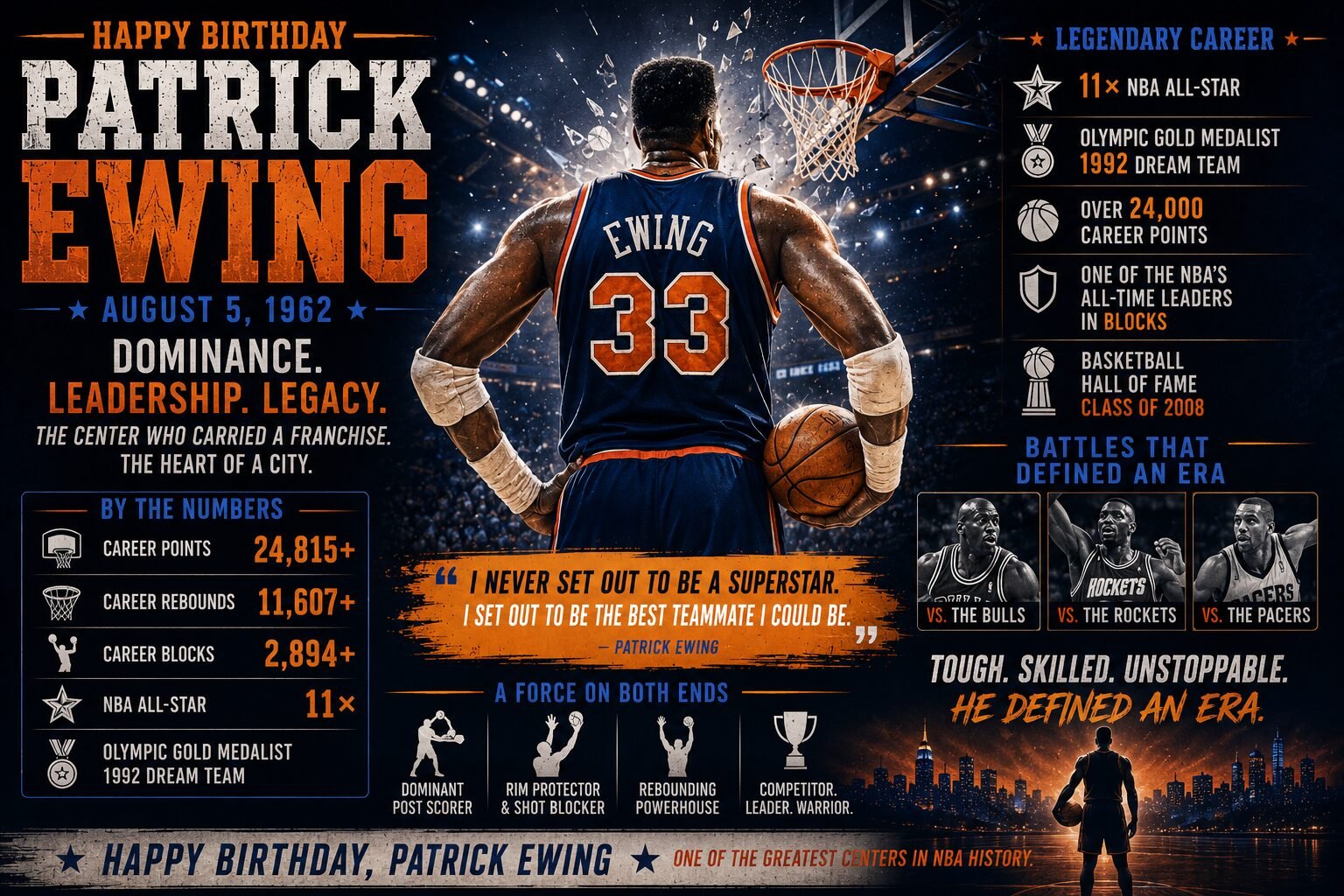
Born on August 5, 1962, Ewing didn’t just become a star for the New York Knicks — he became the face of the franchise during one of its most competitive eras. On his birthday, fans celebrate more than points and rebounds. They celebrate dominance, leadership, and one of the greatest big men in NBA history.
Affiliate Disclosure: This article may contain affiliate links and banner advertisements. If you make a purchase through these links, we may earn a small commission at no additional cost to you. Thank you for supporting our platform.
From Georgetown to NBA Greatness
Patrick Ewing’s journey to basketball greatness began far from the bright lights of the NBA. Born in Kingston, Jamaica, Ewing spent his early childhood before moving with his family to Cambridge, Massachusetts, in the United States. It was there that his remarkable athletic ability began to emerge. His combination of size, strength, coordination, and determination quickly made him one of the nation’s most highly recruited high school basketball players.
Ewing chose to attend Georgetown University, where he played under legendary head coach John Thompson. Thompson became more than just a coach—he served as a mentor who helped shape Ewing both as a basketball player and as a young man. Together, they built one of the most successful college basketball programs in the country, transforming Georgetown into a national powerhouse during the early 1980s.
During his four-year collegiate career, Ewing developed into one of the most dominant players in NCAA history. His intimidating defensive presence, exceptional shot-blocking ability, rebounding, and polished offensive game made him nearly impossible for opponents to contain. Georgetown reached three NCAA Championship games during his career, winning the national title in 1984 and consistently competing among the nation’s elite teams. Ewing earned numerous All-American honors while establishing himself as the consensus top prospect for the NBA.
Beyond the statistics and championships, Ewing became the face of college basketball. His fierce competitiveness, relentless work ethic, and ability to take over games earned the respect of teammates, coaches, and opponents alike. Every time he stepped onto the floor, opposing teams were forced to adjust their entire game plan because of the impact he made on both ends of the court.
He wasn’t just skilled.
He was unstoppable.
Whether protecting the rim with thunderous blocked shots, controlling the paint with his rebounding, or scoring against double teams, Ewing consistently proved why he was considered one of the greatest college centers ever to play the game. By the time he completed his career at Georgetown, he had firmly established himself as one of the most accomplished players in NCAA history and the clear choice to become the first overall pick in the 1985 NBA Draft.
His remarkable success at Georgetown laid the foundation for a Hall of Fame NBA career and marked the beginning of one of basketball’s most respected legacies.
The Rise with the Knicks
When the New York Knicks selected Patrick Ewing with the first overall pick in the 1985 NBA Draft, the expectations were enormous. He arrived in New York as one of the most highly anticipated prospects in basketball history, and the franchise looked to him to restore its place among the NBA’s elite. Ewing embraced the challenge from the very beginning, quickly becoming the face of one of the league’s most recognizable organizations.
His impact was immediate. Ewing captured the NBA Rookie of the Year Award and established himself as one of the league’s premier centers. Combining exceptional footwork, remarkable athleticism, and a polished offensive game, he became one of the NBA’s most difficult players to defend. At the same time, his intimidating presence in the paint made opposing players think twice before attacking the basket.
As the years passed, Ewing became the unquestioned cornerstone of the Knicks. During the late 1980s and throughout the 1990s, he led New York through one of the franchise’s most successful eras. The Knicks became perennial playoff contenders, earning multiple Atlantic Division titles and consistently battling the NBA’s best teams in the Eastern Conference. Under Ewing’s leadership, Madison Square Garden once again became one of basketball’s toughest places for opponents to play.
He brought:
- Elite scoring in the post, using outstanding footwork, a reliable turnaround jumper, powerful inside moves, and a smooth mid-range shot to consistently rank among the NBA’s leading scorers.
- Shot-blocking dominance, protecting the rim with exceptional timing, strength, and defensive instincts that made him one of the league’s most feared interior defenders.
- Rebounding strength, controlling the glass on both ends of the floor through determination, positioning, and physical play that created valuable extra possessions for his team.
- Leadership, serving as the emotional and competitive heartbeat of the Knicks while setting the standard for preparation, toughness, and professionalism every time he stepped onto the court.
Ewing’s greatest value extended beyond his impressive statistics. Night after night, he faced double and triple teams while carrying the offensive load against some of the NBA’s toughest defenders. Despite the physical style of play that defined the 1990s, he consistently delivered outstanding performances while anchoring one of the league’s best defensive teams.
His fierce competitiveness became a defining characteristic of the Knicks during one of the NBA’s most physical eras. Alongside teammates such as John Starks, Charles Oakley, and later Allan Houston, Ewing helped build a team known for its toughness, resilience, and refusal to back down from any opponent. Their intense playoff battles against Michael Jordan’s Chicago Bulls, Reggie Miller’s Indiana Pacers, and Hakeem Olajuwon’s Houston Rockets became some of the most memorable rivalries in NBA history.
He didn’t just anchor the team.
He carried it.
For more than a decade, Patrick Ewing was the foundation of New York basketball. His leadership, consistency, and relentless determination transformed the Knicks into perennial championship contenders and cemented his place as one of the greatest players in franchise history. Even today, he remains the standard by which every great Knicks center is measured.
Career Highlights & Achievements
Patrick Ewing’s résumé is legendary:
- 11× NBA All-Star
- Olympic Gold Medalist (Dream Team, 1992)
- Over 24,000 career points
- One of the NBA’s all-time leaders in blocks
- Basketball Hall of Fame (2008)
His production ranks among the greatest centers ever.
Buy Yours: Patrick Ewing New York Knicks Mitchell & Ness Name & Number Hoodie – Blue
A Force in the Paint
Patrick Ewing established himself as one of the NBA’s most complete and dominant centers by controlling the game on both offense and defense. Every time he stepped onto the court, he demanded the attention of opposing coaches and players alike. His unique combination of size, athleticism, footwork, and basketball intelligence allowed him to impact nearly every possession, making him one of the league’s premier two-way players throughout the 1980s and 1990s.
On the offensive end, Ewing possessed one of the most polished skill sets of any center in NBA history. He could overpower defenders with his strength in the low post, score with an array of turnaround jumpers and hook shots, and consistently knock down mid-range jump shots that forced opposing big men to defend him away from the basket. His versatility made him incredibly difficult to guard because he could score from multiple spots on the floor.
Defensively, Ewing was equally dominant. His shot-blocking ability discouraged opponents from attacking the rim, while his physical presence altered countless shots that never appeared in the box score. He anchored the Knicks’ defense for more than a decade, communicating with teammates, protecting the paint, and serving as the final line of defense against some of the NBA’s most explosive offenses.
He excelled at:
- Post scoring, using exceptional footwork, soft shooting touch, powerful finishes, and a variety of moves that made him one of the league’s most reliable offensive weapons.
- Rim protection, blocking shots with outstanding timing and positioning while forcing opposing players to rethink their approach whenever they entered the paint.
- Mid-range shooting, developing one of the most dependable jump shots among NBA centers, giving him an offensive weapon that few players at his position possessed during his era.
- Controlling the boards, consistently battling for rebounds on both ends of the floor to limit opponents’ second-chance opportunities while creating extra possessions for New York.
What made Ewing especially valuable was his consistency. Night after night, he delivered elite production regardless of the opponent. Whether facing Hall of Fame centers such as Hakeem Olajuwon, David Robinson, Shaquille O’Neal, or Alonzo Mourning, Ewing embraced every challenge and competed with relentless intensity. His toughness and willingness to play through injuries further earned the admiration of teammates and Knicks fans.
He was the centerpiece of every game plan.
Opposing coaches built their defensive strategies around slowing him down, often sending double teams and collapsing the paint whenever he touched the basketball. At the same time, offensive game plans were designed to avoid his defensive presence near the basket whenever possible.
Patrick Ewing’s ability to dominate both ends of the floor made him much more than a star player.
He became the foundation of the New York Knicks for more than a decade, proving that an elite center could control the outcome of a game through skill, toughness, and an unwavering competitive spirit.
Buy Yours: Patrick Ewing HOF Signed Mitchell & Ness Basketball Jersey Knicks Beckett 177490
Battles of the 90s
Patrick Ewing’s career was defined by some of the fiercest rivalries in NBA history. The 1990s were widely regarded as one of basketball’s most physical and competitive eras, featuring numerous Hall of Fame players and championship-caliber teams. Every postseason seemed to produce another unforgettable battle, and Ewing was at the center of many of the decade’s most memorable playoff series.
Night after night, Ewing faced the challenge of competing against some of the greatest players ever to step onto a basketball court. Every game demanded maximum effort, both physically and mentally. There were no easy victories, especially in the Eastern Conference, where playoff basketball often resembled a war of attrition. Every rebound, every loose ball, and every possession had to be earned through toughness, determination, and relentless effort.
He battled against:
- Michael Jordan and the Chicago Bulls, whose championship dynasty often stood between the Knicks and an NBA Finals appearance. The Bulls-Knicks rivalry became one of the league’s defining matchups, with every game featuring physical defense, emotional intensity, and playoff-level basketball. Although Jordan’s Bulls frequently emerged victorious, Ewing never backed down from the challenge and consistently gave New York a chance to compete against one of the greatest teams in NBA history.
- Hakeem Olajuwon and the Houston Rockets, another Hall of Fame center whose battles with Ewing showcased two of the game’s premier big men. Their matchup reached its peak during the 1994 NBA Finals, where the Knicks and Rockets fought through a grueling seven-game series. Every possession became a contest of skill, strength, and determination as two elite centers battled for basketball’s ultimate prize.
- Reggie Miller and the Indiana Pacers, whose dramatic playoff meetings became legendary throughout the decade. While Miller tormented the Knicks with his clutch shooting, Ewing answered with dominant performances in the paint, creating one of the NBA’s most emotionally charged rivalries. The fierce competition between New York and Indiana produced unforgettable moments that remain staples of NBA playoff history.
Those weren’t the only legendary battles that defined Ewing’s career. Throughout the 1990s, he also squared off against dominant centers such as David Robinson, Shaquille O’Neal, Alonzo Mourning, Dikembe Mutombo, and young stars who viewed defeating Ewing as a measuring stick for their own greatness. Every matchup tested his skill, endurance, and competitive spirit against the very best the NBA had to offer.
What made these rivalries so memorable was the style of basketball played during that era. Games were intensely physical, defensive stops were celebrated as much as spectacular dunks, and playoff series often became emotional, hard-fought battles that lasted the full seven games. Players competed with incredible passion and toughness while earning mutual respect through years of unforgettable competition.
Those matchups helped define an era of physical, competitive basketball.
Although the Knicks never captured an NBA championship during Ewing’s tenure, they were consistently among the league’s elite because of his leadership and determination. He helped make Madison Square Garden the stage for some of the greatest playoff moments in NBA history, and his rivalries with Jordan, Olajuwon, Miller, and countless other Hall of Famers remain an enduring part of basketball lore.
For an entire generation of NBA fans, the road to the Finals often ran through Patrick Ewing and the New York Knicks. His willingness to compete against the very best, regardless of the odds, cemented his legacy as one of the defining players of one of basketball’s greatest decades.
Buy Yours: Patrick Ewing Autographed Game Used 99-00 Next Basketball Shoes – JSA LOA/Mears
Why Knicks Fans Still Revere Him
In New York, Ewing represents:
- Toughness
- Leadership
- Consistency
- A defining era of Knicks basketball
He became the heart of the franchise.
Patrick Ewing’s career was defined by some of the fiercest rivalries in NBA history. The 1990s were widely regarded as one of basketball’s most physical and competitive eras, featuring numerous Hall of Fame players and championship-caliber teams. Every postseason seemed to produce another unforgettable battle, and Ewing was at the center of many of the decade’s most memorable playoff series.
Night after night, Ewing faced the challenge of competing against some of the greatest players ever to step onto a basketball court. Every game demanded maximum effort, both physically and mentally. There were no easy victories, especially in the Eastern Conference, where playoff basketball often resembled a war of attrition. Every rebound, every loose ball, and every possession had to be earned through toughness, determination, and relentless effort.
He battled against:
- Michael Jordan and the Chicago Bulls, whose championship dynasty often stood between the Knicks and an NBA Finals appearance. The Bulls-Knicks rivalry became one of the league’s defining matchups, with every game featuring physical defense, emotional intensity, and playoff-level basketball. Although Jordan’s Bulls frequently emerged victorious, Ewing never backed down from the challenge and consistently gave New York a chance to compete against one of the greatest teams in NBA history.
- Hakeem Olajuwon and the Houston Rockets, another Hall of Fame center whose battles with Ewing showcased two of the game’s premier big men. Their matchup reached its peak during the 1994 NBA Finals, where the Knicks and Rockets fought through a grueling seven-game series. Every possession became a contest of skill, strength, and determination as two elite centers battled for basketball’s ultimate prize.
- Reggie Miller and the Indiana Pacers, whose dramatic playoff meetings became legendary throughout the decade. While Miller tormented the Knicks with his clutch shooting, Ewing answered with dominant performances in the paint, creating one of the NBA’s most emotionally charged rivalries. The fierce competition between New York and Indiana produced unforgettable moments that remain staples of NBA playoff history.
Those weren’t the only legendary battles that defined Ewing’s career. Throughout the 1990s, he also squared off against dominant centers such as David Robinson, Shaquille O’Neal, Alonzo Mourning, Dikembe Mutombo, and young stars who viewed defeating Ewing as a measuring stick for their own greatness. Every matchup tested his skill, endurance, and competitive spirit against the very best the NBA had to offer.
What made these rivalries so memorable was the style of basketball played during that era. Games were intensely physical, defensive stops were celebrated as much as spectacular dunks, and playoff series often became emotional, hard-fought battles that lasted the full seven games. Players competed with incredible passion and toughness while earning mutual respect through years of unforgettable competition.
Those matchups helped define an era of physical, competitive basketball.
Although the Knicks never captured an NBA championship during Ewing’s tenure, they were consistently among the league’s elite because of his leadership and determination. He helped make Madison Square Garden the stage for some of the greatest playoff moments in NBA history, and his rivalries with Jordan, Olajuwon, Miller, and countless other Hall of Famers remain an enduring part of basketball lore.
For an entire generation of NBA fans, the road to the Finals often ran through Patrick Ewing and the New York Knicks. His willingness to compete against the very best, regardless of the odds, cemented his legacy as one of the defining players of one of basketball’s greatest decades.
Buy Yours: Patrick Ewing HOF Autographed Mitchell & Ness Basketball Jersey Knicks Beckett
A Birthday Worth Celebrating in New York
Patrick Ewing didn’t just play basketball.
He defined an era.
On August 5, we celebrate more than a Hall of Famer.
We celebrate dominance.
Happy Birthday, Patrick Ewing — one of the greatest centers in NBA history.





Totally agree, he really did carry New York with him. It’s amazing to see how impactful his game was.