Affiliate Disclaimer
This blog may contain affiliate links or banner advertisements. If you click on one of these links or advertisements and make a purchase, The Shopping Plaza may earn a small commission at no additional cost to you. These commissions help support our work and allow us to continue creating free sports content, rankings, tournament features, and Legacy Showdown matchups like Gametime Gauntlet. We only recommend products, services, or merchandise that we believe may be of interest to our readers. Thank you for supporting The Shopping Plaza and Gametime Gauntlet.
The Matchup
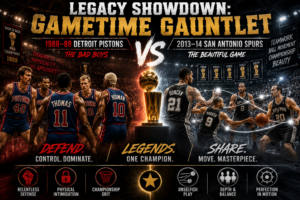
The next matchup in the NBA Region delivers one of the most fascinating stylistic contrasts in the entire Gametime Gauntlet. The #6 seed 1988-89 Detroit Pistons, forever remembered as the ‘Bad Boys,’ built their championship identity around physical defense, mental toughness, depth, and an unapologetically confrontational style. Isiah Thomas and Joe Dumars supplied the backcourt skill, Bill Laimbeer and Rick Mahorn brought interior force, Dennis Rodman and John Salley gave Detroit defensive versatility, and Vinnie Johnson provided instant offense from the bench.
Across the bracket stand the #7 seed 2013-14 San Antonio Spurs, a champion remembered for almost the opposite aesthetic. Tim Duncan, Tony Parker, Manu Ginobili, and an emerging Kawhi Leonard operated inside Gregg Popovich’s sophisticated system of passing, spacing, cutting, shooting, and constant unselfish movement. San Antonio’s 2014 NBA Finals performance against the defending champion Miami Heat became a showcase for collective offense and precision execution.
This is not a hypothetical game played under one era’s rules. Gametime Gauntlet evaluates each team relative to its own time across ten categories. Detroit’s case rests on a brutal championship path, defensive influence, and pressure-tested toughness. San Antonio counters with regular-season dominance, extraordinary depth, efficiency, dynasty-level longevity, and one of the most admired team-oriented championship performances in NBA history.
- Dominance Over Competition
Detroit was an elite champion, finishing 63-19 and establishing itself as the best regular-season team in the Eastern Conference. The Pistons combined a rugged defensive identity with enough offensive balance to control games without depending on one scorer every night. Their postseason included demanding series against Boston and Chicago before a sweep of the Lakers in the Finals. San Antonio, however, was similarly excellent across the full season, finishing 62-20 with the NBA’s best record. The Spurs then navigated four playoff rounds and reached another level in the Finals, defeating the two-time defending champion Miami Heat in five games. San Antonio won the last three games of that series by decisive margins and made an elite opponent look overwhelmed by its execution. Detroit’s 63 wins make this close, but the source blog’s edge goes to San Antonio because of the totality of its season and the emphatic way it finished the championship run.
Winner: 2013-14 San Antonio Spurs
- Championship Achievement
Both teams completed exceptional championship seasons, and this is one of the narrowest categories in the matchup. Detroit swept the Los Angeles Lakers in the 1989 Finals, though Magic Johnson and Byron Scott were compromised by injuries during the series. That should not diminish Detroit’s achievement: the Pistons had already survived a punishing Eastern Conference and had reached the Finals the previous year before losing to Los Angeles in seven games. San Antonio’s title carried a different kind of weight. The Spurs returned to the Finals one year after their devastating seven-game loss to Miami and defeated the same championship core in a five-game rematch. Their response to the heartbreak of 2013 turned the 2014 championship into a demonstration of resilience as well as excellence. Detroit’s sweep was dominant, but San Antonio’s redemption against the defending champions gives the Spurs the slightest edge in Championship Achievement.
Winner: 2013-14 San Antonio Spurs
- Strength of Competition
Detroit’s road to the championship passed through an extraordinarily difficult basketball landscape. The Pistons had to contend with a Boston Celtics organization that had defined much of the decade, an emerging Chicago Bulls team led by Michael Jordan, and finally the Los Angeles Lakers of Magic Johnson and Kareem Abdul-Jabbar. Even when injuries affected Los Angeles in the Finals, Detroit had already proven itself against multiple Hall of Fame-level opponents. The Eastern Conference in particular demanded physical, possession-by-possession basketball, and Detroit’s identity was forged through those battles. San Antonio also faced quality competition, including Dallas, Portland, Oklahoma City, and the defending champion Miami Heat. Kevin Durant had won the league MVP, while LeBron James remained at the height of his powers. Yet Detroit’s championship path intersected with a remarkable concentration of iconic 1980s stars and teams. Strength of Competition therefore remains with the Pistons.
Winner: 1988-89 Detroit Pistons
- Star Power
Detroit’s roster contained major individual talent. Isiah Thomas was the emotional and offensive leader, Joe Dumars was an elite two-way guard who won Finals MVP, Dennis Rodman was becoming one of basketball’s greatest defenders and rebounders, and Bill Laimbeer was an All-Star-caliber center whose toughness helped define the team’s personality. San Antonio counters with a remarkable collection of accomplished players from different stages of their careers. Tim Duncan was already one of the greatest power forwards ever, Tony Parker and Manu Ginobili were established championship stars, and Kawhi Leonard was emerging into an elite two-way force before winning Finals MVP. The Spurs also had Boris Diaw, Danny Green, Patty Mills, Tiago Splitter, and other players capable of taking over specific roles within the system. Detroit’s stars were formidable, but San Antonio’s combination of an all-time foundational superstar, two longtime championship partners, and a rising future superstar gives the Spurs the edge. Star Power goes to San Antonio.
Winner: 2013-14 San Antonio Spurs
- Depth and Supporting Cast
Detroit was extremely deep and deserves serious consideration here. The Pistons could surround Thomas and Dumars with Laimbeer, Mahorn, Rodman, Salley, James Edwards, and Vinnie ‘The Microwave’ Johnson, giving coach Chuck Daly multiple ways to change the physical and tactical complexion of a game. That depth helped Detroit withstand difficult playoff series and maintain its defensive intensity. San Antonio’s 2014 rotation, however, became one of the defining strengths of the championship team. Duncan, Parker, Ginobili, and Leonard were supported by Danny Green’s shooting and defense, Boris Diaw’s passing and versatility, Patty Mills’ energy, Tiago Splitter’s interior work, Marco Belinelli’s shooting, and other role players who understood exactly what the system demanded. The Spurs did not merely have a productive bench; they could alter lineups without losing their fundamental identity. Their ball movement often made the distinction between starter and reserve feel less important than on most championship teams. The source’s Depth and Supporting Cast point belongs to San Antonio.
Winner: 2013-14 San Antonio Spurs
- Historical Impact
The 2014 Spurs became a lasting symbol of beautiful, unselfish team basketball. Coaches and fans continue to reference their Finals ball movement as an example of what can happen when spacing, passing, cutting, decision-making, and trust operate together at an elite level. Detroit’s historical influence, however, reaches into the evolution of how an entire era is remembered. The Bad Boys became synonymous with physical defense, intimidation, hard fouls, and the idea that a team could impose its personality on more glamorous opponents. Their battles with Michael Jordan’s Bulls became a central chapter in Jordan’s rise, including the famous defensive approach widely associated with the ‘Jordan Rules.’ Detroit also served as a bridge between the Lakers-Celtics dominance of the 1980s and Chicago’s championship era of the 1990s. The Pistons’ image remains instantly recognizable even to fans who did not watch the team live. San Antonio influenced how basketball can be played; Detroit helped shape the competitive mythology of an entire period. Historical Impact goes to the Pistons.
Winner: 1988-89 Detroit Pistons
- Statistical Excellence
Detroit’s 63-19 record was outstanding and reflected a championship team with elite defensive credentials. The Pistons allowed opponents to dictate very little, used their depth to maintain pressure, and finished with the league’s best record in the East. San Antonio’s statistical profile was similarly impressive but came with a broader offensive identity. The Spurs finished 62-20, led the league in victories, and combined excellent shooting with one of the NBA’s most efficient and balanced offenses. Their assist-heavy style was not empty aesthetics; it consistently generated high-quality shots for a deep rotation. San Antonio also paired that offense with a top-level defense, allowing the team to win through multiple styles rather than relying exclusively on scoring. The Finals amplified those strengths as the Spurs produced extraordinary shooting and passing stretches against Miami. Detroit’s defense and record keep the comparison respectable, but San Antonio’s two-way efficiency and offensive execution give it Statistical Excellence.
Winner: 2013-14 San Antonio Spurs
- Longevity of Greatness
Detroit’s championship was part of a legitimate multi-year run. The Pistons reached the NBA Finals in 1988, won championships in 1989 and 1990, and remained one of the defining teams at the end of the decade. That back-to-back title stretch proves that the Bad Boys were far more than a one-season phenomenon. San Antonio’s championship context, however, is almost unmatched in modern professional basketball. The Duncan-Popovich Spurs remained a contender across nearly two decades, winning championships in 1999, 2003, 2005, 2007, and 2014 while repeatedly posting elite regular seasons. Parker and Ginobili joined Duncan for four of those titles, and the organization continually adapted its style as the roster aged and the league changed. The 2014 team was particularly impressive because it represented reinvention rather than simple continuation. A core that had won through defense and interior play earlier in its life eventually produced a championship famous for movement, spacing, and collective offense. Detroit had dynasty credentials, but San Antonio’s sustained excellence gives the Spurs Longevity of Greatness.
Winner: 2013-14 San Antonio Spurs
- Clutch Performance
San Antonio demonstrated tremendous emotional resilience in 2014 by returning to the Finals after the painful ending of the previous season. The Spurs handled close playoff situations, survived a seven-game first round against Dallas, and responded when Oklahoma City threatened them in the Western Conference Finals. Detroit’s championship identity, however, was built through repeated high-pressure confrontations against elite opponents. The Pistons had endured the heartbreak of losing the 1988 Finals in seven games and returned with greater resolve. In 1989 they defeated Boston, survived Michael Jordan and Chicago in a physical six-game Eastern Conference Finals, and entered the Finals determined to finish the job that had escaped them the year before. Isiah Thomas, Joe Dumars, and Detroit’s veteran core were comfortable in ugly, tense games where every possession became a test of discipline and nerve. Their ability to absorb physical and psychological pressure was one of the team’s defining characteristics. San Antonio was composed, but Detroit’s repeated survival in the most confrontational playoff environment of its era earns Clutch Performance.
Winner: 1988-89 Detroit Pistons
- Legacy Endurance
Detroit’s Bad Boys remain one of the most recognizable championship identities in NBA history. Their toughness, defense, personalities, rivalries, and role in Michael Jordan’s development ensure that the 1989 Pistons will continue to be discussed for generations. The 2014 Spurs have built a different but equally distinctive legacy. Their championship is frequently remembered as a high point of team-oriented offensive basketball, especially because of the way they dismantled a Miami team that had reached four consecutive Finals. The title also served as the final championship of the Duncan-Parker-Ginobili era and introduced Kawhi Leonard to the sport’s biggest stage as Finals MVP. San Antonio’s style has become shorthand for unselfishness, precision, and organizational continuity. Detroit’s legacy is more confrontational and culturally vivid, while San Antonio’s is often celebrated as an ideal of collective execution. The source blog gives the slight edge to the Spurs, and their place in discussions of the best-passing and most cohesive champions supports that decision.
Winner: 2013-14 San Antonio Spurs
Gametime Gauntlet Scorecard
Dominance Over Competition: 2013-14 San Antonio Spurs
Championship Achievement: 2013-14 San Antonio Spurs
Strength of Competition: 1988-89 Detroit Pistons
Star Power: 2013-14 San Antonio Spurs
Depth and Supporting Cast: 2013-14 San Antonio Spurs
Historical Impact: 1988-89 Detroit Pistons
Statistical Excellence: 2013-14 San Antonio Spurs
Longevity of Greatness: 2013-14 San Antonio Spurs
Clutch Performance: 1988-89 Detroit Pistons
Legacy Endurance: 2013-14 San Antonio Spurs
FINAL SCORE: 2013-14 San Antonio Spurs 7 – 1988-89 Detroit Pistons 3
Final Verdict
This matchup is closer in substance than a 7-3 final score might initially suggest. Detroit captures three categories that reveal exactly why the Bad Boys remain such a difficult historical opponent: Strength of Competition, Historical Impact, and Clutch Performance. The Pistons fought through a basketball world populated by Michael Jordan, Larry Bird’s Celtics, and Magic Johnson’s Lakers, and they developed an identity strong enough to alter how opponents approached them.
San Antonio advances because its advantages spread across more of the Gametime Gauntlet framework. The Spurs win Dominance Over Competition, Championship Achievement, Star Power, Depth and Supporting Cast, Statistical Excellence, Longevity of Greatness, and Legacy Endurance. Their 62-win season, exceptionally deep rotation, Duncan-Parker-Ginobili championship foundation, emerging Kawhi Leonard, and extraordinary Finals performance created a team capable of winning with precision rather than intimidation.
The contrast is what makes the matchup memorable. Detroit wanted to make opponents uncomfortable, turn games into physical tests, and force stars to survive a hostile defensive environment. San Antonio wanted the ball to move faster than the defense could react, using spacing and rapid decisions to make individual matchups less important. The Bad Boys have enough toughness and historical weight to win meaningful categories, but the 2013-14 Spurs present the broader overall résumé and advance.
Final Result: 2013-14 San Antonio Spurs advance by a score of 7-3.
Audience Challenge
Would Detroit’s physical perimeter pressure and interior toughness have disrupted San Antonio’s passing rhythm, or would the Spurs have used movement and spacing to pull the Bad Boys away from their preferred defensive positions? Could Isiah Thomas and Joe Dumars control the backcourt against Tony Parker and Manu Ginobili? How would Dennis Rodman’s defensive versatility have been deployed against Tim Duncan, Kawhi Leonard, or San Antonio’s shifting lineups? And when the matchup became a battle between intimidation and precision, which championship identity would bend first?