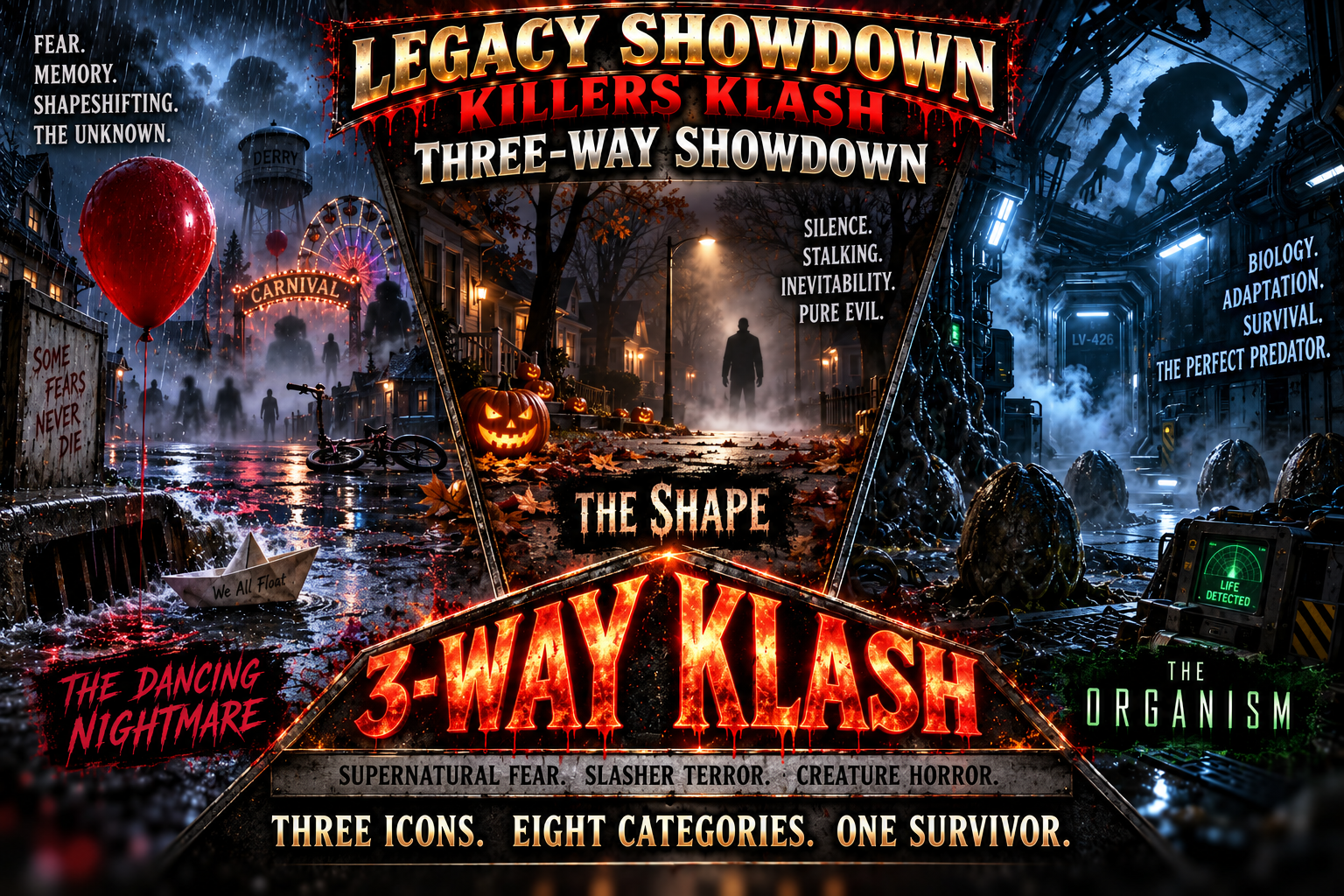


The Dancing Clown. The Shape. The Perfect Organism. Three completely different nightmares collide in the tournament’s biggest twist yet.
Welcome back to Killers Klash, where horror’s most terrifying, unforgettable, and iconic characters go head-to-head to determine who possesses the stronger legacy killer instinct. As part of our larger Legacy Showdown series, the tournament has already forced horror legends to survive six categories measuring not simply who would win a fight, but whose impact, identity, moments, and endurance have created the stronger overall legacy.
But this round changes the rules.
Pennywise and Michael Myers both survived Round 2 and appeared headed toward a traditional one-on-one confrontation. Pennywise eliminated Candyman 4-2 by winning Peak Impact, Longevity, Big Moments, and Legacy Endurance. Michael Myers defeated Hannibal Lecter 4-2 after taking Longevity, Cultural Impact, Identity & Style, and Legacy Endurance.
Then Killers Klash introduces its first three-way dance.
Entering the tournament as a surprise challenger is the Xenomorph from Alien—a creature whose arrival in 1979 fused science fiction and horror into one of cinema’s most influential nightmares. The Xenomorph does not need the mythology of Derry or the streets of Haddonfield. It brings biomechanical terror, predatory instinct, an unforgettable life cycle, and one of the most distinctive creature designs in film history.
The matchup now represents three radically different traditions. Pennywise is supernatural and psychological, feeding on fear and reshaping itself around the victim. Michael Myers is minimalist slasher terror, an almost unreadable human-shaped presence whose blank mask became a genre symbol. The Xenomorph is creature horror at its most efficient: adaptive, physical, alien, and terrifying because human beings are not its equals in the environments where it hunts.
The six original Killers Klash categories remain, but a three-way matchup this deep in the tournament deserves a harder test. Two new judging categories have therefore been added: Fear Factor & Threat Versatility, measuring how many different forms of terror a character can convincingly generate, and Franchise & Genre Influence, measuring how strongly the character changed later horror storytelling, filmmaking, creature design, or franchise conventions.
Eight categories. Three icons. One survivor. Let the Klash begin.
Affiliate Disclaimer
Affiliate Disclaimer: This blog may contain affiliate links or banner advertisements. If you click on one of these links or advertisements and make a purchase, we may earn a small commission at no additional cost to you. These commissions help support our work and allow us to continue creating entertaining content like Killers Klash and the Legacy Showdown series.
The Expanded Three-Way Showdown Rules
For this special three-way matchup, each competitor is evaluated across eight categories:
- Peak Impact
- Longevity
- Cultural Impact
- Big Moments
- Identity & Style
- Legacy Endurance
- Fear Factor & Threat Versatility — How many different forms of terror the character can convincingly create, and how adaptable the threat remains across victims, environments, and stories.
- Franchise & Genre Influence — How strongly the character shaped later horror storytelling, filmmaking, creature design, slasher conventions, or franchise development.
1. Peak Impact
Pennywise:
Pennywise has enjoyed two major screen peaks. Tim Curry’s 1990 performance made the clown a nightmare for a generation of television viewers, while Bill Skarsgård’s interpretation helped turn It into a massive theatrical horror event decades later. The 2017 film made red balloons, storm drains, the clown’s distorted smile, and Derry’s hidden evil part of mainstream horror culture again.
That second peak was especially important because Pennywise did not return as nostalgia alone. The character became culturally dominant for a new audience, proving that the concept could be reinterpreted on a much larger cinematic scale.
Michael Myers:
Michael Myers’ peak begins with John Carpenter’s Halloween, one of the foundational films of the modern slasher tradition. The blank mask, measured stalking, suburban setting, minimalist score, and unexplained violence turned Michael into the Shape—a presence whose simplicity made him more frightening.
Halloween’s impact spread throughout horror. Michael became a template for the silent, masked, seemingly unstoppable killer, and his original film remains essential to discussions of suspense and slasher filmmaking.
The Xenomorph:
The Xenomorph’s peak arrived with Alien and expanded with Aliens. Alien introduced a creature and life cycle unlike almost anything mainstream audiences had seen, while Ridley Scott’s claustrophobic direction and H.R. Giger’s biomechanical design created a nightmare that felt simultaneously organic, sexual, industrial, and completely alien.
Aliens then demonstrated that the creature could survive a dramatic genre shift from isolated horror into large-scale action-horror without losing its menace. Few monsters have anchored two films so different in style while both became landmarks.
Edge: Pennywise
All three competitors have extraordinary peaks. Michael helped define the modern slasher. The Xenomorph powered two genre landmarks. Pennywise, however, receives the narrow edge because the character achieved major mainstream horror dominance in two widely separated screen generations and successfully turned an already famous literary monster into a renewed cultural phenomenon.
This is not a judgment that It is more historically important than Halloween or Alien. It is a judgment about the size and repeatability of the character’s peak cultural presence. Pennywise takes Round 1.
2. Longevity
Pennywise:
Pennywise benefits from a literary foundation that continually introduces new readers to It, along with major television and film adaptations that have refreshed the character for different generations. The mythology of Derry also gives the larger story room to expand beyond one direct adaptation.
The character’s cyclical nature makes reinterpretation natural. Pennywise can disappear for years and return without feeling disconnected from the central mythology.
Michael Myers:
Michael Myers has remained a horror institution since 1978 despite sequels, reboots, remakes, alternate continuities, retcons, legacy sequels, and repeated attempts to end his story. The franchise has changed around him, but the mask and the Shape remain immediately recognizable.
Michael’s annual connection to Halloween gives him an additional form of longevity. Even when no new movie is arriving, October naturally renews his cultural presence through marathons, costumes, merchandise, and horror discussion.
The Xenomorph:
The Xenomorph has endured since 1979 through films, crossovers, comics, games, collectibles, novels, and repeated expansions of the Alien universe. Unlike Michael or Pennywise, however, the Xenomorph is a species rather than one continuing individual, which gives the franchise enormous flexibility.
Different stories can change the setting, colony, time period, human cast, or specific variation of the creature while preserving the central threat. That has allowed Alien to survive far beyond the original Nostromo.
Edge: Michael Myers
All three have crossed decades, but Michael’s longevity is uniquely tied to one simple, persistent identity. The Xenomorph survives as a species and Pennywise through periodic reinterpretation; Michael repeatedly returns as the Shape despite radical changes in continuity and filmmaking eras.
Nearly five decades after Halloween, audiences still need little more than the mask, the breathing, and the music to know he is back. Michael Myers takes Round 2.
3. Cultural Impact
Pennywise:
Pennywise turned the sinister clown into one of modern horror’s most recognizable images. Red balloons, storm drains, Derry, and the idea of a clown that feeds on fear have become cultural shorthand, while both major screen portrayals remain widely discussed.
The character also reaches beyond film through Stephen King’s novel, giving Pennywise an unusual combination of literary and cinematic recognition.
Michael Myers:
Michael Myers is one of horror’s most universal visual symbols. The pale mask, coveralls, kitchen knife, and slow walk require almost no explanation. Halloween helped shape the public image of the slasher villain and influenced generations of masked killers.
His connection to the Halloween holiday magnifies that impact. Michael is not simply remembered when the franchise releases a movie; he is culturally reactivated every October.
The Xenomorph:
The Xenomorph permanently changed creature horror and science-fiction imagery. Its elongated head, inner jaw, biomechanical body, acid blood, eggs, facehuggers, and chestburster life cycle became some of cinema’s most recognizable monster concepts.
Alien also changed how audiences imagined extraterrestrial threats. The Xenomorph is not a humanoid invader delivering speeches or operating technology. It is an organism whose biology itself is terrifying.
Edge: Michael Myers
The Xenomorph may have the strongest creature-design influence, and Pennywise owns extraordinary contemporary recognition. Michael narrowly wins because his image has become nearly synonymous with the slasher itself and because the Halloween holiday continually reinforces his cultural presence.
A blank mask that began as a low-budget filmmaking solution became one of horror’s permanent emblems. Michael Myers takes Round 3.
4. Big Moments
Pennywise:
Pennywise owns an impressive gallery of nightmare sequences: Georgie’s storm-drain encounter, personalized manifestations of the Losers’ fears, the slideshow sequence, the house on Neibolt Street, and confrontations beneath Derry. Shape-shifting gives each major scare its own visual identity.
Both Tim Curry and Bill Skarsgård also contribute distinct signature moments, increasing the character’s total legacy across adaptations.
Michael Myers:
Michael’s greatest moments are masterpieces of suspense: appearing behind a hedge, materializing in the background, stalking Laurie Strode, rising after apparently being defeated, and disappearing at the end of the original Halloween. Later films added increasingly brutal confrontations and renewed battles with Laurie.
His moments often succeed through anticipation rather than spectacle. The audience notices Michael before the victim does and waits for the inevitable movement.
The Xenomorph:
The Xenomorph franchise possesses some of the most famous sequences in horror and science fiction. The discovery of the eggs, the facehugger attack, the chestburster sequence, Dallas entering the ventilation system, Ripley’s final confrontation, and the reveal of the Alien Queen all became defining cinematic images.
Aliens expanded the mythology with the motion tracker, the colony assault, the hive, the power-loader battle, and the Queen’s pursuit. These are not merely memorable monster scenes; several became templates copied throughout genre filmmaking.
Edge: The Xenomorph
Pennywise has tremendous visual variety and Michael has some of slasher cinema’s purest suspense sequences. The Xenomorph takes this round because its greatest moments repeatedly became landmarks in film history.
The facehugger, chestburster, hive, Queen, and power-loader confrontation form an extraordinary collection of images that expanded the creature’s mythology while permanently entering popular culture. The Xenomorph takes Round 4.
5. Identity & Style
Pennywise:
Pennywise’s clown form is instantly recognizable, particularly through the red balloon and contrasting performances of Curry and Skarsgård. The character’s ability to become whatever a victim fears gives the identity extraordinary flexibility.
That flexibility is also the complication: Pennywise is fundamentally a shape-shifter, so the clown is the iconic face rather than the totality of the being.
Michael Myers:
Michael Myers is minimalist horror design perfected. Mask, coveralls, knife, silence, breathing, deliberate movement, and the absence of readable emotion create a complete identity with remarkably few components.
He does not need dialogue or supernatural visual effects. A silhouette at the end of a hallway can be enough.
The Xenomorph:
The Xenomorph is one of the most distinctive creature designs ever placed on screen. H.R. Giger’s biomechanical aesthetic combines skeletal, organic, mechanical, and predatory elements into something that looks neither conventionally animal nor technological.
Its identity extends through movement and biology: the inner jaw, acid blood, facehugger stage, chestburster stage, adult form, and hive structure all reinforce the same alien ecosystem. The design communicates danger before the creature does anything.
Edge: The Xenomorph
Michael’s simplicity makes this extremely close, and Pennywise’s clown imagery is enormously marketable. The Xenomorph wins because virtually every element of its anatomy contributes to one coherent nightmare.
Its silhouette, life cycle, movement, textures, and biological weapons are unmistakable. It did not simply become an iconic monster; it created an entire visual language of extraterrestrial horror. The Xenomorph takes Round 5.
6. Legacy Endurance
Pennywise:
Pennywise appears built for generational renewal. Stephen King’s novel remains a permanent source, while the character has already proven capable of thriving through substantially different screen interpretations. Fear, childhood trauma, memory, and the darkness beneath ordinary communities remain durable themes.
The expanding Derry mythology gives future storytellers additional paths for keeping Pennywise culturally active.
Michael Myers:
Michael’s legacy has survived nearly every challenge a franchise can experience: changing continuities, unpopular sequels, remakes, long gaps, competing slasher trends, and multiple supposed conclusions. None has removed him from horror’s top tier.
His identity is also unusually performer-independent. The mask and physical language allow different actors to inhabit the Shape while audiences continue recognizing Michael immediately.
The Xenomorph:
The Xenomorph’s legacy is extraordinarily durable because the creature is not restricted to one human antagonist, one planet, or one timeline. The species can be placed into new environments and stories while its basic biological threat remains intact.
The Alien franchise also continually renews interest through games, comics, films, and broader world-building. The creature’s influence on monster design guarantees it a permanent place in genre history.
Edge: Michael Myers
The Xenomorph has tremendous franchise flexibility and Pennywise has literary permanence. Michael receives the narrow edge because his endurance has already survived nearly five decades of direct franchise turbulence while remaining one of horror’s most recognizable individual villains.
Continuities can be erased and timelines rebuilt, but the Shape keeps walking back into Haddonfield. Michael Myers takes Round 6.
7. Fear Factor & Threat Versatility
Pennywise:
This new category is almost designed to reveal Pennywise’s greatest competitive advantage. Pennywise does not need to frighten every victim the same way. It can identify fear, exploit memory, distort reality, impersonate people or creatures, manipulate environments, and turn a victim’s imagination against them.
That versatility makes preparation difficult. Knowing the clown form does not mean knowing what Pennywise will become next. Psychological terror, supernatural imagery, deception, isolation, and direct physical attack can all be part of the same encounter.
Michael Myers:
Michael generates a different kind of fear: inevitability. He stalks, waits, watches, appears where he should not be, and keeps moving after injuries that should stop an ordinary person. His lack of speech removes negotiation and makes motive difficult to interpret.
The limitation is versatility. Michael’s method is extraordinarily effective, but comparatively narrow. He is a stalking and killing force rather than a character who can radically redesign the victim’s reality.
The Xenomorph:
The Xenomorph is terrifying across multiple environments because its biology makes it a near-perfect ambush predator. Darkness, ventilation systems, industrial corridors, colonies, spacecraft, and hive structures all become hunting territory. Acid blood makes even successfully injuring it dangerous.
Its life cycle adds another dimension of fear because the threat can begin before the adult creature exists. Facehuggers, implantation, chestbursters, adult drones, and Queens create multiple stages of danger.
Yet the Xenomorph generally attacks through biological and physical threat. It does not manipulate an individual’s personal psychology as specifically as Pennywise can.
Edge: Pennywise
The Xenomorph may be the most physically versatile threat and Michael may be the purest stalking nightmare, but Pennywise can attack the body, mind, senses, memories, relationships, and personal fears of a victim.
The ability to become the thing a particular person fears most gives Pennywise a nearly unlimited horror toolkit. In the first new judging category, Pennywise takes Round 7.
8. Franchise & Genre Influence
Pennywise:
Pennywise helped make It one of the defining horror properties associated with Stephen King and demonstrated how a literary monster could be successfully reinvented for a new blockbuster era. The modern adaptation also influenced the visual language of contemporary supernatural horror.
Its influence is significant, although the broader Stephen King legacy and the coming-of-age structure of It share that credit with the villain.
Michael Myers:
Michael Myers and Halloween helped establish the modern slasher blueprint: an iconic killer, vulnerable young protagonists, stalking perspective, suburban or familiar spaces transformed into danger, suspenseful pursuit, and a final survivor confronting the threat.
The wave of slashers that followed makes Michael one of the most influential characters in horror franchise history. Without Halloween’s success, the commercial path of the 1980s slasher boom looks very different.
The Xenomorph:
The Xenomorph transformed both creature design and science-fiction horror. Alien proved that a space-set science-fiction film could function as claustrophobic monster horror, while Aliens demonstrated how the same mythology could expand into action-horror without destroying the creature’s credibility.
The Xenomorph’s design influenced generations of extraterrestrial monsters, video-game enemies, biomechanical artwork, creature effects, and stories about hostile organisms. Its life cycle also became one of genre fiction’s most frequently referenced biological-horror concepts.
Edge: The Xenomorph
This is the closest round in the entire three-way dance. Michael has an enormous claim because Halloween helped launch the slasher boom and established conventions repeated for decades. The Xenomorph wins by the smallest margin because its influence crosses multiple genres simultaneously: horror, science fiction, creature features, action-horror, production design, biological horror, and interactive entertainment.
The character did not merely influence later movie monsters. It changed the visual imagination of what an alien monster could be. The Xenomorph takes Round 8.
Final Verdict: A Three-Way Deadlock
Eight categories produce the most unusual result Killers Klash has seen: Pennywise wins Peak Impact and Fear Factor & Threat Versatility. Michael Myers wins Longevity, Cultural Impact, and Legacy Endurance. The Xenomorph wins Big Moments, Identity & Style, and Franchise & Genre Influence.
That leaves the score at Michael Myers 3, the Xenomorph 3, and Pennywise 2.
Pennywise finishes third by only one category, and the score understates how dangerous the character is in this format. No competitor in the matchup can match Pennywise’s ability to customize fear around an individual victim, and his repeated cultural peaks make him one of the strongest supernatural icons in the tournament. But with only two category victories, the Dancing Clown is eliminated.
Michael and the Xenomorph remain tied at three categories each, forcing an overall legacy tiebreaker. Michael’s case is enormous: Halloween helped define the slasher, the mask became a universal horror symbol, and the Shape has survived nearly five decades of franchise reinvention. The Xenomorph counters with two foundational early films, one of cinema’s greatest creature designs, an unforgettable biological life cycle, and influence that extends across horror, science fiction, action, games, and creature design.
The tiebreaker goes to Michael Myers by the narrowest possible margin. The reason is not that the Xenomorph is less influential. It is that Killers Klash ultimately evaluates the legacy of horror villains, and Michael’s identity as one continuing named antagonist has remained extraordinarily stable across generations. The Xenomorph’s legacy belongs partly to a species and an entire fictional ecosystem; Michael’s belongs unmistakably to the Shape.
Michael Myers survives the first three-way dance in Killers Klash. Pennywise and the Xenomorph leave behind two of the strongest performances of the tournament, but Michael’s combination of longevity, cultural symbolism, and individual-villain endurance sends him forward.
Three-Way Showdown Scorecard
Peak Impact: Pennywise
Longevity: Michael Myers
Cultural Impact: Michael Myers
Big Moments: The Xenomorph
Identity & Style: The Xenomorph
Legacy Endurance: Michael Myers
Fear Factor & Threat Versatility: Pennywise
Franchise & Genre Influence: The Xenomorph
Category Totals: Michael Myers 3 — The Xenomorph 3 — Pennywise 2
Overall Legacy Tiebreaker: Michael Myers
Audience Challenge
Did Killers Klash get the three-way dance right? Should Pennywise have taken another category because of his supernatural versatility? Should Michael Myers have won Franchise & Genre Influence because Halloween helped ignite the slasher boom? Or should the Xenomorph’s revolutionary design and cross-genre influence have carried it through the tiebreaker? Pick the category you would change, defend your choice, and tell us whether Michael Myers truly deserves to survive the tournament’s biggest twist yet.