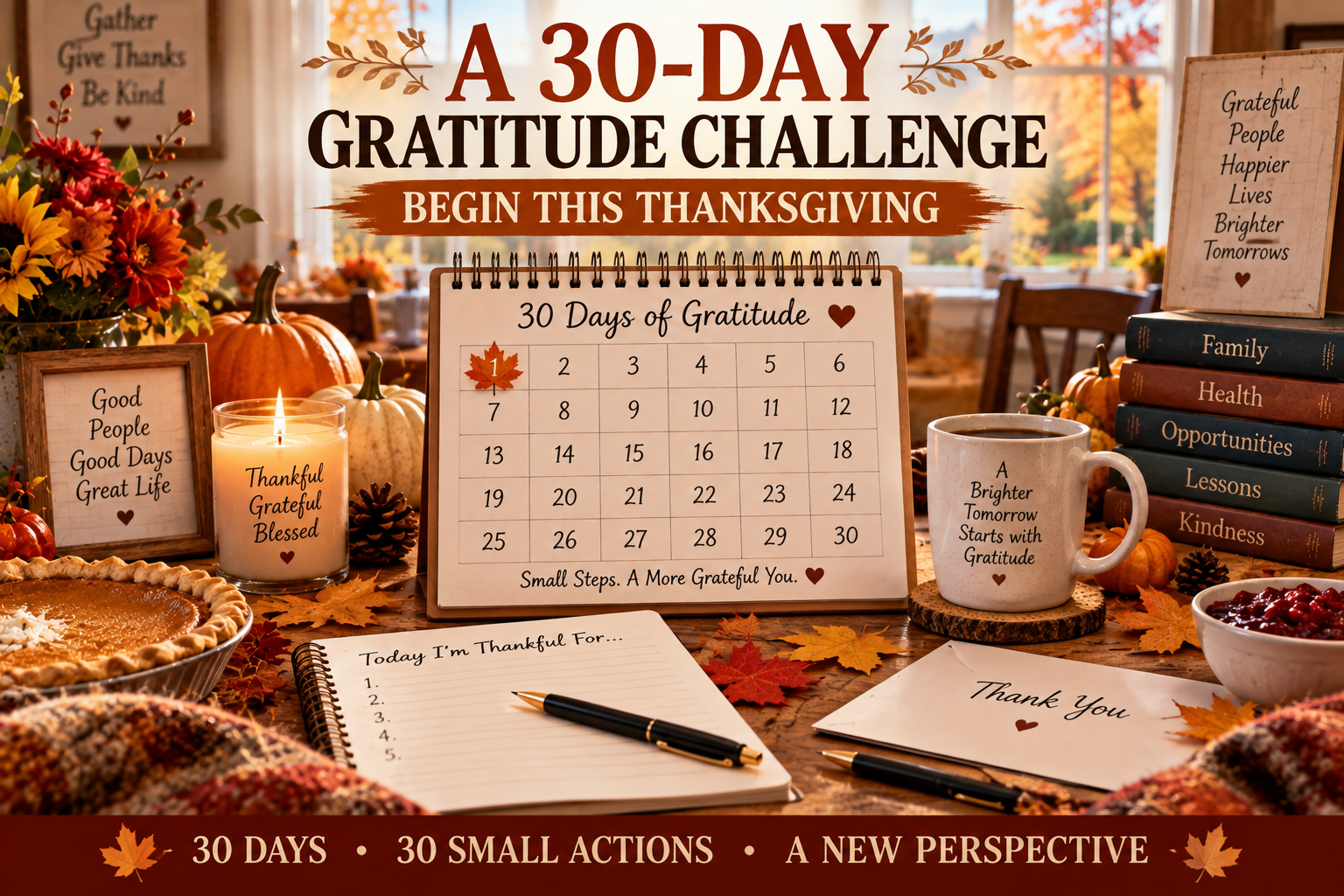


Affiliate Disclaimer: This post may contain affiliate links. If you make a purchase through one of these links, The Shopping Plaza may earn a commission at no additional cost to you.
Turn Thanksgiving Gratitude Into a Habit That Lasts
Thanksgiving may be the one day of the year when gratitude receives everyone’s attention at the same time. Families gather, people reflect on what matters, and conversations often turn toward the people, experiences, and opportunities they appreciate.
Then Friday arrives.
The holiday passes, routines return, December becomes busy, and gratitude can quietly move back into the background.
What if Thanksgiving became the beginning instead of the end?
A 30-day gratitude challenge can turn a holiday tradition into a daily habit. The goal is not to pretend that every day is wonderful or pressure yourself to feel positive when something is genuinely difficult. The goal is simply to train your attention to notice more of what is already good.
For the next 30 days, complete one small gratitude activity each day. Most require only a few minutes.
By the end, you may discover that gratitude is no longer something you remember only around a Thanksgiving table. It can become part of the way you experience ordinary life.
How to Use This 30-Day Challenge
You do not need special equipment or a complicated routine.
A notebook or journal can be helpful, but a note on your phone or a simple document works too.
Try to complete each day’s activity without worrying about writing the perfect answer. Some days may produce a paragraph. Others may produce one sentence.
If you miss a day, continue the next day. This is not a test.
The purpose is consistency, awareness, and reflection.
Begin on Thanksgiving Day if you can, or start whenever you are ready. The date matters less than the decision to begin.
Day 1: Name Five Things You Are Thankful For
Begin with the classic gratitude exercise.
Write down five things you appreciate today.
They can be large or small: family, a meal, a comfortable home, a favorite tradition, a good conversation, or simply having time to slow down.
Do not worry about originality.
The first day is about creating a starting point and noticing what immediately comes to mind when you think about gratitude.
Day 2: Thank Someone Who Made Your Life Easier
Think of one person who regularly makes your life easier.
Send a message, make a phone call, or tell them in person.
Be specific about what you appreciate.
Instead of only saying, “Thanks for everything,” explain the action or quality that matters to you.
Gratitude becomes more powerful when it moves from thought into expression.
Day 3: Appreciate One Ordinary Convenience
Choose something you normally use without thinking about it.
It could be electricity, running water, your phone, transportation, a household appliance, or internet access.
Imagine your day without it.
Then take a moment to appreciate how much time or effort that ordinary convenience saves you.
Familiarity often hides value.
Day 4: Remember a Problem You No Longer Have
Think about something that once caused stress but is no longer part of your daily life.
Perhaps a difficult project ended, a financial problem improved, a class was completed, or an uncertain situation eventually became clear.
Remember how significant the problem felt at the time.
Then appreciate the fact that it no longer occupies the same space in your life.
Day 5: Notice One Good Moment as It Happens
Today, try to catch gratitude in real time.
When something pleasant happens, pause for a few seconds.
Maybe someone makes you laugh, your lunch tastes especially good, or you hear a favorite song.
Do not wait until bedtime to remember it.
Tell yourself, “This is a good moment.”
That small act trains you to experience gratitude while life is actually happening.
Day 6: Be Thankful for Something Your Body Allows You to Do
Rather than focusing on appearance, appreciate function.
Think about something your body allows you to experience or accomplish today, whatever that looks like for you.
It may be moving through your routine, laughing, speaking, listening, resting, creating, working, or simply experiencing the world in your own way.
Gratitude does not require comparing your abilities with anyone else’s.
Day 7: Celebrate One Small Win
Identify something you accomplished this week.
It does not need to be impressive.
Maybe you completed a task, kept a commitment, handled a difficult conversation, or made progress on a goal.
Acknowledge it.
Small wins are easy to overlook when our attention immediately moves toward unfinished work.
Day 8: Appreciate a Favorite Memory
Choose one memory that still makes you smile.
Spend a few minutes remembering the details.
Who was there? What happened? Why does it still matter?
You do not need to recreate the experience.
Simply appreciate that it became part of your story.
Day 9: Thank Someone From Your Past
Think about a teacher, coach, former coworker, friend, relative, or mentor who influenced you.
If appropriate and possible, reach out.
If contacting them is not possible, write down what you would thank them for.
People can continue influencing our lives long after a particular chapter ends.
Day 10: Find Something Good About Your Routine
Choose one part of your daily routine that normally feels ordinary.
Maybe it is breakfast, your commute, an evening activity, or a regular conversation.
Ask what the routine represents.
Stability? Family? Independence? Responsibility? Comfort?
The activity may be repetitive, but its meaning may be much larger.
Day 11: Appreciate Something You Learned the Hard Way
Think about a lesson that came from a mistake or difficult experience.
You do not have to be grateful for the pain itself.
Focus on what you know now because you lived through it.
Wisdom often arrives disguised as an experience we would not have chosen.
Day 12: Give Someone a Genuine Compliment
Notice something good about another person and say it.
Compliment their effort, kindness, reliability, creativity, humor, or another quality you sincerely appreciate.
A genuine compliment costs nothing.
It can improve someone else’s day while reminding you to look for strengths in the people around you.
Day 13: Appreciate Something Money Cannot Buy
Identify something valuable that cannot simply be purchased.
Trust. Friendship. A meaningful memory. A sense of humor. Time with someone you love. Knowledge earned through experience.
Money matters, but many of life’s richest experiences exist outside a price tag.
Day 14: Notice Something You Usually Rush Past
Slow down long enough to notice one detail you usually ignore.
It could be the sound of rain, the smell of dinner cooking, the feeling of a quiet room, or the energy of a busy family evening.
You do not need an hour of mindfulness.
Thirty intentional seconds can make an ordinary moment feel different.
Day 15: Be Thankful for How Far You Have Come
You are halfway through the challenge.
Use today to look backward.
Think about where you were one year ago, five years ago, or at another meaningful point in your life.
What have you learned? What have you survived? What can you handle now that once felt unfamiliar?
Progress is easier to recognize when we occasionally turn around.
Day 16: Appreciate a Person You Sometimes Take for Granted
Choose someone whose presence has become so familiar that you rarely stop to appreciate it.
Think about what this person contributes to your life.
Then express your gratitude if you can.
Do not wait for a special occasion to tell ordinary people they matter.
Day 17: Find One Thing to Appreciate About Work
Whether you love your work, tolerate it, or are currently working toward something different, identify one thing it provides.
It may be income, experience, structure, relationships, skills, or clarity about what you want next.
Gratitude for one aspect does not mean you must be satisfied with every aspect.
Day 18: Appreciate a Simple Comfort
Choose one small comfort today.
A warm drink. A favorite chair. Comfortable clothes. A good meal. A quiet break.
Enjoy it without dismissing it as insignificant.
Simple comforts make up a surprisingly large portion of everyday happiness.
Day 19: Write Down Three Things That Went Right
At the end of the day, write down three things that went right.
They do not have to be major successes.
Maybe traffic was light, an appointment went smoothly, someone helped you, or you finished something earlier than expected.
Our minds often replay what went wrong.
Today, deliberately give equal attention to what went right.
Day 20: Appreciate an Opportunity You Almost Overlooked
Think about an opportunity that became valuable only after you accepted it.
Maybe it introduced you to a person, skill, job, hobby, idea, or new direction.
Not every opportunity announces its importance immediately.
Be thankful for one door you are glad you walked through.
Day 21: Give Something Without Expecting Anything Back
Turn gratitude into generosity.
Help someone, share useful information, offer encouragement, donate something appropriate, or complete a small act of kindness.
Do it without expecting recognition.
Gratitude grows when appreciation for what we have inspires us to contribute something to someone else.
Day 22: Appreciate Something About Your Home
Focus on one part of your home that makes life better.
It may be a room, a favorite object, the people who share the space, or simply the security and familiarity it provides.
Homes do not need to be perfect to contain things worth appreciating.
Day 23: Be Thankful for a Second Chance
Think about a time when you were able to try again.
Perhaps you repaired a mistake, restarted a goal, changed direction, or received another opportunity.
Second chances remind us that one decision does not always define the entire future.
Appreciate the ability to begin again.
Day 24: Spend Ten Minutes Without Complaining
Choose ten minutes today and intentionally avoid complaining.
If you notice a complaint forming, replace it with either a solution-focused question or a statement of gratitude.
The exercise is not meant to silence legitimate concerns.
It simply helps you notice how automatically attention can move toward what is wrong.
Day 25: Appreciate Someone’s Effort, Not Just Their Result
Thank or compliment someone for trying, helping, practicing, preparing, or staying consistent.
Results receive plenty of attention.
Effort often does not.
Recognizing effort can encourage another person while training you to value the process behind achievement.
Day 26: Be Thankful for Something You Are Still Learning
Choose an area where you are not yet an expert.
Instead of being frustrated by what you do not know, appreciate the opportunity to improve.
Being a beginner means there is still something new to discover.
Growth would be impossible if we already knew everything.
Day 27: Revisit Your Five Things From Day 1
Look back at the five things you wrote on the first day.
Do they still make your list?
What would you add now?
After nearly a month of deliberate gratitude, you may notice details that would not have occurred to you when you began.
That expanded awareness is part of the challenge’s purpose.
Day 28: Create a Gratitude Tradition
Choose one gratitude practice you could repeat beyond this challenge.
Maybe everyone at dinner names one good thing from the day. Perhaps you keep a weekly gratitude note or send one appreciation message every Friday.
Keep it simple enough to continue.
A sustainable habit is more valuable than an elaborate practice you abandon after a week.
Day 29: Find Gratitude in Something Imperfect
Choose something in your life that is useful, meaningful, or lovable even though it is not perfect.
It might be your home, work, a project, a relationship, or even yourself.
Appreciation does not require perfection.
Learning to recognize value inside imperfection can protect you from spending your life waiting for everything to become flawless.
Day 30: Write a Letter to Your Future Self
Finish the challenge by writing a short note to yourself.
Describe what you are thankful for right now.
Mention the people, lessons, goals, ordinary moments, and progress you hope you will remember.
Then save the letter.
Read it next Thanksgiving.
You may be surprised by what changed, what remained, and which blessings you had forgotten were once important enough to write down.
What to Do After Day 30
Completing the challenge does not mean you need to continue 30 separate activities every month.
Choose the practices that felt natural.
Maybe you enjoyed writing down three things that went right. Perhaps expressing gratitude to people felt especially meaningful. Maybe simply noticing one good moment each day was enough.
Keep one or two habits.
The goal was never to create more work.
It was to change what you notice.
Gratitude Is a Practice, Not a Personality Trait
Some people seem naturally optimistic, while others instinctively notice problems first.
That does not mean gratitude belongs only to certain personalities.
Gratitude can be practiced.
Every time you deliberately notice something good, you strengthen the habit of looking for it.
You will still have frustrating days.
You will still complain sometimes.
You will still encounter problems that deserve your attention.
The goal is not permanent positivity.
The goal is perspective.
Begin at Thanksgiving, but Do Not Leave Gratitude There
Thanksgiving gives us a beautiful starting point.
There may be food on the table, people gathering, familiar traditions, memories, laughter, and a natural reason to say thank you.
But the most powerful result of gratitude happens when it follows us home from the holiday.
Over the next 30 days, some days will feel easy. Others may be busy, disappointing, or exhausting.
Look for something anyway.
Not because everything is good.
Because something often is.
A helpful person. A small victory. A lesson. A warm meal. A familiar routine. A second chance. A quiet moment. An opportunity to try again.
Thirty days will not create a perfect life.
But they may create a more observant one.
And when we become better at noticing what is good, ordinary days can begin to feel richer.
So let Thanksgiving Day become Day 1.
Write down five things.
Then tomorrow, continue.
One day. One exercise. One reason to notice.
By the time the challenge ends, gratitude may no longer feel like something you are forcing yourself to practice.
It may simply become part of the way you look at your life.