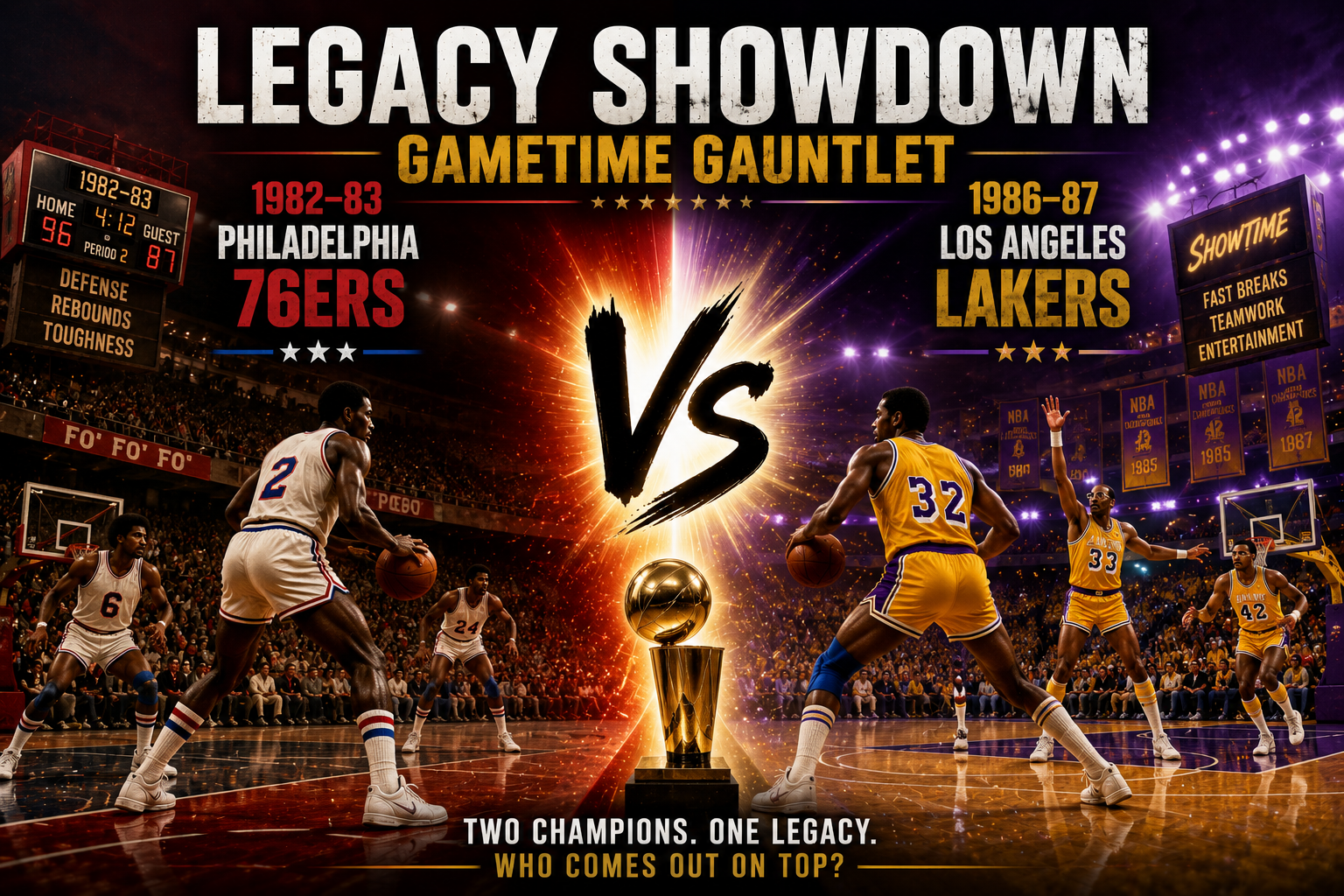

Fo, Fo, Fo meets Showtime in an NBA Region quarterfinal heavyweight battle.
Affiliate Disclaimer
This blog may contain affiliate links or banner advertisements. If you click on one of these links or advertisements and make a purchase, The Shopping Plaza may earn a small commission at no additional cost to you. These commissions help support our work and allow us to continue creating free sports content, rankings, tournament features, and Legacy Showdown matchups like Gametime Gauntlet. We only recommend products, services, or merchandise that we believe may be of interest to our readers. Thank you for supporting The Shopping Plaza and Gametime Gauntlet.
The Matchup
The NBA Region quarterfinals continue with a matchup between two champions that combined regular-season excellence with unmistakable postseason authority. The 1982-83 Philadelphia 76ers entered the season after consecutive painful playoff endings and responded by adding Moses Malone to a veteran core led by Julius Erving. Malone’s famous ‘Fo, Fo, Fo’ prediction became part of basketball history when Philadelphia came astonishingly close, sweeping New York, defeating Milwaukee in five games, and sweeping Los Angeles in the NBA Finals for a 12-1 postseason record.
Across the bracket stands the 1986-87 Los Angeles Lakers, arguably the purest expression of Showtime basketball. Magic Johnson was at the height of his powers, Kareem Abdul-Jabbar remained an elite interior weapon, James Worthy was becoming a championship star, and Byron Scott, Michael Cooper, A.C. Green, Mychal Thompson, and a deep supporting cast gave Pat Riley answers throughout the rotation. Los Angeles also went 65-17, then raced through the Western Conference before defeating Larry Bird’s Boston Celtics in six games for the championship.
This comparison is not about imagining which roster would win under one era’s rules. Gametime Gauntlet measures greatness relative to each team’s own environment. Philadelphia’s case rests on one of the most ruthless single-season playoff runs in NBA history. Los Angeles counters with superstar orchestration, extraordinary depth, cultural influence, and a championship season embedded in one of professional basketball’s defining dynasties.
- Dominance Over Competition
There is almost nothing separating these teams in the regular-season standings: both finished 65-17. Philadelphia, however, turned the postseason into something close to a demolition tour. The 76ers went 12-1, sweeping the Knicks, beating the Bucks 4-1, and then sweeping the defending champion Lakers in the Finals. Their only playoff loss came against Milwaukee, meaning Philadelphia finished three rounds with two sweeps and a five-game series. Los Angeles was also dominant in 1987, going 15-3 in the playoffs after its 65-win regular season and overwhelming the Western bracket before beating Boston. Showtime’s pace, passing, and transition attack frequently made excellent opponents look overmatched. But when two 65-win champions are separated by postseason control, Philadelphia’s near-perfect 12-1 run is the sharper statement. The slight edge remains with the 1982-83 76ers.
Winner: 1982-83 Philadelphia 76ers
- Championship Achievement
Both teams completed championship seasons worthy of all-time discussion, so the distinction here is about the nature of the title run. Philadelphia had been knocking on the championship door and finally broke through after acquiring Moses Malone, turning disappointment into one of the most decisive playoff performances ever produced. The 76ers lost just once in the entire postseason and finished the job by sweeping Los Angeles, the same franchise that had defeated Philadelphia in the 1980 and 1982 Finals. That sweep gave the championship an added sense of completion and revenge. The 1987 Lakers also earned a magnificent title, defeating Seattle in the conference finals and then a familiar Boston rival on the championship stage. Magic Johnson’s famous junior sky hook in Game 4 became one of the signature plays of the rivalry. Yet Philadelphia’s 12-1 postseason remains the defining separator. Championship Achievement goes to the 76ers.
Winner: 1982-83 Philadelphia 76ers
- Strength of Competition
Philadelphia’s road was not easy. Milwaukee had won 51 games and possessed a talented, physical roster, while Los Angeles entered the Finals as the defending champion with Magic Johnson and Kareem Abdul-Jabbar. The 76ers deserve additional credit for making that competition look less formidable than it actually was. The 1987 Lakers, however, completed their championship against a Boston Celtics team that represented the other half of the decade’s defining rivalry. Boston had Larry Bird, Kevin McHale, Robert Parish, Dennis Johnson, and championship experience, and the Celtics had eliminated Detroit in a grueling Eastern Conference Finals. Los Angeles also had to survive the expectations that came with being the West’s dominant power year after year. The Western Conference path itself was less punishing than Boston’s, but the championship opponent carries substantial weight. On balance, the source matchup gives the edge to the Lakers, and the strength of their ultimate Finals test supports that decision. Strength of Competition goes to Los Angeles.
Winner: 1986-87 Los Angeles Lakers
- Star Power
Philadelphia’s top-end talent was spectacular. Moses Malone was the reigning league MVP and the force that changed the 76ers’ championship ceiling, while Julius Erving remained one of basketball’s most recognizable and influential superstars. Maurice Cheeks was an elite floor general and defender, and Bobby Jones supplied Hall of Fame-level defensive intelligence and versatility. Los Angeles answers with a star collection that is even more difficult to match. Magic Johnson won the 1987 league MVP and Finals MVP, Kareem Abdul-Jabbar was already the league’s all-time scoring king, and James Worthy was emerging as one of the era’s premier postseason forwards. Michael Cooper was an elite defensive specialist, while Byron Scott gave the offense another dangerous scorer. The combination of Magic, Kareem, and Worthy places three defining Hall of Fame talents in central roles on the same championship roster. Star Power goes to the Lakers.
Winner: 1986-87 Los Angeles Lakers
- Depth and Supporting Cast
Philadelphia’s supporting cast was built beautifully around Malone and Erving. Maurice Cheeks could organize the offense, pressure opposing guards, and contribute efficiently without demanding superstar usage. Bobby Jones provided defense, movement, and selfless play, while Andrew Toney supplied explosive perimeter scoring and earned the nickname ‘Boston Strangler’ for his performances against the Celtics. Marc Iavaroni, Clint Richardson, Clemon Johnson, and others filled specific roles for a roster with excellent balance. The Lakers could counter with one of the deepest and most adaptable rotations of the Showtime era. Byron Scott, Michael Cooper, A.C. Green, Mychal Thompson, Kurt Rambis, and veteran contributors gave Pat Riley combinations for speed, defense, size, shooting, and physicality. Cooper’s defensive versatility was especially valuable because he could guard dangerous perimeter scorers while Magic controlled the offense. Philadelphia’s depth was championship-caliber, but Los Angeles offered more ways to change the shape of a game without removing its identity. Depth and Supporting Cast goes narrowly to the Lakers.
Winner: 1986-87 Los Angeles Lakers
- Historical Impact
The 1983 76ers occupy an important place in NBA history because they delivered Philadelphia’s first championship since 1967 and nearly fulfilled Moses Malone’s audacious playoff prediction. Their 12-1 run remains shorthand for postseason dominance, and the pairing of Malone with Erving produced one of the great one-season championship peaks. The 1987 Lakers, though, represent something larger than a single brilliant campaign. Showtime changed how a championship team could be presented and perceived, combining winning basketball with speed, celebrity, entertainment, and a style that helped make the NBA a larger cultural product. Magic Johnson became the ideal conductor for that identity, turning transition possessions and passing creativity into must-see basketball. The Lakers-Celtics rivalry also sat at the center of the league’s 1980s resurgence, and the 1987 Finals added another defining chapter. This particular Lakers team is often remembered as one of the strongest versions of the Showtime dynasty. Philadelphia’s run is historically memorable; Los Angeles helped define an era. Historical Impact goes to the Lakers.
Winner: 1986-87 Los Angeles Lakers
- Statistical Excellence
Because both teams won 65 games, statistical comparison begins from an unusually even baseline. Philadelphia paired that record with a championship roster that could dominate through rebounding, interior scoring, defense, and efficient half-court execution. Moses Malone averaged 24.5 points and 15.3 rebounds per game during the regular season and then controlled the glass throughout the postseason. The 76ers’ playoff record is the statistic that overwhelms the discussion: 12 victories against one defeat. Los Angeles had an elite offensive season in 1986-87, with Magic Johnson producing an MVP campaign and the Lakers playing the fast, efficient basketball associated with Showtime at its best. Their 15-3 playoff record was itself exceptional. Still, Philadelphia’s identical regular-season win total combined with an even better postseason winning percentage creates the cleaner total-season statistical résumé. Statistical Excellence goes to the 76ers.
Winner: 1982-83 Philadelphia 76ers
- Longevity of Greatness
The 1983 championship did not emerge from nowhere. Philadelphia reached the NBA Finals in 1977, 1980, and 1982 before finally winning in 1983, and the Erving-led 76ers were a sustained Eastern Conference power. Yet the specific Malone-Erving championship peak was relatively brief compared with the dynasty on the other side. The Showtime Lakers reached the NBA Finals eight times during the 1980s and won five championships in the decade. The 1986-87 title was not a nostalgic final flash; Los Angeles returned the next season and repeated as champion, becoming the first NBA team in nearly two decades to win consecutive titles. Magic, Kareem, Worthy, Cooper, Riley, and the broader Lakers system repeatedly proved themselves against changing opponents and evolving rosters. That sustained championship relevance is exactly what this criterion is designed to reward. Longevity of Greatness goes decisively to Los Angeles.
Winner: 1986-87 Los Angeles Lakers
- Clutch Performance
Los Angeles owns one of the most famous clutch moments of the 1987 postseason: Magic Johnson’s late sky hook over Boston in Game 4 of the Finals. The Lakers also handled the enormous pressure attached to the Celtics rivalry and closed the championship in six games. Philadelphia’s clutch argument is less about repeated escapes and more about refusing to let opponents create dangerous situations in the first place. The 76ers entered the playoffs carrying championship expectations created by Malone’s prediction and then lost only once. When they reached the Finals against the franchise that had beaten them twice in the previous three championship series, they did not tighten up or allow old disappointment to resurface. They swept Los Angeles and closed the series with a 115-108 Game 4 victory. Performing with that level of control while carrying the burden of previous Finals losses is a powerful form of clutch excellence. Clutch Performance goes to Philadelphia.
Winner: 1982-83 Philadelphia 76ers
- Legacy Endurance
The 1982-83 76ers have an enduring legacy that will never disappear from NBA history. ‘Fo, Fo, Fo,’ the 12-1 playoff record, Moses Malone’s dominance, and Julius Erving finally winning an NBA championship give the team an instantly recognizable identity. They are regularly included in conversations about the greatest single-season teams ever assembled. The 1986-87 Lakers are equally secure in those discussions, but they also function as a symbol for an entire basketball era. Magic’s MVP season, Kareem’s late-career greatness, Worthy’s rise, the Celtics rivalry, Pat Riley’s coaching, and the visual identity of Showtime all converge in this roster. The team’s influence is reinforced by what surrounded it: championships before 1987, another championship immediately afterward, and decades of cultural recognition. When basketball history revisits the 1980s, Showtime is one of the first stories told. Legacy Endurance goes to Los Angeles.
Winner: 1986-87 Los Angeles Lakers
Gametime Gauntlet Scorecard
- Dominance Over Competition: 1982-83 Philadelphia 76ers
- Championship Achievement: 1982-83 Philadelphia 76ers
- Strength of Competition: 1986-87 Los Angeles Lakers
- Star Power: 1986-87 Los Angeles Lakers
- Depth and Supporting Cast: 1986-87 Los Angeles Lakers
- Historical Impact: 1986-87 Los Angeles Lakers
- Statistical Excellence: 1982-83 Philadelphia 76ers
- Longevity of Greatness: 1986-87 Los Angeles Lakers
- Clutch Performance: 1982-83 Philadelphia 76ers
- Legacy Endurance: 1986-87 Los Angeles Lakers
FINAL SCORE: 1986-87 Los Angeles Lakers 6 – 1982-83 Philadelphia 76ers 4
Final Verdict
This matchup is difficult because Philadelphia’s greatest argument is almost impossible to improve upon: the 76ers won 65 games and then went 12-1 in the playoffs. They take Dominance Over Competition, Championship Achievement, Statistical Excellence, and Clutch Performance. Moses Malone and Julius Erving did not merely win the title; they powered a postseason that came within one game of completing the prediction that became its nickname. In a tournament focused only on the sharpest single-season championship peak, Philadelphia could easily be the choice.
Gametime Gauntlet, however, measures a wider definition of greatness. Los Angeles wins Strength of Competition, Star Power, Depth and Supporting Cast, Historical Impact, Longevity of Greatness, and Legacy Endurance. Magic Johnson’s MVP-level orchestration, Kareem Abdul-Jabbar’s enduring excellence, James Worthy’s rise, and one of the deepest supporting casts of the Showtime years produced a champion that was both spectacular in 1987 and inseparable from a decade-long dynasty. The Lakers’ victory over Boston also places this championship directly inside the rivalry that helped define the NBA’s modern growth.
The 6-4 score should not obscure how close the historical comparison is. Philadelphia owns the more overwhelming playoff record and arguably the cleaner one-season postseason achievement. Los Angeles advances because greatness in this format extends beyond the win-loss column into roster depth, sustained excellence, cultural influence, and enduring historical identity. The 1986-87 Lakers combine all of those dimensions at an exceptionally high level, giving Showtime the narrow overall victory.
Final Result: 1986-87 Los Angeles Lakers advance by a score of 6-4.
Audience Challenge
Would Moses Malone’s famous ‘Fo, Fo, Fo’ squad have been able to slow Magic Johnson’s transition attack and control the glass against Showtime? Could Maurice Cheeks and Bobby Jones disrupt the Lakers enough defensively for Erving and Malone to dictate the series, or would Los Angeles’ passing, depth, and versatility eventually create too many problems? And when judging historical greatness, should Philadelphia’s near-perfect 12-1 postseason carry more weight than the Lakers’ larger dynasty and cultural legacy? This is exactly the kind of matchup Gametime Gauntlet was built to debate.