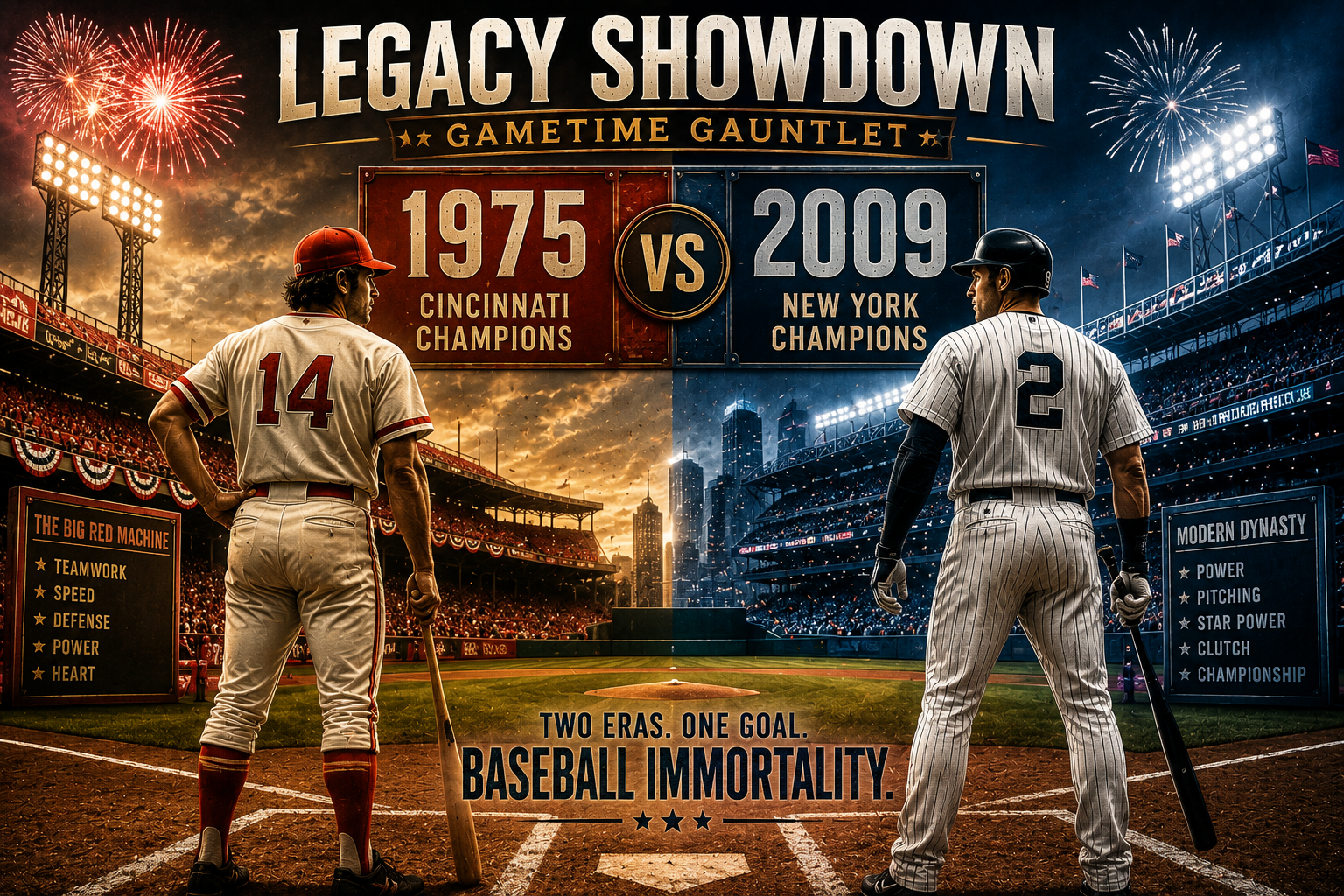

The next matchup in the MLB Region brings together two powerhouse champions from very different eras. The #2 seed 1975 Cincinnati Reds stood at the height of the Big Red Machine dynasty, combining elite hitting, speed, defense, leadership, and remarkable roster balance. The #15 seed 2009 New York Yankees captured the franchise’s 27th World Series championship behind a star-studded lineup, veteran pitching, and a dominant postseason. Gametime Gauntlet does not ask who would literally win a cross-era game; it judges each team relative to its own competitive environment. Ten categories will determine whether the Big Red Machine keeps rolling or the modern Yankees pull off a major bracket upset.
Affiliate Disclaimer
This blog may contain affiliate links or banner advertisements. If you click on one of these links or advertisements and make a purchase, we may earn a small commission at no additional cost to you. These commissions help support our work and allow us to continue creating free sports content, tournament features, rankings, and Legacy Showdown matchups such as Gametime Gauntlet. We only recommend products or services that we believe may be of interest to our readers. Thank you for supporting The Shopping Plaza and Gametime Gauntlet.
Gametime Gauntlet Rules
Each club is judged relative to its own era. Modern training and technology advantages are ignored, and the focus is overall greatness rather than a hypothetical head-to-head game. Each of the ten categories awards one point to the team judged superior, and the team winning the majority advances.
- Dominance Over Competition
Cincinnati won 108 games in 1975 and finished 20 games ahead in the National League West, a remarkable display of control over a full season. The Reds combined a relentless offense with speed, on-base ability, defense, and enough pitching to keep opponents under pressure. Their .667 winning percentage made them the best regular-season team in baseball. They then swept Pittsburgh in the NLCS before surviving Boston in a seven-game World Series. The 2009 Yankees were excellent in their own right, winning 103 games and posting the American League’s best record. New York was a legitimate powerhouse, but Cincinnati’s five additional victories and enormous divisional margin make its regular-season dominance even more imposing. Winner: 1975 Cincinnati Reds.
- Championship Achievement
Both teams finished their seasons with World Series championships, so this category requires more than simply counting trophies. Cincinnati’s 1975 championship represented the breakthrough title of a Big Red Machine core that had already established itself among baseball’s elite. The Reds swept the NLCS and then survived one of the most dramatic World Series ever played against Boston. After losing the unforgettable Game 6 at Fenway Park, Cincinnati recovered immediately and won Game 7 on the road. The 2009 Yankees also produced a convincing title run, going 11-4 in October and defeating the defending champion Phillies in six games. But the Reds’ championship sits directly inside a dynastic peak that continued with another title in 1976. Winner: 1975 Cincinnati Reds.
- Strength of Competition
The 1975 Reds faced excellent opponents, including a 92-win Pittsburgh club in the NLCS and a talented Boston team that pushed the World Series to seven games. Their championship path deserves full respect within the context of their era. The 2009 Yankees, however, competed in a larger and more internationally diverse talent environment with greater roster specialization. New York also had to navigate three postseason rounds rather than two. The Yankees defeated Minnesota, a strong Angels club, and then the defending World Series champion Phillies. That added playoff layer created more opportunities for a great team to be eliminated before reaching the championship. Relative to the structure and depth of the modern competitive landscape, New York receives the edge. Winner: 2009 New York Yankees.
- Star Power
The 1975 Reds were overflowing with historically significant talent. Joe Morgan won the National League MVP award and was one of baseball’s most complete players, while Johnny Bench had already established himself as a transformational catcher. Pete Rose supplied relentless hitting and competitive identity, Tony Perez brought middle-of-the-order power, and George Foster was emerging as another major offensive force. Ken Griffey Sr. and Dave Concepcion added even more quality to a lineup with very few weak points. The 2009 Yankees counter with Derek Jeter, Alex Rodriguez, Mariano Rivera, CC Sabathia, Mark Teixeira, and Jorge Posada, giving New York extraordinary name recognition of its own. Still, the concentration of all-time talent at the heart of the Big Red Machine gives Cincinnati the narrow edge. Winner: 1975 Cincinnati Reds.
- Depth and Supporting Cast
Cincinnati’s greatness extended far beyond its biggest names. Griffey, Concepcion, Cesar Geronimo, Foster, and a flexible supporting cast helped create a lineup capable of producing in numerous ways, while Sparky Anderson managed the roster with precision. The Reds could beat opponents with power, speed, defense, patience, or timely hitting. New York’s 2009 roster, however, may have been even deeper from top to bottom. Jeter and Rodriguez were surrounded by Teixeira, Posada, Robinson Cano, Hideki Matsui, Johnny Damon, Nick Swisher, and Melky Cabrera, while Sabathia, Andy Pettitte, and Rivera supplied major pitching experience. Matsui becoming World Series MVP demonstrates how many different Yankees were capable of deciding a championship game. New York’s combination of stars and secondary contributors earns this category. Winner: 2009 New York Yankees.
- Historical Impact
The Big Red Machine became more than a champion; it became one of baseball’s defining team identities. Cincinnati demonstrated the power of building a roster around athleticism, positional excellence, on-base skill, speed, defense, and power at the same time. The 1975 team stands at the center of that image and helped establish the mid-1970s Reds as a benchmark for complete roster construction. Morgan, Bench, Rose, Perez, and their teammates still appear prominently in discussions of legendary lineups and dynasties. The 2009 Yankees hold an important place as the franchise’s 27th champion and the club that ended a nine-year title drought. But that team did not reshape baseball’s historical imagination in the same way the Big Red Machine did. Winner: 1975 Cincinnati Reds.
- Statistical Excellence
Cincinnati’s numbers reflect how complete the team was. The Reds finished 108-54, led the National League with 840 runs, and combined power with exceptional speed and on-base pressure. Joe Morgan’s MVP season gave the lineup an elite centerpiece, but Cincinnati’s production was distributed throughout the roster. The 2009 Yankees were also a statistical powerhouse, winning 103 games while leading Major League Baseball in runs scored and home runs. New York’s offense was built perfectly for its era and its home ballpark, and its overall record confirms that the production translated into victories. Yet Cincinnati won more games and displayed a broader form of era-relative dominance across several offensive dimensions. The Big Red Machine takes a close statistical comparison. Winner: 1975 Cincinnati Reds.
- Longevity of Greatness
The 1975 Reds were clearly part of something larger than one magical season. Cincinnati had already reached the World Series in 1970 and 1972, remained a major National League force, and then reached its defining peak with consecutive championships in 1975 and 1976. That sustained success allows the 1975 club to represent the centerpiece of a genuine dynasty. Much of the core remained together long enough to build a recognizable era rather than a single championship snapshot. The 2009 Yankees belonged to a franchise with extraordinary long-term success, but that particular roster came after the 1996-2003 dynastic run. New York remained competitive afterward but did not win another championship with the same core. Winner: 1975 Cincinnati Reds.
- Clutch Performance
Cincinnati proved its nerve throughout an extraordinary World Series against Boston. The Reds won several close games, survived enormous momentum swings, and recovered from the emotional blow of Carlton Fisk’s famous Game 6 home run. In Game 7, Cincinnati erased a 3-0 deficit and eventually won on Joe Morgan’s ninth-inning single. The 2009 Yankees were similarly comfortable in pressure situations, but they sustained that execution across three postseason rounds. Alex Rodriguez answered years of October criticism with a tremendous postseason, Mariano Rivera remained elite in high-leverage innings, and Hideki Matsui delivered six RBIs in the World Series clincher. New York went 11-4 during the postseason and repeatedly received decisive performances from its stars. That sustained October efficiency gives the Yankees the edge. Winner: 2009 New York Yankees.
- Legacy Endurance
Nearly every serious discussion of baseball’s greatest teams eventually reaches the Big Red Machine. The 1975 Reds remain famous not simply because they won 108 games and a championship, but because their roster has become symbolic of complete team greatness. Morgan, Bench, Rose, and Perez continue to anchor historical debates about their positions, their era, and the greatest lineups ever assembled. The legendary 1975 World Series has also kept the team’s championship story alive for generations. The 2009 Yankees remain beloved by their fan base and historically important as the franchise’s 27th champion, but their legacy competes with many other iconic Yankees championship clubs. Cincinnati’s identity is more singular and more tightly connected to one celebrated dynasty. Winner: 1975 Cincinnati Reds.
Final Verdict
The 2009 New York Yankees were a formidable modern champion whose #15 seed understates how dangerous they are in this tournament. Their deep roster, modern competitive environment, and excellent postseason performance earn them victories in Strength of Competition, Depth and Supporting Cast, and Clutch Performance. Yet the 1975 Cincinnati Reds bring too many different forms of greatness into the same comparison. Their 108 victories, concentrated star power, statistical excellence, place at the center of the Big Red Machine dynasty, and enduring historical reputation allow them to control seven categories. Cincinnati’s case is not built on one superstar or one famous October moment; it is the accumulation of dominance, balance, sustained excellence, and historical importance. The Yankees make the matchup respectable, but the Big Red Machine moves forward as a serious threat to win the entire MLB Region.
Final Result: 1975 Cincinnati Reds advance by a score of 7-3.
Gametime Gauntlet Scorecard
Dominance Over Competition: 1975 Cincinnati Reds
Championship Achievement: 1975 Cincinnati Reds
Strength of Competition: 2009 New York Yankees
Star Power: 1975 Cincinnati Reds
Depth and Supporting Cast: 2009 New York Yankees
Historical Impact: 1975 Cincinnati Reds
Statistical Excellence: 1975 Cincinnati Reds
Longevity of Greatness: 1975 Cincinnati Reds
Clutch Performance: 2009 New York Yankees
Legacy Endurance: 1975 Cincinnati Reds
Audience Challenge
Would the 2009 Yankees’ modern depth, star power, and postseason experience have been enough to push the Big Red Machine even further, or do the 1975 Reds deserve a decisive place among baseball’s greatest champions? Which of the ten categories would you change, and would your changes be enough to alter the 7-3 result? Make your case and tell us which powerhouse should advance in Gametime Gauntlet.