
Affiliate Disclosure
Some of the links on this page may be affiliate links. This means that if you click through and make a purchase, The Shopping Plaza may earn a small commission at no additional cost to you.
These commissions help support the operation of this website and allow us to continue creating free content, contests, rankings, and entertainment features like Sitcom Showdown.
We only recommend products, services, and merchandise that we believe may be of interest to our readers. Your support through these affiliate links is greatly appreciated and helps keep The Shopping Plaza growing.
Thank you for supporting The Shopping Plaza!
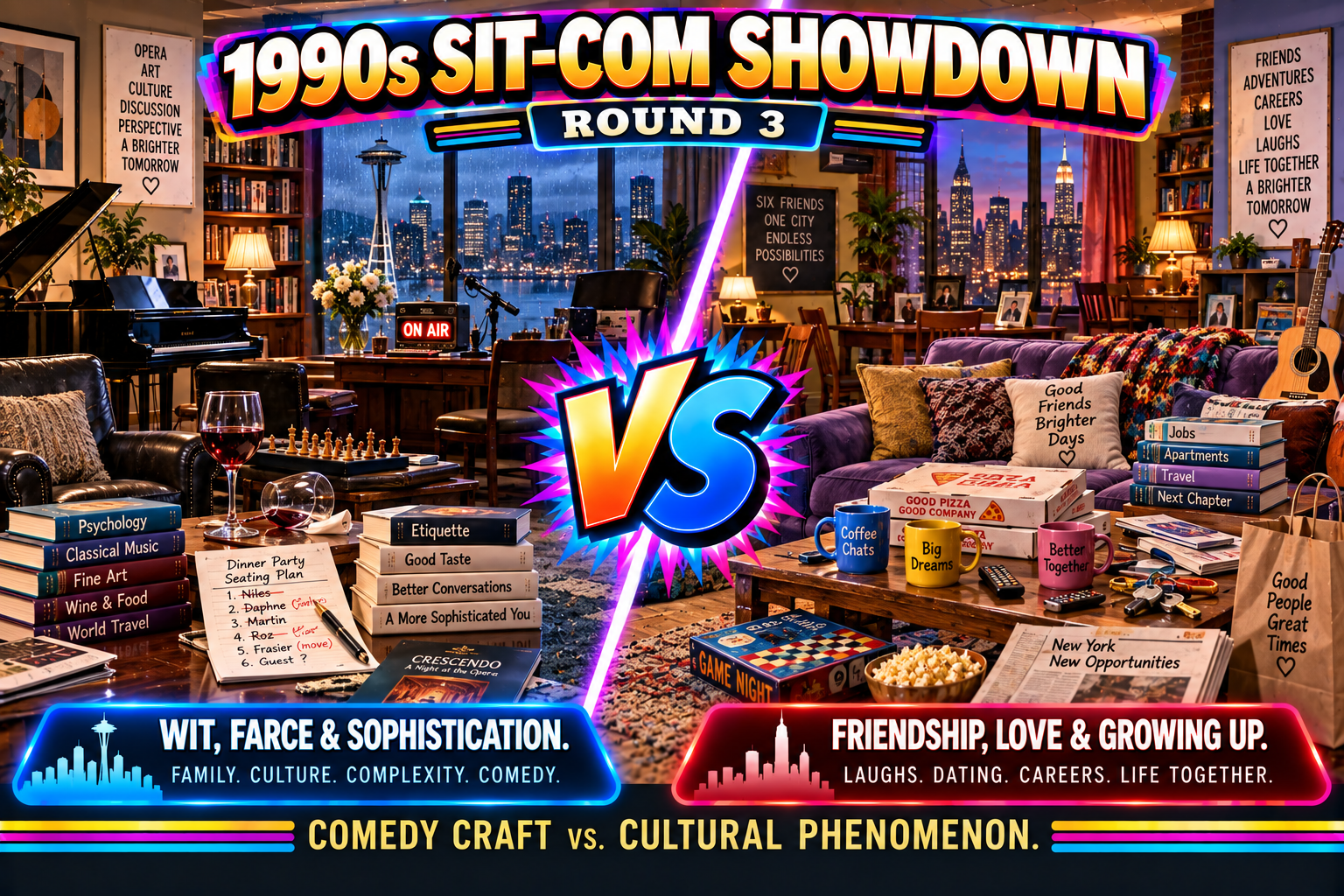
Round 3 now moves into the 1990s bracket, and the opening matchup is a heavyweight collision between Frasier and Friends. Frasier transformed a supporting character from Cheers into the center of a sophisticated Seattle comedy about family, ego, culture, romance, and the endless complications created by Frasier Crane’s belief that he understands people better than he usually does. Friends built its world around six young adults in New York City and turned friendship, dating, work, marriage, heartbreak, and growing into adulthood into one of the defining television experiences of its generation.
Frasier advanced after defeating Everybody Loves Raymond in Round 2, while Friends moved forward after defeating Full House. Both enter this stage with formidable resumes. Frasier is one of the most critically decorated and precisely written sitcoms of its era. Friends became a worldwide popular-culture phenomenon whose characters, relationships, catchphrases, fashion, and familiar locations remain instantly recognizable decades later.
Round 3 uses our expanded ten-category format. Alongside the original eight criteria, Writing & Storytelling and Character Development allow us to look beneath popularity and ask which series constructed the stronger complete sitcom legacy. This matchup may come down to a classic tournament question: can Frasier’s writing precision and character sophistication overcome the extraordinary chemistry, cultural reach, and enduring popularity of Friends?
The Expanded Round 3 Legacy Showdown Rules
- Comedy Quality
- Character Chemistry
- Cultural Impact
- Longevity & Replay Value
- Iconic Moments
- Supporting Cast
- Era Difficulty
- Legacy Endurance
- Writing & Storytelling – How effectively the series constructs episodes, long-term arcs, themes, callbacks, and comic or emotional payoffs.
- Character Development – How convincingly major characters grow, change, deepen, or reveal new dimensions across the series.
Round 1: Comedy Quality
Friends possessed an exceptionally reliable comic engine. Joey’s confidence and innocence, Chandler’s sarcasm, Ross’s intensity, Monica’s competitiveness, Phoebe’s unpredictability, and Rachel’s reactions gave the writers six distinctive personalities. The series could generate comedy from dating disasters, apartments, jobs, Thanksgiving dinners, misunderstandings, and the group’s constant involvement in one another’s lives.
Frasier operated with a different level of verbal and structural precision. Frasier and Niles could turn pretension, sibling rivalry, psychiatry, opera, wine, social status, or an elaborate misunderstanding into beautifully constructed farce. Martin’s practicality and Roz’s bluntness punctured the brothers’ self-importance, while physical comedy and escalating misunderstandings frequently turned sophisticated setups into chaos. Friends is enormously funny, but Frasier takes the category for the intricacy and range of its comic craftsmanship.
Winner: Frasier.
Round 2: Character Chemistry
Frasier built outstanding chemistry around the Crane family. Frasier and Niles could be competitive, affectionate, jealous, and inseparable within a single episode. Martin’s working-class sensibility created a productive contrast with his sons, while Daphne and Roz developed their own places within the family circle. The ensemble feels connected because the characters repeatedly choose one another despite their frustrations.
Friends makes chemistry its defining advantage. Ross, Rachel, Monica, Chandler, Joey, and Phoebe work as six individual characters, three natural pairings, multiple romantic combinations, and one unified group. Chandler and Joey’s friendship, Monica and Rachel’s history, Ross and Monica’s sibling relationship, Phoebe’s outsider perspective, and the eventual Monica-Chandler romance create layers within the ensemble. Few sitcom casts have ever made simply sitting together feel so essential to the show’s identity.
Winner: Friends.
Round 3: Cultural Impact
Frasier had major cultural influence and helped demonstrate that an intelligent, dialogue-heavy comedy could remain broadly accessible. Frasier and Niles became recognizable symbols of cultured pretension, and the show’s success proved that a spinoff could develop a creative identity distinct from the series that produced it.
Friends reached another level of cultural saturation. The Rachel haircut became a fashion phenomenon, Central Perk became one of television’s most recognizable fictional gathering places, and phrases such as ‘We were on a break!’ became part of popular conversation. The cast became global celebrities, and the series helped shape how an entire television generation imagined friendship, dating, apartments, and young adulthood in New York. Friends wins decisively here.
Winner: Friends.
Round 4: Longevity & Replay Value
Friends ran ten seasons and maintained the same six-person central ensemble from beginning to end. Its serialized relationships reward chronological viewing, but individual episodes remain easy to revisit. Holiday episodes, romances, breakups, trips, weddings, and apartment stories became comfort television for generations of viewers.
Frasier ran eleven seasons, an extraordinary accomplishment for a spinoff whose lead character had already spent years on Cheers. Its episodes are unusually rewarding on repeat viewing because verbal jokes, misunderstandings, callbacks, and carefully constructed farces often reveal details that can be missed the first time. Friends has exceptional rewatch culture, but Frasier earns a narrow edge for the additional season and the density of its writing.
Winner: Frasier.
Round 5: Iconic Moments
Frasier has unforgettable signatures: Frasier’s radio booth, Niles’ infatuation with Daphne, Martin’s chair, Eddie staring at Frasier, Cafe Nervosa, sibling competitions, disastrous dinner parties, and the brothers’ elaborate social ambitions collapsing around them. Its best farces rank among the most celebrated episodes of television comedy.
Friends has an overwhelming collection of mainstream sitcom iconography. The orange couch at Central Perk, the fountain opening, Monica’s purple apartment, Joey asking ‘How you doin’?’, Ross shouting ‘Pivot!’, the prom video, the turkey on Monica’s head, Ross and Rachel’s first kiss, Monica and Chandler’s relationship, and the group’s final departure from the apartment are embedded in popular culture. Friends takes the round.
Winner: Friends.
Round 6: Supporting Cast
Friends featured a memorable recurring world that included Gunther, Janice, Jack and Judy Geller, Carol and Susan, Mike Hannigan, Richard Burke, Estelle, and an extraordinary parade of guest stars. These characters could strengthen romances, family stories, or recurring jokes without overwhelming the central six.
Frasier’s supporting cast was even more integrated into the show’s machinery. Bulldog, Gil Chesterton, Noel, Kenny, Bebe Glazer, Lilith, Frederick, Sherry, Donny, Mel, and many others created recurring complications in Frasier’s professional and personal life. The series also inherited the ability to bring characters from Cheers into Frasier’s Seattle world without losing its own identity. Frasier receives a narrow edge for the depth and utility of its recurring ensemble.
Winner: Frasier.
Round 7: Era Difficulty
Friends entered a crowded 1990s sitcom landscape and had to distinguish itself among numerous ensemble and relationship comedies. It also sustained enormous popularity while its characters transitioned from single twenty-somethings into marriages, parenthood, and more established careers without completely abandoning the hangout premise that made the show successful.
Frasier faced an unusual challenge from the beginning. It had to take a familiar supporting character from one of television’s most beloved sitcoms, move him across the country, rebuild his family and social world, and convince audiences that the new series deserved to exist independently of Cheers. Rather than becoming a lesser extension, Frasier developed its own tone, cast, setting, and comic language and then lasted eleven seasons. That successful reinvention gives it the edge.
Winner: Frasier.
Round 8: Legacy Endurance
Frasier’s legacy is extraordinary. It remains a standard for sophisticated sitcom writing, ensemble acting, farce, and successful spinoff construction. Frasier Crane also achieved unusual longevity as a television character across multiple series and decades, strengthening the sense that the character exists beyond any single program.
Friends has an even broader cultural afterlife. New generations continue discovering the series through reruns and streaming, while merchandise, quotes, clips, reunions, Central Perk imagery, and the six central characters remain globally recognizable. Its influence on ensemble friendship comedies and popular ideas about the television ‘friend group’ remains enormous. Frasier has the stronger case in craft-specific legacy, but Friends wins overall legacy endurance through its exceptional multigenerational reach.
Winner: Friends.
Round 9: Writing & Storytelling
Friends was very effective at balancing episodic comedy with long-term romantic and personal arcs. Ross and Rachel’s relationship created a serialized backbone, while Monica and Chandler’s romance developed from friendship into one of the show’s strongest later stories. Careers, marriages, pregnancies, and changing living arrangements allowed the group to evolve without breaking the basic ensemble structure.
Frasier is one of the strongest writing contenders in the entire tournament. Episodes often operate like tightly engineered stage comedies, with misunderstandings, entrances, exits, lies, assumptions, and callbacks building toward precisely timed payoffs. Yet the series could also handle quieter stories about Martin and his sons, Niles’ long relationship arc with Daphne, Frasier’s loneliness, and the gap between professional insight and personal confusion. Its ability to combine sophisticated farce with emotional storytelling earns Frasier the round.
Winner: Frasier.
Round 10: Character Development
Friends gives its central six substantial visible development. Rachel grows from a sheltered runaway bride into an independent professional and mother. Chandler moves beyond sarcasm and fear of commitment into marriage and parenthood. Monica finds professional confidence and a lasting relationship, while Joey, Phoebe, and Ross experience their own changes in career, love, family, and self-understanding.
Frasier’s development is often subtler but deeply layered. Frasier rebuilds his relationship with Martin and Niles while repeatedly confronting his own vanity, loneliness, and romantic failures. Niles transforms from a man trapped in an unhappy marriage and idealized longing into someone capable of building a genuine life with Daphne. Martin becomes more emotionally open, while Daphne and Roz gain greater independence and complexity. Friends shows broader coming-of-age change across six leads, giving it the narrowest edge.
Winner: Friends.
Final Verdict
This is the closest Round 3 matchup we have encountered in the 1990s bracket so far. Frasier wins Comedy Quality, Longevity & Replay Value, Supporting Cast, Era Difficulty, and Writing & Storytelling. Those victories recognize its extraordinary craftsmanship, its successful reinvention of an existing television character, and its ability to construct some of the most sophisticated farce and dialogue-driven comedy in sitcom history.
Friends wins Character Chemistry, Cultural Impact, Iconic Moments, Legacy Endurance, and Character Development. Its victories reflect the almost unmatched connection among its six central characters, the enormous cultural footprint the series created, and the way viewers watched those characters move from uncertain young adulthood toward careers, marriage, parenthood, and new stages of life.
After ten categories, the score is tied 5-5. In a tournament, however, somebody has to advance. The tiebreaker goes to overall sitcom legacy: which show combines its individual category strengths into the larger, more enduring cultural presence? Frasier may have the edge in pure writing precision, but Friends has achieved a level of multigenerational recognition and audience attachment that few television comedies have ever matched. By the narrowest possible margin, Friends wins the tiebreaker and advances deeper into the 1990s Sit-Com Showdown.
Audience Challenge
A 5-5 tie means this matchup is begging for debate. Should Frasier advance because of its writing, sophisticated comedy, longevity, and extraordinary success as a spinoff? Or is Friends the right winner because its chemistry, cultural impact, iconic moments, character growth, and worldwide legacy are simply too powerful to overcome? Cast your vote, tell us which category you would change, and keep following Legacy Showdown as Round 3 of the 1990s bracket continues.