
Affiliate Disclosure
Some of the links on this page may be affiliate links. This means that if you click through and make a purchase, The Shopping Plaza may earn a small commission at no additional cost to you.
These commissions help support the operation of this website and allow us to continue creating free content, contests, rankings, and entertainment features like Sitcom Showdown.
We only recommend products, services, and merchandise that we believe may be of interest to our readers. Your support through these affiliate links is greatly appreciated and helps keep The Shopping Plaza growing.
Thank you for supporting The Shopping Plaza!
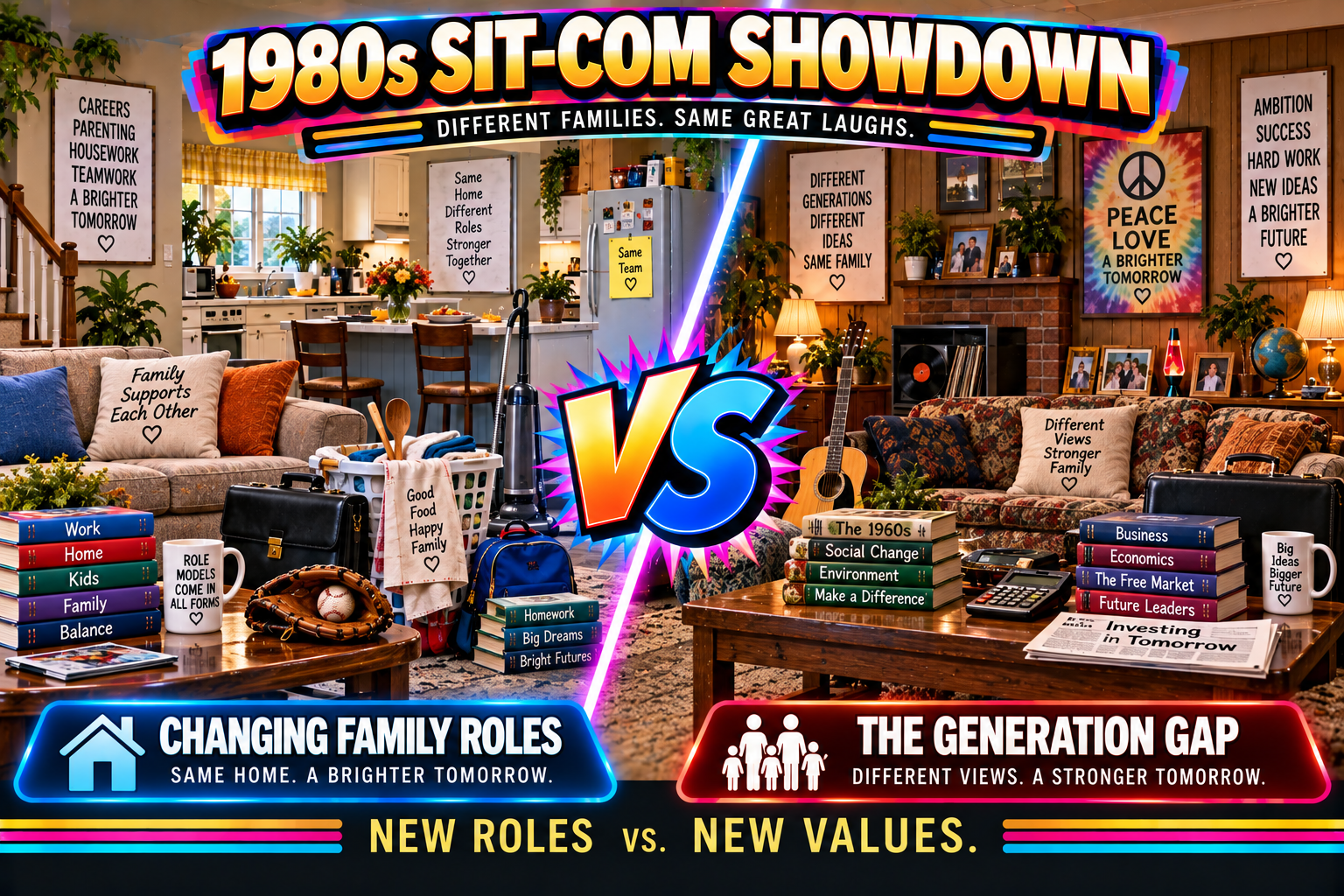
The second round of the 1980s Sit-Com Showdown brings together two series that placed changing ideas about the American family at the center of their comedy: Who’s the Boss? and Family Ties. Both became major fixtures of the decade, both were driven by unusually strong family chemistry, and both found humor in households that challenged familiar television expectations.
Who’s the Boss? built its identity around Tony Micelli, a widowed former baseball player who moves with his daughter Samantha into the Connecticut home of advertising executive Angela Bower and her son Jonathan. Tony Danza and Judith Light gave the series a warm, teasing chemistry, while Katherine Helmond’s Mona supplied fearless one-liners and a very different perspective on romance and independence. Family Ties approached generational change from another direction, placing former 1960s liberals Steven and Elyse Keaton under the same roof as their ambitious, conservative son Alex P. Keaton, along with Mallory, Jennifer, and later Andy.
This is a deceptively difficult matchup. Who’s the Boss? offers warmth, romantic tension, and a household structure that quietly challenged traditional gender expectations. Family Ties combines family comedy with generational conflict and one of the decade’s defining breakout characters. Eight categories will determine which 1980s favorite earns the right to move deeper into the bracket.
The Legacy Showdown Rules
- Comedy Quality
- Character Chemistry
- Cultural Impact
- Longevity & Replay Value
- Iconic Moments
- Supporting Cast
- Era Difficulty
- Legacy Endurance
Round 1: Comedy Quality
Who’s the Boss? found its humor in personality clashes, domestic role reversals, romantic misunderstandings, and the contrast between Tony’s working-class directness and Angela’s more reserved professional world. Tony Danza had an easy comic presence, Judith Light could match him with exasperation and dry reactions, and Katherine Helmond often stole scenes as Mona. The series was rarely interested in being outrageous; its comedy worked because viewers enjoyed spending time with the characters.
Family Ties had a sharper comic engine built directly into its premise. Alex P. Keaton’s devotion to business, money, and conservative politics constantly collided with Steven and Elyse’s idealism and memories of the 1960s. Michael J. Fox could turn Alex’s confidence, ambition, and occasional arrogance into rapid-fire comedy while still making the character likable. Mallory’s very different personality gave Alex another natural foil, and Steven’s reactions often supplied understated laughs. Both shows were funny, but Family Ties had the more distinctive and consistently productive comic conflict.
Winner: Family Ties.
Round 2: Character Chemistry
Who’s the Boss? makes this category extremely competitive. Tony and Angela developed one of the decade’s most memorable slow-burn relationships, with years of affection, teasing, frustration, attraction, and hesitation giving viewers a reason to remain emotionally invested. Tony’s relationship with Samantha brought genuine father-daughter warmth, while Angela and Jonathan had their own family dynamic. Mona could enter almost any combination of characters and immediately change the energy of a scene. The household eventually felt less like an unusual arrangement and more like a genuine family.
Family Ties was equally convincing as a family unit. Steven and Elyse felt like partners as well as parents, and the siblings had recognizable combinations of affection, rivalry, irritation, and loyalty. Alex’s clashes with his parents worked because ideological disagreement never erased the love underneath it. Michael J. Fox also developed strong chemistry with nearly every member of the ensemble. Still, the Tony-Angela relationship gives Who’s the Boss? an extra dimension that could carry both comedy and romantic emotion across the entire series.
Winner: Who’s the Boss?.
Round 3: Cultural Impact
Who’s the Boss? deserves considerable credit for presenting a household that reversed several familiar television gender roles. Angela was the successful executive and primary breadwinner, while Tony became the live-in housekeeper who cooked, cleaned, cared for the children, and brought emotional stability to the home. The show did not treat Tony’s domestic competence as making him less masculine, which gave the premise more significance than its comfortable sitcom tone sometimes suggested. Tony and Angela also became one of television’s best-known will-they-or-won’t-they couples of the era.
Family Ties, however, became closely connected to the political and generational identity of the 1980s. Alex P. Keaton was conceived as a contrast to his former-hippie parents, yet Michael J. Fox’s performance made him the breakout character and one of the decade’s most recognizable television personalities. The ideological divide within the Keaton home reflected a larger cultural conversation about how America had changed from the 1960s into the Reagan era. The series became more than a family comedy; it became a recognizable snapshot of generational change.
Winner: Family Ties.
Round 4: Longevity & Replay Value
Who’s the Boss? remains an inviting rewatch because its strongest appeal comes from relationships. The Tony-Angela dynamic develops gradually, Samantha and Jonathan grow up, and the household changes while retaining its essential warmth. Individual episodes can also be enjoyed without extensive knowledge of the larger story. The fashion and some social references are unmistakably 1980s, but the themes of parenting, work, love, independence, and blended family life remain accessible.
Family Ties also holds up well because the central generational conflict is immediately understandable. Alex and his parents can disagree about politics, money, careers, or values without viewers needing complicated background information. The Keaton family’s affection gives the series a comfort-show quality, while Michael J. Fox’s performance remains energetic and highly watchable. Because its strongest episodes often combine humor with family emotion or serious subject matter, Family Ties offers a little more variety on repeat viewing.
Winner: Family Ties.
Round 5: Iconic Moments
Who’s the Boss? created its most memorable moments through relationships rather than spectacle. Tony and Angela’s near-romantic breakthroughs, jealous misunderstandings, heartfelt conversations, and constant uncertainty over what they meant to each other became central to the viewing experience. Mona’s unapologetic stories about her social and romantic life created another recurring signature, while Tony’s devotion to Samantha produced some of the show’s strongest emotional scenes.
Family Ties has the advantage of a character who became an icon almost immediately. Alex P. Keaton’s suits, briefcase, economic enthusiasm, political confidence, and verbal sparring with his parents created a character image inseparable from 1980s television. The series also proved capable of memorable dramatic episodes, allowing Michael J. Fox and the ensemble to move beyond standard sitcom rhythms when stories became serious. Who’s the Boss? has beloved relationship moments, but Family Ties produced more moments and character traits that entered the larger memory of the decade.
Winner: Family Ties.
Round 6: Supporting Cast
Who’s the Boss? had a compact but effective ensemble. Samantha and Jonathan allowed the show to explore growing up from different perspectives, and Alyssa Milano became increasingly prominent as Samantha matured. Mona was the true supporting-cast powerhouse. Katherine Helmond made her independent, flirtatious, adventurous, and endlessly confident, creating a character who could steal a scene without undermining Tony or Angela. Her presence gave the series a valuable third adult voice.
Family Ties had exceptional depth across the Keaton household. Mallory’s interests and personality contrasted beautifully with Alex, Jennifer brought a younger and often more grounded perspective, and Steven and Elyse were fully developed characters rather than generic sitcom parents. Andy later changed the sibling dynamics, while recurring friends and romantic interests expanded the world around the family. Most importantly, the show could build episodes around different combinations of Keatons and still feel like itself. That ensemble flexibility earns the edge.
Winner: Family Ties.
Round 7: Era Difficulty
Who’s the Boss? entered an era crowded with enormously successful family sitcoms and still established a distinct identity. Its premise could have been treated as a simple gimmick, but the series sustained it by developing Tony and Angela as multidimensional adults rather than stereotypes. A male housekeeper working for a successful female executive gave the show an unconventional family structure, and it turned that structure into a long-running mainstream hit without losing its accessibility.
Family Ties faced the same competitive landscape while building comedy around a premise closely tied to changing American generations. It had to balance political and social differences without allowing those disagreements to overwhelm the family relationship at the center of the show. It also successfully transitioned from an ensemble concept into a series increasingly associated with Michael J. Fox’s breakout popularity while keeping the Keaton family important. Both navigated the decade impressively, but Who’s the Boss? gets a slight edge for making its gender-role reversal feel natural enough to become mainstream family television.
Winner: Who’s the Boss?.
Round 8: Legacy Endurance
Who’s the Boss? remains fondly remembered for Tony and Angela, the unusual family structure, Mona’s humor, and the chemistry that kept viewers invested for years. It has retained a place in conversations about classic 1980s sitcoms and about television series that challenged conventional household roles without abandoning the warmth of traditional family comedy. Tony Danza, Judith Light, Alyssa Milano, and Katherine Helmond remain strongly associated with the series.
Family Ties has an even larger historical footprint. Michael J. Fox’s Alex P. Keaton remains one of the defining sitcom characters of the decade, and the show continues to serve as a cultural reference point for the political and generational contrasts of 1980s America. Its combination of family warmth, topical conflict, comedy, and occasional dramatic ambition helped give it a legacy beyond simple nostalgia. Who’s the Boss? endures as a beloved hit, but Family Ties is more firmly embedded in the story of what 1980s television represented.
Winner: Family Ties.
Final Verdict
Who’s the Boss? puts up a much stronger fight than the final score alone might suggest. It wins Character Chemistry and Era Difficulty, driven by the outstanding Tony-Angela relationship and by the way its unconventional household quietly challenged traditional expectations about gender, work, parenting, and family life. It remains one of the warmest and most recognizable sitcoms of the 1980s.
Family Ties takes Comedy Quality, Cultural Impact, Longevity & Replay Value, Iconic Moments, Supporting Cast, and Legacy Endurance. Michael J. Fox’s Alex P. Keaton gives the show an enormous advantage, but this victory is not about one character alone. The entire Keaton family helped turn generational disagreement into smart, funny, emotionally grounded television, while the series captured something distinctive about the decade in which it aired.
With a 6-2 victory, Family Ties advances deeper into the 1980s Sit-Com Showdown bracket. Who’s the Boss? leaves with its legacy intact, but the Keatons prove to be the stronger all-around tournament contender.
Audience Challenge
Do you agree with the decision? Was Family Ties the stronger overall 1980s sitcom, or should the chemistry of Tony, Angela, Mona, Samantha, and Jonathan have carried Who’s the Boss? into the next round? Cast your vote, defend your favorite, and keep following Legacy Showdown as the 1980s Sit-Com Showdown bracket continues.