

Affiliate Disclosure
Some of the links on this page may be affiliate links. This means that if you click through and make a purchase, The Shopping Plaza may earn a small commission at no additional cost to you.
These commissions help support the operation of this website and allow us to continue creating free content, contests, rankings, and entertainment features like Sitcom Showdown.
We only recommend products, services, and merchandise that we believe may be of interest to our readers. Your support through these affiliate links is greatly appreciated and helps keep The Shopping Plaza growing.
Thank you for supporting The Shopping Plaza!
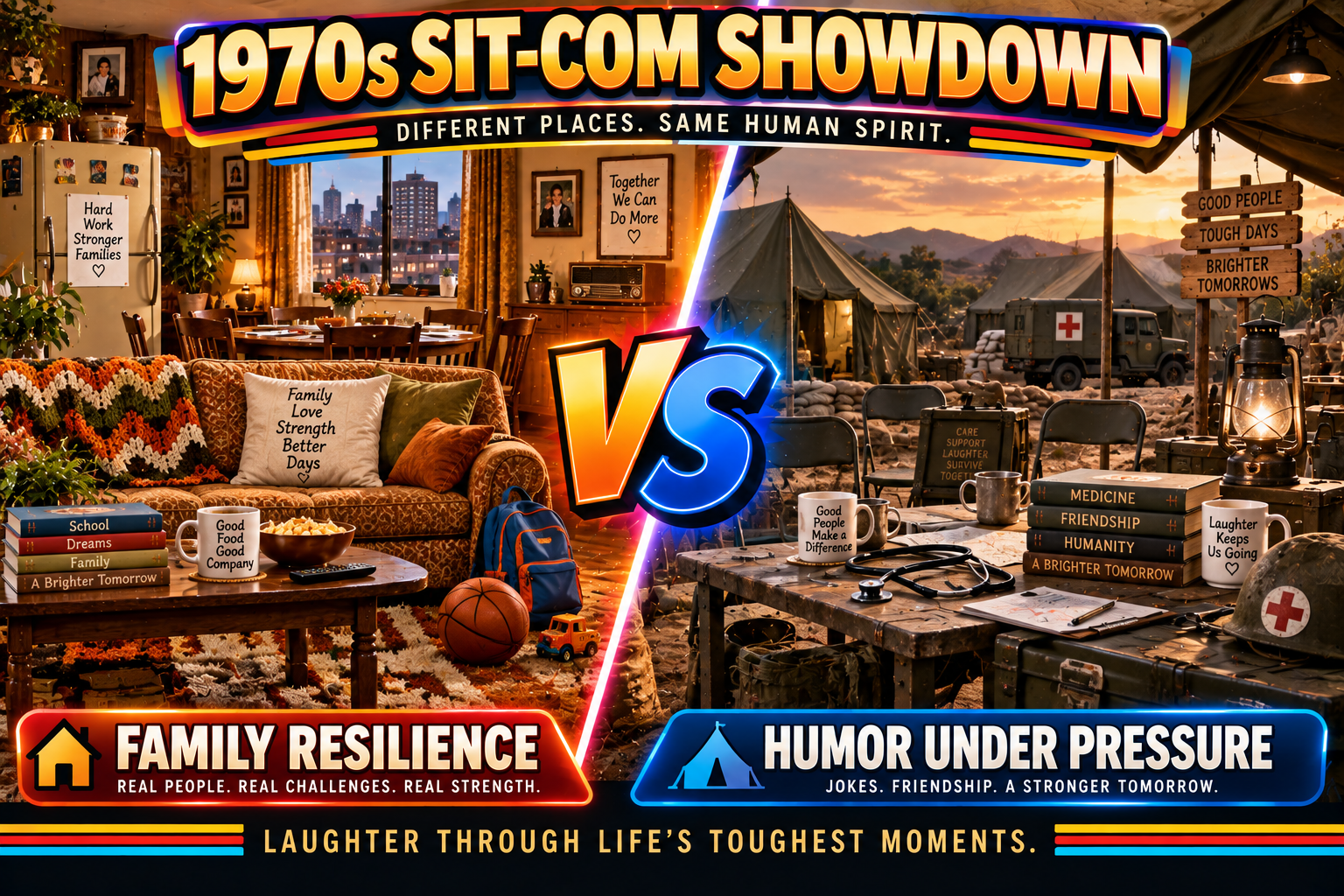
The final second-round matchup in the 1970s bracket brings together two sitcoms that could make audiences laugh while confronting circumstances that were anything but easy. Good Times takes us inside the Evans family home in a Chicago housing project, while M*A*S*H follows the doctors, nurses, and soldiers of the 4077th Mobile Army Surgical Hospital during the Korean War.
Good Times found humor, love, and resilience in a working-class family struggling with poverty, unemployment, discrimination, and the everyday pressure of trying to build a better life. M*A*S*H used wisecracks, absurdity, friendship, and sometimes heartbreaking drama to explore people attempting to preserve their humanity in the middle of war. Both shows proved that sitcoms could entertain viewers without pretending that serious problems disappeared when the laugh track arrived.
That makes this one of the most substantial matchups in the 1970s bracket. Can the unforgettable Evans family and the cultural energy of J.J. Evans overcome one of the most acclaimed ensembles in television history? Or will the extraordinary combination of comedy, drama, character development, and longevity carried by M*A*S*H send the 4077th into the next round?
The Legacy Showdown Rules
- Comedy Quality
- Character Chemistry
- Cultural Impact
- Longevity & Replay Value
- Iconic Moments
- Supporting Cast
- Era Difficulty
- Legacy Endurance
Round 1: Comedy Quality
Good Times could be extremely funny even when the Evans family was dealing with serious problems. John Amos and Esther Rolle gave James and Florida a believable parental dynamic, while Jimmie Walker brought explosive comic energy as J.J. Evans. His confidence, schemes, reactions, and famous “Dy-no-mite!” catchphrase gave the series one of the decade’s most recognizable comic personalities. The humor worked best when it grew naturally from the family’s relationships rather than distracting from their circumstances.
M*A*S*H had an unusually difficult comedic assignment: finding humor in a military hospital where wounded soldiers were constantly arriving. Hawkeye Pierce, Trapper John, B.J. Hunnicutt, Henry Blake, Colonel Potter, Radar, Klinger, Margaret Houlihan, and others used jokes as a form of survival. The writing could move from wordplay and practical jokes to satire of military bureaucracy without losing sight of the human stakes. That combination gave the comedy unusual range and sophistication.
Winner: M*A*S*H.
Round 2: Character Chemistry
Good Times succeeded because the Evans family felt connected even when they disagreed. James and Florida provided the foundation, while J.J., Thelma, and Michael brought distinct personalities and generational perspectives into the apartment. Arguments about money, responsibility, education, relationships, and the future could become intense, but the family bond remained the emotional center. Willona also became essential, adding humor, friendship, and another source of support.
M*A*S*H built one of television’s deepest ensembles over an eleven-season run. Hawkeye could share completely different chemistry with Trapper, B.J., Radar, Margaret, Father Mulcahy, Klinger, and the commanding officers, and each relationship revealed another side of him. Major cast departures could have damaged the series, yet replacements such as B.J. Hunnicutt, Colonel Potter, and Charles Winchester developed identities strong enough to create new dynamics rather than simply imitate the characters they replaced. Few sitcom ensembles have handled major personnel changes so successfully.
Winner: M*A*S*H.
Round 3: Cultural Impact
Good Times made an important contribution to American television by placing a Black working-class family at the center of a network sitcom and treating economic hardship as part of everyday family life. Florida and James Evans represented parents determined to hold their family together despite limited opportunities, while Michael often gave the show a voice for social awareness. J.J. became a genuine pop-culture phenomenon, and “Dy-no-mite!” escaped the boundaries of the series to become one of the era’s signature television catchphrases.
M*A*S*H achieved a different level of cultural reach. Although set during the Korean War, the series arrived while the United States was still living through the Vietnam era, allowing its antiwar themes and skepticism toward authority to resonate far beyond its historical setting. It demonstrated that a television comedy could address death, trauma, ethics, bureaucracy, friendship, and the emotional cost of war without abandoning humor. The series influenced generations of dramedies that followed by showing how laughter and heartbreak could coexist within the same story.
Winner: M*A*S*H.
Round 4: Longevity & Replay Value
Good Times retains strong replay value because the Evans family’s struggles with money, parenting, ambition, and opportunity remain understandable decades later. The show also carries tremendous nostalgic appeal, especially through the family chemistry, Willona’s presence, and J.J.’s larger-than-life personality. However, major cast and tonal changes affected the series, particularly after the departure of John Amos and the loss of James Evans as the family patriarch. Those changes make some stretches feel less consistent than the strongest early seasons.
M*A*S*H lasted eleven seasons and evolved substantially without losing its basic identity. Early episodes often leaned harder into broad comedy, while later seasons increasingly explored moral conflict, exhaustion, relationships, and the psychological consequences of war. Because the ensemble changed gradually, viewers can revisit different eras of the show and find distinctive character combinations in each one. Its blend of episodic stories and long-term character growth gives it unusual replay depth.
Winner: M*A*S*H.
Round 5: Iconic Moments
Good Times created images and moments that remain deeply connected to 1970s television. J.J. throwing his arms into the air and declaring “Dy-no-mite!” became instantly recognizable, while the Evans apartment itself became a familiar television home. Yet the series also delivered painful dramatic moments, most notably the family confronting the death of James Evans. Florida’s grief showed how quickly the series could move beyond comedy and remind viewers of the emotional stakes behind the family’s struggles.
M*A*S*H produced an enormous collection of memorable scenes across its run, from elaborate practical jokes and Klinger’s attempts to earn a Section 8 discharge to emotionally devastating operating-room stories and farewells. Henry Blake’s departure became one of television’s most famous examples of a sitcom suddenly confronting death without warning. The final episode, “Goodbye, Farewell and Amen,” turned the end of the series into a major television event and provided lasting images of the characters saying goodbye to the 4077th. Its biggest moments span both comedy and tragedy, giving the show exceptional range.
Winner: M*A*S*H.
Round 6: Supporting Cast
Good Times had a memorable supporting world around the Evans family. Willona Woods grew from the funny neighbor and Florida’s friend into one of the show’s most important characters, while figures such as Bookman added recurring comic friction. The series also introduced Penny later in its run, expanding Willona’s story and giving the show another family relationship to explore. Even so, much of the series’ strongest identity remained concentrated within the Evans household.
M*A*S*H is almost unfair in this category because so many supporting characters became indispensable. Radar O’Reilly, Margaret Houlihan, Klinger, Father Mulcahy, Frank Burns, Charles Winchester, Colonel Potter, Henry Blake, and others could carry substantial storylines while still strengthening the central ensemble. Characters who initially seemed built around a single joke often gained emotional depth as the series continued. The supporting cast helped transform the 4077th from a setting into a complete community.
Winner: M*A*S*H.
Round 7: Era Difficulty
Good Times competed during a decade in which socially conscious sitcoms were becoming increasingly important, but its specific challenge was significant. The show had to make audiences laugh while depicting a family facing poverty and limited economic opportunity, and it carried the additional burden of representing Black family life on mainstream network television. The balance was not always easy, especially as J.J.’s popularity sometimes pulled the series toward broader comedy while other creative voices wanted greater emphasis on family realism. Simply navigating those competing expectations was difficult.
M*A*S*H faced an equally extraordinary challenge. It had to transform a military field hospital into a sustainable weekly television setting while balancing antiwar satire, network comedy expectations, changing cast members, and increasingly serious storytelling. It also competed in a 1970s landscape filled with landmark sitcoms and continued successfully into the early 1980s. The show did not merely survive those challenges; it repeatedly expanded what audiences expected a half-hour comedy to accomplish.
Winner: Slight edge to M*A*S*H.
Round 8: Legacy Endurance
Good Times remains an important part of television history. The Evans family continues to represent a significant step in the depiction of Black working-class families on network television, and characters such as Florida, James, J.J., Thelma, Michael, and Willona remain beloved by generations of viewers. Its catchphrases, performances, themes, and willingness to address economic hardship have kept it relevant in discussions of 1970s television. The show deserves far more than simple nostalgia.
M*A*S*H, however, has maintained a truly exceptional television legacy. It remains a benchmark for programs attempting to combine comedy and drama, and its characters continue to be discussed as examples of ensemble development and long-form television storytelling. Its finale became part of television history, while individual episodes and character departures remain famous decades later. More importantly, its central questions about war, authority, friendship, medicine, sacrifice, and human survival have not lost their relevance.
Winner: M*A*S*H.
Final Verdict
Good Times entered this matchup with an important television legacy, a beloved family, and one of the most recognizable comedy characters of the 1970s. The Evans family brought humor and humanity to stories about economic struggle, and the show helped expand representation on American television. In another matchup, those strengths could easily have carried it into the next round.
But M*A*S*H is an exceptionally difficult opponent. It takes all eight categories in this showdown, although Era Difficulty is particularly close. Its advantage comes from the rare combination of sophisticated comedy, extraordinary ensemble chemistry, cultural influence, memorable dramatic moments, supporting-cast depth, and a legacy that continues to shape how television mixes laughter with serious storytelling.
With an 8-0 victory, M*A*S*H advances and closes out the second round of the 1970s bracket as one of the strongest contenders remaining in Sit-Com Showdown. The score looks decisive, but it should not diminish Good Times. The Evans family leaves the tournament with an enduring place in sitcom history – while the 4077th marches on toward an even tougher battle in the next round.
Audience Challenge
Do you agree with the sweep? Is M*A*S*H simply too complete a television classic for Good Times to overcome, or should the Evans family have taken one or more of these categories? Cast your vote, defend your favorite, and keep following Legacy Showdown as the 1970s Sit-Com Showdown bracket moves into its next stage.