
Affiliate Disclosure
Some of the links on this page may be affiliate links. This means that if you click through and make a purchase, The Shopping Plaza may earn a small commission at no additional cost to you.
These commissions help support the operation of this website and allow us to continue creating free content, contests, rankings, and entertainment features like Sitcom Showdown.
We only recommend products, services, and merchandise that we believe may be of interest to our readers. Your support through these affiliate links is greatly appreciated and helps keep The Shopping Plaza growing.
Thank you for supporting The Shopping Plaza!
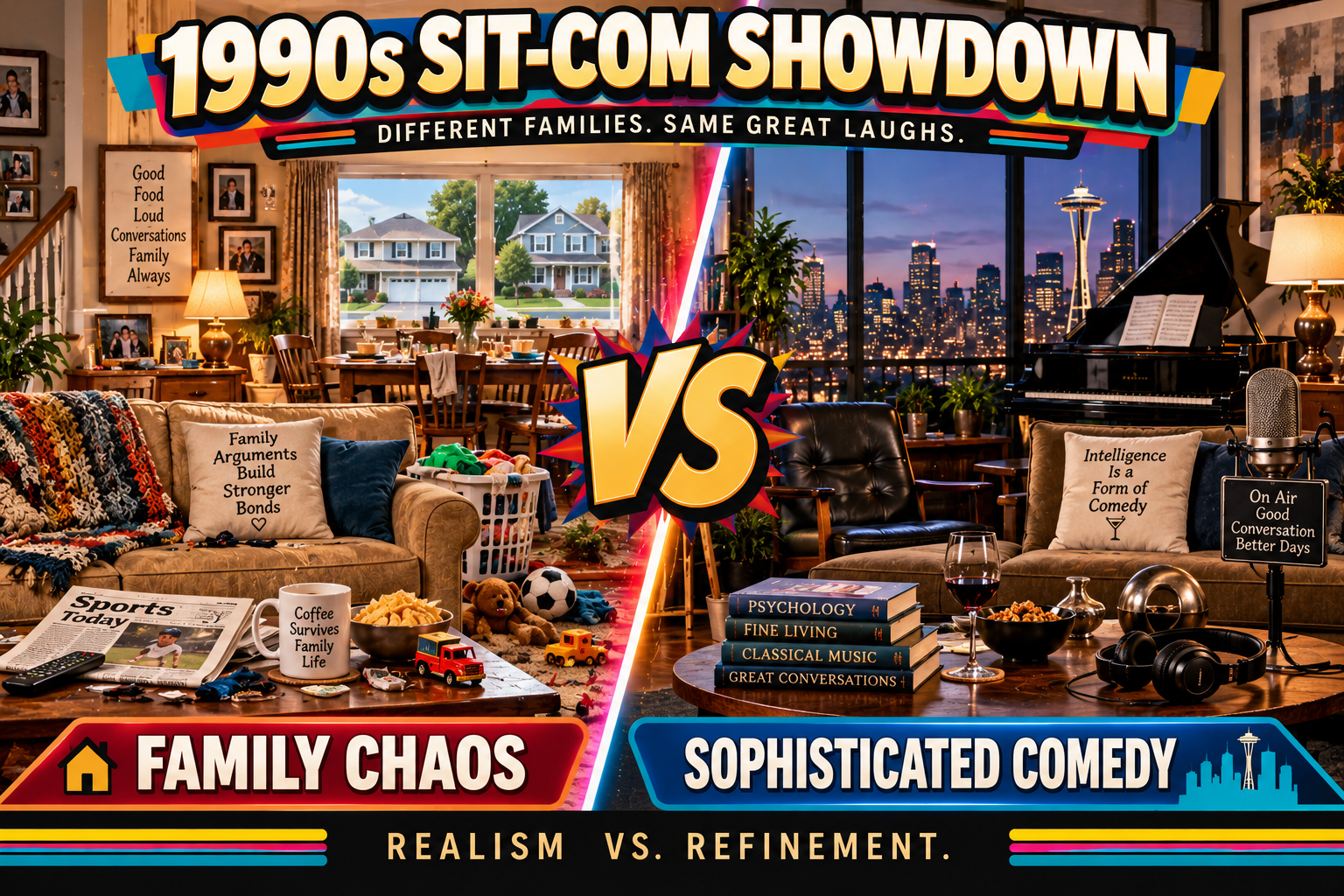
Our 1990s Sit-Com Showdown continues with a matchup between two sophisticated comedy machines built around family conflict: Everybody Loves Raymond and Frasier. One found endless material in marriage, parents, siblings, and the dangerous consequences of living directly across the street from your relatives. The other followed psychiatrist Frasier Crane to Seattle and transformed sibling rivalry, romantic frustration, class differences, radio broadcasting, and family reconciliation into one of television’s most decorated comedies.
Everybody Loves Raymond centered on sportswriter Ray Barone, his wife Debra, brother Robert, and parents Frank and Marie. Its genius was making ordinary domestic disagreements feel painfully familiar and explosively funny. Frasier paired Kelsey Grammer’s cultured, frequently pompous psychiatrist with his equally sophisticated brother Niles, their practical father Martin, caregiver Daphne Moon, producer Roz Doyle, and Martin’s beloved dog Eddie.
This matchup puts realism against refinement, although both shows could be far more complicated than those labels suggest. Raymond excelled at recognizing the absurdity hidden inside everyday family life. Frasier combined verbal wit, farce, romance, physical comedy, and emotional character development. Eight Legacy Showdown categories will determine which comedy advances.
The Legacy Showdown Rules
- Comedy Quality
- Character Chemistry
- Cultural Impact
- Longevity & Replay Value
- Iconic Moments
- Supporting Cast
- Era Difficulty
- Legacy Endurance
Round 1: Comedy Quality
Everybody Loves Raymond turned tiny domestic irritations into major comic battles. Ray’s attempts to avoid conflict usually created more conflict, Debra’s frustration felt earned, Marie could weaponize a compliment, Frank could puncture almost any conversation with bluntness, and Robert’s jealousy gave the family another reliable source of comedy. The writing was exceptionally observant because viewers could recognize pieces of their own marriages, siblings, parents, and in-laws in the Barones.
Frasier operated with a broader technical range. It could build an episode around sophisticated wordplay, mistaken identities, romantic misunderstandings, physical farce, professional embarrassment, or Frasier and Niles escalating a simple problem through vanity and overconfidence. Kelsey Grammer and David Hyde Pierce handled elaborate dialogue and physical comedy with remarkable precision. Raymond may be the more relatable comedy, but Frasier’s combination of intelligence, structure, and comic versatility earns the edge.
Winner: Frasier.
Round 2: Character Chemistry
The Barone family had extraordinary chemistry because every relationship contained both affection and accumulated irritation. Ray and Debra felt like a married couple who knew exactly how to push each other’s buttons. Ray and Robert carried decades of sibling rivalry, while Marie’s favoritism intensified Robert’s resentment. Frank and Marie could argue brutally and still communicate the strange durability of a long marriage. The ensemble made dysfunction feel lived-in rather than manufactured.
Frasier’s chemistry was equally impressive. Frasier and Niles could move from intellectual partnership to childish sibling competition in seconds, while Martin’s practical worldview repeatedly challenged both sons’ pretensions. Daphne became part of the family naturally, and Roz gave Frasier a workplace relationship built on teasing, honesty, and loyalty. The slow development of Niles and Daphne added another emotional dimension. This category is extremely close, but the Barones’ almost uncomfortable authenticity gives Raymond the slightest advantage.
Winner: Everybody Loves Raymond.
Round 3: Cultural Impact
Everybody Loves Raymond became one of the defining family sitcoms of its era and helped prove that traditional domestic comedy could remain relevant during a period increasingly filled with workplace, youth, and single-adult ensembles. The overbearing mother-in-law, jealous brother, exhausted spouse, and conflict-avoiding husband were familiar types, but the show sharpened them into characters audiences immediately recognized. Its format also proved adaptable internationally.
Frasier carried the legacy of a major Cheers character into a completely new setting and then built an identity strong enough to stand independently for eleven seasons. It demonstrated that a spinoff could equal or even exceed expectations created by its parent series, and its success reinforced the viability of literate, adult-oriented network comedy. Frasier Crane became one of television’s longest-running major sitcom characters, connecting two different eras of network comedy.
Winner: Frasier.
Round 4: Longevity & Replay Value
Everybody Loves Raymond ran nine seasons and remains remarkably easy to revisit because its conflicts rarely depend on a particular decade. Arguments about household chores, parenting, intimacy, relatives, money, favoritism, holidays, and family boundaries remain recognizable. The Barone house and the parents’ home across the street create a comfortable, familiar world, and individual episodes usually require little background knowledge.
Frasier ran eleven seasons and offers similarly strong episodic replay value. The Seattle apartment, Café Nervosa, and radio station provide distinctive recurring environments, while the characters evolve enough to reward longer viewing. Some cultural references have aged, but sibling competition, parental relationships, loneliness, dating, professional insecurity, and personal reinvention remain timeless. With two additional seasons and a wider range of story structures, Frasier takes another narrow victory.
Winner: Frasier.
Round 5: Iconic Moments
Everybody Loves Raymond produced memorable moments from situations that could happen in almost any family. Marie’s intrusive visits, Frank’s blunt observations, Robert’s strange habits and jealous reactions, and Ray’s desperate attempts to escape responsibility became recurring signatures. Episodes involving holiday disasters, marital arguments, family competitions, and Robert’s complicated romantic life gave fans many favorites without requiring elaborate premises.
Frasier’s iconic moments often came from perfectly constructed escalation. Niles preparing for a date while a series of silent disasters unfolds, Frasier’s disastrous dinner parties, mistaken romantic assumptions, radio mishaps, sibling competitions, and the long-running Niles-and-Daphne story created a deep collection of standout episodes. Even Eddie staring at Frasier became an instantly recognizable recurring joke. Frasier’s strongest episodes are frequently remembered not merely as funny installments but as examples of sitcom craftsmanship.
Winner: Frasier.
Round 6: Supporting Cast
Everybody Loves Raymond had one of the strongest compact supporting ensembles in family comedy. Peter Boyle’s Frank could dominate a scene with a sentence, Doris Roberts made Marie simultaneously infuriating and hilarious, and Brad Garrett turned Robert’s insecurity into a fully developed character rather than a simple jealous-brother joke. Recurring relatives and Robert’s relationships expanded the Barone world, but the core family remained the engine.
Frasier’s supporting cast was exceptionally deep. David Hyde Pierce’s Niles became nearly as essential as Frasier himself, John Mahoney gave Martin warmth and grounded authority, Jane Leeves made Daphne much more than the eccentric live-in caregiver, and Peri Gilpin’s Roz became a crucial friend and professional counterpart. Recurring figures such as Bulldog, Lilith, Bebe Glazer, Gil Chesterton, and others could immediately change an episode’s energy. Frasier wins because its supporting universe extended farther beyond the central family without weakening it.
Winner: Frasier.
Round 7: Era Difficulty
Everybody Loves Raymond premiered in 1996, when the sitcom landscape was packed with established giants and newer comedies fighting for attention. Its premise was intentionally ordinary, meaning the show could not rely on a flashy setting or high-concept hook. It had to distinguish itself almost entirely through writing, casting, timing, and the painful accuracy of its family observations. Turning that simplicity into nine successful seasons was a major accomplishment.
Frasier faced a different challenge: it arrived as a spinoff of Cheers, one of television’s most acclaimed sitcoms. That gave it recognition, but also enormous expectations and the risk of being treated as an unnecessary extension of a beloved character. Instead, the series relocated Frasier, rebuilt his supporting world, deepened his family history, and developed a completely different comic rhythm. Creating an eleven-season classic in the shadow of Cheers gives Frasier the slight edge.
Winner: Frasier.
Round 8: Legacy Endurance
Everybody Loves Raymond remains an important benchmark for domestic comedy. Its arguments still feel familiar, its ensemble performances remain strong, and the show’s influence can be seen in later sitcoms willing to mine marriage and extended-family frustration without idealizing either. Ray, Debra, Robert, Marie, and Frank remain recognizable because their conflicts were rooted in relationships that viewers continue to understand.
Frasier’s legacy reaches even further. It remains one of the most acclaimed spinoffs in television history, Frasier Crane is an enduring sitcom character, and the original series continues to be praised for writing, performance, farce, and ensemble precision. Its world proved durable enough for the character to return in another television continuation decades later. Raymond endures extremely well, but Frasier’s place in the larger history of the sitcom is stronger.
Winner: Frasier.
Final Verdict
Everybody Loves Raymond makes this matchup more competitive than the 7-1 score initially suggests. It takes Character Chemistry because the Barone family’s relationships feel so painfully authentic that viewers can almost believe they are overhearing real relatives argue. Several other categories—especially Comedy Quality, Longevity & Replay Value, and Era Difficulty—are close enough that reasonable fans could score them differently.
Frasier wins the overall battle because it combines elite writing with extraordinary range. It can deliver verbal sophistication, physical farce, sibling rivalry, romance, workplace comedy, family drama, and emotional growth without losing its identity. Niles, Martin, Daphne, Roz, and the recurring Seattle characters also give Frasier one of the deepest ensembles in the tournament.
With a 7-1 victory, Frasier advances deeper into the 1990s Sit-Com Showdown bracket. Everybody Loves Raymond leaves as one of television’s great family comedies, but Frasier’s combination of craftsmanship, longevity, supporting depth, and historical legacy makes it the stronger tournament contender.
Audience Challenge
Do you agree with the 7-1 result? Should Everybody Loves Raymond have taken more categories for its realism and family chemistry, or does Frasier’s writing, ensemble depth, and long-term legacy make the outcome convincing? Cast your vote, defend your favorite, and keep following Legacy Showdown as the 1990s Sit-Com Showdown bracket continues.