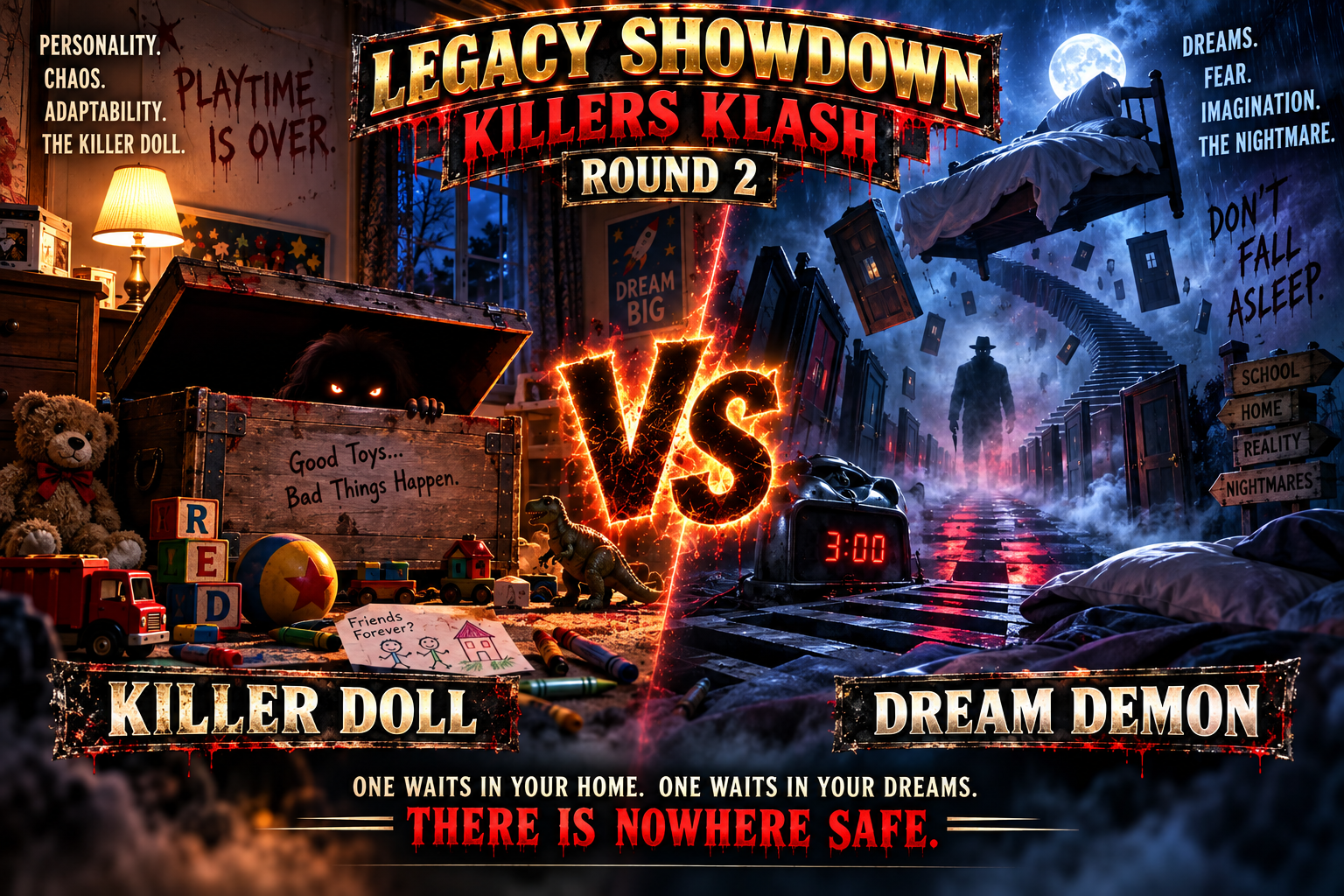

One is a pint-sized killer trapped inside a doll. The other turns dreams into death. Two horror icons enter Round 2—but only one can advance.
Welcome back to Killers Klash, where horror’s most terrifying, unforgettable, and iconic characters go head-to-head to determine who possesses the stronger legacy killer instinct. As part of our larger Legacy Showdown series, Killers Klash takes legendary killers, monsters, and supernatural threats from across horror history and puts their reputations to the test. Each matchup looks beyond simply asking who is scarier or who would win a fight. This tournament is about the legacy each character has built across horror history.
Round 1 eliminated half the field. Chucky survived his opening battle with Pinhead by proving that his combination of personality, franchise longevity, dark humor, and adaptability could compete with one of supernatural horror’s most distinctive figures. Freddy Krueger entered the tournament against the Creeper and delivered one of Round 1’s most commanding performances, using his enormous cultural footprint, dream-world mythology, unmistakable personality, and decades of horror history to advance.
Now those paths collide. Chucky, the foul-mouthed killer doll at the center of the Child’s Play franchise, faces Freddy Krueger, the burned dream stalker whose striped sweater, fedora, bladed glove, and twisted humor made A Nightmare on Elm Street a horror institution.
This is also a battle between two villains who changed the personality of the slasher. Neither is a silent, emotionless pursuer. Chucky talks, jokes, schemes, mocks, manipulates, and evolves. Freddy taunts his victims, controls the environment around them, weaponizes their fears, and turns murder into a surreal performance. Their personalities are central reasons both characters endured.
Round 2 keeps the same six official Killers Klash categories used in the opening round: Peak Impact, Longevity, Cultural Impact, Big Moments, Identity & Style, and Legacy Endurance. Each category receives an edge before one character advances deeper into the tournament.
Chucky vs. Freddy Krueger. The killer doll against the dream demon. Let the Klash begin.
Affiliate Disclaimer
Affiliate Disclaimer: This blog may contain affiliate links or banner advertisements. If you click on one of these links or advertisements and make a purchase, we may earn a small commission at no additional cost to you. These commissions help support our work and allow us to continue creating entertaining content like Killers Klash and the Legacy Showdown series.
Rules of the Showdown
We evaluate each competitor based on six categories:
- Peak Impact
- Longevity
- Cultural Impact
- Big Moments
- Identity & Style
- Legacy Endurance
1. Peak Impact
Chucky:
At his peak, Chucky transformed what could have been a one-film gimmick into one of horror’s most durable franchises. The original Child’s Play took the innocent image of a popular children’s doll and turned it into a source of paranoia, suspense, and violence. Brad Dourif’s voice performance gave Charles Lee Ray a personality that immediately separated Chucky from silent slashers. The reveal that the doll was truly alive allowed the movie to move from psychological uncertainty into full supernatural slasher territory without losing its tension.
As the franchise expanded, Chucky became increasingly comfortable mixing horror with black comedy. His size created unusual limitations, but the films repeatedly turned those limitations into advantages: adults underestimated him, children were rarely believed, and an ordinary-looking toy could enter homes without immediately appearing threatening. Later installments pushed his personality even further, allowing Chucky to become funnier, stranger, and more self-aware while remaining recognizably dangerous.
Chucky’s peak is impressive because it was not limited to one performance or one creative period. He became the face of a franchise capable of changing tone without completely losing its identity.
Freddy Krueger:
Freddy Krueger’s peak placed him among the defining faces of 1980s horror. A Nightmare on Elm Street introduced a concept with almost unlimited possibilities: a killer who attacks teenagers inside their dreams. That idea removed one of horror’s most basic protections. Victims could run from a masked killer, lock a door, or call for help, but eventually everyone has to sleep.
Robert Englund’s performance turned Freddy into far more than a supernatural stalker. His burned face, striped sweater, fedora, bladed glove, mocking voice, and increasingly theatrical personality created an instantly identifiable horror figure. The dream setting also allowed the franchise to create surreal images and deaths that conventional slashers could not easily imitate.
At the height of his popularity, Freddy crossed beyond horror fandom into mainstream popular culture. He became a merchandising figure, television personality, Halloween staple, and one of the most recognizable villains of his generation.
Edge: Freddy Krueger
Chucky’s rise is one of horror’s great franchise success stories, but Freddy’s peak was larger. At his height, Freddy was not merely the villain of a successful slasher series—he became a mainstream cultural celebrity while remaining the centerpiece of a nightmare-based horror mythology. Chucky made the killer-doll concept iconic. Freddy helped define an entire era of horror.
The dream concept also gave Freddy extraordinary creative range at his peak. He could frighten audiences through suspense, surreal imagery, grotesque transformations, psychological manipulation, or dark comedy. For becoming one of the defining horror faces of his era and turning the dream world into his personal killing ground, Freddy Krueger takes Round 1.
2. Longevity
Chucky:
Chucky has demonstrated exceptional longevity since Child’s Play arrived in 1988. Rather than remaining frozen in the formula that made the original successful, the character and franchise repeatedly reinvented themselves. The series moved through straightforward supernatural slasher horror, darker comedy, self-aware franchise storytelling, family dynamics, and eventually serialized television.
Brad Dourif’s continued association with Chucky gave the character remarkable vocal continuity, while the franchise found ways to expand his mythology without replacing the personality audiences came to see. Tiffany, Glen and Glenda, multiple Chucky bodies, returning survivors, and the television series allowed the mythology to grow while keeping the killer doll at its center.
Most importantly, Chucky remained active during periods when many of his 1980s slasher contemporaries disappeared for years at a time. His franchise has been willing to experiment, take tonal risks, and continue evolving.
Freddy Krueger:
Freddy has also displayed extraordinary staying power. Beginning in 1984, A Nightmare on Elm Street grew into a major series of sequels, television connections, crossover appearances, a remake, merchandise, games, comics, and decades of horror fandom. Robert Englund’s portrayal became so definitive that Freddy remained culturally visible even during long periods without a new theatrical installment.
Freddy’s mythology is inherently durable because dreams never become outdated. Every new generation understands nightmares, fear of sleep, and the vulnerability of losing control inside one’s own mind. Freddy vs. Jason also demonstrated that he could function as part of a larger horror-icon culture rather than only within Elm Street.
The weakness is not Freddy’s recognition—it is the relative inconsistency of his recent screen presence. Freddy remains famous, but Chucky has enjoyed a more sustained modern storytelling life.
Edge: Chucky
This is one of the closest rounds because Freddy predates Chucky and has remained recognizable for more than four decades. Yet longevity is not only about how long a character has existed; it also considers how successfully the character continues generating stories and adapting to new formats.
Chucky has done that exceptionally well. His franchise survived changing horror trends, shifts in distribution, tonal reinventions, returning continuity, and the move into television. Freddy remains immortal as an icon, but Chucky has been the more continuously active character in recent decades. For turning adaptability itself into a form of survival, Chucky takes Round 2.
3. Cultural Impact
Chucky:
Chucky transformed the image of an innocent children’s toy into a permanent horror symbol. The phrase ‘killer doll’ immediately invites comparisons to him, and his red hair, overalls, striped shirt, freckles, knife, and deceptively cheerful toy appearance are recognized far beyond dedicated horror audiences. He helped establish the idea that something designed to comfort a child could become the threat inside the home.
The character’s personality expanded that influence. Chucky is vulgar, sarcastic, angry, funny, manipulative, and surprisingly expressive for a small doll. He has appeared throughout Halloween culture, parody, merchandise, costumes, collectibles, memes, and broader discussions of famous horror villains.
His relationship with Tiffany also helped create one of horror’s most recognizable villain pairings, broadening the franchise’s identity beyond a single killer.
Freddy Krueger:
Freddy’s cultural impact is among the strongest ever achieved by a horror villain. The bladed glove alone can identify him. Add the striped sweater, fedora, burned face, boiler-room imagery, and the concept of being attacked in dreams, and Freddy becomes almost impossible to confuse with any other character.
During his rise, Freddy became part of mainstream celebrity culture in a way few movie monsters have managed. His personality made him usable outside the films because he could speak directly to audiences, deliver jokes, appear in promotional material, and behave almost like a sinister entertainer. The character inspired merchandise, costumes, songs, parodies, television appearances, references, and generations of imitators.
More significantly, Freddy changed the language of supernatural slasher horror. The concept of trying not to fall asleep because Freddy might be waiting remains one of horror’s most instantly understandable ideas.
Edge: Freddy Krueger
Chucky is unquestionably a pop-culture icon, and very few horror characters could defeat him comfortably in this category. Freddy is one of them. His imagery became inseparable from the larger public image of horror during the 1980s, and the dream-killer concept remains instantly recognizable decades later.
Both characters benefited from personality, humor, merchandising, and visual identities that traveled far beyond their movies. Freddy, however, reached a level where his glove, sweater, face, voice, and basic mythology each became independent cultural symbols. Chucky helped make killer dolls a permanent horror archetype; Freddy helped make himself a permanent symbol of horror itself. Freddy Krueger takes Round 3.
4. Big Moments
Chucky:
Chucky’s franchise has accumulated an impressive collection of memorable reveals, kills, confrontations, transformations, and darkly comic sequences. The original film’s gradual revelation that the Good Guy doll is alive remains one of the most important moments in killer-doll horror. Watching the seemingly harmless toy suddenly curse, attack, and reveal Charles Lee Ray’s personality completely changes the rules of the story.
Later films became increasingly imaginative with Chucky’s physical limitations and supernatural possibilities. His battles with Andy Barclay created a long-running hero-villain relationship, while Bride of Chucky expanded the franchise through Tiffany and a more openly comedic tone. Other installments explored possession, identity, multiple dolls, returning characters, and the consequences of Chucky’s mythology spreading beyond one family.
Because Chucky can be both ridiculous and dangerous, his biggest moments often work on two levels: audiences may laugh at his delivery and then immediately be reminded that he remains vicious.
Freddy Krueger:
Freddy’s greatest moments are among the most visually imaginative in slasher history because dreams allow reality to collapse whenever he appears. The original film gave audiences unforgettable images of Freddy appearing in impossible places, attacking Nancy in supposedly safe spaces, and turning sleep itself into a source of dread.
Across the franchise, beds, bathtubs, classrooms, staircases, television sets, puppetry, and ordinary environments became extensions of Freddy’s imagination. His kills could be tailored to a victim’s personality or fear, allowing major sequences to feel like miniature nightmare spectacles rather than conventional stalking scenes.
Freddy vs. Jason added another enormous moment to his legacy by finally placing two major slasher icons into the same story. His franchise repeatedly produced images that could only exist because the killer controlled the dream.
Edge: Freddy Krueger
Chucky has plenty of unforgettable scenes, particularly because his personality makes even a simple confrontation entertaining. Freddy nevertheless owns a larger collection of visually surreal signature moments. His power allows the environment itself to become part of the attack, meaning his best sequences can bend reality in ways Chucky’s more physical methods usually cannot.
The difference is creative scale. Chucky can turn an ordinary room into a dangerous space. Freddy can turn almost anything a victim imagines into the rules of the nightmare. For transforming dream logic into an endless supply of memorable horror set pieces, Freddy Krueger takes Round 4.
5. Identity & Style
Chucky:
Chucky has one of horror’s most ingenious visual contradictions: he looks like a toy intended to make children happy, yet he contains the personality of a vicious adult killer. His Good Guy appearance—red hair, freckles, colorful clothing, bright eyes, and childlike proportions—makes his violent behavior intentionally wrong in a way audiences understand immediately.
His voice and personality complete the identity. Chucky is not frightening because he is silent or mysterious. He is loud, insulting, impatient, sarcastic, profane, and often very funny. Brad Dourif’s performance gives him emotional range that can move from fake sweetness to explosive rage within seconds.
The franchise has also allowed Chucky’s physical appearance to evolve. Damage, scars, stitching, alternate bodies, and different versions of the doll have expanded the imagery without erasing the recognizable Good Guy foundation.
Freddy Krueger:
Freddy’s identity may be even more densely packed with recognizable elements. The fedora, red-and-green striped sweater, burned skin, bladed glove, rasping voice, dark humor, and dream-world powers combine into a character whose appearance and behavior are unmistakable.
His style is also inseparable from performance. Robert Englund uses posture, facial expression, voice, hand movement, and timing to make Freddy feel like a nightmare showman. He does not simply enter dreams; he stages them. He enjoys making victims understand what is happening, often turning their fears or insecurities into part of the attack.
Unlike many horror villains whose weapons are interchangeable, Freddy’s glove feels like an extension of his body. His identity is visual, verbal, supernatural, and theatrical all at once.
Edge: Chucky
This category is almost impossible to separate because both characters possess elite horror identities. Freddy may have the larger collection of instantly recognizable visual components, but Chucky earns the narrow edge because the contradiction at the center of his design remains so uniquely effective: an innocent children’s doll inhabited by a vulgar, manipulative killer.
Chucky’s style has also proven unusually flexible. He can function in suspense, slasher horror, supernatural horror, black comedy, franchise satire, and television without ceasing to feel like Chucky. For turning a children’s toy into one of horror’s most expressive and unmistakable killers, Chucky takes Round 5.
6. Legacy Endurance
Chucky:
Chucky’s legacy continues to grow because the character has refused to remain a relic of 1980s horror. New generations have encountered him through sequels, television, streaming, merchandise, Halloween culture, online clips, collectibles, and renewed interest in practical creature effects. His franchise continuity also rewards longtime fans because earlier characters and events can return years later.
The character’s premise remains accessible. Audiences do not need extensive mythology to understand why a living doll with the soul of a killer is disturbing. At the same time, the franchise has enough accumulated history to support deeper stories about Andy, Tiffany, Nica, Chucky’s past, and the consequences of his repeated attempts to escape or multiply his existence.
That combination of simplicity and expandable mythology gives Chucky excellent long-term durability.
Freddy Krueger:
Freddy’s legacy has endured even when the franchise itself has not produced a steady stream of new films. That may be the strongest evidence of his staying power. Horror fans continue ranking the Elm Street films, celebrating Robert Englund’s performance, wearing Freddy costumes, buying replicas of the glove, and introducing the original movies to younger viewers.
The core concept remains timeless because nightmares require no technological or cultural explanation. Fear of sleep, loss of control, and the possibility that something is waiting inside the mind can work in any generation. Freddy also occupies an important historical position alongside the defining slasher icons of the late twentieth century.
His screen activity may fluctuate, but the character himself has never disappeared from horror’s collective memory.
Edge: Freddy Krueger
Chucky’s continued activity makes this round extremely competitive, and his ability to reinvent himself may actually be stronger than Freddy’s recent franchise momentum. Legacy Endurance, however, asks the larger question: if decades continue to pass, which character appears most permanently embedded in horror history?
Freddy’s answer is difficult to challenge. Even without constant new installments, he remains one of the characters audiences use to represent the entire slasher era. His concept, costume, weapon, personality, and dream mythology remain immediately identifiable. For remaining culturally alive even when Elm Street itself goes quiet, Freddy Krueger takes Round 6.
Final Verdict: Freddy Krueger Advances
After six rounds, Freddy Krueger defeats Chucky 4-2 and advances to the next stage of Killers Klash.
Chucky takes Longevity and Identity & Style, two categories that explain exactly why the killer doll has survived for so long. His franchise has been remarkably willing to reinvent itself, and the contrast between his innocent toy appearance and explosive personality remains one of horror’s strongest character concepts. This is not a matchup where Chucky is exposed as a lesser icon. He loses because he has run into one of the very few horror villains whose overall cultural footprint is even larger.
Freddy takes Peak Impact, Cultural Impact, Big Moments, and Legacy Endurance. At his height, he became one of the faces of 1980s horror and crossed into mainstream celebrity in a way almost no slasher villain has replicated. His dream mythology created nearly unlimited possibilities for memorable sequences, while his glove, sweater, fedora, burned face, voice, and personality became permanent pieces of horror iconography.
The 4-2 score reflects an important distinction. Chucky may have demonstrated the stronger ability to stay actively reinvented across recent decades, but Freddy’s highest level of cultural saturation and his permanent position in the horror pantheon give him the broader legacy advantage. Chucky leaves Round 2 as one of the tournament’s strongest eliminated competitors. Freddy Krueger moves on because his nightmare has simply cast the longer shadow.
Freddy Krueger wins 4-2 and advances in the Killers Klash tournament.
Round 2 Scorecard
Peak Impact: Freddy Krueger
Longevity: Chucky
Cultural Impact: Freddy Krueger
Big Moments: Freddy Krueger
Identity & Style: Chucky
Legacy Endurance: Freddy Krueger
Audience Challenge
Do you agree with the result? Should Freddy Krueger advance after taking four of the six legacy categories, or does Chucky’s remarkable longevity, adaptability, personality, and continuing franchise presence deserve the Round 2 victory? Which decision would you change—Peak Impact, Big Moments, Identity & Style, or Legacy Endurance? Cast your vote, defend your killer, and tell us who possesses the stronger legacy killer instinct.