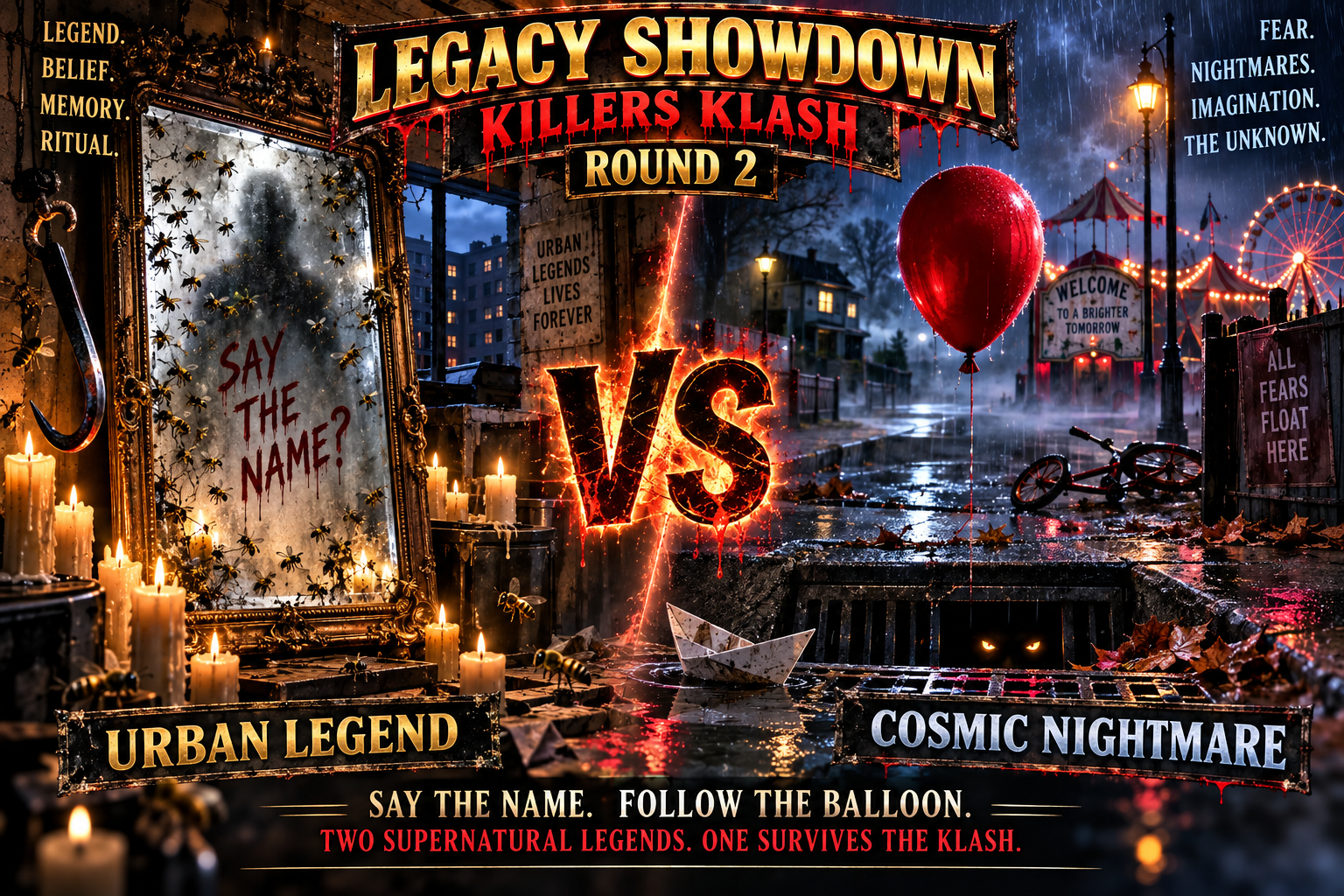

Say his name and a legend appears. Follow the red balloon and an ancient nightmare waits. Two supernatural horror icons collide.
Welcome back to Killers Klash, where horror’s most terrifying, unforgettable, and iconic characters go head-to-head to determine who possesses the stronger legacy killer instinct. As part of our larger Legacy Showdown series, this tournament is not simply about who would win a physical fight. It measures the legacy each character has built through impact, longevity, cultural recognition, unforgettable moments, distinctive identity, and endurance across generations.
Round 2 gives us one of the tournament’s most atmospheric supernatural matchups. Candyman enters as a tragic urban legend whose name, voice, hook, bees, mirror ritual, and haunting mythology transformed him into one of the most distinctive horror figures of the 1990s. Pennywise arrives as the shape-shifting face of Stephen King’s It, a creature that feeds on fear and repeatedly uses the appearance of a clown to terrorize the children of Derry.
Candyman advanced from Round 1 after defeating Jigsaw in a tightly contested matchup, with his Cultural Impact, Identity & Style, and Legacy Endurance proving decisive. Pennywise moved forward after defeating Leatherface, using his enormous Peak Impact, Big Moments, Cultural Impact, and unforgettable supernatural identity to establish himself as one of the strongest competitors in the bracket.
Now their mythologies collide. Candyman is summoned by belief and repetition. Pennywise exploits fear and returns in cycles. Both are more than physical killers: they invade memory, imagination, community, and folklore. One turns a name spoken into a mirror into a doorway. The other can turn almost any fear into a weapon.
Round 2 keeps the six official Killers Klash categories: Peak Impact, Longevity, Cultural Impact, Big Moments, Identity & Style, and Legacy Endurance. Candyman vs. Pennywise. Urban legend against cosmic nightmare. Let the Klash begin.
Affiliate Disclaimer
Affiliate Disclaimer: This blog may contain affiliate links or banner advertisements. If you click on one of these links or advertisements and make a purchase, we may earn a small commission at no additional cost to you. These commissions help support our work and allow us to continue creating entertaining content like Killers Klash and the Legacy Showdown series.
Rules of the Showdown
We evaluate each competitor based on six categories:
- Peak Impact
- Longevity
- Cultural Impact
- Big Moments
- Identity & Style
- Legacy Endurance
1. Peak Impact
Candyman:
Candyman’s 1992 arrival gave horror a villain who felt unlike the dominant slashers of the previous decade. Tony Todd’s commanding performance, the film’s urban atmosphere, Philip Glass’s haunting score, and the mythology surrounding Cabrini-Green created a character who felt simultaneously intimate and legendary. Candyman did not simply stalk victims; he existed because stories about him continued to circulate.
The mirror ritual gave the character an immediately understandable horror hook. Repeating his name turns curiosity into invitation, making the audience imagine whether it would dare complete the ritual. His tragic history and relationship with Helen also gave the original film unusual thematic depth, connecting horror with memory, belief, violence, race, reputation, and the way communities create legends.
At his peak, Candyman was sophisticated supernatural horror with a villain whose presence could be seductive, frightening, mournful, and threatening at once. His influence is substantial, but his greatest cultural peak remained more concentrated than Pennywise’s.
Pennywise:
Pennywise has experienced two enormous peaks across different generations. Tim Curry’s portrayal in the 1990 television adaptation introduced millions of viewers to a sinister clown whose friendliness could turn threatening in an instant. Decades later, Bill Skarsgård’s version helped turn It into a major theatrical horror event for a new generation.
The 2017 film dramatically expanded Pennywise’s modern visibility. Red balloons, storm drains, the dancing clown imagery, the distorted smile, and the Losers’ Club’s encounters with personalized fears became part of mainstream horror culture. The character was no longer simply known to Stephen King readers or viewers of the earlier adaptation; Pennywise became one of the dominant horror images of the late 2010s.
Few horror villains have successfully achieved major cultural peaks in two separate screen eras with two different performances. That ability gives Pennywise extraordinary range in this category.
Edge: Pennywise
Candyman’s original peak is artistically powerful and historically important, but Pennywise has achieved something especially difficult: major impact across two distinct generations of screen horror. Tim Curry made Pennywise unforgettable for one audience, while Bill Skarsgård helped transform the character into a theatrical phenomenon for another.
Candyman’s peak helped redefine supernatural urban-legend horror. Pennywise’s modern peak became a massive mainstream horror event while reinforcing a mythology that had already frightened audiences for decades. For the size of that reach and the strength of two different cultural peaks, Pennywise takes Round 1.
2. Longevity
Candyman:
Candyman has remained relevant since the early 1990s through sequels, home-video discovery, critical reassessment, horror fandom, and the 2021 continuation of the franchise. Tony Todd’s performance became inseparable from the character, and the mythology survived even during periods when no new Candyman film was dominating theaters.
The 2021 film was especially important because it demonstrated that the legend could be revisited rather than simply remade. It returned to themes of community memory, violence, storytelling, and the transformation of real pain into folklore. That continuation helped introduce Candyman to viewers who had not experienced the original film during its initial release.
Candyman’s longevity is therefore meaningful because it is tied to the endurance of an idea. The legend can change depending on who tells it, yet the ritual and the name remain recognizable.
Pennywise:
Pennywise’s longevity begins with Stephen King’s novel and extends through multiple major screen interpretations, decades of readership, television exposure, theatrical films, merchandise, Halloween culture, and continued adaptations connected to the mythology of Derry.
The character’s basic premise is built for endurance. Pennywise is not merely a clown; the clown is one form used by an ancient shape-shifting entity that exploits fear. That means the mythology can be retold with different visual styles and different manifestations without losing the central threat.
The long gap between the 1990 miniseries and the modern films actually strengthened the case for endurance. Pennywise returned with a different actor, different production scale, and different generation of viewers—and immediately became culturally dominant again.
Edge: Pennywise
Candyman has survived for more than three decades and successfully returned to modern horror, which makes this a legitimate contest. Pennywise, however, has a broader foundation across literature, television, theatrical film, and continuing expansion of the Derry mythology.
More importantly, Pennywise has proven that the character can be reinterpreted dramatically while remaining recognizable. Tim Curry and Bill Skarsgård offer very different performances, yet both are accepted as defining versions. For surviving across formats, decades, and generations with enormous visibility, Pennywise takes Round 2.
3. Cultural Impact
Candyman:
Candyman’s cultural impact reaches beyond simple villain recognition because the character is built around the way communities create, repeat, and inherit stories. The mirror ritual became one of horror’s great participation myths: say the name five times and risk making the legend real. That structure places Candyman in the tradition of whispered dares and urban legends people pass from one generation to another.
Tony Todd’s voice, physical presence, hook, coat, bees, and tragic mythology created a rare Black horror icon with genuine cultural weight. The original film also invited conversations about race, historical violence, housing, mythmaking, and who gets remembered or forgotten. Later interpretations deepened the idea that Candyman can function as more than one individual’s ghostly reputation.
Because of that, Candyman’s influence is not measured only by costumes or box-office visibility. The character occupies a distinctive place in discussions about what horror legends represent and how social history can become embedded inside supernatural storytelling.
Pennywise:
Pennywise has achieved enormous popular recognition. The red balloon, storm drain, clown face, phrase ‘You’ll float too,’ and images associated with Derry became instantly recognizable pieces of modern horror culture. The modern films also contributed to a renewed wave of clown-related horror imagery and made Pennywise a major Halloween costume and merchandise figure.
The character’s cultural reach is amplified by Stephen King’s enormous readership and the continuing popularity of It. Pennywise represents childhood fear made physical, and the clown disguise exploits the uncomfortable contrast between something associated with entertainment and something predatory.
Pennywise may currently possess greater raw mainstream visibility, especially among younger audiences. Yet much of that impact is tied to the broader success of It and the character’s terrifying visual presentation rather than the layered social and folkloric influence that defines Candyman.
Edge: Candyman
Pennywise is arguably the more recognizable character in contemporary mainstream culture, which makes this one of the hardest decisions in the matchup. But Cultural Impact is not identical to popularity. Candyman helped expand the kinds of stories, histories, communities, and identities that could stand at the center of an iconic horror mythology.
The mirror ritual became a piece of horror folklore, while Candyman’s racial and historical dimensions have kept the character relevant to conversations extending far beyond conventional slasher analysis. Pennywise is a cultural phenomenon; Candyman carries a particularly distinctive cultural significance. By a narrow margin, Candyman takes Round 3.
4. Big Moments
Candyman:
Candyman’s biggest moments depend heavily on atmosphere and revelation. Helen’s decision to test the mirror legend begins the descent from skepticism into supernatural terror. Candyman’s first full confrontation with her is memorable because Tony Todd’s voice and composure make the character feel almost ceremonial rather than frantic.
The bees, the hook, the murals, the bonfire, the repeated uncertainty surrounding Helen’s actions, and the ending of the original film all contribute to a mythology where victim and legend begin to blur together. Later installments add new interpretations of the Candyman identity and return the mirror ritual to a modern context.
Candyman’s moments are often strongest because they linger psychologically. The character does not need constant appearances; anticipation and belief make the eventual encounters feel larger.
Pennywise:
Pennywise has an enormous advantage in the number and variety of supernatural set pieces available to him. Georgie’s encounter at the storm drain establishes the danger immediately. From there, the creature can emerge through slideshows, abandoned spaces, distorted bodies, hallucinations, personalized fears, and the grotesque geography beneath Derry.
Because Pennywise can change shape, nearly every member of the Losers’ Club can receive a different nightmare. That gives the story a collection of signature moments rather than one repeated method of attack. The modern films especially use visual effects, performance, sound, and production design to turn Pennywise’s appearances into major horror spectacles.
The earlier television version also contributes its own unforgettable moments, particularly through Tim Curry’s ability to make an apparently ordinary clown suddenly feel malicious.
Edge: Pennywise
Candyman has haunting, elegant signature scenes, and his first major appearance remains one of supernatural horror’s great villain introductions. Pennywise simply has more creative territory available. Shape-shifting and fear manipulation allow the character’s biggest scenes to change completely depending on the victim.
From Georgie’s storm drain encounter to the personalized nightmares of the Losers’ Club, Pennywise’s mythology produces an unusually deep collection of memorable horror sequences. For variety, scale, and instantly recognizable set pieces, Pennywise takes Round 4.
5. Identity & Style
Candyman:
Candyman’s identity is built from a combination of elegance and brutality. Tony Todd’s deep voice, long coat, hook, deliberate movement, and commanding presence make him feel less like a conventional slasher and more like a figure emerging from folklore. He does not rush. He arrives with the confidence of someone who believes the story already belongs to him.
The bees provide another distinctive visual element, while the mirror ritual gives his identity a ceremonial structure. Most importantly, Candyman’s style is inseparable from storytelling itself. He needs people to repeat the legend. His reputation is part of his supernatural existence.
That makes him unusually self-aware as a horror concept without requiring comedy or direct audience acknowledgment. Candyman is frightening because memory, belief, violence, and identity all become part of the same legend.
Pennywise:
Pennywise has one of horror’s strongest visual identities, particularly in the clown form. Tim Curry created a version that could look almost ordinary before becoming threatening, while Bill Skarsgård emphasized unnatural movement, unusual facial expressions, an antique-looking costume, and a predatory quality that made the clown seem fundamentally wrong.
The red balloon has become an extension of Pennywise’s identity, while the storm drain and Derry itself reinforce the mythology. Shape-shifting gives the creature extraordinary stylistic flexibility because Pennywise can become whatever will most effectively frighten a victim.
The challenge is that Pennywise’s identity is intentionally unstable. The clown is iconic, but it is still a preferred form rather than the complete nature of the creature.
Edge: Candyman
Pennywise may have the more immediately recognizable modern image, but Candyman’s identity is exceptionally unified. Voice, hook, bees, mirror, name, tragic history, and the need for belief all reinforce the same central idea: a legend survives because people keep telling the story.
Nothing about Candyman feels accidental or interchangeable. Even his method of being summoned expresses the theme of the character. Pennywise is visually spectacular and endlessly adaptable, but Candyman’s style has a coherence and mythic elegance that few horror villains can equal. Candyman takes Round 5.
6. Legacy Endurance
Candyman:
Candyman’s endurance is already impressive. More than thirty years after the original film, the character remains immediately associated with mirror rituals, Tony Todd’s performance, urban-legend horror, and one of the genre’s most distinctive supernatural mythologies. The modern continuation proved that the legend could be revisited without simply repeating the original story.
His deeper themes also support long-term relevance. Stories about memory, historical violence, community trauma, reputation, and the transformation of real events into folklore are not tied to one decade. Future filmmakers could reinterpret Candyman again because the mythology is designed around retelling.
That gives Candyman a strong legacy foundation: as long as people keep repeating the story, the concept itself suggests that Candyman can return.
Pennywise:
Pennywise possesses one of the strongest endurance mechanisms in modern horror: the character exists simultaneously as a literary creation and a screen icon. Stephen King’s novel ensures that new readers continually encounter the mythology, while multiple adaptations allow each generation to form its own visual version of the creature.
The themes are equally durable. Childhood fear, trauma, friendship, memory, the things adults refuse to see, and the terror hidden beneath an apparently ordinary town can be reinterpreted indefinitely. Pennywise’s cyclical nature even makes recurring adaptations feel consistent with the spirit of the character.
Most importantly, Pennywise has already demonstrated successful generational renewal. The character frightened television audiences in 1990, returned as a major theatrical icon decades later, and continues to support new interest in Derry’s mythology.
Edge: Pennywise
Candyman’s legacy is secure and may continue growing because the character’s mythology invites reinterpretation. But Pennywise has already demonstrated the ability to dominate horror culture in separate generations while being supported by one of Stephen King’s most famous novels.
That combination of literary permanence, adaptable screen portrayals, universal fears, and continuing Derry mythology gives Pennywise an unusually strong path into the future. Candyman survives through the power of legend. Pennywise survives through literature, adaptation, and fear itself. Pennywise takes Round 6.
Final Verdict: Pennywise Advances
After six rounds, Pennywise defeats Candyman 4-2 and advances to the next stage of Killers Klash.
Candyman wins Cultural Impact and Identity & Style, and those victories capture what makes him such an extraordinary horror creation. His mythology carries social, historical, and folkloric weight that goes far beyond a conventional supernatural killer. Tony Todd’s performance, the mirror ritual, the hook, the bees, and the idea that belief itself sustains the legend give Candyman an identity that remains almost impossible to duplicate.
Pennywise wins Peak Impact, Longevity, Big Moments, and Legacy Endurance. The character has achieved major recognition through literature and two very different screen generations, while the shape-shifting mythology creates an enormous range of memorable scares. Tim Curry and Bill Skarsgård each gave audiences a distinctive Pennywise, yet the core idea survived both interpretations.
The 4-2 score is more decisive than the quality gap between these characters. Candyman has the richer argument in several thematic areas and may be one of the tournament’s most sophisticated supernatural figures. Pennywise advances because the overall legacy is broader: multiple generational peaks, extraordinary adaptability, a deep collection of signature moments, and a literary foundation that continually introduces the character to new audiences.
Pennywise wins 4-2 and advances in the Killers Klash tournament.
Round 2 Scorecard
Peak Impact: Pennywise
Longevity: Pennywise
Cultural Impact: Candyman
Big Moments: Pennywise
Identity & Style: Candyman
Legacy Endurance: Pennywise
Audience Challenge
Do you agree with the result? Should Pennywise advance because of his generational reach, shape-shifting mythology, unforgettable moments, and literary endurance? Or should Candyman’s cultural significance, elegant supernatural identity, mirror ritual, and deeper connection to folklore earn him the Round 2 victory? Which category would you change? Cast your vote, defend your killer, and tell us who truly possesses the stronger legacy killer instinct.