
Affiliate Disclaimer: This post may contain affiliate links. If you make a purchase through one of these links, The Shopping Plaza may earn a commission at no additional cost to you.
The Scariest Monsters Are Sometimes the Ones We Imagine
A dark room can become much more frightening when we cannot see what is inside it. A shadow looks suspicious. A small noise suddenly sounds important. Our imagination begins filling in the missing details, and before long we may be reacting to something that has not actually happened.
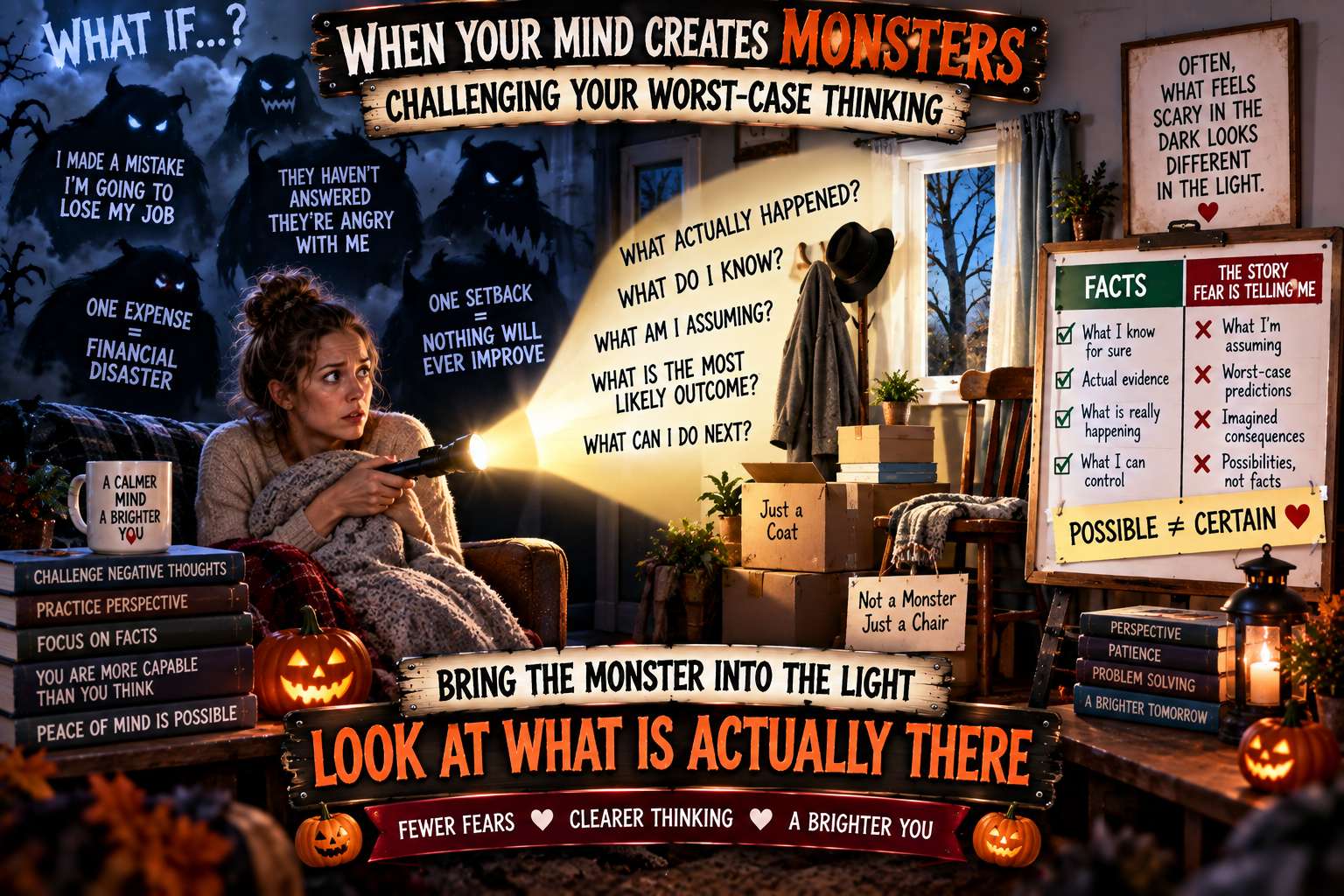
Worst-case thinking works in a similar way. An unanswered email becomes evidence that someone is upset with us. A mistake at work becomes the beginning of losing our job. One unexpected expense becomes a prediction of financial disaster. A difficult conversation becomes a future argument before a single word has been spoken.
Our minds are capable of imagining danger because anticipating problems can help protect us. The difficulty begins when possibility starts feeling like certainty.
Challenging worst-case thinking does not mean pretending bad things never happen. It means learning to distinguish between what is happening, what could happen, and what fear is predicting will happen. That distinction can keep an imagined monster from controlling a very real decision.
Why the Mind Jumps to the Worst Possible Outcome
Worst-case thinking often begins with a desire for protection. If we can predict everything that might go wrong, perhaps we can prevent ourselves from being surprised or hurt.
Unfortunately, mentally rehearsing disaster does not necessarily make us safer. It can make us exhausted.
Uncertainty is especially difficult because the brain wants an answer. When no answer is available, a negative prediction can feel strangely satisfying because at least it replaces uncertainty with a story. The story may be frightening, but it feels definite.
Past experiences can strengthen this habit. If something went badly before, we may expect the same outcome again. Stress can also make negative possibilities feel more believable because our emotional resources are already stretched.
Understanding this pattern is important. You are not required to believe every thought simply because your mind produced it. Thoughts are mental events, not automatic facts. You can notice a frightening prediction, examine it, and decide whether the evidence supports it.
Learn to Recognize Catastrophizing
Catastrophizing is the tendency to take a problem or uncertainty and mentally escalate it toward an extreme negative conclusion.
You make one mistake and think, “I always ruin everything.” Someone does not respond quickly and you assume the relationship is damaged. A project receives criticism and you decide the entire effort is a failure. You face one setback and imagine that nothing will ever improve.
Listen for absolute language such as always, never, everyone, no one, ruined, impossible, disaster, or hopeless. These words are not automatically wrong, but they can be clues that your thinking has moved beyond the immediate facts.
Another clue is a rapid chain of consequences. “If this goes wrong, then that will happen, then everything will collapse.” Each link may be possible, but the mind treats the entire chain as inevitable.
Recognizing catastrophizing gives you an opportunity to interrupt it. Instead of asking, “Why is everything falling apart?” you can ask, “What has actually happened so far?” That question brings you back from the imagined future to the situation in front of you.
Separate Facts From the Story You Are Telling Yourself
When anxiety rises, take a piece of paper or open a note and create two simple categories: what I know and what I am assuming.
Suppose you submitted an application and have not received a response. What do you know? You submitted it. You have not heard back. What are you assuming? They hated your application, you have no chance, and you will never find another opportunity.
The assumptions may eventually prove correct or incorrect, but they are not yet facts.
This exercise can be used with relationships, work, finances, creative projects, health-related uncertainty, and everyday decisions. The goal is not to force yourself into a positive conclusion. It is to return to accuracy.
Sometimes the facts will reveal a genuine problem that needs attention. That is useful because real problems can be addressed. Imagined conclusions are harder to solve because they keep changing and expanding.
Clarity begins when you stop arguing with an entire frightening story and identify the few facts that actually require a response.
Replace ‘What If?’ With ‘What Then?’
Worst-case thinking loves the question “What if?”
What if I fail? What if I am rejected? What if the plan changes? What if I make a mistake?
Try adding a second question: “What then?”
If you do not get the job, what will you do next? You may ask for feedback, improve your resume, continue applying, or explore another opportunity. If a project performs poorly, you can examine what happened and revise your approach. If a difficult conversation becomes uncomfortable, you can pause, clarify your point, or return to it later.
“What then?” does not guarantee that a setback will be easy. It reminds you that the feared event is not necessarily the end of your ability to respond.
Worst-case thinking often gains power by presenting an unwanted outcome as a cliff with nothing beyond it. Creating a response plan builds a bridge beyond the fear.
You may not control every outcome, but you can strengthen your confidence in your ability to deal with what happens next.
Calculate the Most Likely Outcome Too
When we are anxious, we often compare the best possible outcome with the worst possible outcome and then emotionally prepare for the worst.
There is another possibility: the most likely outcome.
If you make a small mistake during a presentation, the worst case might be humiliation and professional disaster. The best case might be a flawless performance. The most likely case may be that you correct yourself, continue, and most people barely remember the mistake.
This approach does not require statistics. It requires balance.
Ask yourself three questions: What is the worst realistic outcome? What is the best realistic outcome? What is the most likely outcome based on the information available?
The word realistic matters. Fear can create scenarios that are technically imaginable but extremely unlikely.
Considering the middle prevents the most dramatic possibility from becoming the default prediction. Most days are not made entirely of miracles or disasters. They are filled with imperfect, manageable outcomes that we can navigate.
Do Not Confuse a Feeling With a Forecast
A powerful emotional state can make a thought feel more accurate than it is.
“I feel nervous, so something must be wrong.” “I feel unprepared, so I must be incapable.” “I feel embarrassed, so everyone must be judging me.”
Feelings provide information about your internal experience. They do not automatically predict external events.
You can be nervous before something goes well. You can feel uncertain while making a wise decision. You can feel embarrassed about a mistake that other people barely noticed. You can feel discouraged while still making progress.
Try changing “I feel like this will fail” to “I feel afraid that this might fail.” The second statement separates emotion from prediction.
That separation creates room for evidence, preparation, and choice. Your feelings deserve attention and compassion, but they do not have to function as fortune-tellers.
Bring the Monster Into the Light
In scary stories, the unknown creature is often most frightening before we see it clearly. Once it is visible, we can understand what we are dealing with.
Do the same with a recurring fear.
Write the worst-case scenario in specific terms. Avoid vague statements such as “everything will be terrible.” What exactly are you afraid will happen? Then identify the probability, the consequences, the resources you would have, and the actions you could take.
Specificity often reduces the size of the monster.
You may discover that the feared event would be unpleasant but survivable. You may discover that you can reduce the risk through preparation. You may also discover a legitimate concern that deserves attention.
Either result is better than being chased by an undefined sense of catastrophe.
A problem you can name is easier to evaluate than a cloud of dread that seems to contain every possible problem at once.
Stop Rehearsing Disasters You Cannot Prevent
There is a difference between useful planning and repetitive worry.
Useful planning ends with an action: make the appointment, save additional money, practice the presentation, create a backup, ask the question, review the instructions.
Repetitive worry keeps replaying the same scenario without producing anything new.
When you notice yourself mentally rehearsing a disaster, ask, “Is there an action available to me right now?” If yes, decide whether to take it. If no, continuing to replay the scenario may not be preparation anymore.
You can write the concern down and schedule a time to revisit it when more information is available. Then return your attention to something you can influence.
Your mind may bring the worry back. That does not mean you failed. Redirecting attention is a practice, not a one-time command.
You do not need to solve tomorrow’s imaginary emergencies before completing today’s real responsibilities.
Use Evidence From Your Own Past
Worst-case thinking tends to forget your history of coping.
Think about difficult situations you have already faced. You may have survived rejection, changed plans unexpectedly, learned a difficult skill, handled a mistake, recovered from disappointment, or solved a problem you initially thought was overwhelming.
Those experiences matter.
Ask yourself, “Have I ever been afraid before and still managed the situation?” The answer is probably yes.
Past resilience does not guarantee that every future challenge will be easy. It provides evidence that you possess problem-solving ability, adaptability, patience, or the willingness to seek help.
Fear often says, “You will not be able to handle this.” Your history may contain dozens of examples proving that you have handled hard things before.
Use those memories as evidence, not as pressure. You do not need to be invincible. You only need to remember that your first frightened prediction has not always been the final truth.
Limit the Audience for Your Fear
When we are worried, we sometimes seek reassurance from many different people. One person says everything will be fine, another raises a new concern, and a third tells a story about something that went terribly wrong. Instead of becoming calmer, we collect additional scenarios.
Choose your sources of perspective carefully.
Talk with people who are trustworthy, relevant to the situation, and capable of being balanced. If the concern requires specialized expertise, seek an appropriate professional rather than relying on random opinions.
The goal is not to find someone who guarantees the outcome you want. It is to gain useful perspective.
Too many opinions can feed worst-case thinking because every new possibility gives the mind another monster to build.
Sometimes clarity comes from reducing the noise and returning to the facts you actually have.
Give Yourself a Time Limit for Worry
Trying to command yourself never to worry can backfire. A more practical strategy is to create boundaries around it.
Set aside a short period to think through the concern deliberately. Write down what is bothering you, what you know, what you can control, and what action is available.
When the time ends, shift to another task.
If the worry returns, remind yourself that you have already given it attention and can revisit it during the next planned period if necessary.
This technique does not eliminate uncertainty. It prevents uncertainty from consuming every available moment.
You are teaching your mind that a concern can be acknowledged without receiving unlimited access to your day.
The goal is not perfect mental silence. The goal is greater control over where your attention goes.
Take One Concrete Action
Worst-case thinking thrives when we remain completely still because there is no new evidence to challenge the prediction.
Action creates information.
If you fear being unprepared, practice. If you worry that you misunderstood something, ask. If you fear missing a deadline, create a schedule. If you are worried about an opportunity, research the requirements. If you are anxious about a difficult conversation, write down what you need to communicate.
One concrete action can shrink a large cloud of anxiety into a manageable task.
You do not need to solve everything at once. You need to identify the part of the situation that belongs to you now.
Action cannot guarantee the outcome, but it can replace helplessness with participation. That shift alone can change the way a problem feels.
Choose Realistic Hope Over Forced Positivity
Challenging worst-case thinking is not the same as insisting that everything will be wonderful.
Forced positivity can be just as inaccurate as catastrophizing.
Realistic hope says, “This may be difficult, but there are multiple possible outcomes.” It says, “I cannot control everything, but I can prepare.” It says, “A setback would hurt, but I could respond.” It says, “I do not know what happens next, and that means the negative outcome is not guaranteed either.”
This kind of hope is strong because it does not require denial.
You can acknowledge uncertainty and still believe in your capacity to navigate it. You can recognize risk without surrendering to catastrophe. You can prepare for problems without living as though they have already occurred.
The goal is not to replace every frightening thought with a cheerful one. It is to replace distorted certainty with a more accurate and useful perspective.
Your Thoughts Can Knock Without Being Invited In
Your mind will continue creating possibilities. Some will be exciting. Some will be practical. Some will be frightening.
You cannot always control which thought knocks on the door, but you can decide how long it stays.
When a worst-case thought appears, notice it. Name it. Ask what evidence supports it. Separate facts from assumptions. Consider the most likely outcome. Decide what you would do if the feared result occurred. Take any useful action available, and then return your attention to the life happening in front of you.
The monster may return tomorrow. You can repeat the process.
Strength does not mean never imagining something bad. It means becoming less willing to let imagination masquerade as certainty.
Your mind is extraordinarily creative. That creativity can build monsters in the darkness, but it can also build plans, alternatives, solutions, and hope.
Turn on the light. Look at what is actually there. Respond to the real problem rather than every frightening possibility.
You may discover that some monsters disappear completely. Others become smaller. And the ones that remain may look far more manageable once you remember that you do not have to face them with imagination alone.