

Affiliate Disclaimer: This post may contain affiliate links. If you make a purchase through one of these links, The Shopping Plaza may earn a commission at no additional cost to you.
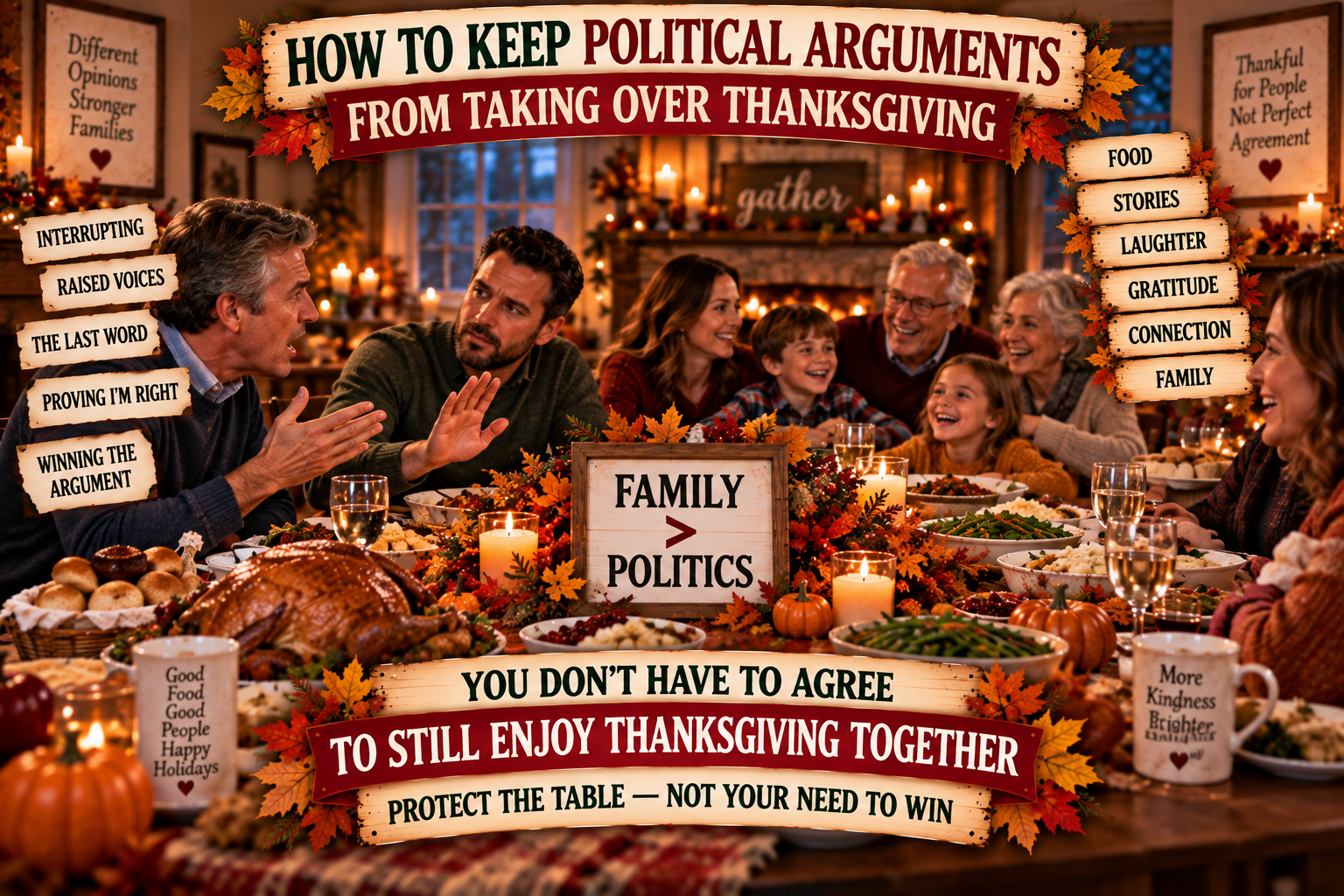
Thanksgiving Does Not Have to Become a Political Debate Stage
Thanksgiving has always brought together people with different personalities, experiences, values, and opinions. In many families, those differences include politics.
One person follows political news constantly. Another would rather avoid it completely. Some relatives may agree on most issues, while others see the world very differently. Add holiday stress, old family dynamics, strong emotions, and a crowded dinner table, and a simple political comment can quickly become the conversation everyone remembers.
The problem is not that people have political beliefs. Caring about public issues is normal.
The problem begins when the desire to debate becomes more important than the people sitting around the table.
Thanksgiving does not require everyone to agree. It does require some willingness to recognize that a family meal has purposes beyond proving a political point.
You can hold strong convictions and still choose not to spend Thanksgiving arguing about them.
Sometimes protecting the gathering means deciding that the relationship deserves more attention than the disagreement.
Decide Before Dinner What Kind of Thanksgiving You Want
Before the gathering begins, think about your goal for the day.
Do you want to reconnect with relatives, enjoy traditions, share a meal, laugh, rest, or create memories?
Remember that goal if politics enters the conversation.
A debate may feel important in the moment, but ask whether it is helping create the Thanksgiving you wanted.
You do not have to follow every conversation wherever it tries to take you.
Accept That People at the Table May Disagree
A peaceful Thanksgiving does not require political uniformity.
Relatives can vote differently, prioritize different issues, and interpret events differently.
Accepting that reality can reduce the urge to treat every disagreement like a problem that must be solved before dessert.
You may leave Thanksgiving with exactly the same political differences you had when you arrived.
That can still be a successful gathering.
Set Expectations Before the Gathering When Necessary
If political arguments have repeatedly disrupted past holidays, consider addressing the issue beforehand.
A host might say, “I know we all have strong opinions, but I’d really like Thanksgiving to focus on family rather than political debates.”
This is not a demand that people abandon their beliefs.
It is a request to protect a particular setting.
Clear expectations can make redirection easier later because everyone already knows the intention.
Do Not Start With a Provocation
If you want a peaceful gathering, avoid opening with comments designed to challenge someone.
A joke about another person’s political beliefs may seem harmless to you but can immediately establish an adversarial mood.
The same is true of sarcastic remarks, loaded questions, and comments made specifically because you know someone will react.
You cannot control what everyone else says.
You can choose not to light the first match.
Recognize the Difference Between Conversation and Combat
Political discussion is not automatically unhealthy.
Some families can discuss difficult issues respectfully.
Ask whether people are listening, asking genuine questions, and allowing disagreement.
If everyone is interrupting, raising voices, repeating slogans, or trying to humiliate someone, the conversation has changed.
At that point, continuing is unlikely to create understanding.
Knowing when a discussion has stopped being productive is an important social skill.
Do Not Treat Thanksgiving as Your Chance to Convert Everyone
You may believe strongly that your position is correct.
Your relative probably believes the same about theirs.
Trying to completely change someone’s worldview between the turkey and pumpkin pie is an ambitious goal.
Consider lowering the objective.
You can explain your perspective if the conversation is respectful.
You do not have to leave the table with a convert.
Sometimes mutual understanding is a more realistic goal than agreement.
Ask Questions Instead of Making Accusations
If a political conversation does occur, curiosity can lower the temperature.
Instead of saying, “How could anyone believe that?” ask, “What makes that issue important to you?”
Questions can reveal experiences and priorities beneath a person’s position.
You may still disagree.
But understanding why someone thinks differently can make the conversation feel more human and less like two teams shouting across a field.
Avoid Insulting Labels
Political arguments escalate quickly when people stop discussing ideas and begin attacking identities.
Avoid calling relatives stupid, ignorant, evil, brainwashed, selfish, or similar labels.
Once a person feels personally attacked, the conversation usually stops being about the original issue.
Disagree with the position without reducing the person to the position.
Respectful disagreement requires remembering that the relative across from you is more than their politics.
Know Which Topics Are Especially Volatile
Every family has subjects that reliably create conflict.
You may already know them.
If a particular issue has produced the same argument at several previous gatherings, ask whether another round is likely to accomplish anything.
You are allowed to say, “We’ve had this debate before, and I don’t think Thanksgiving is the right time to repeat it.”
Learning from previous holidays can prevent you from recreating them.
Use a Calm Redirect
When the conversation starts becoming tense, redirect it.
“Let’s give politics a break. What is everyone doing for Christmas?”
Or, “We probably aren’t solving that tonight. Who wants dessert?”
A redirect does not need to be sophisticated.
It simply offers the table another path.
Sometimes people are relieved when someone gives them permission to leave a heated subject.
Have Several Safe Conversation Topics Ready
It helps to know where you can redirect the discussion.
Family memories, travel, hobbies, movies, sports, recipes, children, pets, work accomplishments, holiday traditions, and future plans can all create conversation.
Ask open-ended questions.
“What was everyone’s favorite Thanksgiving growing up?”
A good question can shift the entire energy of the table.
Do Not Take Every Political Comment Personally
A relative may make a general political statement that irritates you.
Before reacting, ask whether it was actually directed at you.
You do not have to personally defend an entire political movement, party, candidate, or ideology every time someone makes a comment.
You are one person at Thanksgiving dinner.
You are not the official spokesperson for everyone who shares some of your views.
Use the Pause Before Responding
Political subjects can trigger immediate emotional reactions.
Before answering, pause.
Take a breath.
Ask yourself whether your next sentence will improve the conversation or intensify it.
That pause may be only a few seconds.
It can be the difference between a disagreement and an argument.
Lower Your Voice When Others Raise Theirs
Volume often creates the illusion that an argument is becoming stronger when it is simply becoming louder.
If someone raises their voice, resist matching them.
Speak more slowly.
Keep your tone steady.
If calm communication is no longer possible, suggest ending the discussion.
You do not need to outshout someone to maintain your position.
Do Not Demand the Last Word
Many political arguments continue because both people want to make one final point.
Then the other person responds with their final point.
Then another final point appears.
Someone eventually has to stop.
You can be that person.
Letting another person speak last does not mean they won.
It means you decided the conversation had reached its useful limit.
Set a Boundary if the Discussion Becomes Disrespectful
There is a difference between political disagreement and personal hostility.
If the conversation turns into insults, harassment, or repeated targeting, set a boundary.
“I am willing to disagree, but I’m not willing to be insulted.”
If the behavior continues, leave the conversation.
Political passion does not excuse disrespect.
Take a Break When You Feel Yourself Getting Angry
If you notice your frustration rising, step away.
Help in the kitchen.
Refill your drink.
Go outside for a few minutes.
Talk with someone in another room.
A short break can restore perspective.
You do not have to remain seated inside a conversation that is pushing you toward a reaction you will regret.
Do Not Pull Children Into Adult Political Conflict
Children may hear political discussions without understanding the full context.
Avoid asking them to choose sides, repeat adult opinions, or become part of an argument between relatives.
If political conversation becomes heated, adults can move the discussion elsewhere or end it.
Thanksgiving should not require children to navigate adult political tension.
Remember the Relationship Beyond the Political Label
The person across the table may vote differently from you.
They may also be the person who helped you move, taught you a family recipe, called when you were struggling, made you laugh as a child, or showed up during an important moment.
Political disagreement is real.
So is the rest of the relationship.
Do not allow one category to erase every other thing you know about someone.
Focus on Shared Values Where You Can
People who disagree politically may still care about many of the same underlying things.
Family security.
Opportunity.
Safe communities.
A better future for children.
Fairness.
Freedom.
Dignity.
They may disagree strongly about how those goals should be achieved.
Recognizing shared values does not eliminate disagreement.
It can remind everyone that political opponents are not automatically moral opposites.
Know When the Best Political Conversation Is No Political Conversation
There is no rule requiring politics to be discussed at Thanksgiving.
You can care deeply about public issues and still take one afternoon away from them.
There will be other days for news, debates, elections, policies, and political conversations.
Thanksgiving offers a different opportunity.
Sometimes choosing not to debate is not avoidance.
It is prioritization.
Do Not Carry the Argument Through the Rest of the Holiday
If a political disagreement happens, try to let it end.
Do not spend the next three hours making sarcastic references to it.
Do not recruit other relatives to continue the fight.
Do not let one heated exchange contaminate every later conversation.
Reset.
Ask someone about dessert.
Play a game.
Watch something together.
A difficult ten minutes does not need to become a difficult Thanksgiving.
Make Gratitude Bigger Than the Disagreement
Thanksgiving gives you a useful question:
What do you appreciate about the people around this table, even when you disagree with them?
Maybe you appreciate their loyalty, humor, generosity, history, effort, or presence.
Gratitude does not require pretending differences do not matter.
It reminds you that differences are not always the only thing that matters.
Protect the Table, Not Your Need to Win
Political disagreements are not disappearing from families anytime soon.
People care deeply about issues that affect their lives, communities, and country.
Those conversations can matter.
But timing matters too.
Thanksgiving dinner does not have to become a test of whether everyone can defeat everyone else’s arguments.
You can believe strongly in something and still decide not to debate it today.
You can hear an opinion you dislike without immediately responding.
You can disagree without insulting.
You can set a boundary without creating a scene.
You can leave a conversation without surrendering your beliefs.
Most importantly, you can remember why everyone gathered in the first place.
The people around the table are not merely political positions.
They are parents, siblings, grandparents, cousins, friends, spouses, children, and people connected through years of shared history.
Some relationships may be complicated.
Some disagreements may be serious.
But not every serious disagreement needs to occupy every available moment.
If politics begins taking over Thanksgiving, pause.
Lower the temperature.
Redirect the conversation.
Remember the relationship.
Choose the discussions worth having and the ones worth postponing.
There will be another day to debate public policy.
There may not always be another Thanksgiving with every person currently sitting at the table.
So protect the conversation.
Protect the relationships that deserve protecting.
Protect your own peace.
And make enough room at Thanksgiving for something larger than politics: food, stories, laughter, gratitude, connection, and the simple experience of being together despite the things on which you may never agree.






When family gathers from distant regions, managing differing beliefs proves quite a trial.