
Affiliate Disclaimer: This post may contain affiliate links. If you make a purchase through one of these links, The Shopping Plaza may earn a commission at no additional cost to you.
Halloween Does Not Have to Be a Social Performance
Halloween is often portrayed as a highly social holiday. There are costume parties, crowded attractions, neighborhood events, haunted houses, school celebrations, bar gatherings, and groups of friends moving from one activity to another. If social situations make you anxious, all of that excitement can start to feel more like pressure than fun.
You may want to participate while simultaneously worrying about conversations, crowds, costumes, photographs, introductions, or whether you will know what to say. You may even turn down activities you would otherwise enjoy because the social part feels too intimidating.
But Halloween does not belong only to outgoing people.
You can enjoy the season without forcing yourself into situations that make you miserable. You can also challenge yourself in small, manageable ways when you want to grow more comfortable socially.
The goal is not to become a different personality for one night. It is to create a Halloween that gives you room for enjoyment, connection, and courage without treating your comfort level as something you need to apologize for.
Separate What You Want From What You Think You Should Do
Social anxiety can become more stressful when it mixes with expectations.
You see photographs of large parties and think you should want to attend one. Friends talk excitedly about a crowded event, and you worry that declining will make you seem boring. You imagine that staying home means you are somehow wasting Halloween.
Ask yourself a more useful question: What would I actually enjoy?
Maybe you want a small gathering with two close friends. Perhaps you would enjoy decorating, watching horror movies, carving pumpkins, handing out candy, baking seasonal treats, or walking through a neighborhood to see decorations.
There is no official Halloween checklist.
Choosing an activity because you genuinely enjoy it is very different from choosing it because you are afraid of how your absence will be judged.
Make the Event Smaller Before You Make Yourself Braver
When an activity feels overwhelming, people sometimes believe their only options are attending exactly as planned or staying home entirely.
Look for a middle option.
If a party lasts four hours, attend for one. If a large group is meeting, arrive with one person you already know. If a crowded Halloween attraction feels intimidating, choose a quieter time or a smaller local event.
Reducing the size of the challenge can make participation realistic.
Courage does not have to begin with the most difficult version of the situation.
A manageable experience that goes reasonably well can build more confidence than forcing yourself through an overwhelming night and deciding never to try again.
Bring a Social Anchor
Attending an event can feel easier when you have one trusted person nearby.
Ask a friend, partner, relative, or coworker you are comfortable with to attend with you when possible.
A social anchor gives you someone familiar to talk with when you first arrive, someone who can help introduce you to others, and someone you can reconnect with if you begin feeling overwhelmed.
This does not mean you must remain beside them every second.
Think of the person as a home base rather than a shield.
Knowing that one familiar connection is available can make unfamiliar interactions feel much less intimidating.
Use the Costume to Make Conversation Easier
One unexpected advantage of Halloween is that costumes provide ready-made conversation topics.
You do not need to invent an interesting opening line when you can simply ask, “How did you come up with your costume?” or “Did you make that yourself?”
Likewise, your own costume gives other people something easy to ask you about.
If wearing an elaborate costume makes you self-conscious, choose something comfortable and simple. If a creative costume helps you feel more confident, use that instead.
There is no requirement to attract attention.
The best costume for a socially anxious person may be one that makes participation easier rather than one designed to impress everyone in the room.
Prepare a Few Easy Conversation Starters
One source of social anxiety is uncertainty about what to say.
Prepare several simple questions before an event.
Ask about costumes, favorite Halloween movies, childhood Halloween traditions, decorations, candy, or upcoming plans.
These topics fit naturally into the occasion and do not require deeply personal conversation.
You can also prepare a short answer to common questions about yourself.
Preparation is not fake. It is simply reducing the number of decisions you have to make while already feeling nervous.
Once a conversation begins, it may become more natural than you expected.
Give Yourself a Job
Unstructured socializing can feel uncomfortable because you do not know where to stand or what to do.
Having a role can help.
At a small party, offer to help arrange snacks, greet guests with the host, refill drinks, manage music, take photographs, or organize a game. If you are hosting, handing out candy or managing an activity gives you a natural purpose.
A job creates built-in interactions.
Instead of wondering how to enter a conversation, people may approach you because of what you are doing.
Purpose can reduce self-consciousness by moving attention away from how you appear and toward something useful.
Arrive Before the Crowd
Walking into a room that is already full can be one of the hardest parts of a social event.
If possible, arrive early.
It is often easier to greet a few people as they enter than to walk into a large group already divided into conversations.
Arriving early also gives you time to become familiar with the environment.
You can locate a quieter area, speak with the host, and settle in before the energy increases.
Small logistical choices can make a large emotional difference.
Create an Exit Plan Before You Go
Knowing that you can leave often makes staying easier.
Decide in advance how long you would like to attend. Arrange your own transportation when possible or discuss the plan with the person accompanying you.
You might tell yourself, “I will stay for one hour and then decide whether I want another thirty minutes.”
This removes the feeling of being trapped.
If you are enjoying yourself, you can stay longer. If your anxiety remains high, you have already given yourself permission to leave.
An exit plan is not an expectation of failure. It is a way to create enough safety that you can try.
Take Short Breaks Without Abandoning the Evening
You do not have to remain socially engaged every minute.
Step outside for fresh air. Visit a quieter room. Get some water. Spend a few minutes helping in the kitchen. Take a brief walk if the setting allows it.
A short break can lower the intensity enough for you to return.
This is especially helpful at Halloween events where loud music, costumes, decorations, crowds, and constant activity can add sensory stimulation to social pressure.
Leaving for five minutes is different from deciding the entire night is over.
Sometimes a pause is exactly what allows you to keep participating.
Stop Assuming Everyone Is Evaluating You
Social anxiety can create the feeling that other people are carefully monitoring everything you do.
You become aware of where your hands are, whether you are talking enough, whether your costume looks strange, whether your joke was funny, and whether someone noticed an awkward pause.
Most people are far more focused on themselves.
They are thinking about their own conversations, costumes, friends, photographs, plans, and insecurities.
An awkward moment that feels enormous to you may barely register for anyone else.
When you notice yourself imagining other people’s judgments, return to what you actually know.
A fear of being evaluated is not proof that evaluation is happening.
Do Not Grade Yourself During the Event
It is difficult to enjoy a party while simultaneously giving yourself a performance review.
“I should have said something funnier.” “I have been too quiet.” “Everyone else looks more comfortable.” “That conversation was awkward.”
Constant self-evaluation keeps your attention turned inward.
Try replacing judgment with observation.
Instead of “I am terrible at this,” think, “I felt nervous during that introduction.”
The second statement describes an experience without turning it into an identity.
You are allowed to have awkward moments. Everyone does.
The objective is participation, not a flawless social performance.
Choose Smaller Connections Over Working the Room
You do not need to speak with twenty people for an event to count as successful.
One meaningful conversation may be enough.
If large group conversations are difficult, look for another person standing slightly apart from the crowd. Speak with someone you already recognize. Join a conversation of two or three people rather than a large circle.
Quality matters more than quantity.
Many socially anxious people are excellent conversationalists in smaller settings because they listen carefully and connect deeply.
Build your Halloween around the type of interaction that works best for you.
Let Yourself Enjoy Halloween at Home
There is nothing wrong with deciding that your favorite Halloween is a quieter one.
Decorate your home. Make seasonal food. Create a Halloween playlist. Watch classic horror films or family Halloween movies. Read ghost stories. Carve pumpkins. Hand out candy. Play a themed game with family.
You can even make staying home feel intentional by creating your own tradition.
The difference between isolation and chosen solitude is important.
If you are staying home solely because fear has prevented you from doing something you genuinely wanted to do, consider whether a small step outside your comfort zone might be worthwhile.
But if a quiet celebration is honestly what you enjoy, you do not need to justify it.
Challenge Yourself Without Punishing Yourself
Growth often requires discomfort, but discomfort does not need to become punishment.
Choose one manageable social challenge.
Attend a small gathering for an hour. Introduce yourself to one new person. Compliment someone’s costume. Invite a friend to watch a Halloween movie. Walk through a community event instead of avoiding it entirely.
Then recognize what you accomplished.
Do not immediately move the goalposts by saying it was not enough.
Confidence grows through evidence.
Each small experience tells your mind, “I was nervous, and I handled it.”
That evidence can gradually become stronger than the predictions anxiety makes before the next event.
Have Compassion for the Version of You Who Feels Nervous
It is easy to become frustrated with yourself for feeling anxious.
You may think, “Why can’t I just relax?” or “Other people do this without thinking about it.”
Self-criticism adds another layer of difficulty to an already uncomfortable experience.
Try speaking to yourself the way you would speak to a friend.
You would probably not tell a nervous friend that they were pathetic for needing a break or weak for preferring a smaller gathering.
Offer yourself the same patience.
You can want to grow while still treating your current self with respect.
Make Halloween Yours
Halloween is a holiday about transformation, imagination, and stepping briefly outside ordinary life. That does not mean you have to transform into the most outgoing person in the room.
You can participate as yourself.
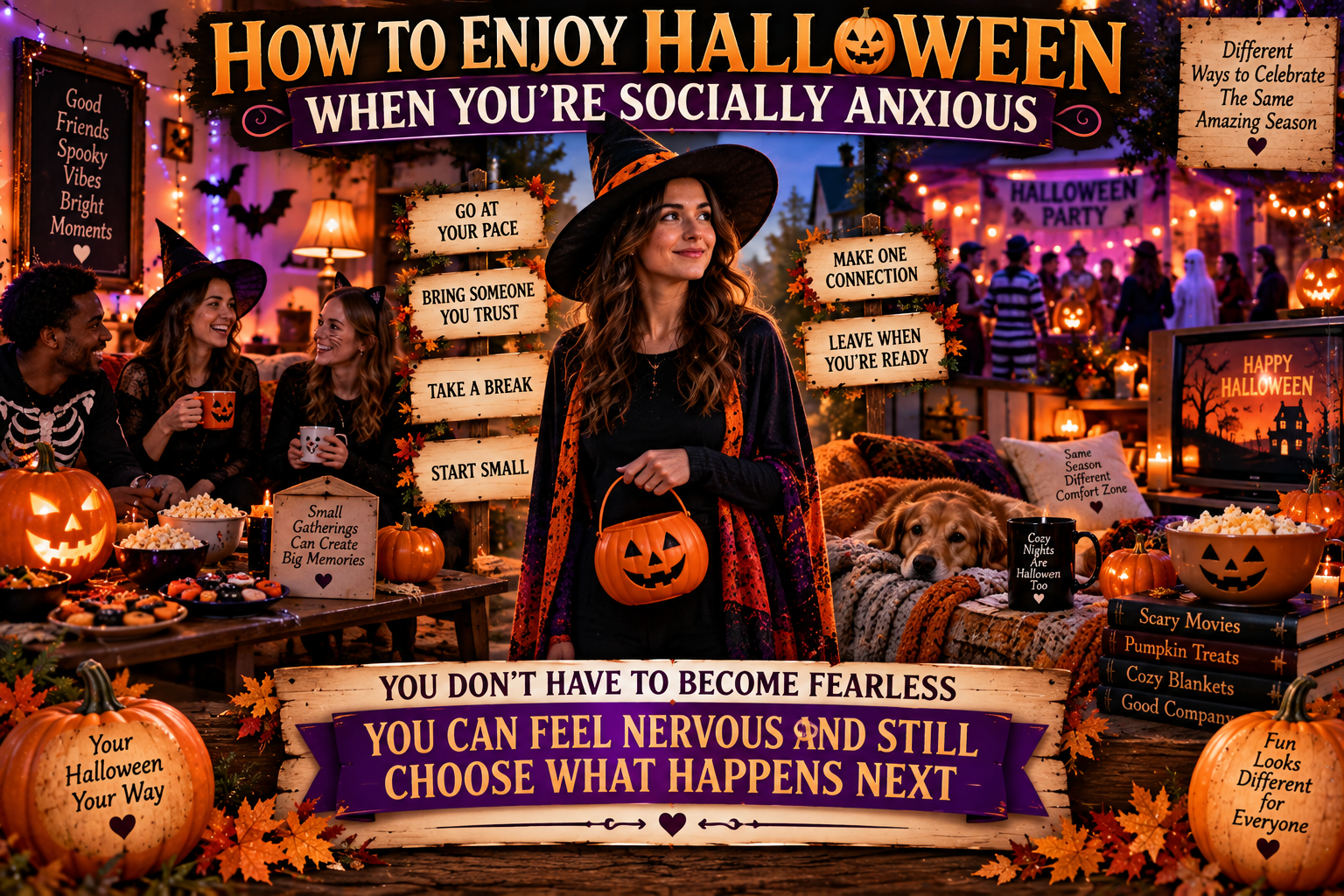
Choose events that genuinely interest you. Make intimidating situations smaller. Bring someone you trust. Prepare a few conversation starters. Give yourself a role. Arrive early. Take breaks. Keep an exit plan.
And if your ideal celebration is a pumpkin, a bowl of candy, a favorite movie, and a quiet evening at home, that can be Halloween too.
Social courage is not measured by how loudly you speak or how long you remain at a crowded party.
Sometimes courage is walking through the door for thirty minutes. Sometimes it is starting one conversation. Sometimes it is accepting an invitation you would normally decline. Sometimes it is saying no to an event you do not actually want and choosing a celebration that fits you better.
You do not have to spend Halloween hiding from every social situation, and you do not have to force yourself into every one either.
Find the middle ground where enjoyment and growth can exist together.
Wear the costume if you want. Skip the costume if you do not. Join the party, take the break, talk to one person, head home when you have had enough.
Halloween should give you memories—not another reason to judge yourself.
Let the night be playful. Let your progress be small. Let yourself participate without demanding perfection.
You may discover that enjoying Halloween socially is not about becoming fearless.
It is about realizing that you can feel nervous and still choose what happens next.