

Affiliate Disclaimer: This post may contain affiliate links. If you make a purchase through one of these links, The Shopping Plaza may earn a commission at no additional cost to you.
Gratitude Can Feel Hardest When We Need Perspective Most
It is easy to talk about gratitude when life feels comfortable. When plans are working, relationships are strong, finances are manageable, and the future looks promising, finding reasons to be thankful may come naturally.
Difficult seasons are different.
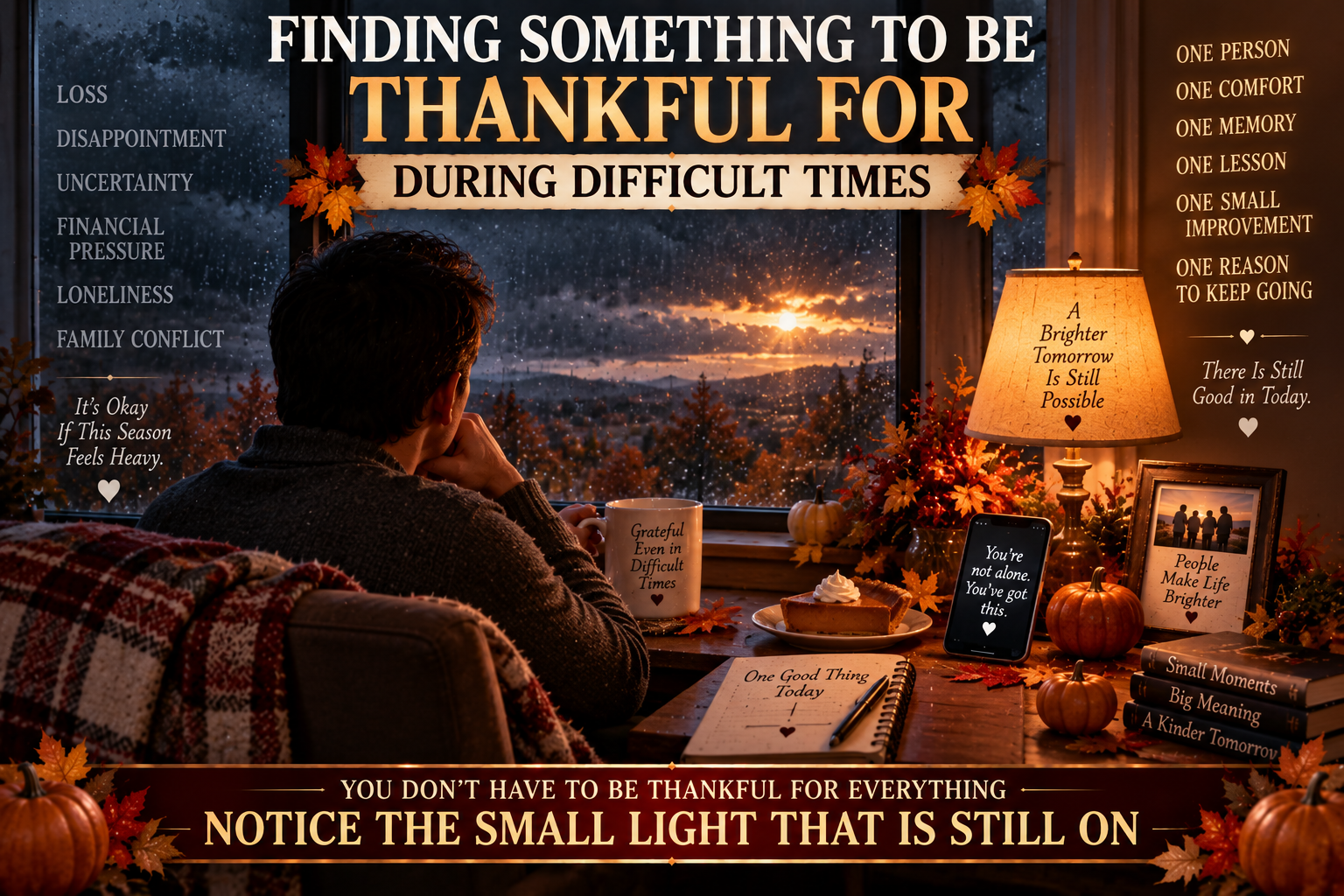
Loss, disappointment, uncertainty, financial pressure, loneliness, family conflict, career setbacks, or simply an exhausting stretch of life can make gratitude feel almost impossible. When something important hurts, being told to “look on the bright side” can feel dismissive rather than encouraging.
Real gratitude does not require pretending that everything is okay.
It does not ask you to call a painful situation good or to smile your way through legitimate disappointment. Instead, gratitude creates room for another truth to exist beside the difficult one.
Something can be hard, and something else can still be meaningful.
Finding one thing to appreciate will not erase the problem. But it can remind you that the problem is not the only thing present in your life. Sometimes that small shift in perspective is enough to help you take the next step.
Do Not Force Yourself to Be Thankful for the Pain
There is an important difference between finding gratitude during a difficult experience and being grateful that the difficult experience happened.
You do not have to be thankful for loss, betrayal, financial hardship, failure, or disappointment.
Trying to force that kind of gratitude too early can make honest emotions feel unacceptable.
Instead, look around the difficulty.
Maybe you are thankful for the person who called. Perhaps you appreciate having somewhere safe to sleep, a meal, a helpful professional, a supportive friend, or enough strength to make it through today.
Gratitude can exist beside pain without approving of the pain.
That distinction makes thankfulness more honest and sustainable.
Start Smaller Than You Think You Should
When life feels overwhelming, broad questions can be difficult.
“What am I thankful for in my life?” may feel too large.
Make the question smaller.
What is one thing that made today slightly easier? What gave you five minutes of comfort? Who treated you kindly? What ordinary convenience worked when you needed it?
Maybe the answer is a cup of coffee, a warm shower, a favorite song, a quiet room, a comfortable blanket, or a text from someone who remembered you.
Small gratitude still counts.
In difficult seasons, tiny points of appreciation can become emotional handholds.
Look for What Is Still Steady
Hard times often focus our attention on what has changed.
One way to regain perspective is to notice what has remained steady.
Perhaps your morning routine still exists. A friend still answers the phone. Your favorite neighborhood walk is still available. A family tradition continues. You still have a skill you worked hard to develop.
Stability can be easy to overlook because it does not demand attention.
Problems announce themselves loudly. Reliable parts of life tend to remain quiet.
Take inventory of what is still standing.
Sometimes recognizing that not everything has fallen apart gives you a stronger place from which to face what has.
Be Thankful for the People Who Show Up
Difficult times often reveal the importance of people.
Notice who checks on you, listens without trying to fix everything, helps with practical tasks, makes you laugh, or simply stays present.
Support does not always arrive dramatically.
It may be a friend sending a message, a relative bringing food, a coworker covering something when you are overwhelmed, or someone asking a second time whether you are really okay.
When you notice these gestures, tell people what they mean to you.
Expressing gratitude can strengthen the connection that is already helping you through the difficult season.
Let Ordinary Comforts Matter
We sometimes dismiss ordinary comforts because they seem too small compared with a serious problem.
But small comforts are often exactly what carry people through difficult days.
A good meal does not solve the problem, but it can make the evening easier. A funny television show does not change the circumstances, but laughter can provide a needed break. A quiet morning may not fix the future, but it can give you enough calm to think more clearly.
You are allowed to appreciate temporary comfort even when the larger issue remains unresolved.
Relief does not need to solve everything before it has value.
Notice What You Are Still Able to Give
When life becomes difficult, we naturally focus on what we need.
Another source of gratitude can come from recognizing what we are still able to give.
Perhaps you can encourage someone else, prepare a meal, share useful knowledge, listen to a friend, help a neighbor, or make a child laugh.
Being able to contribute reminds us that hardship has not removed all of our value or influence.
You do not need to overextend yourself.
The point is simply to notice that even while receiving support, you may still have something meaningful to offer.
Remember Difficult Seasons You Have Already Survived
When you are in the middle of a difficult period, it can feel permanent.
Look backward for evidence.
Think about another time when you did not know how something would work out. Remember the uncertainty, frustration, or fear you felt then.
You eventually reached another chapter.
The outcome may not have been exactly what you hoped for, but you adapted, learned, rebuilt, or continued.
You can be thankful for the strength your earlier self developed.
Past survival does not guarantee that today’s problem will be easy. It does remind you that your current feelings are not necessarily predictions of your future.
Be Grateful for Progress, Even When It Is Slow
Difficult situations often improve gradually rather than dramatically.
That makes progress easy to miss.
Maybe you are sleeping a little better. You made one phone call you had been avoiding. You completed one application, paid one bill, had one difficult conversation, or got through one day with slightly more patience.
Do not dismiss movement because it is small.
Progress deserves recognition before the finish line.
Gratitude for small improvement can provide motivation to continue.
Stop Comparing Your Difficult Season With Someone Else’s Highlight Reel
Hard times can feel worse when you compare them with carefully selected glimpses of other people’s lives.
You see vacations, celebrations, promotions, family photographs, beautiful homes, and accomplishments while living through your own uncertainty.
Remember that you are comparing your full experience with a fragment of theirs.
Other people’s good news does not invalidate your struggle, and your struggle does not mean you are permanently behind.
Return your attention to your own life.
What is helping you today? What are you building? What have you learned? What is still possible?
Gratitude becomes much easier when you stop asking your life to look like someone else’s.
Create a Gratitude Practice That Matches Your Energy
During difficult times, even helpful habits can become burdens if they are too complicated.
Keep gratitude simple.
Write one sentence before bed. Name three things while brushing your teeth. Keep a note on your phone. Share one good moment with someone at dinner.
Do not turn gratitude into another assignment you can fail.
The practice should help you notice, not pressure you to perform positivity.
If all you can identify today is one thing, one thing is enough.
Allow Gratitude and Grief to Sit at the Same Table
Thanksgiving and other family-centered occasions can intensify grief.
An empty chair, changed tradition, strained relationship, or difficult memory may be impossible to ignore.
You do not have to choose between sadness and gratitude.
You can miss someone deeply and be thankful for the years you had together. You can mourn what has changed while appreciating the people who remain.
Grief and gratitude can coexist because love is often connected to both.
Making space for the full range of emotions can be more healing than forcing the holiday to feel cheerful.
Ask What the Difficult Season Is Clarifying
Hard times sometimes strip away distractions and reveal what matters.
You may discover which relationships are dependable, which commitments are draining you, what kind of work feels meaningful, or what priorities you have neglected.
You do not need to be grateful for the hardship itself to appreciate the clarity that emerges from it.
Ask gently: What am I learning about what matters to me?
The answer may not appear immediately.
But when it does, that clarity can become something valuable to carry forward.
Receive Help Without Treating It as Failure
People who are accustomed to being independent may struggle to accept support.
Difficult times can make receiving help unavoidable.
Try viewing assistance through gratitude rather than shame.
If someone genuinely wants to help, allowing them to do so can strengthen connection.
You may have helped others before, and you may help others again.
Life has seasons of giving and receiving.
Being grateful for support does not make you weak. It means recognizing that human beings were never meant to handle every difficult moment entirely alone.
Protect Small Moments of Joy
It can feel strange to laugh or enjoy yourself while something serious remains unresolved.
You may even feel guilty.
But joy does not disrespect difficulty.
A good conversation, favorite meal, holiday tradition, game, movie, or afternoon with someone you love can provide emotional rest.
Let those moments happen.
You do not have to remain miserable every minute to prove that your problem matters.
Sometimes joy is not denial. It is recovery time.
Focus on Today When the Future Feels Too Heavy
Uncertainty can make gratitude difficult because the mind keeps traveling into the future.
What if things get worse? What if the plan fails? What if the answer never comes?
Bring your attention back to what is true today.
What do you have right now? What can you do next? Who can you contact? What is one thing you can appreciate before this day ends?
You do not need enough strength for the next six months at this exact moment.
You need enough for the next step.
Gratitude can help anchor you in the part of life you can actually experience: the present.
Thank Yourself for Continuing
We rarely think of gratitude as something we can direct toward ourselves.
But difficult seasons require effort that other people may never see.
You got out of bed. You kept an appointment. You tried again. You cared for someone else while struggling yourself. You made a responsible decision even though it was difficult.
Acknowledge that effort.
This is not arrogance.
It is recognizing that perseverance deserves appreciation too.
Sometimes the person who has been carrying you through the difficult season is also you.
One Good Thing Can Be Enough for Today
There will be days when gratitude comes easily and days when you have to search for it.
Do not judge yourself for the difference.
If life is difficult right now, you do not need to create a long list proving that you are positive enough.
Find one thing.
One person. One comfort. One lesson. One opportunity. One memory. One small improvement. One moment that did not hurt.
Let that be enough for today.
Tomorrow you can look again.
Gratitude is not a demand that you deny reality. It is a way of remembering that reality is usually larger than the part that hurts most.
Thanksgiving can make this lesson especially visible. Around the table, we may carry grief, uncertainty, disappointment, unfinished goals, and worries that no one else fully understands. Yet there may also be food, conversation, memories, laughter, kindness, or simply another day in which something new remains possible.
You do not have to be thankful for everything.
You only need to remain open to the possibility that even in a difficult season, everything is not bad.
Sometimes hope begins there.
Not with a dramatic transformation. Not with pretending the problem has disappeared.
With one honest reason to say, “This is hard, but this still matters to me.”
Hold onto that.
During the hardest times, gratitude does not always look like celebration.
Sometimes it simply looks like noticing the small light that is still on.