

Affiliate Disclaimer: This post may contain affiliate links. If you make a purchase through one of these links, The Shopping Plaza may earn a commission at no additional cost to you.
The First Thanksgiving Without Them Can Feel Like a Different Holiday
Thanksgiving has a way of bringing memories into the room.
The recipes are familiar. The table may be set the same way. Family members tell stories that have been repeated for years. Traditions return almost automatically.
And then you notice the person who is not there.
After losing someone you love, Thanksgiving can feel painfully different. An empty chair may seem louder than a crowded room. A favorite dish can bring back a memory. Someone may tell a story that makes you laugh and cry within the same minute.
You may want the holiday to feel normal while knowing that normal has changed.
There is no perfect way to experience Thanksgiving after a loss.
You do not have to perform happiness for other people. You do not have to hide your sadness to protect the holiday. You also do not have to spend every moment grieving in order to prove how deeply you loved the person who died.
This Thanksgiving can contain sorrow and gratitude, tears and laughter, remembrance and new memories.
Your task is not to recreate the Thanksgiving that existed before the loss.
It is to find a compassionate way to live through the Thanksgiving that exists now.
Expect the Holiday to Feel Different
Trying to make everything feel exactly the same can create additional pain.
The family has changed because someone important is missing.
Acknowledge that.
You may keep many traditions, change several, or discover that you cannot yet decide what you want.
Different does not mean that the holiday has lost all meaning.
It means you are learning how to carry love and loss into a new version of the day.
Do Not Demand a Certain Kind of Grief From Yourself
You may wake up expecting to cry all day and discover moments of peace.
Or you may think you are doing well until one small reminder suddenly overwhelms you.
Grief does not follow a holiday schedule.
Let your emotions move.
Sadness does not mean you are failing to heal.
Laughter does not mean you have forgotten.
Decide Which Traditions Still Feel Comforting
Some traditions may make you feel connected to the person you lost.
Maybe you want to prepare their favorite recipe, watch the parade they loved, use a special serving dish, or tell the story they always told.
Keep what comforts you.
A familiar tradition can become a bridge between past and present.
Give Yourself Permission to Change Painful Traditions
Other traditions may feel unbearable this year.
You can change them.
Eat somewhere different.
Let someone else host.
Move dinner to another time.
Skip an activity.
Create a simpler meal.
Changing a tradition is not disrespecting the person who died.
Sometimes it is simply acknowledging what your heart can manage right now.
Say Their Name
Families sometimes avoid mentioning the person because everyone is afraid of making the grief worse.
But the absence is already known.
If talking about them feels right, say their name.
Tell a funny story.
Remember something they always did on Thanksgiving.
Ask others what they remember.
The conversation may bring tears, but it may also bring warmth.
Remembering is one way love continues to have a voice.
Create a Place for Remembrance
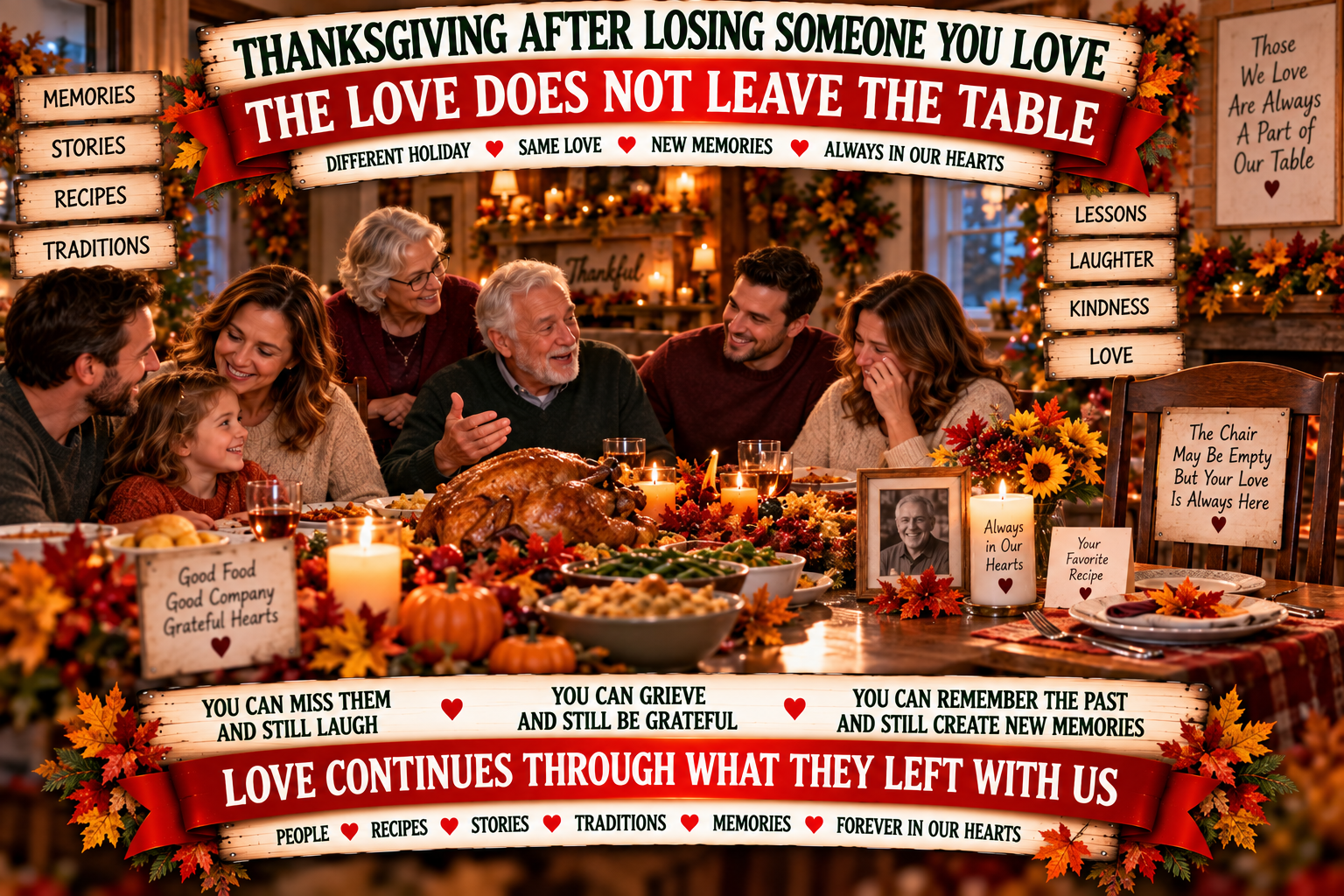
A small memorial can make the person’s presence in your memories feel intentional rather than unspoken.
Light a candle.
Display a photograph.
Place a favorite flower on the table.
Make a toast.
Share one memory before eating.
Keep it as simple as you want.
The purpose is not to turn Thanksgiving into a memorial service.
It is to acknowledge that someone who mattered still matters.
Cook Something They Loved
Food carries memory powerfully.
A recipe can bring back kitchens, conversations, laughter, and family history.
If it feels comforting, make a dish associated with the person you lost.
Tell younger family members why it matters.
A recipe can become more than food.
It can become a story that continues traveling through the family.
Let Someone Else Take Over a Role They Used to Fill
The person you lost may have had a particular Thanksgiving role.
They carved the turkey.
Made the pie.
Said the blessing.
Hosted dinner.
Choosing someone to take over that role can feel emotional.
There is no need to pretend the replacement is the same.
It is not.
Allow the role to become something new while honoring where the tradition began.
Prepare for the Empty-Chair Moment
Sometimes the hardest part is seeing where the person would have been.
Think beforehand about what you want to do.
You might leave the seating arrangement different.
Place a small remembrance nearby.
Say something before dinner.
Or make no special acknowledgment at all.
There is no universal right answer.
Choose what feels most supportive for your family.
Tell People What You Need
Friends and relatives may want to help but have no idea what to say.
Give them guidance when you can.
“I’d love to talk about her today.”
“I’m not ready to discuss the loss very much.”
“I may need to step outside for a few minutes.”
Clear communication can reduce the pressure of hoping other people will somehow guess what you need.
Have an Exit Plan for Overwhelming Moments
You may need a break.
Know where you can go.
Step outside.
Sit in a quiet room.
Take a short walk.
Leave the gathering earlier than planned if necessary.
You are not ruining Thanksgiving by recognizing your emotional limit.
Taking care of yourself may allow you to participate more meaningfully in the parts of the day you can handle.
Do Not Apologize for Tears
A song, smell, story, or familiar phrase may bring tears without warning.
You do not need to apologize.
Crying does not make the gathering uncomfortable by itself.
People who love you can survive seeing your grief.
If you want privacy, take it.
If you want someone beside you, let them stay.
Do Not Feel Guilty When You Laugh
Grief can create a strange guilt around happiness.
You may laugh at a family story and immediately think, “How can I be enjoying myself when they are gone?”
Because you are still alive.
Because love and grief are capable of sharing the same space.
A moment of happiness does not reduce the importance of the person you lost.
You are allowed to enjoy Thanksgiving when enjoyment appears.
Understand That Everyone in the Family May Grieve Differently
One person may want to talk about the loss constantly.
Another may stay busy in the kitchen.
Someone may become quiet.
Someone else may use humor.
Children may move in and out of grief quickly.
Try not to measure love by outward behavior.
People carry loss differently, even when they loved the same person.
Be Gentle With Children Who Are Grieving Too
Children may have questions or reactions that appear at unexpected times.
They may be sad for five minutes and then run off to play.
They may ask direct questions.
They may worry about other family members dying.
Answer honestly in age-appropriate language.
Let them know it is okay to feel sad and okay to have fun.
Children need permission to continue being children while they grieve.
Protect Yourself From Unhelpful Advice
Someone may tell you how you should be grieving.
They may say it is time to move on.
They may offer a spiritual explanation that does not comfort you.
You do not have to argue.
A simple response can be enough.
“I know you mean well, but I need to handle this in my own way.”
Your grief does not require someone else’s approval.
Lower the Pressure to Create a Perfect Holiday
Grief consumes energy.
This may not be the year for elaborate decorations, complicated recipes, or a packed schedule.
Simplify.
Order food.
Ask guests to contribute.
Use paper plates if that makes life easier.
The people who care about you should value your presence more than your performance.
Make Space for Gratitude Without Forcing It
Thanksgiving can make grieving people feel pressured to list blessings while they are hurting.
Start where you genuinely can.
You may be thankful for one person who supported you.
A memory.
A quiet moment.
A meal.
The years you had with the person you lost.
Gratitude does not require you to be grateful for the loss.
It simply allows you to notice what remains meaningful alongside it.
Honor the Relationship, Not Only the Death
When someone dies, the circumstances of the loss can begin to dominate every memory.
Thanksgiving can be an opportunity to remember the life.
What made them laugh?
What did they teach you?
What strange habit did everyone know about?
What did they love to eat?
What story captures who they were?
The death is part of the story.
It does not deserve to become the entire story.
Do Something in Their Memory
If it feels right, turn remembrance into an act.
Donate to a cause they cared about.
Help someone in need.
Prepare a meal for another person.
Call someone who might be lonely.
Continue a kindness they were known for.
An act of generosity can become a way of letting their influence continue.
Let New Memories Form Without Feeling Disloyal
The family may laugh about something new.
A child may start a new tradition.
A different person may cook the meal.
A new guest may join the table.
New memories do not replace old ones.
Life continuing does not erase the person who died.
The family story can grow while still carrying the chapters that came before.
Plan for the Emotional Aftermath
Sometimes you hold yourself together during Thanksgiving and feel the grief more strongly afterward.
That is normal.
Give yourself recovery time.
Keep the next morning quiet if possible.
Rest.
Talk to someone you trust.
Write.
Listen to music.
Let the emotions come without assuming that the difficult evening means you handled Thanksgiving badly.
Remember That Future Holidays Will Continue to Change
The first Thanksgiving after losing someone may feel very different from the fifth.
Grief evolves.
A tradition that hurts this year may comfort you later.
A memory that makes you cry today may eventually make you smile before the tears arrive.
You do not have to figure out every future Thanksgiving now.
You only need to navigate this one.
The Love Does Not Leave the Table
Losing someone you love changes Thanksgiving because love had already made that person part of the holiday.
Their chair mattered because they mattered.
Their recipe mattered because their hands once made it.
Their stories mattered because their voice told them.
Their absence hurts because their presence once brought something irreplaceable.
That truth can make Thanksgiving painful.
It can also reveal something important.
Death can end a person’s physical presence, but it does not erase the relationship’s influence.
The person you lost may still be present in the expressions your children inherited.
In the recipes you continue to make.
In the phrases your family still repeats.
In the lessons you carry.
In the traditions they helped create.
In the kindness you learned from them.
In the stories that begin with, “Do you remember when…?”
This Thanksgiving, you do not need to choose between remembering the person who died and appreciating the people who are still here.
You can do both.
You can miss one voice and listen closely to the voices around you.
You can cry over an empty chair and still laugh at the table.
You can honor an old tradition and create a new one.
You can feel gratitude for the years you had while wishing desperately that you had more.
That is not contradiction.
That is grief.
That is love continuing after loss.
If this Thanksgiving is especially difficult, lower the expectations.
Take the day one hour at a time.
Accept help.
Step away when you need to.
Say their name if you want to.
Keep silent if that feels safer.
Make the recipe.
Skip the recipe.
Light the candle.
Tell the story.
Let yourself laugh.
Let yourself cry.
There is no scorecard for how well you grieve through Thanksgiving.
There is only the opportunity to treat yourself and the people around you with compassion while everyone learns how to live inside a changed family.
The table may never look exactly the same again.
But love is not limited to the chairs that are filled.
Some love arrives through memory.
Some through tradition.
Some through stories.
Some through the ways a person changed us so deeply that pieces of what they gave continue long after they are gone.
This Thanksgiving, their chair may be empty.
But the love they brought into your life does not have to leave the table.