
Affiliate Disclosure
Some of the links on this page may be affiliate links. This means that if you click through and make a purchase, The Shopping Plaza may earn a small commission at no additional cost to you.
These commissions help support the operation of this website and allow us to continue creating free content, contests, rankings, and entertainment features like Sitcom Showdown.
We only recommend products, services, and merchandise that we believe may be of interest to our readers. Your support through these affiliate links is greatly appreciated and helps keep The Shopping Plaza growing.
Thank you for supporting The Shopping Plaza!
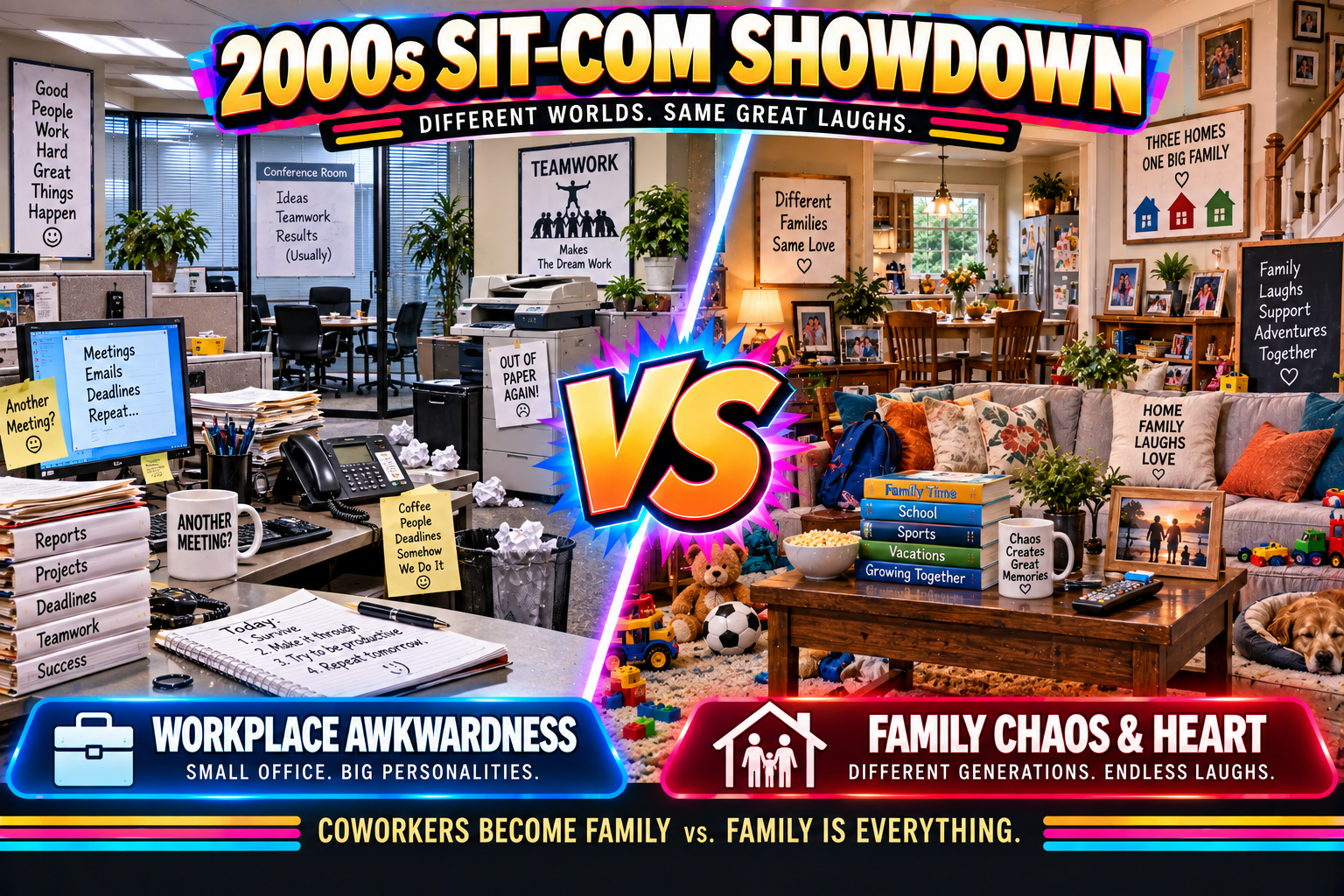
The Sit-Com Showdown now moves into the 2000s, and the opening matchup immediately gives us two giants of the mockumentary era: The Office and Modern Family. Both shows used characters speaking directly to the camera, uncomfortable pauses, reaction shots, and documentary-style storytelling to find comedy in ordinary life. Yet one turned a struggling Pennsylvania paper company into an unforgettable workplace, while the other used three interconnected households to redefine the television family for a new generation.
The Office followed the employees of Dunder Mifflin’s Scranton branch, led for much of the series by the painfully inappropriate but strangely lovable Michael Scott. Jim, Pam, Dwight, Angela, Kevin, Stanley, Phyllis, Oscar, Creed, and the rest of the office transformed a mundane workplace into one of television’s most recognizable ensembles. Modern Family centered on the interconnected Pritchett, Dunphy, and Tucker-Pritchett households, using parents, children, spouses, grandparents, and siblings to explore how the definition of family was changing.
This is one of the strongest matchups we have encountered. The Office possesses enormous cultural influence and replay value, while Modern Family combines a remarkably deep ensemble with eleven seasons of inventive family storytelling. Eight categories will determine which modern comedy earns the first surviving position in the 2000s bracket.
The Legacy Showdown Rules
- Comedy Quality
- Character Chemistry
- Cultural Impact
- Longevity & Replay Value
- Iconic Moments
- Supporting Cast
- Era Difficulty
- Legacy Endurance
Round 1: Comedy Quality
Modern Family could generate comedy from nearly every combination in its enormous ensemble. Phil’s enthusiasm, Claire’s need for control, Jay’s bluntness, Gloria’s intensity, Cam’s theatrical personality, Mitchell’s anxiety, and the children’s changing personalities gave the writers a wide range of comic engines. The show was especially skilled at constructing episodes in which separate family stories eventually intersected around a common misunderstanding or theme.
The Office was often willing to make comedy painfully uncomfortable. Michael Scott’s desperate need to be liked, Dwight’s intensity, Jim’s pranks, awkward meetings, office romances, corporate nonsense, and the silent reactions of employees trapped in absurd situations gave the show a distinctive comic language. Episodes such as the disastrous dinner party or Michael’s painfully misguided promises could make viewers laugh while almost wanting to leave the room. Both shows were technically accomplished, but The Office’s ability to turn workplace discomfort into a unique style gives it the narrow edge.
Winner: The Office.
Round 2: Character Chemistry
The Office built exceptional relationships inside Dunder Mifflin. Jim and Pam supplied the emotional center, Jim and Dwight evolved from prankster and victim into something closer to genuine friends, Michael’s relationships with his employees revealed unexpected vulnerability, and the background workers gradually became fully recognizable personalities. The ensemble felt like coworkers who had spent far too many years together.
Modern Family takes this category because its entire premise depended on believable chemistry across three different households and several generations. Phil and Claire had a completely different marriage from Jay and Gloria or Mitchell and Cam. Jay’s relationships with Claire, Mitchell, Manny, and later Joe allowed the show to examine fatherhood and grandfatherhood from several angles. The children grew up on screen, changing the chemistry naturally as siblings became adults. Almost any two members of the extended family could carry a storyline.
Winner: Modern Family.
Round 3: Cultural Impact
Modern Family made a substantial cultural contribution by presenting a family structure that included remarriage, a large age difference between spouses, a same-sex marriage, adoption, blended families, and several generations without treating the entire premise as unusual. Mitchell and Cam in particular brought a gay couple raising a child into millions of mainstream living rooms, while the larger family emphasized that there was no single correct blueprint for a modern household.
The Office had an even larger impact on the language and style of modern comedy. Its reaction shots, awkward silences, workplace absurdity, documentary interviews, quotes, memes, and character archetypes became deeply embedded in internet culture. Michael Scott and Dwight Schrute became instantly recognizable comic figures, while the Jim-looking-at-the-camera reaction became practically a visual language of its own. The series also helped popularize a style of American workplace mockumentary comedy that influenced later television.
Winner: The Office.
Round 4: Longevity & Replay Value
Modern Family ran for eleven seasons, giving viewers more than a decade with the Pritchett-Dunphy-Tucker family. The children visibly mature, marriages evolve, careers change, and the extended family enters new stages of life. Its large episode library and generally self-contained family stories make it easy to revisit, while chronological viewing rewards audiences who want to watch the younger characters grow up.
The Office ran nine seasons, but its afterlife became extraordinary. Viewers repeatedly return to Dunder Mifflin for comfort viewing, background watching, favorite episodes, and complete rewatches. The workplace setting makes many situations timeless: terrible bosses, pointless meetings, office romances, annoying coworkers, corporate decisions, and employees trying to survive the workday. Modern Family wins the raw season count, but The Office’s unusually powerful rewatch culture gives it the category.
Winner: The Office.
Round 5: Iconic Moments
Modern Family accumulated memorable running jokes and emotional milestones across eleven seasons. Phil’s enthusiastic parenting, Cam’s theatrical reactions, Gloria’s pronunciation and intensity, Jay’s gruff affection, family vacations, Halloween episodes, weddings, births, graduations, and the children’s milestones gave longtime viewers a deep collection of favorite moments. The show’s recurring documentary glances also became part of its identity.
The Office has an almost overwhelming catalog of scenes that remain active in popular culture: the fire drill, CPR training, Jim’s elaborate Dwight pranks, the stapler in gelatin, Michael declaring bankruptcy, Kevin’s chili disaster, the Dundies, Threat Level Midnight, Jim and Pam’s wedding, Dwight’s fire-safety chaos, and the Dinner Party episode. Individual images and lines from the series continue circulating as memes and reaction references years after the finale.
Winner: The Office.
Round 6: Supporting Cast
The Office has tremendous depth. Angela, Kevin, Oscar, Stanley, Phyllis, Creed, Meredith, Toby, Kelly, Ryan, Darryl, Andy, Erin, Jan, David Wallace, and many others could step forward and become the focus of an episode. One of the show’s great achievements was turning people who initially seemed like background office workers into distinct comic personalities with their own histories and relationships.
Modern Family, however, is constructed so that what might be called a supporting cast on another sitcom is effectively a collection of co-leads. Jay, Gloria, Manny, Phil, Claire, Haley, Alex, Luke, Mitchell, Cam, and Lily each contribute something essential. As the children grow older, the show continually redistributes attention rather than relying on one central star. Recurring relatives, friends, neighbors, and romantic partners add even more depth. The sheer balance of the extended family gives Modern Family the slightest advantage.
Winner: Modern Family.
Round 7: Era Difficulty
The Office faced an uncertain beginning. Adapting a highly regarded British comedy for American television created immediate comparisons, and its first season had not yet found the warmer, more flexible identity that would define the series. The writers and performers successfully transformed Michael Scott and the Scranton office into characters who could sustain a much longer American run, eventually surviving major changes including Steve Carell’s departure.
Modern Family entered television when the traditional family sitcom had lost some of the dominance it once enjoyed. Instead of simply recreating an older domestic formula, it modernized the genre through the mockumentary format and a family structure that reflected changing American households. It then sustained an enormous ensemble for eleven seasons while its child actors grew into adults and social attitudes continued evolving. Slight edge to Modern Family for refreshing the family sitcom and maintaining its interconnected premise across more than a decade.
Winner: Modern Family.
Round 8: Legacy Endurance
Modern Family has an exceptional legacy. Its long run, ensemble strength, awards recognition, representation of different family structures, and ability to modernize domestic comedy guarantee it a major place in television history. The Pritchett-Dunphy-Tucker family helped prove that a broad network comedy could be both traditional in its emphasis on family and contemporary in how that family was constructed.
The Office has developed a cultural afterlife that few sitcoms achieve. New viewers continue discovering Dunder Mifflin, characters remain fixtures of internet culture, quotes and reaction images circulate constantly, and the show has become a defining representation of workplace comedy for a generation. Its influence extends beyond television into how people joke about bosses, meetings, coworkers, and office life. Modern Family’s legacy is formidable, but The Office has become the more pervasive cultural institution.
Winner: The Office.
Final Verdict
This is exactly the kind of matchup that makes Sit-Com Showdown difficult. Modern Family wins Character Chemistry, Supporting Cast, and Era Difficulty, reflecting just how ambitious its interconnected family ensemble was. Keeping three households and multiple generations distinct, funny, emotionally connected, and relevant for eleven seasons is an achievement that deserves serious tournament respect.
The Office takes Comedy Quality, Cultural Impact, Longevity & Replay Value, Iconic Moments, and Legacy Endurance. Its victory comes from the extraordinary afterlife of Dunder Mifflin. The show’s awkward workplace humor, unforgettable characters, endlessly replayed episodes, and enormous presence in internet culture have allowed it to grow beyond its original NBC run.
With a competitive 5-3 victory, The Office advances from the first matchup of our 2000s Sit-Com Showdown bracket. Modern Family exits as one of the strongest shows to lose in this tournament so far, while The Office establishes itself as an immediate threat to go much deeper in Legacy Showdown.
Audience Challenge
Do you agree with the 5-3 decision? Should Modern Family’s eleven-season consistency and extraordinary ensemble have carried it past Dunder Mifflin, or do The Office’s replay value, iconic moments, and enormous cultural afterlife make it the rightful winner? Cast your vote, defend your favorite, and keep following Legacy Showdown as the 2000s Sit-Com Showdown bracket continues.