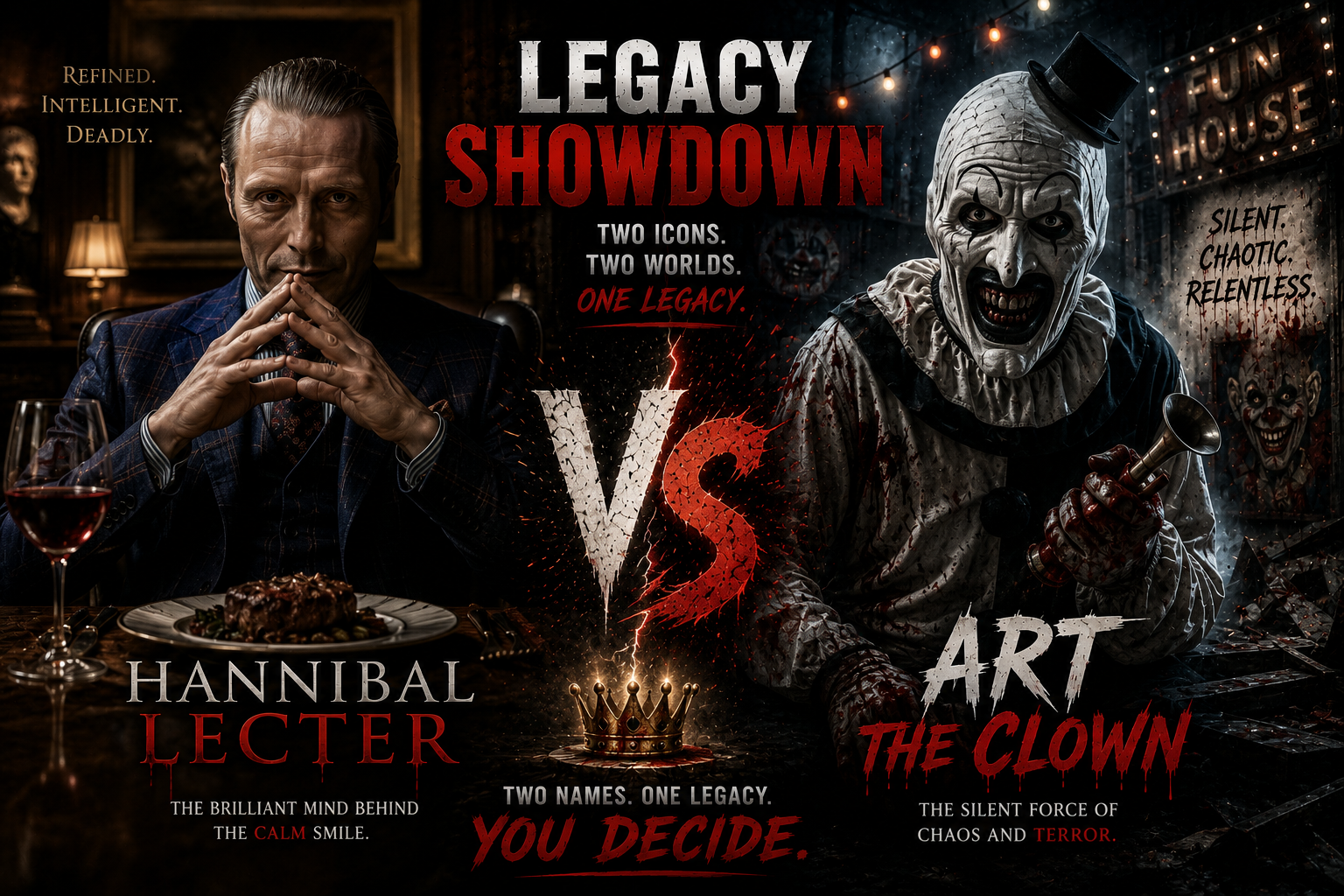


Two terrifying figures from very different corners of horror. One refined and calculated. One chaotic and relentless. One question remains: whose legacy stands the test of time?
Welcome back to Killers Klash, where horror’s most terrifying, unforgettable, and iconic characters go head-to-head to determine who possesses the stronger legacy killer instinct. As part of our larger Legacy Showdown series, Killers Klash takes legendary killers, monsters, and supernatural threats from across horror history and puts their reputations to the test. Each matchup looks beyond simply asking which character is scarier and examines the qualities that transformed these frightening figures into enduring horror icons.
This time, we’re bringing together two killers who could hardly be more different: Hannibal Lecter, the sophisticated and psychologically complex killer made legendary by The Silence of the Lambs, and Art the Clown, the silent and brutally unpredictable nightmare at the center of the Terrifier series.
Hannibal Lecter represents psychological horror at its most intelligent and controlled. His calm voice, refined personality, extraordinary intelligence, and ability to manipulate the people around him make him terrifying even when he is physically restrained. Rather than depending primarily on weapons or relentless pursuit, Lecter can dominate a scene through conversation alone, turning psychological observation into one of his most dangerous weapons.
Art the Clown represents almost the complete opposite approach. Silent, theatrical, physically expressive, and extraordinarily brutal, Art communicates through exaggerated gestures, sinister smiles, dark comedy, and horrifying violence. His rise through the Terrifier franchise has transformed him from an independent horror creation into one of the most recognizable new villains of modern horror.
But Killers Klash isn’t about deciding who would win a fight. This showdown is about legacy. We’ll compare Hannibal Lecter and Art the Clown across six categories: Peak Impact, Longevity, Cultural Impact, Big Moments, Identity & Style, and Legacy Endurance. Each round receives an edge before we determine which character has built the stronger overall horror legacy.
One can terrify a room without raising his voice.
The other doesn’t need to speak at all.
Hannibal Lecter vs. Art the Clown.
It’s time to find out who possesses the stronger legacy killer instinct.
Affiliate Disclaimer
Affiliate Disclaimer: This blog may contain affiliate links or banner advertisements. If you click on one of these links or advertisements and make a purchase, we may earn a small commission at no additional cost to you. These commissions help support our work and allow us to continue creating entertaining content like Killers Klash and the Legacy Showdown series.
Let the Klash begin.
RULES OF THE SHOWDOWN
We evaluate each competitor based on six categories:
1. Peak Impact
2. Longevity
3. Cultural Impact
4. Big Moments
5. Identity & Style
6. Legacy Endurance
1. PEAK IMPACT
Hannibal Lecter:
At his peak, Hannibal Lecter delivered one of the most celebrated and unsettling villain performances in film history. Anthony Hopkins’s portrayal in The Silence of the Lambs transformed Lecter into something far more frightening than a conventional movie killer: intelligent, sophisticated, observant, manipulative, and almost unnervingly calm. Rather than needing constant violence to establish his menace, Lecter could dominate a scene through conversation, eye contact, and his ability to identify the psychological vulnerabilities of the person standing in front of him. His conversations with Clarice Starling became some of the film’s defining sequences, creating extraordinary tension even while Lecter remained confined behind bars or glass. The character’s escape sequence demonstrated that the intelligence and sophistication surrounding him never made Lecter any less dangerous when he decided to become physically violent. Hopkins’s performance earned the Academy Award for Best Actor, while The Silence of the Lambs achieved the remarkable feat of winning the five major Academy Awards: Best Picture, Director, Actor, Actress, and Adapted Screenplay. At his absolute peak, Hannibal Lecter helped prove that a deeply disturbing horror-thriller character could become both a mainstream cultural phenomenon and one of cinema’s most critically celebrated villains.
Art the Clown:
Art the Clown’s peak represents a very different kind of horror success, built around extreme violence, practical gore effects, dark comedy, and the growth of the Terrifier franchise into a modern horror phenomenon. David Howard Thornton’s largely silent performance gives Art an unusual personality, allowing exaggerated facial expressions, gestures, and almost playful behavior to communicate what dialogue normally would. That playful presentation becomes especially disturbing because audiences understand that Art can shift from clownish humor to horrifying brutality without warning. The Terrifier films have developed a reputation for pushing practical gore and kill sequences to extremes, creating scenes specifically designed to test the limits of what audiences expect from modern slasher horror. Art’s black-and-white costume, tiny hat, sinister grin, silent mannerisms, and unpredictable personality have also given him a recognizable appearance that stands apart from many contemporary horror villains. As the franchise has grown, Art has moved beyond being primarily an underground horror attraction and become an increasingly prominent figure within mainstream horror conversations. His rise is especially impressive because the character developed without beginning as the centerpiece of a massive established Hollywood franchise. At his peak, Art represents the resurgence of unapologetically extreme independent horror and demonstrates that a modern slasher villain can still break through and capture widespread attention.
Edge: Hannibal Lecter
Art the Clown has experienced an extraordinary rise and deserves significant credit for becoming one of the defining new horror villains of his generation. His brutality, silent personality, practical-effects-driven violence, and instantly recognizable appearance have given modern horror audiences something that feels simultaneously influenced by classic slashers and uniquely his own. However, Hannibal Lecter’s peak reached a level of critical acclaim, mainstream recognition, cultural importance, and cinematic prestige that Art has not matched. The Silence of the Lambs wasn’t simply successful within horror—it became one of the defining films of its era and achieved historic recognition at the Academy Awards. Lecter also demonstrated that a horror villain didn’t need supernatural abilities, elaborate weapons, or constant graphic violence to completely dominate an audience’s attention. Art’s peak demonstrates the continuing power of extreme independent horror, while Lecter’s peak showed that a terrifying character could cross genre boundaries and command the attention of critics, awards voters, mainstream moviegoers, and horror fans simultaneously. Art may still have additional chapters ahead of him, but Hannibal Lecter’s established peak remains extraordinarily difficult to surpass. For delivering one of cinema’s most acclaimed villain performances and helping carry psychological horror into the highest levels of mainstream cinematic recognition, Hannibal Lecter takes Round 1.
2. LONGEVITY
Hannibal Lecter:
Hannibal Lecter has demonstrated remarkable longevity across literature, film, and television, remaining culturally relevant for decades after his introduction in Thomas Harris’s novels. On screen, the character has been interpreted by multiple actors, most famously Anthony Hopkins in The Silence of the Lambs, Hannibal, and Red Dragon. Rather than disappearing after one legendary performance, Lecter’s story continued expanding through different periods of his life and relationships with the people attempting to understand or capture him. The television series Hannibal later offered another major interpretation, with Mads Mikkelsen bringing a different combination of sophistication, intelligence, manipulation, and menace to the character. That successful reinvention demonstrated that Hannibal Lecter could survive beyond Anthony Hopkins’s iconic portrayal without losing the qualities that make him fascinating. His continued presence in books, movies, television, and popular culture has allowed different generations to discover their own version of the character. More importantly, Lecter’s appeal does not depend on changing horror trends because intelligence, psychological manipulation, and the frightening contrast between sophistication and brutality remain timeless sources of fear. Few horror villains have maintained such a strong identity across so many different storytelling formats and interpretations.
Art the Clown:
Art the Clown is much newer to the horror landscape, but his rise has been remarkably fast and suggests that he could eventually develop significant longevity of his own. After early appearances in short-film material and All Hallows’ Eve, Art became the centerpiece of the Terrifier franchise and gradually developed into one of modern horror’s most recognizable new villains. David Howard Thornton’s performance has been essential to that growth, giving Art a distinctive personality through facial expressions, exaggerated physical comedy, and silent reactions rather than traditional dialogue. Each major Terrifier installment has expanded the character’s audience, mythology, and reputation for increasingly extreme violence. Art has also benefited from the enthusiasm of horror fans who have embraced his appearance through costumes, collectibles, merchandise, conventions, and online horror culture. His growing popularity suggests that he has the potential to become a long-term franchise figure rather than a temporary horror phenomenon. However, Art’s story is still being written, and the character has not yet faced the ultimate longevity test of remaining culturally relevant across several decades and multiple generations.
Edge: Hannibal Lecter
Art the Clown’s rapid growth makes this an intriguing comparison because he appears to be building the foundation necessary for a lasting horror legacy. However, longevity must ultimately be demonstrated over time, and Hannibal Lecter possesses a major advantage in that category. Lecter has remained relevant through novels, acclaimed films, sequels, prequels, television, different actors, and changing generations of audiences. Even more impressive is the fact that the character successfully survived the transition from Anthony Hopkins’s legendary interpretation to Mads Mikkelsen’s distinctly different version, proving that audiences remain fascinated by Hannibal Lecter rather than only one particular performance. Art has established tremendous momentum and could eventually become one of the enduring horror icons of his era, but his timeline remains relatively short compared with Lecter’s decades of proven staying power. The real test for Art will be whether audiences are still discussing, reinventing, and discovering him twenty or thirty years from now. Hannibal Lecter has already passed that test. For maintaining his relevance across decades, generations, mediums, and multiple acclaimed interpretations, Hannibal Lecter takes Round 2.
3. CULTURAL IMPACT
Hannibal Lecter:
Hannibal Lecter has achieved a level of cultural recognition that extends far beyond traditional horror audiences, becoming one of cinema’s most famous villains. Anthony Hopkins’s performance in The Silence of the Lambs established many of the mannerisms audiences now associate with the character: the controlled voice, intense stare, extraordinary intelligence, sophisticated tastes, and disturbing ability to remain calm while discussing horrifying subjects. His conversations with Clarice Starling helped create a villain who could frighten audiences without constantly relying on physical violence, because Lecter’s greatest weapon often seemed to be his ability to understand people better than they understood themselves. Images of Lecter restrained behind his mask have become instantly recognizable pieces of movie culture, appearing in parodies, Halloween costumes, merchandise, television references, and countless discussions of great cinematic villains. Lines and moments from The Silence of the Lambs have remained embedded in popular culture decades after the film’s release. The character also helped popularize the image of the brilliant, sophisticated serial killer whose intelligence can be every bit as frightening as his brutality. Even people who rarely watch horror movies often recognize the name Hannibal Lecter and understand exactly what kind of sinister character it represents. His influence reaches beyond a single franchise, making Lecter part of the broader vocabulary of popular culture.
Art the Clown:
Art the Clown has experienced one of the most impressive cultural rises among modern horror villains, particularly within the dedicated horror community. His black-and-white clown appearance, tiny hat, exaggerated grin, silent personality, and brutally unpredictable behavior have given him an immediately recognizable visual identity. Horror fans have increasingly embraced Art through Halloween costumes, collectibles, merchandise, convention appearances, social media, fan artwork, and discussions surrounding the increasingly popular Terrifier franchise. His appeal also represents something significant about modern horror culture: audiences can still transform an independently created character into a major genre attraction without that character beginning inside a long-established Hollywood franchise. Art’s extreme violence has become an important part of his reputation, with viewers frequently discussing whether they can handle the franchise’s most graphic and outrageous sequences. At the same time, David Howard Thornton’s physical performance gives Art a darkly comedic personality that makes him more distinctive than a killer who simply stalks victims without emotion. The character is clearly beginning to cross from cult horror popularity into broader mainstream awareness, establishing the potential for a much larger cultural footprint. However, Art is still building that legacy, and his recognition outside dedicated horror circles has not yet reached the extraordinary level Hannibal Lecter has maintained for decades.
Edge: Hannibal Lecter
Art the Clown’s cultural rise should not be underestimated because relatively few modern horror villains have developed such a passionate following in such a short period. He has become an important symbol of contemporary independent horror and could eventually join the permanent collection of characters audiences immediately associate with the genre. Hannibal Lecter, however, has already crossed a threshold Art is still approaching: he became larger than horror itself. Lecter’s name, mannerisms, mask, intelligence, disturbing sophistication, and relationship with Clarice Starling have remained recognizable throughout mainstream popular culture for decades. His influence also extends into the way movies and television portray intelligent and psychologically manipulative killers, giving the character significance beyond simple visual recognition. Art currently commands enormous attention among horror fans, while Lecter has been recognized by horror audiences, mainstream moviegoers, critics, award institutions, and people who may rarely engage with the genre at all. Art’s cultural story may still have considerable room to grow, but Hannibal Lecter’s established reach remains significantly greater. For transcending the boundaries of horror and becoming one of the most recognizable villains in modern popular culture, Hannibal Lecter takes Round 3.
4. BIG MOMENTS
Hannibal Lecter:
Hannibal Lecter’s greatest moments demonstrate that a horror villain does not need constant action or graphic violence to completely control a scene. In The Silence of the Lambs, many of his most memorable sequences consist primarily of conversations with Clarice Starling, yet those exchanges generate extraordinary psychological tension because Lecter always seems to be studying her. Their early encounters establish his frightening intelligence as he quickly recognizes insecurities and personal details that Clarice would rather keep hidden. The famous exchange surrounding his past crimes demonstrates how Lecter can make even calm conversation deeply disturbing through Anthony Hopkins’s controlled delivery and unnerving confidence. His eventual escape provides a dramatic change of pace, revealing the horrifying physical brutality hidden beneath the sophisticated personality audiences had been watching. Even when Lecter is confined behind glass or locked inside a cell, he frequently feels like the person with the greatest control over everyone around him. His greatest scenes therefore succeed through anticipation, dialogue, manipulation, and the knowledge that the calm man speaking politely is capable of extraordinary violence. Few horror characters have created so many unforgettable moments while doing so much of their most frightening work simply through words.
Art the Clown:
Art the Clown approaches memorable horror moments from almost the complete opposite direction, using shocking visuals, extreme practical effects, dark comedy, and escalating brutality to create scenes audiences have difficulty forgetting. The Terrifier films deliberately push beyond the boundaries of conventional slasher violence, turning Art’s kills into elaborate sequences designed to make even experienced horror fans uncomfortable. What makes these moments particularly distinctive is Art’s behavior during them, as he often treats horrifying violence like a performance and reacts with exaggerated expressions of amusement. His silent personality makes the contrast even stranger because he can communicate excitement, disappointment, curiosity, or mockery entirely through physical gestures and facial expressions. The franchise has produced several notorious sequences that became major talking points among horror audiences precisely because viewers were shocked by how far the filmmakers were willing to go. Art can also move from almost cartoonish comedy to vicious violence within seconds, creating an unpredictable tone where audiences never know how extreme the next encounter will become. Practical gore effects further strengthen these sequences by giving Art’s brutality a deliberately visceral and tangible appearance. His biggest moments are designed not merely to frighten viewers but to challenge them, ensuring that people continue discussing what they witnessed long after the scene ends.
Edge: Art the Clown
Hannibal Lecter possesses some of the greatest dialogue-driven moments ever created for a horror villain, and his conversations with Clarice demonstrate how psychological tension can be every bit as powerful as physical violence. However, when the category is specifically Big Moments, Art the Clown has built much of his modern reputation around producing scenes intended to leave audiences stunned. The Terrifier franchise repeatedly raises expectations surrounding what Art might do next, making his major sequences events within the films themselves. Lecter’s strength is restraint—he can make a conversation terrifying with a stare, a carefully chosen question, or a disturbing observation—while Art’s strength is escalation, pushing an already horrific situation further than audiences expect. His combination of extreme practical effects, outrageous brutality, physical comedy, and complete unpredictability gives his biggest scenes a uniquely unforgettable quality. Hannibal’s moments may carry greater psychological sophistication, but Art’s are often specifically constructed to become the scenes horror audiences immediately discuss, debate, and dare other viewers to watch. For repeatedly pushing visual horror to its limits and creating some of modern horror’s most shocking and talked-about sequences, Art the Clown takes Round 4.
5. IDENTITY & STYLE
Hannibal Lecter:
Hannibal Lecter’s identity is built around a chilling contradiction: he is refined, intelligent, cultured, and extraordinarily polite while also being capable of horrifying violence. Rather than looking like a traditional horror monster, Lecter often appears sophisticated and composed, which makes the darkness beneath that exterior even more disturbing. His calm voice, piercing stare, precise language, and ability to psychologically analyze almost anyone around him give the character an intimidating presence without requiring constant physical aggression. Anthony Hopkins’s portrayal emphasized this controlled menace, making even simple conversations feel dangerous because Lecter always seems to know more than everyone else in the room. His intelligence becomes part of his weaponry, allowing him to manipulate people, discover their vulnerabilities, and maintain psychological control even while physically imprisoned. The famous restraint mask associated with Lecter also became one of horror and thriller cinema’s most recognizable visual images, reinforcing the idea that this seemingly composed man is considered extraordinarily dangerous. Unlike villains defined primarily by weapons or supernatural abilities, Lecter’s greatest stylistic weapon is his mind. His combination of sophistication, intelligence, manipulation, and concealed brutality created a villain identity that remains unmistakably his own.
Art the Clown:
Art the Clown possesses an equally distinctive identity, but almost everything about his style operates differently from Hannibal Lecter’s. Art rarely needs spoken dialogue because David Howard Thornton uses exaggerated facial expressions, gestures, body language, and mime-like physical comedy to communicate the character’s twisted personality. His black-and-white clown makeup, tiny hat, dark costume, wide grin, and expressive eyes create a silhouette that has quickly become recognizable among modern horror audiences. What makes Art especially unsettling is the strange playfulness he brings to horrific situations, sometimes behaving like an entertainer performing for an audience even while committing brutal acts. He can appear childish, amused, irritated, curious, or ridiculously theatrical before suddenly becoming vicious, making his behavior extremely difficult to predict. That combination of slapstick-style comedy and extreme violence gives the Terrifier films a tone that separates Art from more traditionally serious slasher villains. His silence actually strengthens his identity because audiences must interpret his intentions entirely through movement and expression, creating an unsettling uncertainty about what he might do next. Art’s style is ultimately built around contradiction as well: he looks and behaves like a silent comic performer while functioning as one of modern horror’s most vicious killers.
Edge: Tie
This category produces a fascinating contrast because Hannibal Lecter and Art the Clown have developed extraordinarily distinctive identities through almost completely opposite methods. Hannibal dominates through words, using intelligence, sophistication, psychological observation, and carefully controlled conversation to intimidate the people around him. Art dominates largely through silence, relying on facial expressions, gestures, physical comedy, visual appearance, and unpredictable brutality to communicate his personality. Lecter’s refined manners make his violence more disturbing because audiences understand what is hidden beneath the sophisticated exterior, while Art’s playful clown behavior makes his brutality more disturbing because he often seems to treat violence as entertainment. Both characters can command a scene without needing conventional action: Hannibal can do it through a conversation across prison glass, while Art can do it with nothing more than a grin or exaggerated gesture. Their identities are instantly recognizable, but they represent two completely different approaches to creating an unforgettable horror villain. Choosing one would undervalue just how successfully each character has perfected his particular style. For creating two unmistakable horror identities—one through sophisticated psychological menace and the other through silent, theatrical chaos—Hannibal Lecter and Art the Clown split Round 5 with a Tie.
6. LEGACY ENDURANCE
Hannibal Lecter:
Hannibal Lecter’s legacy has endured far beyond the individual films and novels in which he appears, establishing him as one of the most important psychological villains in modern storytelling. Decades after The Silence of the Lambs, the character continues to be discussed for his intelligence, manipulation, sophistication, and disturbing ability to understand the weaknesses of the people around him. Anthony Hopkins’s portrayal created an unforgettable cinematic version of Lecter, but the character’s endurance was further demonstrated when Mads Mikkelsen successfully offered a dramatically different interpretation in the television series Hannibal. That ability to survive reinterpretation is particularly important because it proves that Lecter’s appeal extends beyond a single actor or performance. Writers and filmmakers continue to draw inspiration from the idea of the brilliant, cultured antagonist whose psychological power can be just as frightening as physical violence. Lecter also remains a fascinating character for discussions involving film, psychology, criminal behavior, characterization, and the construction of memorable villains. New generations continue discovering him through novels, movies, television, streaming, and broader popular culture. His legacy therefore feels firmly established rather than dependent upon whether another Hannibal Lecter production is immediately around the corner.
Art the Clown:
Art the Clown is rapidly constructing what could eventually become one of the strongest horror legacies created by a modern slasher character. His rise from relatively obscure independent horror beginnings to the centerpiece of the Terrifier franchise demonstrates how quickly an enthusiastic fan base can transform a character into a recognizable genre figure. Art’s black-and-white appearance, silent mannerisms, exaggerated expressions, dark humor, and extreme brutality have already given him characteristics that younger horror audiences immediately recognize. His popularity also represents the continuing strength of independent horror, showing that a frightening new character does not necessarily need to originate from an established Hollywood franchise to capture widespread attention. Merchandise, costumes, conventions, social media discussions, and the growing visibility of Terrifier have all helped strengthen his position within contemporary horror culture. More importantly, Art has something many attempted modern horror villains never achieve: audiences actively want to see the character return. That enthusiasm provides the foundation for a potentially enduring legacy, but Art is still relatively early in his journey compared with characters who have remained culturally relevant for several decades. The next ten, twenty, or thirty years will ultimately determine whether Art becomes a permanent horror institution or remains primarily an icon associated with this particular era.
Edge: Hannibal Lecter
Art the Clown has tremendous momentum, and there is a legitimate possibility that future generations will eventually place him alongside horror’s established legends. However, Legacy Endurance requires more than current popularity—it requires surviving changing audiences, filmmaking trends, interpretations, and generations. Hannibal Lecter has already accomplished exactly that. He has endured through literature, major films, television, different actors, changing cultural eras, and decades of discussion surrounding his psychology and characterization. Art currently represents one of modern horror’s most exciting rising icons, while Lecter represents a legacy that has already been tested repeatedly and remained remarkably strong. The fact that Hannibal could be reinvented through a new actor and television format while retaining the character’s essential fascination demonstrates just how durable the concept has become. Art may eventually establish comparable multigenerational endurance, but he needs considerably more time before that argument can truly be made. For remaining influential, recognizable, and psychologically fascinating across decades, mediums, performances, and generations, Hannibal Lecter takes Round 6.
FINAL VERDICT
Hannibal Lecter wins this Legacy Showdown due to his longevity, cultural impact, and lasting influence across multiple forms of media.
However, Art the Clown represents the future of extreme horror and continues to grow in popularity.
—
YOU DECIDE
Who has the greater legacy?
The brilliant mind behind the calm smile… or the silent force of chaos and terror?
Two names. One legacy. You decide.