
Two killers from completely different worlds. One is a silent force of unstoppable terror. The other is a polished reflection of psychological darkness. One question remains: whose legacy stands the test of time?
Welcome back to Killers Klash, where horror’s most terrifying, unforgettable, and iconic characters go head-to-head to determine who possesses the stronger legacy killer instinct. As part of our larger Legacy Showdown series, Killers Klash takes legendary killers, monsters, and supernatural threats from across horror history and compares the qualities that helped transform them into enduring cultural icons.
This isn’t simply about deciding who would win in a fight or who has the higher body count. Instead, each matchup examines something much bigger: who has left the greater lasting impact on horror, popular culture, and the memories of generations of fans?
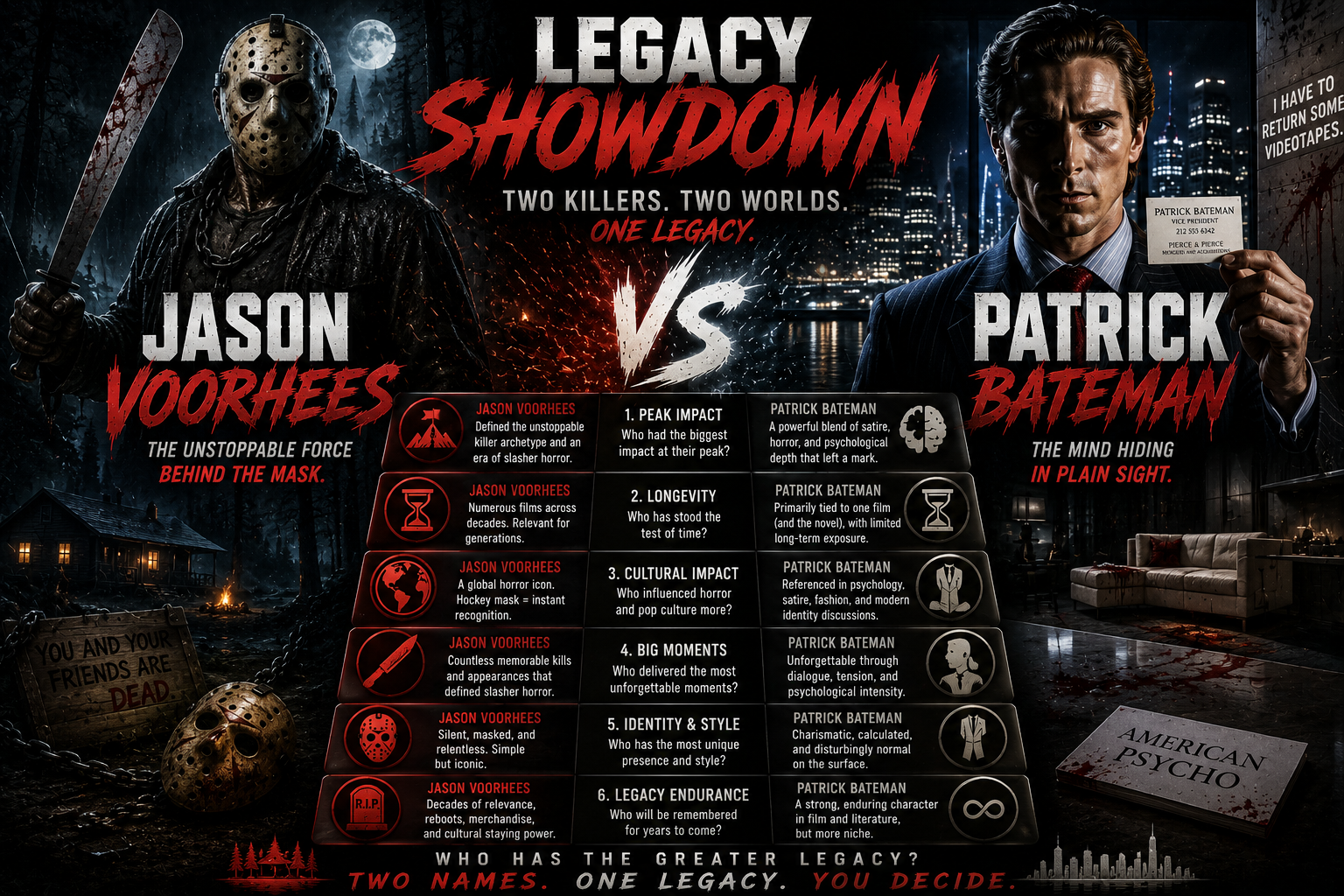
In this matchup, we bring together two killers who represent dramatically different styles of horror: Jason Voorhees vs. Patrick Bateman.
Representing the Friday the 13th franchise is Jason Voorhees, one of the most recognizable slasher villains ever created. With his hockey mask, machete, towering physical presence, and seemingly unstoppable ability to keep returning, Jason became one of the defining figures of the slasher era. Over decades of films, he evolved from the terrifying legend surrounding Camp Crystal Lake into a nearly supernatural killing machine whose image became recognizable far beyond the franchise itself.
Standing across from Jason is Patrick Bateman, the chilling and psychologically complex central character of American Psycho. Rather than hiding his darkness behind a frightening supernatural appearance, Bateman hides behind expensive suits, immaculate grooming, professional success, and the polished image of an ambitious Wall Street executive. Beneath that carefully constructed exterior lies narcissism, instability, jealousy, rage, and violent impulses that make him frightening for entirely different reasons.
That contrast creates one of our more unusual Killers Klash battles.
Jason represents relentless physical terror—a virtually unstoppable force who stalks his victims with little need for words or explanation. Bateman represents psychological horror beneath an ordinary appearance, relying on personality, satire, unpredictability, and the disturbing disconnect between how he presents himself and what may be happening beneath the surface.
One became an icon through decades of sequels, kills, resurrections, reinventions, and franchise recognition. The other built an enormous cultural following through a single defining film performance, an influential novel, unforgettable dialogue, and a character whose popularity has continued expanding through modern culture.
So which one possesses the stronger overall legacy?
We’ll put Jason Voorhees and Patrick Bateman through six Killers Klash categories: Peak Impact, Longevity, Cultural Impact, Big Moments, Identity & Style, and Legacy Endurance. An edge will be awarded in each round before we determine which competitor has earned the stronger legacy killer instinct.
It’s time for Jason Voorhees vs. Patrick Bateman.
Let’s break it down.
Affiliate Disclaimer: This blog may contain affiliate links or banner advertisements. If you click on one of these links or advertisements and make a purchase, we may earn a small commission at no additional cost to you. These commissions help support our work and allow us to continue creating entertaining content like Killers Klash and the Legacy Showdown series.
RULES OF THE SHOWDOWN
We evaluate each competitor based on six categories:
1. Peak Impact
2. Longevity
3. Cultural Impact
4. Big Moments
5. Identity & Style
6. Legacy Endurance
1. PEAK IMPACT
Jason Voorhees:
Jason Voorhees became one of the defining faces of slasher horror, helping solidify the image of the nearly unstoppable killer who relentlessly pursues his victims. Although the original Friday the 13th centered on Pamela Voorhees, Jason quickly emerged as the franchise’s central attraction and eventually became far bigger than the series itself. His enormous physical presence, limited speech, brutal attacks, and relentless pursuit of anyone unfortunate enough to cross his path made him terrifyingly simple and effective. The addition of his famous hockey mask in Friday the 13th Part III completed the visual identity that would become instantly recognizable around the world. During the franchise’s peak in the 1980s, Jason returned again and again, with audiences coming specifically to see what new victims, confrontations, and creative kills awaited them at Crystal Lake and beyond. His ability to survive seemingly fatal injuries gradually transformed him from a human killer into something resembling an unstoppable supernatural force. At his height, Jason didn’t merely participate in the slasher boom—he became one of the characters who defined what audiences imagined when they thought of a slasher villain.
Patrick Bateman:
Patrick Bateman’s peak comes from Christian Bale’s powerful portrayal in American Psycho, blending satire, horror, dark comedy, and psychological complexity in a way that left a lasting impression. Bateman is frightening precisely because his polished appearance initially seems completely disconnected from the violence and instability lurking underneath. By day, he presents himself as a wealthy, image-obsessed Wall Street professional surrounded by expensive restaurants, designer clothing, luxury apartments, and status-conscious colleagues. Beneath that carefully constructed exterior, however, lies a character consumed by narcissism, jealousy, rage, and increasingly disturbing impulses. Scenes involving business cards, his obsessive morning routine, and his chilling conversations before acts of violence turned Bateman into a uniquely quotable and memorable character. The film’s ambiguity surrounding what Bateman actually did versus what may have occurred inside his increasingly unstable mind adds another layer to his appeal. Over time, Bateman has experienced an extraordinary second life through internet culture, memes, social-media discussions, and renewed analysis of the film’s commentary on masculinity, consumerism, identity, and excess.
Edge: Jason Voorhees
Patrick Bateman’s peak is extremely impressive, especially considering that much of his legacy comes from one defining film performance that has only grown more culturally prominent with time. However, Jason Voorhees reached a different level of dominance during the height of the slasher era. Jason became the centerpiece of a major horror franchise and developed into an instantly recognizable symbol whose hockey mask could represent the entire slasher genre. While Bateman’s strength comes from psychological complexity, satire, and Christian Bale’s performance, Jason’s peak transformed him into a horror attraction all by himself. Audiences didn’t need Jason to speak, explain his motivations, or reveal complicated psychological layers—the mask, machete, and imposing presence immediately communicated what kind of danger had arrived. His influence helped reinforce the unstoppable-killer formula that countless slashers would imitate, modify, or react against in the decades that followed. For reaching the higher peak as a pure horror icon and helping define an entire era of slasher cinema, Jason Voorhees takes Round 1.
2. LONGEVITY
Jason Voorhees:
Jason Voorhees has appeared across numerous films spanning decades, maintaining his relevance through changing generations of horror audiences. After emerging as the central killer of the Friday the 13th franchise, Jason became such a powerful attraction that filmmakers repeatedly found ways to bring him back regardless of how definitively previous installments appeared to defeat him. His journey has taken him from the woods surrounding Camp Crystal Lake to Manhattan, supernatural resurrection, body-swapping territory, outer space, and even a crossover confrontation with Freddy Krueger. While some of those directions became increasingly outrageous, they also demonstrated just how adaptable Jason could be without losing the fundamental qualities audiences expected from him. His hockey mask, machete, imposing physical presence, and relentless pursuit of victims remained recognizable even as actors, filmmakers, settings, and decades changed around him. Jason has also remained visible outside the films through video games, merchandise, Halloween costumes, collectibles, and continued horror fandom. Few slasher villains have maintained such a recognizable identity across so many different eras, making longevity one of Jason’s greatest strengths.
Patrick Bateman:
Patrick Bateman’s presence is largely tied to one primary film and Bret Easton Ellis’s original novel, giving him far fewer major appearances than Jason Voorhees. However, the limited amount of material surrounding Bateman has not prevented the character from experiencing impressive cultural longevity. Christian Bale’s performance in American Psycho has steadily grown in popularity, with new generations discovering the movie long after its original 2000 release. Bateman’s obsessive routines, status-conscious behavior, memorable dialogue, and darkly comedic moments have become especially prominent through internet memes and social media. That renewed attention has allowed the character to remain culturally visible without requiring a long-running series of movies built around him. American Psycho also continues generating discussion because its themes involving consumerism, masculinity, identity, wealth, narcissism, and social conformity remain open to interpretation and analysis. Bateman has therefore achieved significant staying power, but it comes primarily through the continued rediscovery and reinterpretation of one defining portrayal rather than decades of new adventures.
Edge: Jason Voorhees
Patrick Bateman deserves considerable credit for remaining culturally relevant despite having a much smaller body of major screen appearances. In fact, the continued popularity of American Psycho demonstrates just how powerful one memorable performance can become over time. Jason Voorhees, however, has survived through a completely different form of longevity—repeatedly returning across decades while remaining immediately recognizable to horror audiences. The Friday the 13th franchise has reinvented, resurrected, relocated, and even radically reimagined Jason without permanently separating him from the identity that made him famous. Even lengthy gaps between new movies have failed to remove Jason from horror culture because his image continues through merchandise, costumes, games, conventions, and fan discussions. Bateman has demonstrated remarkable endurance from a concentrated legacy, but Jason has remained an active horror institution across multiple generations. For decades of franchise appearances, adaptability, and sustained recognition as one of slasher horror’s defining figures, Jason Voorhees takes Round 2.
3. CULTURAL IMPACT
Jason Voorhees:
Jason Voorhees has become a global horror icon, instantly recognizable through his hockey mask, machete, and imposing physical presence. Even people who have never watched a Friday the 13th movie often recognize Jason and understand exactly what the mask represents. His image has spread far beyond the films into Halloween costumes, toys, collectibles, video games, television references, parodies, merchandise, and countless pieces of horror-inspired artwork. The hockey mask itself has become one of the most recognizable symbols associated with the entire slasher genre. Jason’s influence can also be seen in later horror villains built around the idea of a silent, physically dominant killer who relentlessly stalks victims and seems almost impossible to permanently destroy. His crossover battle with Freddy Krueger in Freddy vs. Jason further demonstrated his cultural status by treating the two characters almost like horror’s version of legendary heavyweight competitors. Decades after his rise to prominence, Jason remains one of the first characters people picture when discussing slasher movies, proving that his cultural identity has extended far beyond Camp Crystal Lake.
Patrick Bateman:
Patrick Bateman has become a major cultural figure in a very different way, frequently appearing in discussions surrounding psychology, satire, masculinity, consumer culture, wealth, status, and modern identity. Christian Bale’s performance gave audiences a character who could be horrifying, absurd, charismatic, insecure, and darkly funny within the same story. Moments that originally served as satire—such as Bateman’s obsessive morning routine and his intense reaction to his colleagues’ business cards—have taken on an enormous second life through memes and social media. Younger audiences have continually rediscovered American Psycho, turning Bateman into an unexpectedly prominent figure in modern internet culture decades after the film’s release. At the same time, the character is often interpreted in dramatically different ways, with some viewers recognizing him as a satire of narcissism and status obsession while others focus on his confidence, appearance, or carefully constructed lifestyle. That contrast has helped keep conversations surrounding Bateman alive because the character can be analyzed from psychological, social, cinematic, and cultural perspectives. His influence may not have the same traditional horror footprint as Jason’s, but Bateman has achieved a remarkable cultural reach considering how heavily his screen legacy rests on one defining film.
Edge: Jason Voorhees
Patrick Bateman has experienced an impressive cultural resurgence, particularly through memes, social media, and continuing discussion of American Psycho’s themes. However, Jason Voorhees has maintained a broader identity as one of the universal symbols of horror itself. His hockey mask can communicate the idea of a slasher villain without audiences needing to hear his name or know the details of the Friday the 13th franchise. Bateman’s cultural importance is closely connected to Christian Bale’s performance and the themes surrounding American Psycho, while Jason’s image has escaped the boundaries of his individual movies and become part of Halloween and horror culture worldwide. Jason has been referenced, imitated, parodied, marketed, and celebrated across generations, giving him recognition well beyond dedicated horror fans. Bateman may generate more complex modern discussions, but Jason possesses the stronger overall footprint as a recognizable pop-culture icon. For worldwide recognition, influence on slasher imagery, and decades of presence throughout horror and popular culture, Jason Voorhees takes Round 3.
4. BIG MOMENTS
Jason Voorhees:
Jason Voorhees is known for countless memorable kills, confrontations, and appearances that helped define the spectacle of slasher horror. Throughout the Friday the 13th series, audiences learned that encountering Jason usually meant witnessing a kill designed to be more shocking, brutal, or inventive than the last. His confrontations at Camp Crystal Lake established many of the ingredients audiences came to expect from the franchise, including sudden attacks, relentless pursuits, and seemingly impossible returns from death. One particularly memorable moment comes in Friday the 13th Part VII: The New Blood, when Jason battles the telekinetic Tina Shepard, creating one of the franchise’s most unusual final confrontations. His trip to Manhattan produced another famous moment when Jason encounters a group of street punks, lifts his hockey mask, and sends them running after revealing what lies underneath. Later, Freddy vs. Jason gave audiences the long-awaited spectacle of Jason physically battling another legendary horror villain in Freddy Krueger. Jason’s big moments are often outrageous, violent, and sometimes darkly humorous, but together they helped create the larger-than-life reputation that transformed him from a movie killer into a slasher legend.
Patrick Bateman:
Patrick Bateman delivers unforgettable moments through dialogue, psychological tension, dark comedy, and disturbing behavior rather than the traditional slasher spectacle associated with Jason. The famous business-card scene perfectly demonstrates this approach, turning something as ordinary as comparing cards between coworkers into an increasingly tense display of Bateman’s jealousy, insecurity, and obsession with status. His morning-routine sequence similarly reveals the extraordinary amount of effort Bateman puts into maintaining his carefully constructed appearance and identity. Another defining moment occurs when Bateman enthusiastically discusses Huey Lewis and the News before suddenly shifting into violence, creating an unsettling collision between cheerful pop-culture commentary and murderous behavior. His interactions with Detective Donald Kimball also generate tension because Bateman struggles to maintain his polished exterior while potentially facing suspicion for his actions. As the story progresses, his increasingly unstable behavior culminates in a desperate confession that further blurs the line between reality, fantasy, and Bateman’s deteriorating psychological state. These scenes became memorable not simply because of what Bateman does, but because Christian Bale’s performance makes even conversations about music, restaurants, clothing, and business cards feel strangely threatening.
Edge: Tie
Jason and Bateman earn their memorable moments in completely different ways, making this one of the most difficult categories to separate. Jason’s greatest scenes are built around physical horror—the kills, chases, confrontations, resurrections, and spectacular displays of brutality that audiences expect from Friday the 13th. Bateman’s moments depend much more heavily on dialogue, performance, satire, awkwardness, and the uncomfortable uncertainty surrounding his psychological state. Jason can create an unforgettable scene without saying a single word, while Bateman can make an ordinary conversation about a business card feel like a psychological breakdown waiting to happen. Jason has the advantage in the sheer number of memorable horror set pieces accumulated across his franchise, but Bateman’s smaller collection of defining scenes has become extraordinarily quotable and culturally recognizable. Their greatest moments demonstrate exactly what makes each character effective: Jason dominates through physical presence and slasher spectacle, while Bateman dominates through personality and psychological tension. For two completely different approaches that have produced equally memorable moments, Round 4 ends in a tie.
5. IDENTITY & STYLE
Jason Voorhees:
Jason Voorhees is silent, masked, relentless, and intimidating, giving him an identity that is remarkably simple yet unmistakably iconic. His hockey mask became the defining element of his appearance, transforming an ordinary piece of sports equipment into one of horror cinema’s most recognizable symbols. Jason rarely needs dialogue because his enormous physical presence, deliberate movements, and refusal to stop pursuing his victims communicate everything audiences need to know. His machete has become closely associated with the character, although Jason has used a wide variety of weapons and environmental objects throughout the Friday the 13th franchise. Another important element of his identity is Camp Crystal Lake itself, a setting so closely connected to Jason that the woods, cabins, and lake almost feel like extensions of the character. His increasingly supernatural durability also reinforces his style, creating the impression that escaping Jason temporarily is possible but permanently stopping him is something else entirely. Jason’s identity may not be psychologically complicated, but its simplicity is one of its greatest strengths: the hockey mask appears, Jason starts walking, and audiences immediately understand the threat.
Patrick Bateman:
Patrick Bateman is charismatic, calculated, image-conscious, and disturbingly normal on the surface, hiding an increasingly unstable personality underneath. His carefully styled hair, expensive suits, immaculate apartment, strict exercise routine, fashionable restaurants, and obsession with prestigious possessions create the appearance of someone who has achieved everything his social environment values. Yet that polished identity is largely a performance, concealing jealousy, narcissism, insecurity, rage, and violent impulses that gradually become more difficult for him to control. Bateman’s style is also inseparable from his dialogue, as he can enthusiastically discuss music, fashion, restaurants, or personal grooming immediately before shifting into deeply disturbing behavior. His obsession with status is perfectly captured by the business-card scene, where something incredibly trivial becomes a devastating threat to his fragile sense of superiority. Even more fascinating is the uncertainty surrounding Bateman’s identity and actions, as American Psycho increasingly forces viewers to question what is actually happening and how much can be trusted from his perspective. Christian Bale’s performance makes that contradiction work brilliantly, allowing Bateman to move between charming, ridiculous, frightening, insecure, and completely unhinged without ever losing the character’s distinctive personality.
Edge: Patrick Bateman
6. LEGACY ENDURANCE
Jason Voorhees:
Jason Voorhees has maintained decades of relevance through sequels, reinventions, crossovers, merchandise, video games, and continued recognition throughout horror culture. Even during periods when the Friday the 13th franchise has not produced new films, Jason has remained highly visible because his identity has grown far beyond the movies themselves. The hockey mask continues to appear on Halloween costumes, collectibles, clothing, posters, and other horror merchandise, keeping Jason recognizable to generations who may not have experienced his original films when they were released. His basic character design also works remarkably well across different eras because the concept of a silent, unstoppable killer requires very little explanation. Jason has survived changing horror trends, increasingly elaborate sequels, supernatural transformations, a trip to space, and even a crossover with Freddy Krueger without losing his fundamental identity. New horror audiences continue discovering the Friday the 13th movies while longtime fans keep Jason’s reputation alive through conventions, franchise discussions, rankings, and nostalgia for classic slasher cinema. Few horror characters have demonstrated the ability to remain so culturally recognizable even when their franchise experiences lengthy periods away from the big screen.
Patrick Bateman:
Patrick Bateman has developed a strong and enduring legacy in both film and literature, although his long-term presence operates on a more concentrated scale than Jason’s massive horror franchise. Bret Easton Ellis’s novel established the character, while Christian Bale’s performance in American Psycho created the version of Bateman that became embedded in modern popular culture. Rather than depending on frequent sequels, Bateman’s endurance has come through repeated rediscovery of the same story and continued analysis of its themes. Discussions surrounding consumerism, wealth, masculinity, narcissism, social conformity, identity, and psychological instability have helped keep American Psycho relevant long after its original release. Internet culture has given Bateman an additional form of endurance, with scenes, quotes, expressions, and images from the film repeatedly transformed into memes and social-media references. That popularity has introduced the character to younger audiences who were not even born when the film first appeared. Bateman’s legacy is therefore stronger than his relatively small number of major appearances might suggest, demonstrating that a character does not necessarily need a sprawling franchise to achieve lasting cultural relevance.
Edge: Jason Voorhees
Patrick Bateman has demonstrated impressive endurance, particularly because so much of his cinematic reputation rests upon one defining performance. However, Jason Voorhees has already proven his ability to survive across multiple generations, changing horror trends, franchise reinventions, and long periods without new theatrical installments. Jason does not need audiences to understand the history of Camp Crystal Lake before recognizing the hockey mask or understanding the threat he represents. His image has become permanently connected to slasher horror in a way that allows the character to remain culturally visible even when no new movie is actively promoting him. Bateman’s continuing popularity demonstrates the lasting power of American Psycho, but Jason’s endurance encompasses movies, Halloween culture, gaming, merchandise, fandom, and the broader history of the horror genre. More importantly, the simplicity of Jason’s core identity gives future filmmakers endless opportunities to bring him back without fundamentally changing what audiences love about the character. For decades of multigenerational recognition and an identity that has endured far beyond the rise and fall of individual horror trends, Jason Voorhees takes Round 6.
FINAL VERDICT
Jason Voorhees wins this Legacy Showdown due to his overwhelming longevity, cultural impact, and role in defining an entire genre.
Patrick Bateman remains one of the most fascinating and layered characters in psychological horror, but Jason’s legacy reaches a broader and more enduring audience.
—
YOU DECIDE
Who has the greater legacy?
The unstoppable force behind the mask… or the mind hiding in plain sight?
Two names. One legacy. You decide.