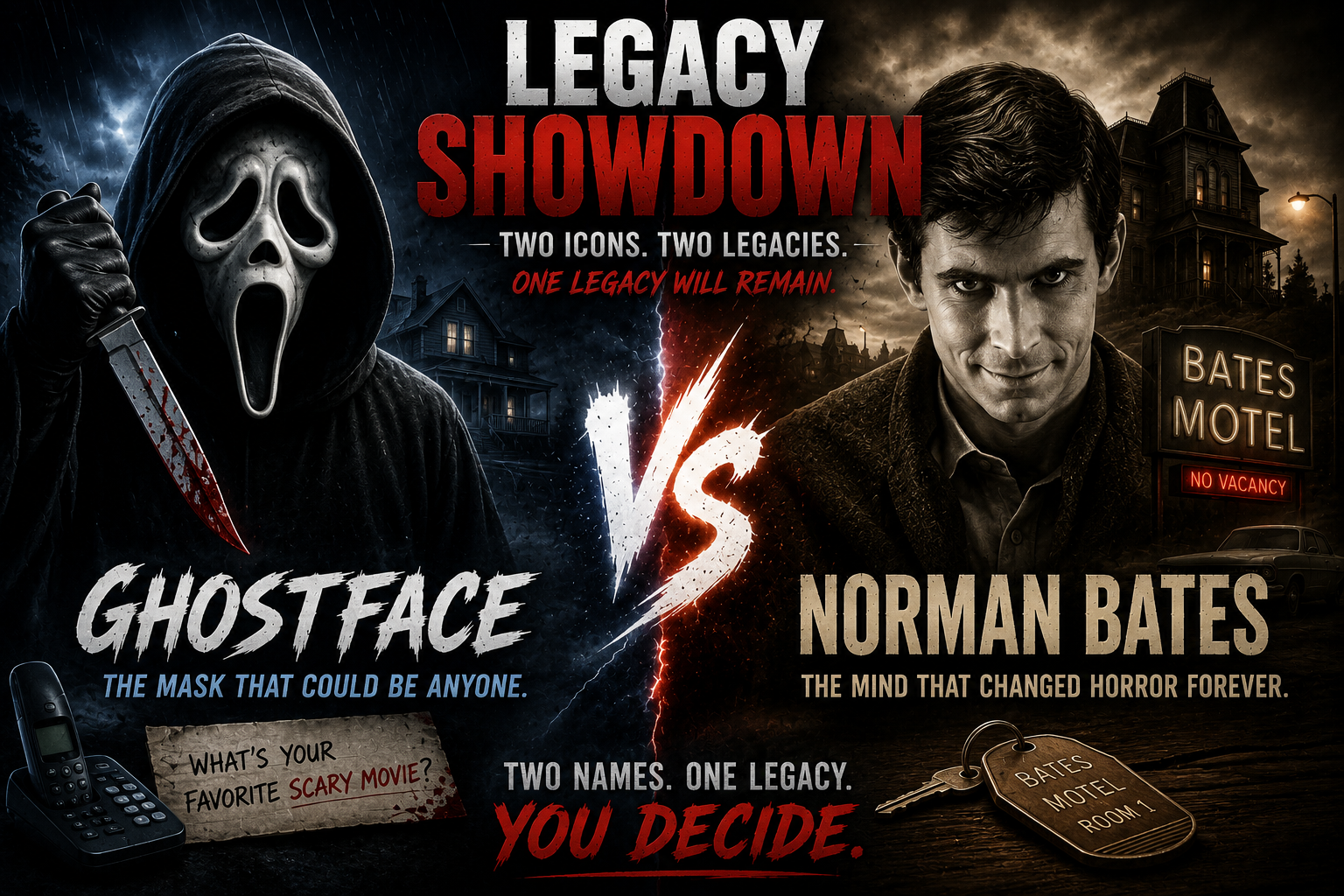

Two icons of psychological horror. Two very different kinds of fear. One question remains: whose legacy stands the test of time?
Welcome back to Killers Klash, where horror’s most terrifying, unforgettable, and iconic characters go head-to-head to determine who possesses the stronger legacy killer instinct. As part of our larger Legacy Showdown series, Killers Klash takes legendary horror characters from different franchises and puts their reputations to the test. Each matchup examines the qualities that transformed these killers, monsters, and supernatural threats into enduring horror icons.
This showdown brings together two killers who represent dramatically different generations and styles of horror: Ghostface vs. Norman Bates.
Representing the Scream franchise is Ghostface, the masked identity that helped reinvent the slasher movie for a new generation. Armed with an unmistakable mask, a menacing telephone voice, and the constant mystery surrounding who is underneath the costume, Ghostface combines brutal slasher horror with suspense, satire, and self-awareness. Because different killers can assume the identity, Ghostface has continued evolving alongside horror itself, allowing the character to remain unpredictable while maintaining the familiar traits audiences immediately recognize.
Standing across from Ghostface is Norman Bates, the psychologically disturbing motel owner from Alfred Hitchcock’s Psycho. Rather than relying on an intimidating mask, supernatural powers, or overwhelming physical strength, Norman became terrifying because of what was hidden beneath his seemingly quiet and harmless exterior. His complicated relationship with Mother, unsettling personality, and shocking secrets helped redefine what audiences expected from a cinematic killer. More than six decades after Psycho first arrived, Norman remains one of the foundational figures of psychological horror.
This creates a fascinating battle between reinvention and foundation. Ghostface helped breathe new life into the slasher genre by understanding and twisting its rules, while Norman Bates helped establish some of the psychological and cinematic ideas that influenced generations of horror filmmakers who followed.
But which one possesses the stronger overall legacy?
It’s time to put Ghostface and Norman Bates through the Killers Klash test and find out.
Rules of the Showdown
Each competitor will be evaluated across six categories:
- Peak Impact
- Longevity
- Cultural Impact
- Big Moments
- Identity & Style
- Legacy Endurance
An edge will be awarded in each round based on which character holds the advantage in that particular category. Once all six rounds are complete, we’ll look at the entire matchup and determine which horror legend ultimately possesses the stronger legacy killer instinct.
Let the showdown begin.
Affiliate Disclaimer: This blog may contain affiliate links or banner advertisements. If you click on one of these links or advertisements and make a purchase, we may earn a small commission at no additional cost to you. These commissions help support our work and allow us to continue creating entertaining content like Killers Klash and the Legacy Showdown series.
1. PEAK IMPACT
Ghostface:
Ghostface burst onto the scene in 1996 with Scream, redefining horror by blending satire, self-awareness, and suspense. The character revitalized the slasher genre during a time when it was fading. What made Ghostface immediately different was that the killers understood the same horror-movie rules that audiences had spent years watching, allowing the film to both celebrate and challenge the genre. The opening sequence with Casey Becker established this perfectly, transforming what begins as a seemingly harmless phone call into one of the most memorable opening scenes in modern horror. Ghostface also introduced an important twist by making the costume an identity that could be assumed by different killers rather than a single supernatural monster. That concept allowed every Scream movie to operate partly as a murder mystery, with audiences trying to determine who was behind the mask. The combination of brutal attacks, clever dialogue, mystery, and commentary on horror conventions helped make Scream a cultural phenomenon. Ghostface didn’t simply become another successful slasher villain—the character helped launch a new era of self-aware horror.
Norman Bates:
Norman Bates shocked audiences in 1960 with Psycho. His reveal and psychological depth changed horror forever, introducing a new kind of villain rooted in the human mind. Alfred Hitchcock initially presents Norman as a shy, awkward motel owner who appears far less threatening than the criminals and dangers audiences might expect from a suspense film. That apparent innocence makes the eventual truth surrounding Norman and his mother even more disturbing. The famous shower sequence involving Marion Crane stunned audiences not only because of its violence and filmmaking, but because the movie suddenly eliminated the character viewers had assumed would remain its central protagonist. As the mystery unfolds, Norman becomes frightening precisely because he can initially appear ordinary, sympathetic, and even vulnerable. The final revelation surrounding Mother transformed the story from a conventional murder mystery into a disturbing psychological portrait that audiences of the era were unlikely to forget. Norman’s impact also extended far beyond Psycho, helping establish the psychologically complex human killer as one of horror’s most powerful villain archetypes.
Edge: Norman Bates
Ghostface deserves enormous credit for helping reinvent the slasher movie for a new generation, but Norman Bates earns the edge because his peak impact occurred at a much earlier stage in horror’s evolution. Psycho challenged audience expectations about who could be a killer, who could be a protagonist, and how psychologically disturbing a mainstream horror-thriller could become. Norman demonstrated that a villain did not need supernatural powers, a monstrous appearance, or even an obviously threatening personality to terrify an audience. His seemingly ordinary exterior actually made the character more unsettling because the danger was hidden beneath someone viewers could initially sympathize with. Ghostface brilliantly reinvented conventions that decades of horror movies had established, while Norman Bates helped establish and reshape many of the psychological and slasher traditions that later filmmakers could build upon. For sheer historical impact and influence on the evolution of horror, Norman Bates takes Round 1.
2. LONGEVITY
Ghostface:
Appearing across multiple films with new characters behind the mask, Ghostface has remained relevant for decades, adapting with each generation. Since Scream debuted in 1996, the franchise has repeatedly found ways to introduce Ghostface to new audiences without abandoning the basic identity that made the character successful. One of the franchise’s greatest advantages is that Ghostface is not dependent on a single killer, allowing different characters, motives, and mysteries to emerge while the familiar mask and voice remain at the center of the story. Sidney Prescott, Gale Weathers, and Dewey Riley helped provide continuity through much of the series, while later installments successfully introduced younger characters capable of carrying the story forward. The franchise has also adapted its commentary to changing eras of horror, moving from the slasher conventions of the 1990s to sequels, remakes, reboots, fandom, and modern “requel” culture. That flexibility has prevented Ghostface from becoming trapped in one particular period of horror history. Nearly three decades after the original Scream, the mask remains instantly associated with the franchise, demonstrating Ghostface’s remarkable ability to survive changing audiences and horror trends.
Norman Bates:
While Psycho spawned sequels and a TV series, Norman Bates’ primary impact is tied to a smaller number of major appearances. Anthony Perkins returned to the character decades after the original film in Psycho II, Psycho III, and Psycho IV, giving Norman considerably more screen history than someone familiar only with Hitchcock’s original might realize. Those sequels explored Norman’s continuing psychological struggles and demonstrated that audiences remained interested in the character long after the shocking revelations of the 1960 original. Norman also received an entirely new generation of attention through Bates Motel, which reimagined his younger years and complicated relationship with his mother, Norma. Freddie Highmore’s portrayal helped introduce Norman Bates to television viewers who may never have experienced the original films during their theatrical eras. However, Norman’s legacy remains overwhelmingly anchored to Hitchcock’s Psycho and Anthony Perkins’ defining original performance. The character has endured remarkably well as a horror icon, but his continued presence has been more selective than the regularly reinvented Ghostface.
Edge: Ghostface
Norman Bates has demonstrated impressive endurance considering that Psycho arrived more than six decades ago, and his influence remains deeply embedded in horror history. However, longevity in this matchup is about more than how long a character has been remembered—it also considers how consistently that character has remained active and relevant to new audiences. Ghostface possesses a major advantage because the identity can survive regardless of who is underneath the mask. Every new generation can receive its own Ghostface mystery while retaining the costume, voice, phone calls, and basic characteristics audiences immediately recognize. Scream has repeatedly used that formula to refresh the franchise without completely reinventing its central villain. Norman Bates remains one of horror’s foundational characters, but Ghostface has enjoyed a more continuous ability to evolve alongside the genre itself. For adaptability, continued franchise activity, and multigenerational relevance, Ghostface takes Round 2.
3. CULTURAL IMPACT
Ghostface:
Ghostface has become a Halloween staple, with the long white mask and flowing black robe instantly recognizable even to people who may never have watched a Scream movie. The character’s appearance is simple enough to imitate but distinctive enough to stand beside the most famous visual identities in horror. Ghostface has become a fixture of Halloween costumes, merchandise, collectibles, video games, parodies, memes, and countless references throughout popular culture. The character also influenced modern horror by demonstrating that slasher movies could acknowledge genre clichés while still delivering genuine suspense and frightening kills. The famous telephone calls and the question “What’s your favorite scary movie?” became inseparable from the Scream identity and helped give Ghostface a personality beyond the costume itself. Unlike many horror villains, Ghostface has remained culturally adaptable because different killers can wear the mask while audiences immediately understand what the character represents. Nearly three decades after the original Scream, Ghostface continues to connect with younger horror audiences while maintaining enormous nostalgic appeal among longtime fans.
Norman Bates:
Norman Bates is one of the most studied and referenced characters in film history, while Psycho itself remains a cornerstone of cinema. The character helped change popular perceptions of what a horror villain could be by demonstrating that terrifying evil could hide behind an apparently quiet, polite, and ordinary individual. Anthony Perkins’ performance became so closely associated with Norman that his nervous mannerisms and uncomfortable charm remain recognizable characteristics of the role generations later. The Bates Motel, the isolated Victorian house overlooking it, and the mysterious figure of “Mother” have all become enduring pieces of horror imagery. The shower scene became one of cinema’s most famous sequences, repeatedly referenced, parodied, analyzed, and imitated across movies, television, advertising, and popular culture. Norman’s influence can also be seen in generations of psychologically complicated killers whose frightening qualities come from disturbed human behavior rather than supernatural powers. Even people who have never watched Psycho may recognize its shower music, imagery, and famous murder sequence, demonstrating how deeply the movie has entered the broader cultural consciousness.
Edge: Norman Bates
Ghostface has unquestionably become one of the defining horror icons of the modern era, particularly through Halloween culture and the continuing popularity of the Scream franchise. However, Norman Bates’ cultural importance extends beyond horror fandom and into the history of filmmaking itself. Psycho became a landmark film whose techniques, storytelling choices, imagery, music, and central villain have been discussed and studied for generations. Norman helped demonstrate that some of cinema’s most frightening monsters could look completely human, influencing the psychological horror and slasher films that followed. Ghostface later became brilliant partly by recognizing, referencing, and playing with the conventions that earlier movies such as Psycho helped establish. Ghostface may have the stronger presence in contemporary Halloween culture, but Norman’s influence reaches deeper into the foundations of modern horror and popular cinema. For historical influence, cinematic importance, and a cultural legacy extending far beyond his own franchise, Norman Bates takes Round 3.
4. BIG MOMENTS
Ghostface:
Ghostface is known for shocking opening scenes, brutal confrontations, and unpredictable twists that have become a defining part of the Scream franchise. The original film immediately established this reputation with the unforgettable opening involving Casey Becker, where a seemingly playful phone conversation gradually turns into a terrifying fight for survival. That sequence demonstrated how effectively Ghostface could create suspense before ever physically attacking a victim. The franchise has continued using elaborate chase sequences, surprise attacks, and dramatic killer reveals to keep audiences guessing about who might survive and who is actually behind the mask. Another major strength is that Ghostface can appear vulnerable during confrontations, stumbling, falling, and taking punishment in ways that make the attacks feel more chaotic and unpredictable than those of nearly unstoppable supernatural killers. The climactic unmaskings have also become major moments themselves, with audiences waiting to discover both the killer’s identity and motivation. From terrifying phone calls to final-act revelations, Ghostface has accumulated an impressive collection of memorable sequences across multiple generations of Scream films.
Norman Bates:
Norman Bates is responsible for the infamous shower scene in Psycho, one of the most iconic moments in film history. Marion Crane entering the shower initially appears to be an ordinary moment, which makes the sudden appearance of the shadowy figure behind the curtain dramatically more shocking. The rapid editing, Bernard Herrmann’s piercing musical score, and unexpected murder created a sequence that became instantly associated with cinematic terror. What made the scene even more extraordinary was that Marion had been positioned as the movie’s central character, making her death relatively early in the story something audiences were not expecting. Norman’s frantic cleanup afterward adds another disturbing dimension, as viewers watch him methodically erase evidence and dispose of Marion’s car without yet understanding the full truth behind the murder. The eventual discovery of Mother’s corpse and Norman’s horrifying psychological secret provides Psycho with another unforgettable revelation near the climax. Few horror characters can claim moments that have been referenced, imitated, parodied, and analyzed as extensively as the defining sequences surrounding Norman Bates.
Edge: Norman Bates
Ghostface has the advantage in sheer quantity, with the Scream franchise producing numerous memorable openings, chase sequences, murders, phone calls, and killer reveals. However, this category is not determined simply by counting memorable scenes—it also considers how powerful and enduring the greatest moments became. Norman Bates possesses one of the strongest individual trump cards imaginable with the Psycho shower scene. Its imagery, editing, music, and shocking narrative consequences became recognizable far beyond the horror genre and continue to influence filmmakers decades later. The final revelation concerning Norman and Mother further strengthens his case by delivering another moment that permanently changed how audiences understood everything they had previously witnessed. Ghostface has created an impressive collection of franchise highlights, but Norman’s greatest moments became pieces of cinema history. For delivering some of the most influential and unforgettable sequences ever associated with a horror character, Norman Bates takes Round 4.
5. IDENTITY & STYLE
Ghostface:
Ghostface’s identity is built around a voice, a mask, and a mystery, creating a villain whose appearance remains familiar even though the person underneath constantly changes. The elongated white face, hollow black eyes, and flowing robe give Ghostface one of horror’s most immediately recognizable silhouettes. Roger L. Jackson’s menacing telephone voice adds another essential element, allowing Ghostface to psychologically torment victims before physically attacking them. Unlike villains whose personalities remain essentially the same from movie to movie, Ghostface changes depending on who is wearing the costume, giving each killer different motivations, relationships, and levels of brutality. The mystery surrounding the identity also makes the audience suspicious of nearly everyone, turning each Scream installment into both a slasher movie and a whodunit. Ghostface can be frightening one moment and surprisingly clumsy or vulnerable the next, which gives the attacks a frantic human quality that distinguishes the character from nearly unstoppable killers. This combination of an iconic visual identity and an endlessly replaceable person behind the mask gives Ghostface a style that is both remarkably consistent and constantly unpredictable.
Norman Bates:
Norman Bates possesses an entirely different style, relying on psychological uneasiness rather than an intimidating costume or monstrous physical appearance. His quiet voice, nervous mannerisms, awkward conversations, and seemingly gentle personality initially make him appear more sympathetic than threatening. That ordinary appearance is precisely what makes Norman so disturbing, because the audience gradually discovers the darkness hidden beneath his shy exterior. His complicated psychological connection to his mother creates the defining element of the character, blurring Norman’s identity until the horrifying truth is finally revealed. Anthony Perkins brought an unusual combination of vulnerability, charm, discomfort, and menace to the role, making viewers simultaneously uneasy around Norman and strangely sympathetic toward him. The Bates house looming above the motel also becomes an extension of Norman himself—isolated, mysterious, and hiding disturbing secrets behind an apparently ordinary exterior. Rather than announcing himself as a monster, Norman slowly allows the audience to discover that something is terribly wrong, giving him one of horror’s most psychologically unsettling identities.
Edge: Tie
This round is difficult to separate because Ghostface and Norman Bates demonstrate two completely different approaches to creating an unforgettable horror identity. Ghostface wins visually, combining the mask, robe, telephone voice, and murder mystery into a character audiences can recognize almost instantly. Norman’s strength comes from the opposite direction: there is no frightening mask protecting audiences from the realization that the monster can appear completely human. Ghostface’s changing identity provides tremendous flexibility, while Norman’s fractured identity provides extraordinary psychological depth. One keeps audiences asking who is behind the mask, while the other forces them to question who Norman Bates truly is beneath his seemingly harmless exterior. Both approaches became defining characteristics of their respective stories and helped distinguish these characters from countless horror villains that followed. For two radically different but equally distinctive approaches to horror identity and style, Round 5 ends in a tie.
6. LEGACY ENDURANCE
Ghostface:
Ghostface continues to evolve with new films and modern audiences, proving that the character’s basic concept can survive major changes in both horror and popular culture. The ability to place a different killer behind the mask gives the Scream franchise something few horror series possess: a natural mechanism for reinvention. New characters, motives, technologies, and social trends can be incorporated without sacrificing the familiar Ghostface identity that audiences expect. Younger generations continue discovering the character through new installments while longtime fans remain connected through the franchise’s history and returning characters. The mask has also developed a life beyond the movies, remaining prominent in Halloween culture, merchandise, gaming, social media, and horror fandom. Ghostface’s self-aware nature is particularly valuable because the character can evolve alongside the horror genre, commenting on whatever trends dominate a particular era. As long as filmmakers can create compelling mysteries around who is wearing the mask and why, Ghostface possesses the flexibility to remain relevant for generations to come.
Norman Bates:
Norman Bates has achieved a different kind of endurance, becoming a timeless character studied through film history, psychology, storytelling, and the development of the horror genre. More than six decades after Psycho first shocked audiences, Norman remains one of cinema’s most recognizable examples of the psychologically complex killer. His legacy does not depend upon a constant stream of new theatrical appearances because the original film continues to introduce audiences to the character. Norman’s awkward personality, relationship with Mother, and disturbing secrets at the Bates Motel remain powerful because the character’s horror is rooted in human behavior rather than special effects or supernatural mythology that might become dated. Later sequels and Bates Motel demonstrated that filmmakers could continue exploring Norman while approaching his psychology and relationships from different perspectives. His influence can be felt in countless later horror and thriller characters who appear ordinary on the surface while hiding something deeply disturbing underneath. Norman Bates has therefore moved beyond simply being the villain of Psycho—he has become part of the foundation upon which psychological horror and modern cinematic villains were built.
Edge: Norman Bates
Ghostface may currently possess greater franchise momentum, but legacy endurance asks a larger question: which character’s importance is most likely to survive regardless of whether new installments continue being produced? Norman Bates has already passed that test across more than six decades. Psycho remains a landmark of cinema, and Norman’s significance continues even for generations far removed from the movie’s original 1960 audience. Ghostface’s adaptability gives the character an excellent chance of remaining relevant for decades, especially because virtually anyone can inherit the mask. Norman, however, has already demonstrated that he does not require reinvention or frequent new movies to maintain his place in horror history. His influence survives through the films and characters he helped inspire, the continued study of Psycho, and the enduring fascination surrounding his unsettling personality. For a legacy that has already survived generations and become permanently woven into the history of horror and cinema, Norman Bates takes Round 6.
FINAL VERDICT
Norman Bates wins this Legacy Showdown due to his foundational impact on horror, cultural significance, and lasting influence.
However, Ghostface remains a powerful symbol of modern horror evolution.
YOU DECIDE
Who has the greater legacy?
The mask that could be anyone… or the mind that changed horror forever?
Two names. One legacy. You decide.