
Affiliate Disclosure
Some of the links on this page may be affiliate links. This means that if you click through and make a purchase, The Shopping Plaza may earn a small commission at no additional cost to you.
These commissions help support the operation of this website and allow us to continue creating free content, contests, rankings, and entertainment features like Sitcom Showdown.
We only recommend products, services, and merchandise that we believe may be of interest to our readers. Your support through these affiliate links is greatly appreciated and helps keep The Shopping Plaza growing.
Thank you for supporting The Shopping Plaza!
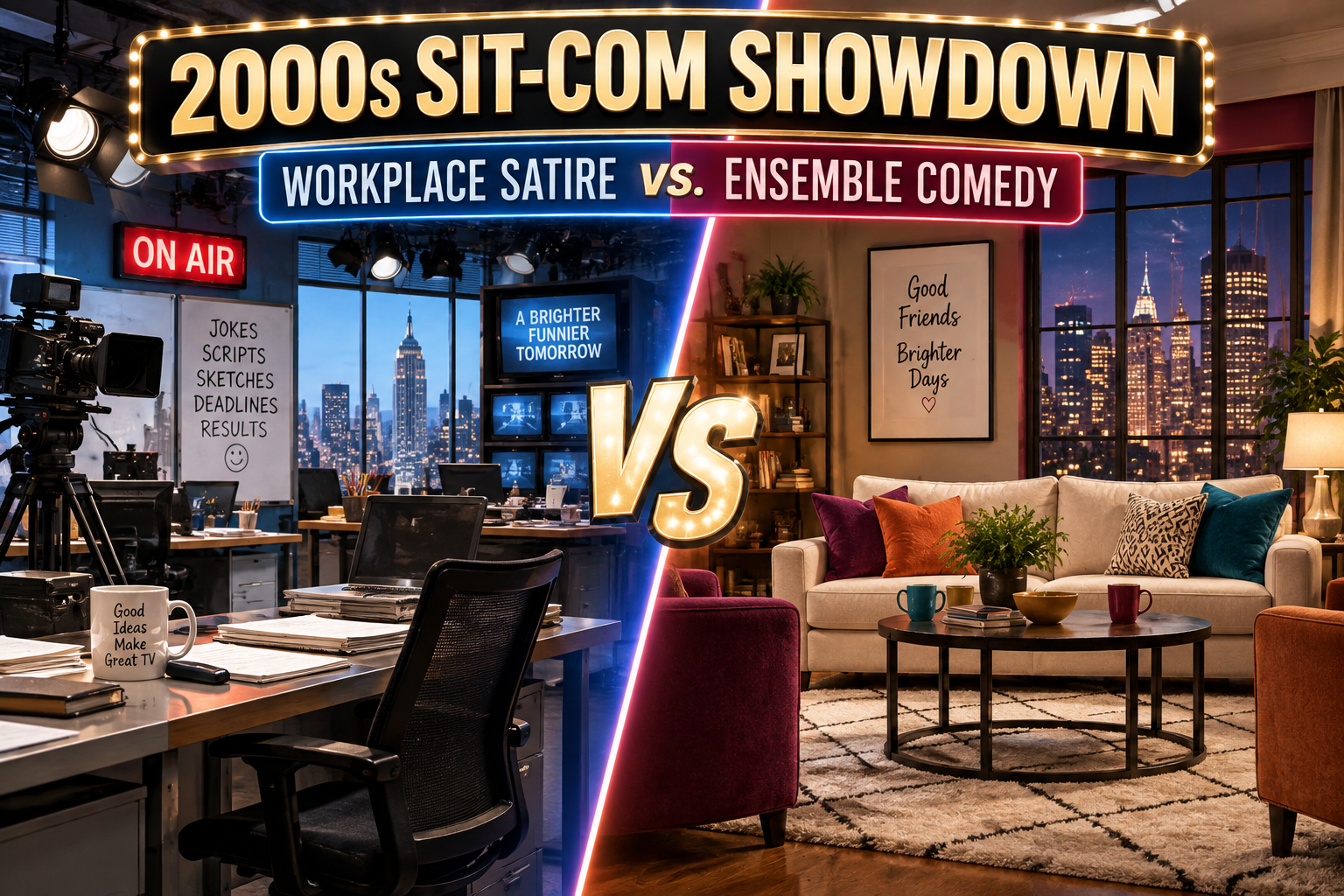
The 2000s Sit-Com Showdown continues with a matchup between two NBC comedies that attacked the sitcom from completely different angles: 30 Rock and Will & Grace. One turned the television industry itself into a rapid-fire playground of corporate absurdity, celebrity satire, workplace dysfunction, and jokes packed so tightly that a second viewing could reveal punchlines missed the first time. The other built its comedy around friendship, romance, identity, and an unforgettable foursome whose chemistry helped change what mainstream network television could look like.
30 Rock followed television writer Liz Lemon as she tried to manage the unpredictable cast and staff of a sketch-comedy show while dealing with network executive Jack Donaghy, superstar Tracy Jordan, attention-hungry Jenna Maroney, and eternally optimistic NBC page Kenneth Parcell. Will & Grace centered on best friends Will Truman and Grace Adler, whose lives were continually complicated and energized by the outrageous Karen Walker and flamboyant Jack McFarland.
This matchup is especially difficult because the shows excel in different kinds of legacy. 30 Rock is a critical and comedic powerhouse whose joke density and television satire remain extraordinary. Will & Grace carries enormous cultural importance, long-running character recognition, and an influence extending beyond comedy into LGBTQ+ representation on American network television. Eight categories will determine which one advances.
The Legacy Showdown Rules
- Comedy Quality
- Character Chemistry
- Cultural Impact
- Longevity & Replay Value
- Iconic Moments
- Supporting Cast
- Era Difficulty
- Legacy Endurance
Round 1: Comedy Quality
Will & Grace had an exceptionally strong comic engine. Will could play the controlled straight man until his own insecurities took over, Grace mixed confidence with chaos, Jack could turn almost any entrance into a performance, and Karen delivered insults with a rhythm entirely her own. The show also understood how to shift pairings, allowing Will and Grace to carry emotional stories while Jack and Karen pushed episodes toward outrageous comedy.
30 Rock, however, operated at a nearly unmatched joke-per-minute pace. Liz Lemon’s exasperation, Jack Donaghy’s corporate certainty, Tracy Jordan’s unpredictability, Jenna’s vanity, Kenneth’s bizarre innocence, and the insanity surrounding TGS created comedy in every corner of the frame. The series could move from media satire to wordplay, visual jokes, absurd cutaways, celebrity parody, and character comedy in seconds. Will & Grace was consistently funny, but 30 Rock’s comic ambition and density give it the edge.
Winner: 30 Rock.
Round 2: Character Chemistry
30 Rock built excellent relationships, particularly the unusual friendship and mentorship between Liz and Jack. Their bond avoided a conventional romance and became richer because two very different people gradually learned to trust, challenge, and understand one another. Tracy and Jenna created constant chaos, while Kenneth’s devotion to television gave the workplace a strange emotional center.
Will & Grace was built around chemistry from the beginning. Eric McCormack and Debra Messing made Will and Grace believable as best friends whose emotional intimacy could survive arguments, relationships, jealousy, and major life changes. Sean Hayes and Megan Mullally then created a second comic partnership so strong that Jack and Karen became essential rather than secondary. All four could be paired in different combinations without losing the show’s energy.
Winner: Will & Grace.
Round 3: Cultural Impact
30 Rock had a major influence on comedy writers and viewers who appreciated its self-awareness, media satire, and willingness to make network television itself the target. Its portrayal of corporate entertainment, celebrity culture, product placement, executive decision-making, and the absurd compromises behind television production made it one of the sharpest industry comedies of its era.
Will & Grace had a broader cultural impact. Putting a gay male lead and several prominent LGBTQ+ characters at the center of a successful mainstream network sitcom was significant at a time when that representation was far less common. The series helped normalize gay characters as complicated friends, professionals, relatives, romantic partners, and comic leads rather than treating their identities as a one-episode issue. Whatever debates surround individual stereotypes or storytelling choices, its visibility and mainstream reach were historically important.
Winner: Will & Grace.
Round 4: Longevity & Replay Value
30 Rock ran seven seasons and rewards repeat viewing unusually well. The speed of its jokes means viewers can discover background gags, callbacks, references, and throwaway lines they missed the first time. Its satire of television executives, celebrities, corporate branding, workplace politics, and entertainment-industry desperation also remains recognizable even as specific references age.
Will & Grace produced eight seasons in its original run and later returned for three additional seasons, giving the central characters an unusually long television life. The friendship stories, dating disasters, workplace problems, and comic pairings remain easy to revisit, while the revival demonstrated that audiences still had interest in these characters years after the first finale. 30 Rock may reward denser rewatches, but Will & Grace wins on the combination of replayability and extraordinary longevity.
Winner: Will & Grace.
Round 5: Iconic Moments
Will & Grace created instantly recognizable signatures through Jack’s performances, Karen’s voice and insults, Grace’s physical comedy, and Will’s reactions to the chaos around him. The foursome generated memorable holiday episodes, romantic milestones, celebrity guest appearances, arguments, reconciliations, and running jokes that became central to the show’s identity.
30 Rock’s iconic catalog is more surreal and endlessly quotable. Liz Lemon’s food obsessions and disastrous personal life, Jack’s business philosophy, Tracy’s impossible declarations, Jenna’s performances, Kenneth’s mysterious background, Dr. Spaceman’s medical advice, and fictional creations such as MILF Island or Werewolf Bar Mitzvah gave the series a universe unlike anything else on network television. Its best jokes and invented pieces of pop culture continue circulating independently of their episodes.
Winner: 30 Rock.
Round 6: Supporting Cast
Will & Grace had a strong recurring world surrounding its central four, including family members, romantic partners, coworkers, neighbors, and a remarkable list of guest stars. Rosario became especially important through her battles and unusual bond with Karen, while characters connected to Will and Grace expanded their professional and romantic lives.
30 Rock takes this category because its supporting bench was almost absurdly deep. Pete, Frank, Toofer, Lutz, Cerie, Grizz, Dot Com, Jonathan, Dr. Spaceman, Dennis Duffy, Devon Banks, Colleen Donaghy, and a revolving collection of network executives, celebrities, writers, and romantic interests could generate entire subplots. Even brief characters often arrived with a fully formed comic identity. The crowded world of TGS and NBC made the series feel like an endless satire machine.
Winner: 30 Rock.
Round 7: Era Difficulty
30 Rock arrived in a changing television environment where single-camera comedy was becoming more prominent but network competition remained intense. Its rapid references, entertainment-industry setting, unconventional characters, and sometimes deliberately strange humor were never designed to be the safest possible mass-audience formula. Surviving seven seasons while maintaining such a distinctive voice was an impressive achievement.
Will & Grace faced a more significant cultural challenge when it premiered in 1998 and carried that importance into the 2000s. A major network was asking a broad prime-time audience to embrace openly gay lead characters as the permanent center of a mainstream sitcom. The show had to succeed as comedy first while operating under far greater scrutiny about representation, acceptance, and stereotypes. Its long run and mainstream popularity helped move television into territory that later shows could enter more easily.
Winner: Will & Grace.
Round 8: Legacy Endurance
30 Rock has an outstanding critical legacy. It remains a favorite among comedy writers and viewers who value intricate jokes, satire, absurdism, and fearless attacks on the television business. Liz Lemon and Jack Donaghy became defining comedy characters, and the series continues to influence discussions about what a densely written workplace sitcom can accomplish.
Will & Grace has a different but larger historical footprint. Its original success, continued visibility, revival, and importance to LGBTQ+ representation give it a legacy that extends beyond ratings or individual jokes. Will, Grace, Jack, and Karen remained recognizable enough to return years later without the premise needing to be reinvented. 30 Rock may be the sharper pure satire, but Will & Grace’s combination of television longevity and cultural significance gives it the final category.
Winner: Will & Grace.
Final Verdict
This matchup produces one of the more revealing scorecards in the tournament. 30 Rock wins Comedy Quality, Iconic Moments, and Supporting Cast, which reflects its extraordinary joke density, bizarre fictional universe, and deep collection of recurring comic characters. On pure comedic construction, Tina Fey’s television satire is an extremely difficult opponent.
Will & Grace wins Character Chemistry, Cultural Impact, Longevity & Replay Value, Era Difficulty, and Legacy Endurance. Its advantage comes from the complete legacy rather than from being the more technically aggressive comedy. The chemistry among Will, Grace, Jack, and Karen sustained the series across its original run and later revival, while its role in bringing LGBTQ+ characters into mainstream network comedy gives the show historical importance beyond the sitcom format itself.
With a competitive 5-3 victory, Will & Grace advances deeper into the 2000s Sit-Com Showdown bracket. 30 Rock exits as one of the smartest and funniest shows in the tournament, but Will & Grace’s combination of ensemble chemistry, longevity, cultural influence, and enduring significance proves enough to survive an exceptionally difficult matchup.
Audience Challenge
Do you agree with the 5-3 decision? Should 30 Rock’s comedy quality and razor-sharp satire have carried it farther, or do the chemistry, longevity, and cultural importance of Will & Grace make it the stronger Legacy Showdown contender? Cast your vote, defend your favorite, and keep following the 2000s Sit-Com Showdown bracket.