

Affiliate Disclaimer: This post may contain affiliate links. If you make a purchase through one of these links, The Shopping Plaza may earn a commission at no additional cost to you.
What We Count Begins to Shape What We See
Problems are demanding. They interrupt our plans, consume our attention, and often follow us into moments that were supposed to be relaxing. A financial concern can sit in the back of the mind during dinner. An unfinished project can make a weekend feel less restful. One difficult conversation can overshadow ten pleasant ones.
That is why the familiar advice to “count your blessings” is more meaningful than it may first appear.
It is not a command to ignore reality. Problems still need solutions. Bills still need to be paid, relationships still require work, goals still require effort, and difficult circumstances do not disappear because we decide to think positively.
Counting our blessings is about refusing to count only our problems.
Thanksgiving gives us a natural opportunity to reset the balance. For a moment, instead of asking what is wrong, missing, unfinished, or uncertain, we can ask what is already supporting us.
The answers may not eliminate our challenges. They can, however, change the emotional position from which we face them.
Sometimes the first step toward a healthier mindset is realizing that the problem taking up most of our attention is not the only thing present in our lives.
Your Mind Naturally Notices Problems
Human attention is easily drawn toward threats, mistakes, and unfinished business.
If nine things go well and one goes badly, which one are you most likely to replay later?
Usually the problem.
This tendency can be useful when something genuinely requires action. But when it becomes our default way of viewing life, it creates a distorted picture.
We begin treating what is wrong as the whole story.
A mindset reset starts by noticing this habit.
When your mind automatically presents a list of problems, you do not have to argue that those problems are imaginary. Simply add another list.
What is working? Who is helping? What do you have today that you once hoped for?
Balance begins when both lists are allowed to exist.
Counting Blessings Is Not Denying Problems
Some people resist gratitude because they worry it means minimizing real difficulties.
It does not.
You can be thankful for your family and frustrated about finances. You can appreciate your job and still recognize that something needs to change. You can enjoy Thanksgiving while carrying grief, uncertainty, or disappointment.
Two truths can exist at once.
“This is difficult” can be true.
“I still have things worth appreciating” can also be true.
Healthy gratitude does not erase the first statement. It prevents the first statement from erasing everything else.
Start With What Is Working
When life feels complicated, ask a simple question: What is working right now?
Maybe your morning routine is stable. Perhaps someone consistently supports you. Maybe you have a safe place to sleep, a skill that helps you earn a living, or a plan for addressing the next problem.
We often overlook functioning parts of life because they do not demand attention.
The car that starts receives less thought than the car that breaks down. The relationship that feels steady may receive less mental energy than the one causing conflict.
Take inventory of what is working.
You may discover that your life contains more stability than your worries allowed you to notice.
Count People Before Possessions
Material blessings matter. A home, food, clothing, transportation, and financial resources can provide comfort and security.
But many of life’s most valuable blessings are people.
Who listens to you? Who makes you laugh? Who would answer if you called? Who taught you something important? Who has stayed consistent?
Thanksgiving is an excellent time to count these relationships.
Do more than silently appreciate them.
Tell people what they mean to you.
A blessing becomes even more meaningful when the person responsible for it knows they were noticed.
Remember the Problems You Once Prayed Would End
Today’s concerns can make yesterday’s struggles disappear from memory.
Think back to a problem that once consumed your attention but no longer does.
Maybe you eventually found the job, finished the class, solved the technical problem, left the difficult situation, repaired the relationship, or simply learned how to manage something that once felt overwhelming.
You may now take the solution for granted.
Pause and remember what it felt like before things improved.
One of today’s ordinary blessings may actually be yesterday’s answered hope.
Stop Turning One Problem Into Ten
A single problem can multiply when the mind begins predicting consequences.
A mistake becomes, “Everything is going wrong.” A financial setback becomes, “I will never get ahead.” One awkward interaction becomes, “Everyone must think badly of me.”
The original problem may be real.
The additional conclusions may not be.
When you feel overwhelmed, separate the actual issue from the story growing around it.
Ask, “What specifically needs my attention?”
Then count what remains unaffected.
This keeps one difficult area from mentally taking ownership of your entire life.
Use Gratitude to Interrupt Comparison
Comparison is one of the fastest ways to forget our blessings.
Someone else appears to have more money, a larger home, a better vacation, a faster career path, or a picture-perfect holiday celebration.
Suddenly what felt sufficient five minutes ago seems disappointing.
Gratitude brings your attention home.
What matters in your life? What have you built? Which relationships would you never trade? What progress have you made?
You can admire someone else’s success without using it as evidence that your own life is inadequate.
Their blessings do not cancel yours.
Count Progress, Not Just Finished Goals
Many people are grateful only after they reach the finish line.
That means months or years of effort can feel like failure simply because the goal remains incomplete.
Count progress too.
Maybe you are halfway through the project. Perhaps you saved more money than last year, improved a skill, became more consistent, or recovered faster from setbacks.
Progress is a blessing because it proves movement.
You do not have to wait until the final result to appreciate how far you have already traveled.
Be Thankful for the Ability to Begin Again
Not every year goes according to plan.
Some goals fail. Habits slip. Relationships change. Opportunities are missed.
Yet one of life’s most overlooked blessings is the ability to begin again.
A new decision can be made today.
You can revise the plan, apologize, learn, restart, or choose a different direction.
Beginning again does not erase what happened.
It prevents what happened from becoming the only thing that can happen next.
Create a Thanksgiving Blessings Inventory
Set aside a few minutes before or during Thanksgiving and create a simple inventory.
Think about people, experiences, opportunities, lessons, comforts, progress, and ordinary conveniences.
Do not worry about making the list impressive.
Specific answers are often more meaningful than broad ones.
Instead of only writing “family,” write the particular thing someone did that mattered. Instead of “home,” identify the place in your home where you feel most comfortable.
The purpose is not to produce a perfect gratitude list.
It is to make invisible blessings visible again.
Turn Complaints Into Questions
Complaining is sometimes useful because it identifies something that needs to change.
But repeated complaints without action can trap attention.
When you notice yourself repeating the same complaint, turn it into a question.
“What can I do about this?” “Who could help me?” “What part can I control?” “What would make this slightly better?”
Then ask one more question: “What is still good despite this?”
This combination keeps gratitude practical.
You acknowledge the problem, look for action, and preserve perspective at the same time.
Protect Your Mind From a Constant Diet of Negativity
Perspective is influenced by what repeatedly receives our attention.
If every conversation, social-media feed, news update, and internal thought centers on what is wrong, gratitude has little room to breathe.
You do not have to ignore important events or avoid difficult conversations.
But you can create balance.
Spend time with people who can discuss problems without making hopelessness their entire worldview. Consume information intentionally rather than continuously. Take breaks from comparison-driven content.
A mindset reset sometimes requires changing what you repeatedly feed your mind.
Let Gratitude Improve the Way You Treat Others
Counting blessings should not stop with feeling fortunate.
It can influence behavior.
When you appreciate someone’s presence, you become more likely to treat that person with attention. When you recognize the help you have received, you may become more willing to help someone else.
Thanksgiving gratitude becomes especially meaningful when it produces generosity.
Offer encouragement. Share a meal. Send the message. Make the phone call. Help with a task.
Gratitude grows when it moves outward.
Do Not Wait for Thanksgiving to Reset
The holiday provides a perfect reminder, but mindset resets are useful throughout the year.
When stress begins dominating your thinking, pause.
Name the problem clearly.
Then deliberately name several things that remain good.
This can take less than a minute.
The practice will not make every stressful situation disappear, but it can prevent your attention from becoming trapped inside one narrow view of reality.
Choose a Daily Blessing
A long gratitude journal is helpful for some people, but it is not necessary.
Try choosing one blessing each day.
Before bed, ask, “What am I glad was part of today?”
The answer might be a conversation, meal, accomplishment, moment of quiet, helpful person, or unexpected laugh.
Some days the blessing will be obvious.
Other days you may have to search.
The search itself is part of the reset because it trains your attention to look beyond the day’s problems.
Let Thanksgiving Change the Way You Measure a Good Life
We often measure life through achievement.
How much did I earn? What did I accomplish? How far did I advance? What do I own?
Thanksgiving offers another measurement.
Who did I love? Who loved me? What did I learn? What ordinary moments made me smile? Where did I grow? What did I survive?
Achievement matters.
But a life can contain tremendous value that never appears on a resume, bank statement, or social-media post.
Gratitude helps us recognize that broader definition of abundance.
Count Your Blessings Without Losing Your Ambition
Being thankful does not mean becoming complacent.
You can appreciate what you have while working toward what you want.
In fact, gratitude can create a healthier foundation for ambition.
Instead of pursuing every goal from the belief that your current life is inadequate, you can pursue growth from a position of appreciation.
“I am grateful for what I have, and I am excited about what I can build next” is very different from “Nothing is enough until I reach the next goal.”
One creates motivation.
The other can create endless dissatisfaction.
A Thanksgiving Mindset Worth Carrying Forward
At some point, the Thanksgiving table will be cleared.
The dishes will be washed. The leftovers will be packed away. Guests will leave. The holiday weekend will end, and ordinary responsibilities will return.
Your problems may still be waiting.
But so will your blessings.
The people who care about you will still matter. The progress you made will still count. The ordinary comforts you noticed will still exist. The lessons you learned will still belong to you.
That is the mindset worth carrying forward.
Count your problems when they need solutions. Give them the attention required to make responsible decisions.
But do not count them so repeatedly that you forget everything else.
Count the people who showed up.
Count the second chances.
Count the lessons.
Count the laughter.
Count the ordinary days that passed peacefully.
Count the progress that happened quietly.
Count the things you once wanted that have become so familiar you almost forgot they were blessings.
Thanksgiving is not asking you to pretend that life is perfect.
It is asking you to look at the whole picture.
Sometimes the problem is only one part of that picture.
A gratitude mindset does not say, “Nothing is wrong.”
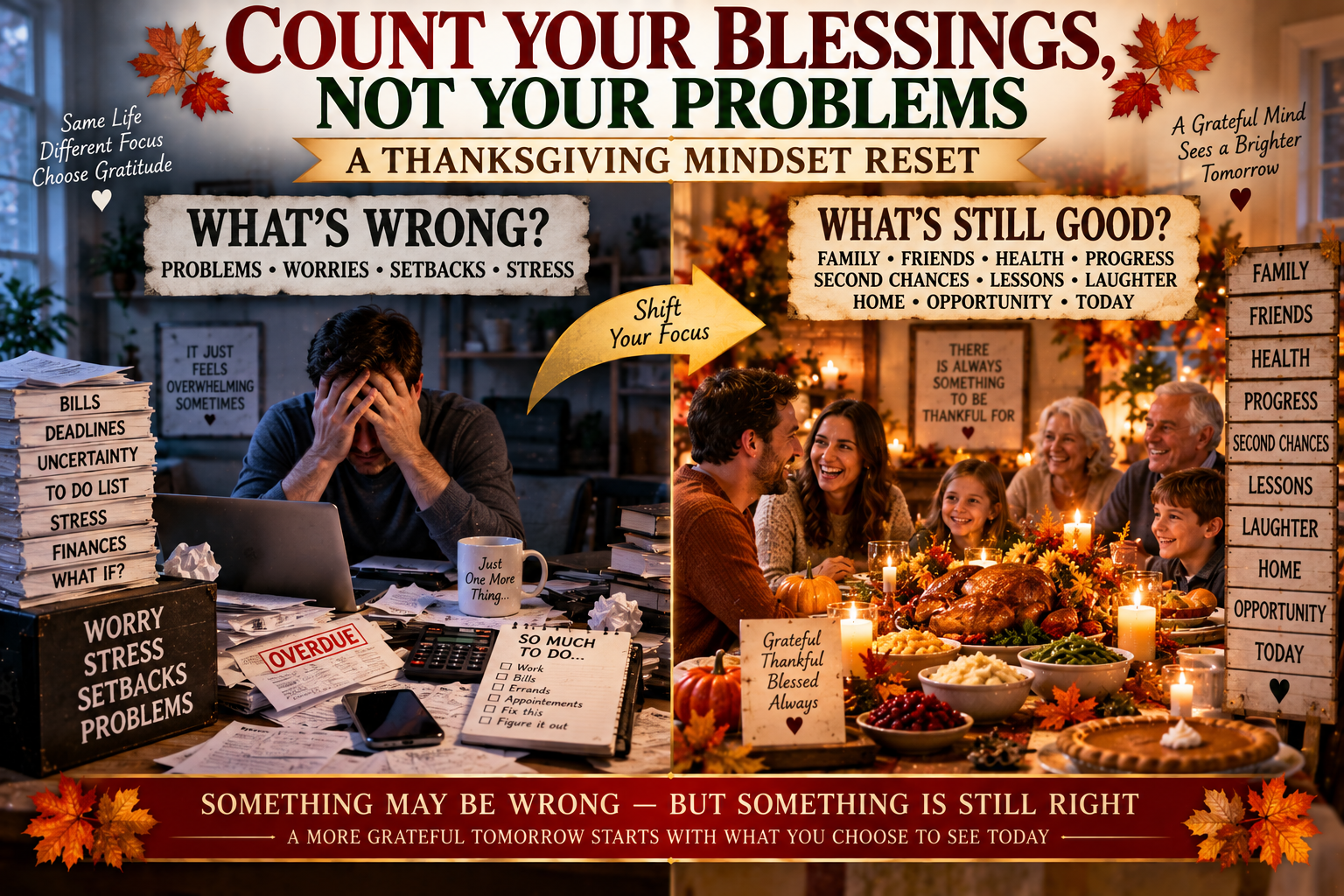
It says, “Something may be wrong, but something is still right.”
That difference can change how you walk into tomorrow.
So when your mind begins counting everything that is difficult, pause and give it another assignment.
Count what remains.
Count what matters.
Count what has carried you this far.
Count your blessings, not because your problems are imaginary, but because your blessings are real too.