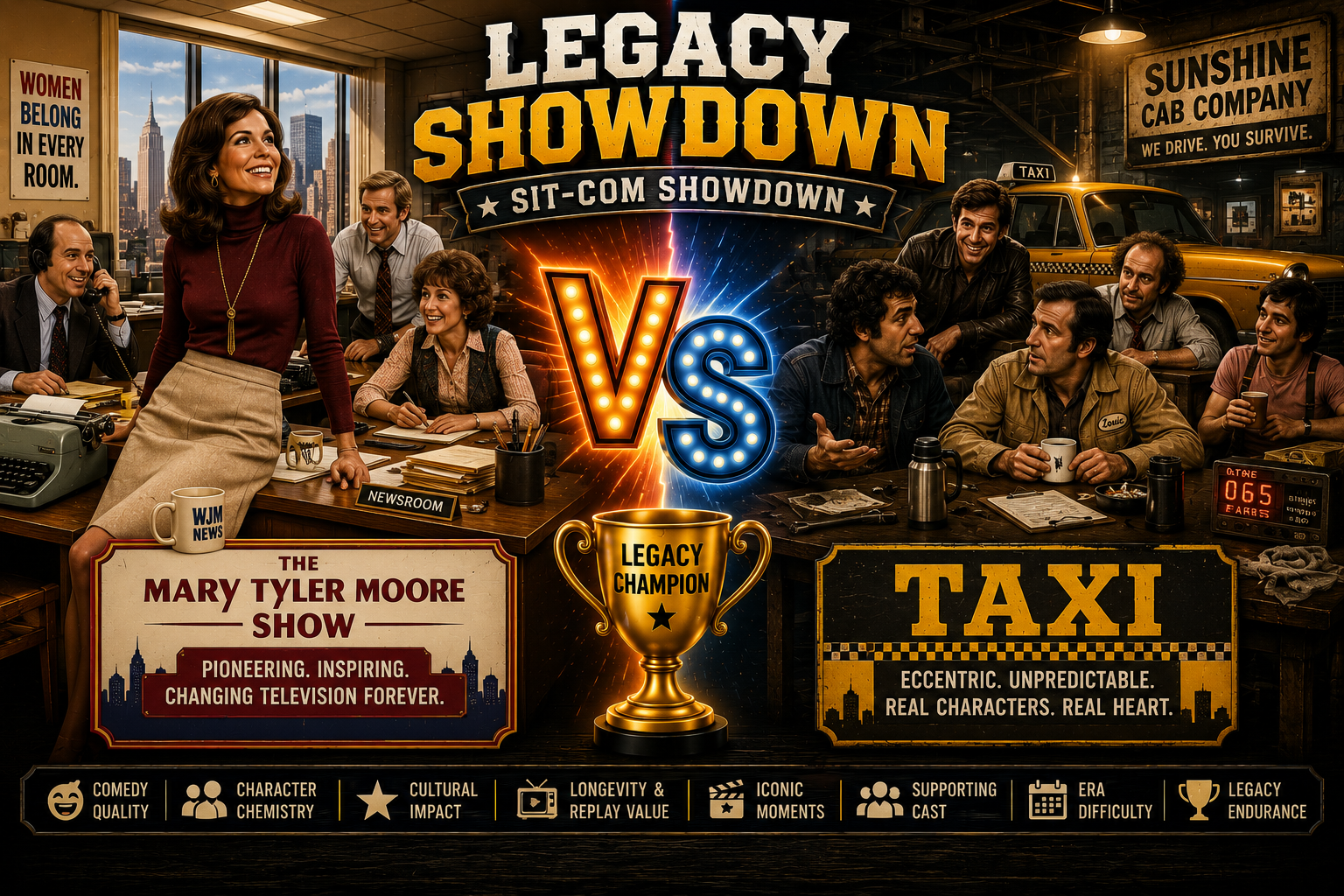


The Legacy Showdown tournament returns to the legendary 1970s region for a battle between two sitcoms that helped redefine ensemble television comedy. On one side is The Mary Tyler Moore Show, the groundbreaking workplace sitcom that changed the role of women in television comedy forever. On the other side stands Taxi, the gritty and character-driven ensemble comedy that turned a simple cab company into one of television’s most memorable comedic worlds.
This matchup feels like a collision between optimism and realism. The Mary Tyler Moore Show represented independence, ambition, and sophistication, while Taxi embraced chaos, struggle, and emotional unpredictability. Both sitcoms featured elite casts and unforgettable writing. The question is which legacy carries greater weight decades later.
The Legacy Showdown Rules
- Comedy Quality
- Character Chemistry
- Cultural Impact
- Longevity & Replay Value
- Iconic Moments
- Supporting Cast
- Era Difficulty
- Legacy Endurance
Round 1: Comedy Quality
The Mary Tyler Moore Show perfected a sophisticated style of workplace comedy built around intelligent writing, relatable situations, and characters whose personalities naturally generated laughs. One of its strongest examples is the classic “Chuckles Bites the Dust,” where the death of children’s entertainer Chuckles the Clown leads to increasingly inappropriate jokes around the newsroom, only for Mary—who disapproves of everyone else’s humor—to become overwhelmed with laughter during the funeral itself. The episode demonstrates the show’s remarkable ability to build comedy from recognizable human behavior while balancing embarrassment, grief, and absurdity without losing its warmth. Taxi, however, was more unpredictable because its comedy could shift from grounded conversations among struggling cab drivers to complete eccentricity, particularly whenever characters such as Louie De Palma, Reverend Jim, or Latka entered the spotlight. A perfect example is “Reverend Jim: A Space Odyssey,” especially Jim’s famously confused driver’s-license test, where Christopher Lloyd turns a simple written exam into an unforgettable display of timing, bewilderment, and character comedy. While The Mary Tyler Moore Show may have been the more polished and consistently sophisticated comedy, Taxi could produce laughs from a wider range of personalities while moving effortlessly between absurdity and surprisingly emotional storytelling. That unpredictability gives Taxi the narrowest advantage in a round where either show could reasonably win.
Round 1 Winner: Taxi — Slight Edge
Round 2: Character Chemistry
Both shows featured exceptional ensembles, but they created chemistry in noticeably different ways. The Mary Tyler Moore Show made the WJM newsroom feel like a second family, with Mary serving as the emotional center while Lou Grant, Murray Slaughter, Ted Baxter, and others developed relationships that mixed professional frustration with genuine affection. A strong example is the relationship between Mary and Lou, whose boss-employee dynamic gradually develops into a deep friendship while still allowing Lou’s gruff personality and Mary’s independence to generate plenty of comedy. Taxi created an even stranger family inside the Sunshine Cab Company, bringing together people who probably never would have become friends anywhere else but who slowly formed powerful bonds through their shared struggles. Alex Reiger and Louie De Palma provide an especially strong example because Alex’s decency and maturity constantly collide with Louie’s selfishness and manipulation, yet their confrontations reveal how perfectly Judd Hirsch and Danny DeVito could play against one another. What gives Taxi the advantage is that almost every combination—Alex and Jim, Latka and Alex, Louie and Elaine, Tony and Bobby—could produce a completely different comedic and emotional dynamic. The Mary Tyler Moore Show created one of television’s warmest workplace families, but Taxi’s collection of wildly mismatched personalities somehow becoming a believable community gives it the stronger overall ensemble chemistry.
Round 2 Winner: Taxi
Round 3: Cultural Impact
This round produces a much clearer advantage because The Mary Tyler Moore Show did more than become a successful sitcom—it helped change what a female television lead could represent. Mary Richards was an unmarried, independent career woman building a professional and personal life on her own terms, making the series especially significant at a time when television women were still frequently defined primarily as wives or mothers. A strong example was Mary’s relationship with Lou Grant, because she was allowed to challenge her male boss, earn his professional respect, and develop into an increasingly confident television producer without the series needing to turn their relationship into a conventional romance. Taxi also broke important ground by portraying working-class characters whose dreams often remained unfulfilled, with Bobby Wheeler’s continuing struggle to become a successful actor demonstrating that sitcom characters did not always need easy victories or neatly resolved problems. That realism helped Taxi influence the style of later character-driven ensemble comedies, but its broader cultural footprint never equaled what Mary Richards represented for women, workplace comedy, and television storytelling. The Mary Tyler Moore Show also helped establish a template for countless later programs centered on independent women building careers, friendships, and identities outside traditional domestic sitcom structures. For fundamentally expanding what a television heroine and workplace sitcom could be, The Mary Tyler Moore Show wins this round decisively.
Round 3 Winner: The Mary Tyler Moore Show
Round 4: Longevity & Replay Value
Both sitcoms remain highly watchable decades later, but Taxi gains a slight advantage because so much of its comedy is rooted in timeless human struggles rather than the particulars of a 1970s workplace. The Mary Tyler Moore Show still offers outstanding writing and performances, although some of its newsroom culture and workplace conventions inevitably reflect the era in which it was produced. A strong example is “Chuckles Bites the Dust,” which remains hilarious because Mary’s uncontrollable laughter at the funeral is based on an uncomfortable human reaction that audiences can understand regardless of generation. Taxi achieves similar timelessness through characters such as Alex, Jim, Louie, Elaine, and Tony, whose financial problems, career disappointments, friendships, and attempts to build better lives remain immediately relatable. Reverend Jim’s driver’s-license test, for example, can still generate laughs without viewers needing much knowledge of the show’s original era because Christopher Lloyd’s confused delivery and the other drivers’ reactions carry the scene. Taxi also benefits on rewatch from its ability to move between outrageous comedy and genuine vulnerability, allowing viewers to discover emotional depth underneath characters who initially appear to be broad comic personalities. The Mary Tyler Moore Show remains an enormously rewarding classic, but Taxi’s deeply human characters and mixture of comedy, disappointment, friendship, and absurdity give it the narrow advantage in long-term replay value.
Round 4 Winner: Taxi — Slight Edge
Round 5: Iconic Moments
Both series created memorable television moments, but The Mary Tyler Moore Show has the advantage because several of its scenes became landmarks that are still celebrated in discussions of classic television. Its strongest example is the series finale, “The Last Show,” when the WJM newsroom staff learns they have been fired and the characters gather for an emotional group hug before awkwardly shuffling together toward the tissue box—a scene that perfectly combined the show’s humor with the genuine affection developed among the cast. Taxi also produced unforgettable moments, particularly through eccentric characters such as Reverend Jim, with Jim’s driver’s-license test becoming one of the show’s most recognizable comedy sequences because of Christopher Lloyd’s extraordinary timing and the increasingly frustrated reactions of the other cabbies. However, The Mary Tyler Moore Show also had culturally recognizable imagery beyond individual episodes, especially Mary Richards joyfully tossing her hat into the air during the opening credits, which became a lasting symbol of the character’s independence and optimism. Taxi’s greatest moments tend to be remembered primarily for brilliant performances and individual character comedy, whereas Mary’s best moments often symbolize something larger about the series and its place in television history. The combination of the hat toss, classic episodes such as “Chuckles Bites the Dust,” and the celebrated final newsroom goodbye gives The Mary Tyler Moore Show several different kinds of iconic television moments. For producing scenes and images that have endured beyond the show itself and become recognizable pieces of classic-TV history, Mary takes this round.
Round 5 Winner: The Mary Tyler Moore Show
Round 6: Supporting Cast
Both programs assembled outstanding supporting casts, but Taxi takes this category because its secondary characters were so distinctive that several could practically dominate an episode whenever the story shifted toward them. The Mary Tyler Moore Show certainly presents a formidable challenge, with Ed Asner’s Lou Grant, Ted Knight’s Ted Baxter, Gavin MacLeod’s Murray Slaughter, Betty White’s Sue Ann Nivens, and Cloris Leachman’s Phyllis Lindstrom creating characters who became important pieces of television history. Ted Baxter is perhaps the strongest example, as Ted Knight transformed an incompetent, egotistical anchorman into someone who could be hilariously ridiculous while occasionally revealing enough vulnerability to make audiences care about him. Taxi, however, countered with an extraordinary collection that included Danny DeVito’s Louie De Palma, Christopher Lloyd’s Reverend Jim, Andy Kaufman’s Latka Gravas, Tony Danza’s Tony Banta, and Marilu Henner’s Elaine Nardo, each bringing an entirely different comic personality to the garage. Reverend Jim provides the strongest example of Taxi’s depth because Christopher Lloyd could turn Jim’s confused observations, strange behavior, and unpredictable responses into the centerpiece of an episode even though Alex Reiger remained the show’s stabilizing central character. More importantly, Taxi could shift attention among Louie’s cruelty, Jim’s eccentricity, Latka’s innocence, Tony’s optimism, and Elaine’s determination without losing the identity of the ensemble. The Mary Tyler Moore Show has one of television’s greatest supporting casts, but the sheer variety, unpredictability, and scene-stealing power surrounding Judd Hirsch on Taxi gives the Sunshine Cab Company the narrow but convincing victory.
Round 6 Winner: Taxi
Round 7: Era Difficulty
Both shows competed during an exceptionally strong period for American sitcoms, when the television landscape included groundbreaking programs such as All in the Family, MASH*, Happy Days, and The Jeffersons, meaning simply standing out required exceptional writing and characters. The Mary Tyler Moore Show deserves enormous credit for succeeding early in the decade while helping redefine workplace comedy, but its intelligent and relatively grounded style fit naturally within the increasingly sophisticated direction television comedy was taking. Taxi, arriving later in 1978, faced the additional challenge of distinguishing itself in an era when audiences had already experienced years of innovative sitcom storytelling, yet it still created something remarkably different. One of The Mary Tyler Moore Show’s strongest examples is “Chuckles Bites the Dust,” which demonstrated how effectively a 1970s sitcom could combine an uncomfortable subject like death with sophisticated character comedy. Taxi pushed that tonal experimentation even further in episodes such as “Reverend Jim: A Space Odyssey,” where an eccentric and seemingly absurd character could generate huge laughs while still being welcomed into a group of struggling people who themselves carried disappointments and unrealized dreams. The show’s willingness to move between broad comedy, economic struggle, loneliness, career disappointment, and genuine sadness made its tone unusually ambitious even during a decade known for experimentation. Because Taxi entered an already highly evolved sitcom landscape and still distinguished itself by taking greater emotional and tonal risks, it earns the slightest advantage in this extremely competitive category.
Round 7 Winner: Taxi — Slight Edge
Round 8: Legacy Endurance
Both sitcoms remain highly respected decades after their original runs, but The Mary Tyler Moore Show wins this category because its influence extends beyond nostalgia and can still be seen in the structure and characters of later television comedies. The series helped establish the workplace as a believable substitute family while proving that an unmarried career woman such as Mary Richards could successfully anchor a major sitcom without her search for a husband becoming the show’s central purpose. Taxi also left an impressive legacy, particularly through its character-driven storytelling and performers such as Judd Hirsch, Danny DeVito, Christopher Lloyd, and Andy Kaufman, whose work helped demonstrate how eccentric and emotionally complicated sitcom characters could be. Reverend Jim is a strong example of that endurance, since Christopher Lloyd’s performance remains one of the show’s most recognizable elements and illustrates why Taxi continues to be admired for turning unusual personalities into surprisingly sympathetic characters. However, The Mary Tyler Moore Show’s legacy reaches further because Mary Richards became an enduring television archetype, while the show’s mixture of workplace relationships, friendship, independence, and sophisticated comedy helped provide a blueprint that later ensemble sitcoms could build upon. Taxi remains a beloved example of outstanding writing and ensemble performance, but The Mary Tyler Moore Show occupies the larger position in television history because discussions of how sitcoms evolved—and especially how women and workplaces were portrayed—continue to lead back to it. For combining lasting entertainment value with an influence that helped shape generations of television that followed, The Mary Tyler Moore Show takes the final round.
Round 8 Winner: The Mary Tyler Moore Show
Final Verdict
This may be the closest matchup in the Sit-Com Showdown tournament so far. Taxi delivered unforgettable ensemble comedy and some of the most unique characters television has ever seen. However, The Mary Tyler Moore Show ultimately survives because of its groundbreaking cultural importance and lasting influence on television itself.
In a narrow decision filled with respect for both series, The Mary Tyler Moore Show advances deeper into the bracket.





That’s a really interesting comparison to make – it’s amazing how different their tones were while both being hugely influential.