

Affiliate Disclaimer: This blog may contain affiliate links or affiliate banner advertisements. If you click on these ads or make purchases through them, we may earn a small commission at no additional cost to you.
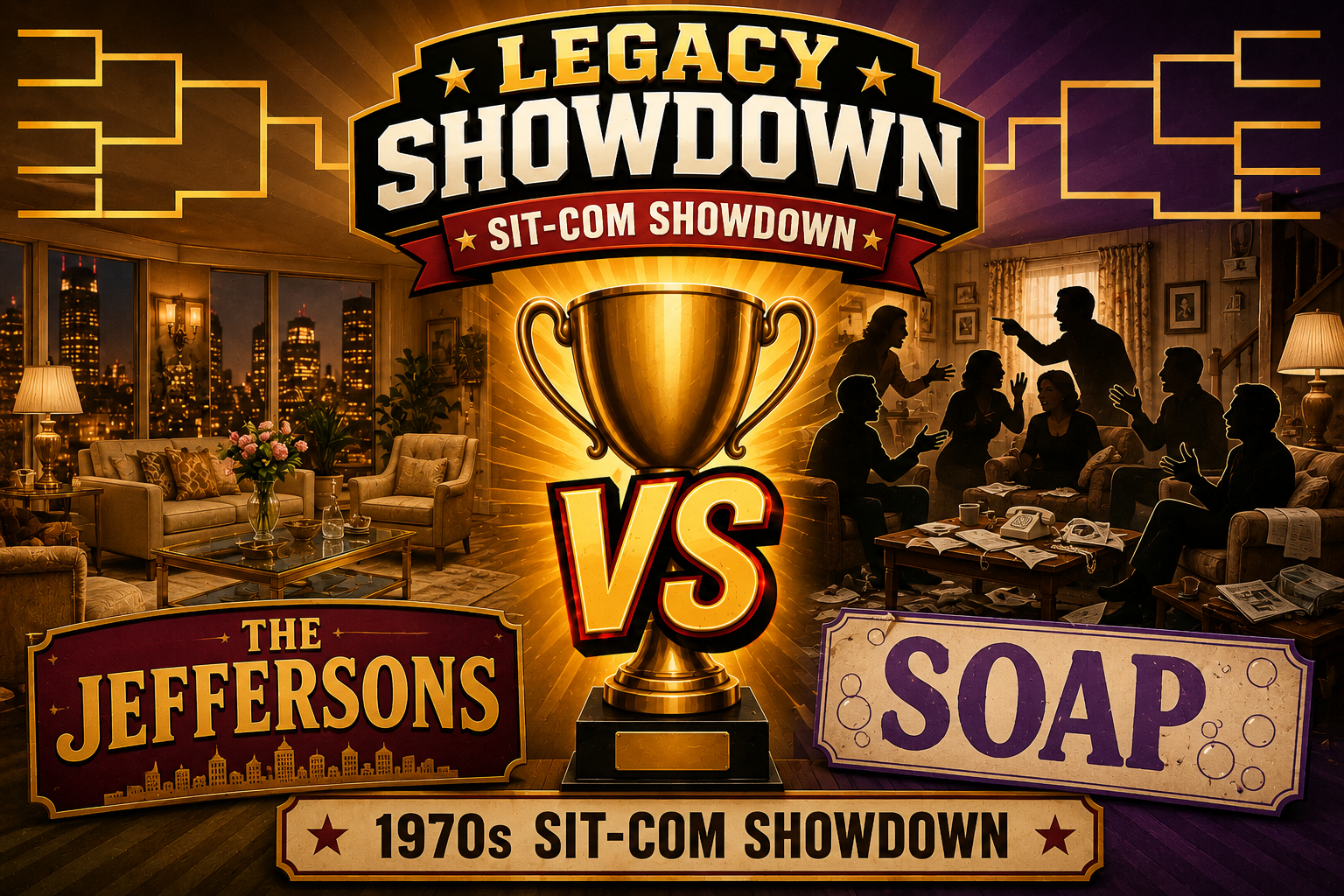
The 1970s region of the Sit-Com Showdown presents one of the most fascinating first-round matchups in the tournament. On one side stands The Jeffersons, a groundbreaking sitcom that combined humor with social commentary while becoming one of the most successful and influential television shows of its era. On the other side is Soap, the bold and unconventional satirical sitcom that challenged television norms through serialized storytelling, outrageous plot twists, and fearless comedy. This matchup pits mainstream success and cultural influence against innovation and creative risk-taking.
The Legacy Showdown Rules
Each matchup is judged using eight categories: Comedy Quality, Character Chemistry, Cultural Impact, Longevity & Replay Value, Iconic Moments, Supporting Cast, Era Difficulty, and Legacy Endurance.
Round 1: Comedy Quality
ay initially appear because The Jeffersons and Soap were funny for very different reasons.
The Jeffersons built much of its comedy around personality clashes, rapid-fire dialogue, misunderstandings, and the enormous comic presence of George Jefferson. Sherman Hemsley could generate laughs simply through George’s reactions, physical mannerisms, stubbornness, ego, and determination to have the final word. The series also had one of the strongest insult-comedy pairings of its era in George and Florence Johnston. Their exchanges became a recurring source of humor because Florence was one of the few people who could challenge George without being intimidated by him. The show even built episode plots around that chemistry. In one storyline, George deliberately has Florence insult him because the businessman he is trying to impress enjoys hearing Florence’s sharp tongue.
Florence could be just as funny when George was not her main target. In “Florence in Love,” she dresses as Aunt Jemima specifically to irritate George, an example of how the show could turn an ordinary domestic conflict into broad character comedy. Another memorable setup comes in “Louise’s Old Boyfriend,” when Florence impersonates Louise and goes on a dinner date with Louise’s former boyfriend, creating the kind of escalating misunderstanding that The Jeffersons handled extremely well.
George himself could carry an episode simply through his schemes. Across the series, he repeatedly exaggerates, manipulates situations, or becomes trapped by his own ego. In one later episode, for example, George tries to compete with a rival business owner by hiring celebrity lookalikes and presenting them as though they were the actual celebrities. The premise is classic George Jefferson: confidence first, consequences later.
That kind of comedy made The Jeffersons extremely accessible. Even when an episode dealt with race, class, marriage, or another serious subject, the writers usually grounded the comedy in recognizable personalities. George could argue with Tom Willis, spar with Florence, irritate Louise, or pursue another business scheme, and the audience immediately understood where the laughs were coming from. The series’ original Round 1 assessment correctly identifies sharp dialogue and George’s personality as its main comic weapons.
But Soap was attempting something far stranger.
Instead of operating primarily as a traditional situation comedy, Soap took the structure of daytime soap operas and pushed that structure into absurdity. Murder mysteries, affairs, kidnappings, family scandals, bizarre misunderstandings, and cliffhangers could all exist beside conventional sitcom jokes. The comedy frequently came from the fact that characters treated increasingly ridiculous circumstances as though they belonged in a perfectly serious melodrama.
That gave Soap an unpredictability that The Jeffersons, despite its tremendous comic performances, rarely attempted.
Consider Chuck Campbell and his ventriloquist dummy, Bob. Bob was not treated merely as a prop for an occasional joke. Chuck interacted with him as though Bob were an independent personality, and the other characters were repeatedly forced to respond to the dummy as if they were dealing with another member of the family. Episode descriptions from the series even have Chuck and Bob arriving together and immediately insulting everyone around them.
That is an unusually strange comic premise for a network sitcom of the late 1970s.
Then there was Benson, the Tate family’s cook and butler. Robert Guillaume’s dry delivery allowed Benson to stand almost outside the madness surrounding him. While the Tate and Campbell families became tangled in increasingly ridiculous problems, Benson could respond with sarcasm and apparent disbelief, giving the audience a character who seemed to understand just how absurd everyone else was. Guillaume’s performance became so successful that the character eventually received his own spin-off.
Richard Mulligan’s Burt Campbell added another completely different style of humor. Burt could shift from neurotic confusion to exaggerated panic and bizarre behavior, allowing Soap to move between verbal comedy, physical comedy, parody, and pure absurdism within the same storyline.
That variety matters when judging Comedy Quality.
The Jeffersons was exceptionally good at a specific kind of sitcom comedy: strong characters placed in conflict and allowed to trade brilliantly timed dialogue. George and Florence alone could justify giving the category to The Jeffersons. Louise’s ability to puncture George’s ego added another dimension, and characters such as Tom and Helen Willis gave George endless opportunities for arguments and uncomfortable situations.
But Soap had a larger comedic toolbox.
It could deliver a sharp one-liner and then follow it with a murder mystery.
It could use sophisticated satire and then immediately turn toward slapstick.
It could parody melodramatic television conventions while simultaneously asking the audience to become invested in the very characters creating the parody.
Even its structure was part of the joke. Each episode functioned like another installment of an impossibly complicated soap opera, with outrageous storylines continuing across episodes instead of being neatly reset at the end of thirty minutes.
That willingness to escalate absurdity created a sense that almost anything could happen.
And that is where Soap earns the narrow victory.
Why The Jeffersons Nearly Wins
There is a strong argument for The Jeffersons in this category.
If Comedy Quality were judged primarily on consistency of character-based laughs, The Jeffersons might actually take the round.
George Jefferson is arguably the funniest individual character in this matchup. His ego, temper, physical reactions, business obsession, arguments with Louise, clashes with Tom, and especially his verbal battles with Florence gave the series an extraordinarily dependable comic engine.
The show also sustained that formula for a remarkable length of time. It ran 11 seasons and more than 250 episodes, evidence of how durable the central comic relationships proved to be.
That should not be underestimated.
Soap could sometimes become so committed to its serialized plotlines that the story itself competed with the jokes. The Jeffersons, by contrast, could place George and Florence in the same room and practically guarantee laughs.
Why Soap Still Gets the Edge
Comedy Quality, however, should reward more than reliability.
It should also reward originality, range, surprise, and the ability to create comedy in ways audiences had not regularly seen before.
That is where Soap separates itself.
The show was willing to make a ventriloquist dummy function almost like a recurring character. It could center humor around dysfunctional families, murder plots, marital chaos, bizarre psychological situations, and other storylines that conventional sitcoms generally would not touch. Its ensemble allowed multiple styles of comedy to operate simultaneously—Benson’s sarcasm, Burt’s nervous absurdity, Chuck and Bob’s surreal routine, and the broader parody of soap-opera conventions.
The Jeffersons may deliver the better traditional sitcom banter.
Soap delivers the more adventurous comedy.
And because this category is specifically Comedy Quality, not cultural impact, longevity, or character chemistry, the willingness to experiment should matter.
The difference is extremely small, but Soap was simply more unpredictable and creatively fearless in how it pursued a laugh.
Round 1 Winner: Soap
Score after Round 1: Soap 1, The Jeffersons 0
The Jeffersons makes this nearly a split decision because George Jefferson and Florence Johnston form one of the strongest comic pairings in the tournament. But Soap takes the round by combining satire, absurdity, ensemble comedy, serialized parody, and genuinely bizarre comic situations into something network television had rarely attempted before. The original blog gave Soap only a “slight edge”; after looking more closely at what both shows actually put on screen, that remains the right call—but now there is a much stronger case behind it.
Round 2: Character Chemistry
If Soap won the opening round by being the more adventurous and unpredictable comedy, Round 2 shifts the competition toward one of The Jeffersons’ greatest strengths: the relationships between its characters.
The original version of this round correctly identified George and Louise Jefferson as the centerpiece of the argument, noting that The Jeffersons felt more grounded and relatable than Soap’s ensemble relationships. Once we examine what actually happened throughout the series, the case for The Jeffersons becomes considerably stronger.
George and Louise Are the Heart of the Show
George Jefferson may have been the loudest personality in the apartment, but his relationship with Louise—his beloved “Weezy”—gave the series its emotional center.
Sherman Hemsley and Isabel Sanford created a believable marriage because George and Louise were allowed to disagree constantly without making the audience question whether they fundamentally loved one another.
George could be stubborn, jealous, egotistical, and obsessed with his business and social standing. Louise frequently served as the person capable of bringing him back to reality. She challenged him when he was unreasonable, refused to simply agree with him, and often saw through his schemes before anyone else did.
Yet beneath all of those arguments was a convincing history between two people who had been together long before George became a successful businessman. The series established George and Louise as having risen from far more modest circumstances together, making their upscale Manhattan apartment the latest chapter of an already established relationship rather than its beginning.
That history gave their chemistry weight.
They were not merely two sitcom characters paired together because the premise required a married couple. They behaved like two people who knew virtually everything about each other—including exactly how to irritate one another.
“George and Louise in a Bind” Shows Why Their Relationship Works
Perhaps the strongest evidence comes from the three-part “George and Louise in a Bind.”
The story begins with something completely familiar: George and Louise have another argument, and Louise storms out. But when a burglar later ties both of them up in their apartment, the situation causes them to reminisce about their years together. The extended episode uses memories from both The Jeffersons and All in the Family to revisit their shared history, and the ordeal ultimately brings them closer.
That storyline demonstrates something important about their chemistry.
George and Louise could fight convincingly because the audience also believed the reconciliation.
The insults did not erase the affection.
The frustration did not erase the history.
And George’s enormous personality never completely overwhelmed Louise because Sanford played her as someone strong enough to stand beside him rather than merely react to him.
Their Marriage Could Generate Comedy and Genuine Emotion
The writers repeatedly tested that chemistry.
In “The Marriage Counselors,” Tom and Helen Willis’s formula for improving marriage actually threatens to disrupt George and Louise’s relationship. In “Louise’s Friend,” George becomes jealous when Louise’s French-class friend turns out to be a man.
Then there is “The Last Leaf.”
Louise becomes convinced that the stability of her marriage is symbolized by her preserved wedding corsage. When the corsage disappears, she begins fearing that George no longer loves her and may be having an affair. The premise is comedic, but it works because viewers are invested enough in George and Louise to care about Louise’s insecurity beneath the misunderstanding.
Those stories could only work after the actors had established a relationship audiences believed.
George and Florence Create an Entirely Different Kind of Chemistry
Character chemistry is not limited to romance.
And that is where The Jeffersons becomes even more difficult to beat.
George and Florence Johnston have almost the opposite relationship from George and Louise.
Louise loves George but challenges him.
Florence seems to wake up every morning wondering how quickly she can insult him.
Marla Gibbs’ dry delivery was a perfect counterweight to Sherman Hemsley’s explosive energy. George would attack; Florence would calmly fire back. George might believe he had finally won an argument, only for Florence to deliver another line that completely deflated his ego.
The important thing is that the audience understood the underlying affection.
George constantly complained about Florence.
Florence constantly mocked George.
Yet she remained an integral part of the Jefferson household.
Their antagonism became one of the show’s most dependable relationships, and Gibbs’ performance was significant enough to earn five Emmy nominations during the series.
George and Louise provided the show’s marital chemistry.
George and Florence provided its comic-combat chemistry.
Both were excellent.
George and Tom Willis Were Built for Conflict
Then there was Tom Willis.
Putting George Jefferson and Tom Willis together almost guaranteed friction.
Tom was white, married to Helen, a Black woman, and George’s discomfort with their interracial marriage became a recurring source of conflict and social commentary.
But what made the relationship interesting was that Tom was not simply George’s enemy.
The two men could argue viciously and still become involved in each other’s lives.
In “Thomas H. Willis & Co.,” for example, Tom wants to establish his own publishing company and ultimately seeks George’s help co-signing a loan—even after George and Helen have been fighting.
Their relationship gradually becomes something resembling a reluctant friendship.
George would probably never describe it that way.
That was part of the joke.
Louise and Helen Provided Another Layer
Louise and Helen Willis had a much warmer friendship.
Their relationship frequently served as a counterbalance to the battles occurring between their husbands.
Louise could visit Helen when she was frustrated with George. Helen understood many of Louise’s frustrations, and the two women could interact without requiring George to dominate the scene.
This gave the ensemble a web of relationships rather than one central pairing surrounded by interchangeable supporting characters.
George and Louise had one dynamic.
George and Florence had another.
George and Tom had another.
Louise and Helen had another.
Florence and Louise had another.
George and Mr. Bentley had yet another.
That variety is exactly what strong ensemble chemistry looks like.
Lionel and Jenny Connected the Two Families
Lionel Jefferson and Jenny Willis made the connection between the Jefferson and Willis families even deeper.
Their relationship forced George to confront his own prejudices because Jenny was the daughter of Tom and Helen.
George could complain about the Willis family all he wanted, but his son loved their daughter.
Episodes repeatedly used Lionel and Jenny’s relationship to bring both families together.
In “The Agreement,” George interferes in their engagement by convincing Lionel that Jenny should sign a prenuptial agreement. The interference produces exactly the kind of chaos viewers would expect: Lionel and Jenny argue and call off their wedding, while Louise knows George’s meddling is responsible.
Later, when Lionel and Jenny experience serious marital problems and separate, George, Louise, Tom, and Helen all become involved in trying to reunite them.
That is important for this category.
The relationships evolved.
Characters who began primarily as neighbors eventually became connected through marriage and family.
Even Mr. Bentley Added a Different Energy
Paul Benedict’s Harry Bentley gave the show yet another kind of chemistry.
Bentley was eccentric, polite, frequently oblivious, and completely unlike George.
That contrast made him valuable.
George often reacted to Bentley as though the man had descended from another planet, while Bentley could wander into the Jefferson apartment and casually create another bizarre situation.
Because Bentley’s personality was so different from Florence, Tom, Louise, and George, his presence prevented the ensemble from becoming repetitive.
Each supporting character brought out a different side of George Jefferson.
That is a major strength.
Soap Is Extremely Competitive Here
Giving this round to The Jeffersons should not diminish what Soap accomplished.
In fact, Soap had arguably the more complicated ensemble.
Jessica and Chester Tate had a deeply dysfunctional marriage shaped by Chester’s repeated infidelity. Mary Campbell and Burt had another complicated relationship. Jessica and Mary provided a sisterly connection between the Tate and Campbell families, while Danny and Jodie Dallas added additional family tensions. Benson’s relationship with the Tate household produced another entirely different dynamic.
And because Soap was serialized, these relationships could change substantially.
People separated.
Affairs occurred.
Secrets were revealed.
Family members fought.
Characters reconciled.
Relationships had consequences that could continue across multiple episodes.
There is a legitimate argument that Soap offered the more complex relationship structure.
But complexity and chemistry are not necessarily the same thing.
Where Soap Falls Slightly Behind
Soap’s relationships were deliberately chaotic.
That was part of the satire.
Chester was repeatedly unfaithful to Jessica. Burt had serious conflicts with his stepsons and an antagonistic relationship with Chester. The two families were connected by love, resentment, secrets, betrayals, and absurd circumstances.
Those relationships were entertaining.
But The Jeffersons created something slightly more difficult to sustain over the long term: relationships that could remain fundamentally recognizable while still producing new comedy year after year.
George and Louise could have their hundredth argument and still feel like George and Louise.
George and Florence could exchange another round of insults without the relationship becoming stale.
George and Tom could fight while the audience understood that some degree of friendship existed underneath their disagreements.
That familiarity became part of the show’s appeal.
Why The Jeffersons Wins Round 2
This category ultimately comes down to one question:
Which show makes the interactions between its characters feel most essential to the comedy and identity of the series?
The answer is The Jeffersons.
Remove the outrageous plots from Soap, and you still have a talented ensemble—but you lose a significant part of what made the show distinctive.
Remove an elaborate plot from The Jeffersons and simply place George, Louise, Florence, Tom, Helen, and Bentley together in the apartment?
You can still have an episode.
That tells us something.
The characters themselves generate the entertainment.
George does not need a murder mystery to become funny.
He needs Florence to insult him.
He needs Louise to tell him he is wrong.
He needs Tom to disagree with him.
He needs Bentley to confuse him.
And because Sherman Hemsley adjusted his performance depending on which character George was confronting, each relationship felt different.
That is outstanding character chemistry.
The Deciding Factor: George and Louise
Ultimately, the deciding factor is the Jefferson marriage itself.
George and Louise could be funny, angry, jealous, affectionate, stubborn, frightened, nostalgic, and supportive.
After all the arguments and schemes, audiences believed these two people belonged together.
That relationship gave the comedy an emotional foundation that Soap’s intentionally dysfunctional world could not quite match.
Soap deserves tremendous credit for ensemble complexity.
But The Jeffersons wins for relationship authenticity, complementary performances, variety of character pairings, and the remarkable chemistry between Sherman Hemsley and Isabel Sanford.
Round 2 Winner: The Jeffersons
Round 3: Cultural Impact
The Jeffersons became a landmark television series that expanded representation and addressed important social themes while remaining funny and accessible. Soap influenced television storytelling, but The Jeffersons had the broader and more lasting cultural impact. Winner: The Jeffersons.
Round 4: Longevity & Replay Value
The Jeffersons remains highly rewatchable because its characters, humor, and themes continue to resonate with audiences. Soap remains influential and fascinating, but its serialized approach can make casual rewatching more difficult. Winner: The Jeffersons.
Round 5: Iconic Moments
Some television shows are remembered because they were successful when they originally aired. Others produce characters, scenes, catchphrases, and performances that continue to live in popular culture long after the final episode.
That distinction becomes especially important in Round 5.
Soap unquestionably produced memorable television. Its bizarre storylines, cliffhangers, outrageous twists, and willingness to push sitcom conventions created moments that viewers had rarely seen before.
But when the category is specifically Iconic Moments, The Jeffersons has a major advantage.
George Jefferson alone generated countless memorable confrontations, reactions, and catchphrase-like moments, while Soap produced shocking and unusual storylines without creating as many individual moments that became embedded in mainstream television culture.
When we examine the two shows more closely, that advantage becomes even clearer.
George Jefferson Was an Iconic-Moment Machine
Some sitcom characters need a particularly strong storyline to produce a memorable scene.
George Jefferson often needed nothing more than someone to disagree with him.
Sherman Hemsley’s performance made George one of television’s most instantly recognizable characters. His distinctive voice, swagger, facial expressions, explosive temper, physical movements, and ability to transform a simple argument into a major confrontation meant that even relatively ordinary scenes could become memorable.
George entering a room already annoyed could be funny.
George discovering that Florence had insulted him could be funnier.
George trying to defend his pride after realizing everyone else knew he was wrong could be funnier still.
Hemsley understood that George’s comedy did not stop with the dialogue. His entire body was part of the performance.
That matters tremendously when discussing iconic television moments because audiences often remember not merely what George said, but how Sherman Hemsley delivered it.
George and Florence Created Countless Memorable Exchanges
If George Jefferson was the show’s greatest source of memorable moments, Florence Johnston was often the person who helped create them.
Their verbal battles became one of the defining features of The Jeffersons.
George was Florence’s employer, but that rarely prevented her from telling him exactly what she thought of him.
George would criticize Florence’s housekeeping.
Florence would criticize George.
George would remind her that he paid her salary.
Florence would find another way to insult him.
And Louise would frequently be nearby watching the entire battle unfold.
What made these exchanges memorable was their predictability and unpredictability at the same time.
Viewers knew Florence was going to fight back.
They simply did not know what she was going to say.
George might begin a confrontation believing he had the upper hand, only for Florence to calmly deliver a devastating comeback.
The reaction from Hemsley could then become as funny as Gibbs’ original line.
That combination created dozens of scenes that worked independently from the plots surrounding them.
George’s Walk Became Part of the Character
There are television characters recognizable from their dialogue.
George Jefferson became recognizable from the way he moved.
Sherman Hemsley’s exaggerated strut became so closely associated with George that the physical performance itself became part of the character’s identity.
George did not simply walk into a room.
He often seemed to arrive.
The posture, shoulders, movement, confidence, and attitude communicated exactly who George Jefferson was before he even opened his mouth.
That kind of physical characterization helps turn a successful sitcom character into a television icon.
You could imitate George without quoting a line.
That is a remarkable level of cultural recognition.
“Weezy” Became Instantly Associated With George and Louise
George’s affectionate nickname for Louise—“Weezy”—became another recognizable element of the series.
It was simple, but because George used it so frequently and Sherman Hemsley delivered it so distinctively, the nickname became inseparable from the Jefferson marriage.
This is important because iconic television is not always created by a spectacular episode.
Sometimes it develops through repetition.
A nickname.
A gesture.
A facial expression.
A particular way of entering a room.
A familiar argument.
Audiences spend years with those details until they become part of the show’s identity.
The Jeffersons had an abundance of them.
George’s Confrontations With Tom Willis Became a Signature of the Series
George’s relationship with Tom Willis created another category of memorable scenes.
Because Tom was white and married to Helen, a Black woman, George’s attitudes about their interracial marriage created repeated confrontations.
The writers frequently turned George’s prejudices and contradictions back on him.
That allowed the scenes to operate on multiple levels.
They were funny because George was outrageous.
They were memorable because the subject matter was socially significant.
And they were revealing because George could sometimes demonstrate the same kinds of prejudices he condemned when directed toward himself.
The George-and-Tom confrontations therefore became more than ordinary neighbor arguments.
They were part of the show’s larger commentary on race, prejudice, hypocrisy, friendship, and changing American society.
Lionel Could Put George in His Place Too
George’s son Lionel also produced memorable moments because he was capable of challenging his father in ways other characters could not.
Lionel loved George, but he was not necessarily impressed by George’s bluster.
That created a wonderful generational contrast.
George had fought his way toward financial success and was enormously proud of what he had accomplished.
Lionel represented a younger generation with different attitudes about race, relationships, education, and social status.
Their exchanges could therefore become both funny and revealing.
George wanted respect as the head of the family.
Lionel sometimes responded as the son who knew exactly how ridiculous his father could be.
The Jeffersons’ Apartment Became an Iconic Sitcom Setting
Iconic moments also depend on recognizable locations.
The Jefferson apartment became one of the familiar sitcom settings of its era.
The doorway alone created endless possibilities.
Florence enters.
Tom and Helen arrive.
Mr. Bentley appears.
Someone George does not want to see shows up.
A relative visits.
Another argument begins.
Because audiences became so familiar with the apartment, characters entering that space could immediately establish expectations.
That familiarity is one of the reasons classic sitcom reruns remain comforting.
Viewers are not simply returning to characters.
They are returning to a place they recognize.
The Opening Theme Is an Iconic Moment Every Episode
It is impossible to discuss the iconic qualities of The Jeffersons without acknowledging “Movin’ on Up.”
The opening sequence immediately communicates the premise: George and Louise Jefferson have achieved economic success and moved into a luxury apartment in Manhattan.
The theme became inseparable from the series.
Even people who have seen relatively few complete episodes may recognize the phrase “movin’ on up” in connection with The Jeffersons.
That gives the series an enormous advantage in this category.
Before an episode even began, The Jeffersons was delivering something memorable.
The Show’s Entire Premise Became Culturally Recognizable
The idea of the Jefferson family “moving on up” became bigger than the literal move from Queens to Manhattan.
It represented George’s success.
His ambition.
His pride.
The family’s changing economic position.
And the social changes the series explored.
That meant the show’s central premise itself became iconic.
George Jefferson was not merely a sitcom father living in an apartment.
He was a successful Black entrepreneur who had built a chain of dry-cleaning businesses and was enormously proud of having earned his place among wealthier New Yorkers.
That made his swagger make sense.
George believed he had arrived.
And he wanted everyone to know it.
George’s Success Created Memorable Comedy
George’s business success also provided endless opportunities for memorable situations.
He could become obsessed with impressing an important client.
Compete with another businessman.
Attempt to demonstrate that he belonged among wealthy people.
Use his money or status to prove a point.
And, inevitably, allow his ego to create trouble.
The comedy worked because George’s pride had understandable roots.
He had achieved something significant.
The problem was that George could turn that achievement into evidence that he was right about practically everything.
That was where the memorable confrontations began.
The Jeffersons Could Also Create Memorable Serious Moments
Iconic moments do not have to be comedic.
One reason The Jeffersons remains important is that the series could suddenly move from broad comedy into serious subject matter.
Episodes addressed racism, interracial relationships, economic differences, prejudice, alcoholism, transgender identity, and other subjects that were not always common sitcom material at the time.
That tonal range gave the characters opportunities to exist outside pure comedy.
George could be ridiculous in one scene and surprisingly vulnerable in another.
Louise could serve as the voice of reason but also receive emotional storylines of her own.
That gave the show memorable dramatic moments alongside the jokes.
The Final Season Produced One of George’s Most Emotional Storylines
A particularly strong example comes from the two-part episode “A Case of Self-Defense.”
After the Jeffersons’ apartment is burglarized, George becomes determined to protect himself and considers buying a gun.
The subject allows the series to explore fear, vulnerability, and the consequences of reacting to that fear.
For a character normally defined by swagger and confidence, seeing George frightened enough to reconsider how he protects his family adds another dimension.
Moments like this demonstrate why George Jefferson endured.
He was not merely a collection of punchlines.
Soap Had Unforgettable Moments of Its Own
This round should not become a dismissal of Soap.
Quite the opposite.
Soap created some of the strangest and most memorable television of its era.
Its opening alone established that viewers were entering a world where soap-opera melodrama would be pushed toward absurdity.
The show could move from infidelity to murder, kidnapping, organized crime, family secrets, ventriloquism, questions of sexuality, supposed alien encounters, and other increasingly outrageous developments.
The audience genuinely could not be certain what was coming next.
That unpredictability produced many memorable episodes.
Chuck and Bob Were Unforgettable
Perhaps no example demonstrates Soap’s bizarre creativity better than Chuck and his ventriloquist dummy, Bob.
The series did not simply use Bob for one gag.
Bob effectively became another personality within the ensemble.
Chuck treated Bob as real.
Bob insulted people.
Other characters were forced to interact with this wooden troublemaker.
The entire concept was ridiculous.
That was precisely why it worked.
For viewers familiar with Soap, Chuck and Bob remain among the show’s most distinctive creations.
There was nothing remotely comparable on The Jeffersons.
Benson Created His Own Memorable Presence
Benson was another standout.
Robert Guillaume’s dry, sarcastic performance made Benson one of Soap’s most memorable characters.
He frequently seemed like the one person who understood just how ridiculous everyone around him was.
Rather than joining the chaos, Benson could comment on it.
His reactions became part of the comedy.
The character proved memorable enough to escape Soap entirely and become the center of his own successful spin-off, Benson.
That is significant evidence of how strong the character was.
Jodie Dallas Was Historically Significant
Billy Crystal’s Jodie Dallas also gave Soap moments that became historically important.
Jodie was one of the earliest openly gay recurring characters on American network television.
The portrayal and some of the storylines surrounding the character can certainly be evaluated differently through a modern lens, but simply putting such a character at the center of a major network comedy in the late 1970s was groundbreaking.
That made some of Jodie’s scenes memorable for reasons extending beyond comedy.
The Murder Mystery Helped Define Soap
The murder of Peter Campbell and the mystery surrounding his death gave Soap one of its defining serialized storylines.
Rather than resetting everything after an episode, the series allowed the mystery and its consequences to continue.
Jessica Tate becomes implicated, the family becomes engulfed in scandal, and viewers are encouraged to follow the story from episode to episode.
That structure helped make Soap feel different from conventional sitcoms.
The question is not whether those moments were memorable.
They were.
The question is whether they became as widely recognizable outside the show’s existing audience.
That is where Soap begins losing this round.
The Difference Between Memorable and Iconic
This distinction decides Round 5.
Soap produced many memorable moments.
The Jeffersons produced moments and character traits that became iconic.
There is a difference.
A memorable moment stays with people who watched the program.
An iconic moment can escape the program.
George’s walk escaped the show.
“Weezy” escaped individual episodes.
George’s personality escaped the show.
“Movin’ on Up” escaped the opening credits and became a cultural expression associated with achieving greater success.
Sherman Hemsley’s portrayal of George Jefferson became recognizable even to many people who were not regular viewers of The Jeffersons.
That broader recognition matters enormously in this category.
Soap’s Serialization Actually Hurts It Here
Interestingly, one of Soap’s greatest strengths becomes a disadvantage in Round 5.
Because its comedy was serialized, many of its best moments depend on understanding the larger storyline.
A murder revelation means more if you understand the murder mystery.
A relationship twist matters more if you have followed the relationship.
A cliffhanger works because viewers want to know what happens next.
That makes Soap extremely effective when watched as a continuing story.
But individual scenes do not always separate as easily from their context.
The Jeffersons works differently.
You can watch a two-minute George-and-Florence argument without knowing anything about the episode and still understand why it is funny.
George says something.
Florence responds.
George explodes.
The scene works.
That portability helps create iconic moments.
Sherman Hemsley Is the Deciding Factor
Ultimately, this round comes down to Sherman Hemsley.
Soap had an excellent ensemble.
Robert Guillaume was outstanding.
Richard Mulligan was outstanding.
Billy Crystal was memorable.
Katherine Helmond anchored the absurdity beautifully.
But The Jeffersons had one performer whose characterization became larger than the program itself.
George Jefferson became a television archetype.
The walk.
The voice.
The expressions.
The confidence.
The temper.
“Weezy.”
The arguments.
The business pride.
The confrontations with Florence.
The battles with Tom.
Put those elements together and George becomes one of those television characters who can be recognized from a few seconds of performance.
That is extremely difficult to beat in a category called Iconic Moments.
Why Soap Cannot Quite Win the Round
There is a legitimate argument for Soap based on sheer audacity.
If this category were called Most Shocking Moments or Most Unpredictable Storylines, Soap would probably win.
Its willingness to take bizarre narrative risks was one of the qualities that helped it win Round 1.
But that is not what we are measuring here.
We are measuring which show created moments, characters, expressions, and images that became most deeply embedded in television culture.
That favors The Jeffersons decisively.
Soap shocked audiences.
The Jeffersons gave audiences George Jefferson.
And George is the difference.
Why The Jeffersons Wins Round 5
The Jeffersons wins because its most memorable material does not require explanation.
You do not need to describe an elaborate storyline to explain why George and Florence are funny together.
You do not need to explain several previous episodes to understand George shouting for “Weezy.”
You do not need to know the episode’s plot to appreciate Sherman Hemsley’s swagger.
And you certainly do not need an explanation to understand what “Movin’ on Up” represents within the world of the series.
Those elements became part of the show’s identity—and eventually part of American television history.
Round 5 Winner: The Jeffersons
George Jefferson alone generated countless memorable confrontations, reactions, and catchphrase-like moments, while Soap produced shocking and unusual storylines without creating as many individual moments that became embedded in mainstream television culture.
When we examine the two shows more closely, that advantage becomes even clearer.
George Jefferson Was an Iconic-Moment Machine
Some sitcom characters need a particularly strong storyline to produce a memorable scene.
George Jefferson often needed nothing more than someone to disagree with him.
Sherman Hemsley’s performance made George one of television’s most instantly recognizable characters. His distinctive voice, swagger, facial expressions, explosive temper, physical movements, and ability to transform a simple argument into a major confrontation meant that even relatively ordinary scenes could become memorable.
George entering a room already annoyed could be funny.
George discovering that Florence had insulted him could be funnier.
George trying to defend his pride after realizing everyone else knew he was wrong could be funnier still.
Hemsley understood that George’s comedy did not stop with the dialogue. His entire body was part of the performance.
That matters tremendously when discussing iconic television moments because audiences often remember not merely what George said, but how Sherman Hemsley delivered it.
George and Florence Created Countless Memorable Exchanges
If George Jefferson was the show’s greatest source of memorable moments, Florence Johnston was often the person who helped create them.
Their verbal battles became one of the defining features of The Jeffersons.
George was Florence’s employer, but that rarely prevented her from telling him exactly what she thought of him.
George would criticize Florence’s housekeeping.
Florence would criticize George.
George would remind her that he paid her salary.
Florence would find another way to insult him.
And Louise would frequently be nearby watching the entire battle unfold.
What made these exchanges memorable was their predictability and unpredictability at the same time.
Viewers knew Florence was going to fight back.
They simply did not know what she was going to say.
George might begin a confrontation believing he had the upper hand, only for Florence to calmly deliver a devastating comeback.
The reaction from Hemsley could then become as funny as Gibbs’ original line.
That combination created dozens of scenes that worked independently from the plots surrounding them.
George’s Walk Became Part of the Character
There are television characters recognizable from their dialogue.
George Jefferson became recognizable from the way he moved.
Sherman Hemsley’s exaggerated strut became so closely associated with George that the physical performance itself became part of the character’s identity.
George did not simply walk into a room.
He often seemed to arrive.
The posture, shoulders, movement, confidence, and attitude communicated exactly who George Jefferson was before he even opened his mouth.
That kind of physical characterization helps turn a successful sitcom character into a television icon.
You could imitate George without quoting a line.
That is a remarkable level of cultural recognition.
“Weezy” Became Instantly Associated With George and Louise
George’s affectionate nickname for Louise—“Weezy”—became another recognizable element of the series.
It was simple, but because George used it so frequently and Sherman Hemsley delivered it so distinctively, the nickname became inseparable from the Jefferson marriage.
This is important because iconic television is not always created by a spectacular episode.
Sometimes it develops through repetition.
A nickname.
A gesture.
A facial expression.
A particular way of entering a room.
A familiar argument.
Audiences spend years with those details until they become part of the show’s identity.
The Jeffersons had an abundance of them.
George’s Confrontations With Tom Willis Became a Signature of the Series
George’s relationship with Tom Willis created another category of memorable scenes.
Because Tom was white and married to Helen, a Black woman, George’s attitudes about their interracial marriage created repeated confrontations.
The writers frequently turned George’s prejudices and contradictions back on him.
That allowed the scenes to operate on multiple levels.
They were funny because George was outrageous.
They were memorable because the subject matter was socially significant.
And they were revealing because George could sometimes demonstrate the same kinds of prejudices he condemned when directed toward himself.
The George-and-Tom confrontations therefore became more than ordinary neighbor arguments.
They were part of the show’s larger commentary on race, prejudice, hypocrisy, friendship, and changing American society.
Lionel Could Put George in His Place Too
George’s son Lionel also produced memorable moments because he was capable of challenging his father in ways other characters could not.
Lionel loved George, but he was not necessarily impressed by George’s bluster.
That created a wonderful generational contrast.
George had fought his way toward financial success and was enormously proud of what he had accomplished.
Lionel represented a younger generation with different attitudes about race, relationships, education, and social status.
Their exchanges could therefore become both funny and revealing.
George wanted respect as the head of the family.
Lionel sometimes responded as the son who knew exactly how ridiculous his father could be.
The Jeffersons’ Apartment Became an Iconic Sitcom Setting
Iconic moments also depend on recognizable locations.
The Jefferson apartment became one of the familiar sitcom settings of its era.
The doorway alone created endless possibilities.
Florence enters.
Tom and Helen arrive.
Mr. Bentley appears.
Someone George does not want to see shows up.
A relative visits.
Another argument begins.
Because audiences became so familiar with the apartment, characters entering that space could immediately establish expectations.
That familiarity is one of the reasons classic sitcom reruns remain comforting.
Viewers are not simply returning to characters.
They are returning to a place they recognize.
The Opening Theme Is an Iconic Moment Every Episode
It is impossible to discuss the iconic qualities of The Jeffersons without acknowledging “Movin’ on Up.”
The opening sequence immediately communicates the premise: George and Louise Jefferson have achieved economic success and moved into a luxury apartment in Manhattan.
The theme became inseparable from the series.
Even people who have seen relatively few complete episodes may recognize the phrase “movin’ on up” in connection with The Jeffersons.
That gives the series an enormous advantage in this category.
Before an episode even began, The Jeffersons was delivering something memorable.
The Show’s Entire Premise Became Culturally Recognizable
The idea of the Jefferson family “moving on up” became bigger than the literal move from Queens to Manhattan.
It represented George’s success.
His ambition.
His pride.
The family’s changing economic position.
And the social changes the series explored.
That meant the show’s central premise itself became iconic.
George Jefferson was not merely a sitcom father living in an apartment.
He was a successful Black entrepreneur who had built a chain of dry-cleaning businesses and was enormously proud of having earned his place among wealthier New Yorkers.
That made his swagger make sense.
George believed he had arrived.
And he wanted everyone to know it.
George’s Success Created Memorable Comedy
George’s business success also provided endless opportunities for memorable situations.
He could become obsessed with impressing an important client.
Compete with another businessman.
Attempt to demonstrate that he belonged among wealthy people.
Use his money or status to prove a point.
And, inevitably, allow his ego to create trouble.
The comedy worked because George’s pride had understandable roots.
He had achieved something significant.
The problem was that George could turn that achievement into evidence that he was right about practically everything.
That was where the memorable confrontations began.
The Jeffersons Could Also Create Memorable Serious Moments
Iconic moments do not have to be comedic.
One reason The Jeffersons remains important is that the series could suddenly move from broad comedy into serious subject matter.
Episodes addressed racism, interracial relationships, economic differences, prejudice, alcoholism, transgender identity, and other subjects that were not always common sitcom material at the time.
That tonal range gave the characters opportunities to exist outside pure comedy.
George could be ridiculous in one scene and surprisingly vulnerable in another.
Louise could serve as the voice of reason but also receive emotional storylines of her own.
That gave the show memorable dramatic moments alongside the jokes.
The Final Season Produced One of George’s Most Emotional Storylines
A particularly strong example comes from the two-part episode “A Case of Self-Defense.”
After the Jeffersons’ apartment is burglarized, George becomes determined to protect himself and considers buying a gun.
The subject allows the series to explore fear, vulnerability, and the consequences of reacting to that fear.
For a character normally defined by swagger and confidence, seeing George frightened enough to reconsider how he protects his family adds another dimension.
Moments like this demonstrate why George Jefferson endured.
He was not merely a collection of punchlines.
Soap Had Unforgettable Moments of Its Own
This round should not become a dismissal of Soap.
Quite the opposite.
Soap created some of the strangest and most memorable television of its era.
Its opening alone established that viewers were entering a world where soap-opera melodrama would be pushed toward absurdity.
The show could move from infidelity to murder, kidnapping, organized crime, family secrets, ventriloquism, questions of sexuality, supposed alien encounters, and other increasingly outrageous developments.
The audience genuinely could not be certain what was coming next.
That unpredictability produced many memorable episodes.
Chuck and Bob Were Unforgettable
Perhaps no example demonstrates Soap’s bizarre creativity better than Chuck and his ventriloquist dummy, Bob.
The series did not simply use Bob for one gag.
Bob effectively became another personality within the ensemble.
Chuck treated Bob as real.
Bob insulted people.
Other characters were forced to interact with this wooden troublemaker.
The entire concept was ridiculous.
That was precisely why it worked.
For viewers familiar with Soap, Chuck and Bob remain among the show’s most distinctive creations.
There was nothing remotely comparable on The Jeffersons.
Benson Created His Own Memorable Presence
Benson was another standout.
Robert Guillaume’s dry, sarcastic performance made Benson one of Soap’s most memorable characters.
He frequently seemed like the one person who understood just how ridiculous everyone around him was.
Rather than joining the chaos, Benson could comment on it.
His reactions became part of the comedy.
The character proved memorable enough to escape Soap entirely and become the center of his own successful spin-off, Benson.
That is significant evidence of how strong the character was.
Jodie Dallas Was Historically Significant
Billy Crystal’s Jodie Dallas also gave Soap moments that became historically important.
Jodie was one of the earliest openly gay recurring characters on American network television.
The portrayal and some of the storylines surrounding the character can certainly be evaluated differently through a modern lens, but simply putting such a character at the center of a major network comedy in the late 1970s was groundbreaking.
That made some of Jodie’s scenes memorable for reasons extending beyond comedy.
The Murder Mystery Helped Define Soap
The murder of Peter Campbell and the mystery surrounding his death gave Soap one of its defining serialized storylines.
Rather than resetting everything after an episode, the series allowed the mystery and its consequences to continue.
Jessica Tate becomes implicated, the family becomes engulfed in scandal, and viewers are encouraged to follow the story from episode to episode.
That structure helped make Soap feel different from conventional sitcoms.
The question is not whether those moments were memorable.
They were.
The question is whether they became as widely recognizable outside the show’s existing audience.
That is where Soap begins losing this round.
The Difference Between Memorable and Iconic
This distinction decides Round 5.
Soap produced many memorable moments.
The Jeffersons produced moments and character traits that became iconic.
There is a difference.
A memorable moment stays with people who watched the program.
An iconic moment can escape the program.
George’s walk escaped the show.
“Weezy” escaped individual episodes.
George’s personality escaped the show.
“Movin’ on Up” escaped the opening credits and became a cultural expression associated with achieving greater success.
Sherman Hemsley’s portrayal of George Jefferson became recognizable even to many people who were not regular viewers of The Jeffersons.
That broader recognition matters enormously in this category.
Soap’s Serialization Actually Hurts It Here
Interestingly, one of Soap’s greatest strengths becomes a disadvantage in Round 5.
Because its comedy was serialized, many of its best moments depend on understanding the larger storyline.
A murder revelation means more if you understand the murder mystery.
A relationship twist matters more if you have followed the relationship.
A cliffhanger works because viewers want to know what happens next.
That makes Soap extremely effective when watched as a continuing story.
But individual scenes do not always separate as easily from their context.
The Jeffersons works differently.
You can watch a two-minute George-and-Florence argument without knowing anything about the episode and still understand why it is funny.
George says something.
Florence responds.
George explodes.
The scene works.
That portability helps create iconic moments.
Sherman Hemsley Is the Deciding Factor
Ultimately, this round comes down to Sherman Hemsley.
Soap had an excellent ensemble.
Robert Guillaume was outstanding.
Richard Mulligan was outstanding.
Billy Crystal was memorable.
Katherine Helmond anchored the absurdity beautifully.
But The Jeffersons had one performer whose characterization became larger than the program itself.
George Jefferson became a television archetype.
The walk.
The voice.
The expressions.
The confidence.
The temper.
“Weezy.”
The arguments.
The business pride.
The confrontations with Florence.
The battles with Tom.
Put those elements together and George becomes one of those television characters who can be recognized from a few seconds of performance.
That is extremely difficult to beat in a category called Iconic Moments.
Why Soap Cannot Quite Win the Round
There is a legitimate argument for Soap based on sheer audacity.
If this category were called Most Shocking Moments or Most Unpredictable Storylines, Soap would probably win.
Its willingness to take bizarre narrative risks was one of the qualities that helped it win Round 1.
But that is not what we are measuring here.
We are measuring which show created moments, characters, expressions, and images that became most deeply embedded in television culture.
That favors The Jeffersons decisively.
Soap shocked audiences.
The Jeffersons gave audiences George Jefferson.
And George is the difference.
Why The Jeffersons Wins Round 5
The Jeffersons wins because its most memorable material does not require explanation.
You do not need to describe an elaborate storyline to explain why George and Florence are funny together.
You do not need to explain several previous episodes to understand George shouting for “Weezy.”
You do not need to know the episode’s plot to appreciate Sherman Hemsley’s swagger.
And you certainly do not need an explanation to understand what “Movin’ on Up” represents within the world of the series.
Those elements became part of the show’s identity—and eventually part of American television history.
Round 5 Winner: The Jeffersons
Round 6: Supporting Cast
Soap featured one of the most ambitious ensemble casts of the 1970s, with multiple storylines and eccentric personalities interacting simultaneously. While The Jeffersons had a strong supporting cast, Soap’s depth and variety provide the advantage here. Winner: Soap.
Round 7: Era Difficulty
Both sitcoms succeeded during a highly competitive period in television history. Soap faced significant controversy and creative risks while attempting ideas rarely seen on network television. The Jeffersons faced the challenge of balancing comedy with social issues while maintaining mass appeal. Ultimately, the broader ratings success gives the edge to The Jeffersons. Winner: The Jeffersons.
Round 8: Legacy Endurance
Soap remains respected among television historians for its innovation, but The Jeffersons continues to enjoy stronger mainstream recognition and cultural significance decades after its original run. Winner: The Jeffersons.
Final Verdict
Soap entered the matchup with creativity, bold storytelling, and a willingness to challenge sitcom conventions. However, The Jeffersons ultimately prevails through greater cultural impact, stronger mainstream recognition, iconic characters, and enduring television relevance. The Jeffersons advances to the next round of the Sit-Com Showdown tournament.