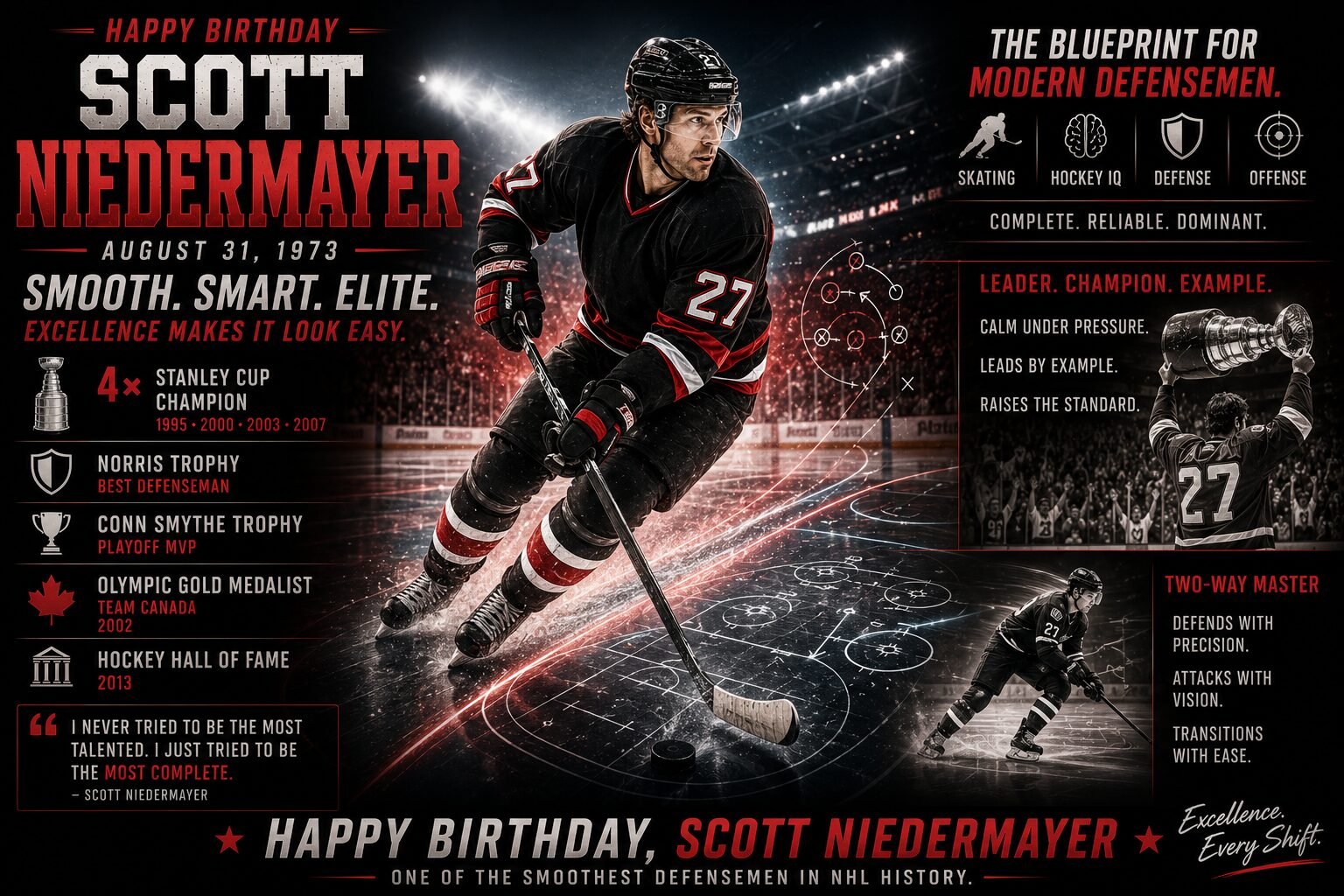


Some defensemen rely on physicality. Others specialize in defense. And then there are those who combine skating, skill, and intelligence to control the game from the blue line.
Scott Niedermayer was that kind of player.
Born on August 31, 1973, Niedermayer didn’t just become a star — he became one of the most complete and graceful defensemen in NHL history. On his birthday, fans celebrate more than stats. They celebrate elegance, leadership, and championship success.
Affiliate Disclosure: This article may contain affiliate links and banner advertisements. If you make a purchase through these links, we may earn a small commission at no additional cost to you. Thank you for supporting our platform.
From Alberta to the NHL
Scott Niedermayer was born in Edmonton, Alberta, Canada, on August 31, 1973, and grew up in nearby Cranbrook, British Columbia, where his love for hockey developed at an early age. From the time he first stepped onto the ice, coaches recognized that he possessed a rare combination of skating ability, poise, and natural athleticism. While many young defensemen relied on physical play, Niedermayer stood out because of how effortlessly he moved around the rink and how intelligently he read the game.
As he progressed through the junior hockey ranks, Niedermayer quickly established himself as one of Canada’s top defensive prospects. Playing for the Kamloops Blazers of the Western Hockey League (WHL), he became a key contributor on one of the most dominant junior teams of the era. His exceptional performances helped lead the Blazers to multiple league championships and a Memorial Cup title, while his calm demeanor and elite talent made him one of the highest-rated players eligible for the NHL Draft.
Unlike many offensive-minded defensemen, Niedermayer never sacrificed defense for scoring opportunities. He understood when to jump into the rush, when to stay back, and how to transition the puck from defense to offense with remarkable efficiency. His complete game caught the attention of NHL scouts across the league, and it became clear that he had all the tools to become a franchise defenseman.
He built his game on:
- Elite skating ability, widely considered among the best ever for an NHL defenseman. His smooth stride, incredible acceleration, and effortless mobility allowed him to escape pressure, lead the rush, and recover defensively with ease.
- Outstanding hockey IQ, consistently making smart decisions with and without the puck. Niedermayer anticipated plays before they developed, putting himself in the right position to break up scoring chances or create offensive opportunities.
- Exceptional vision, allowing him to see passing lanes that many players overlooked. Whether making a crisp breakout pass or setting up teammates in the offensive zone, he controlled the pace of the game with precision and confidence.
- Elite two-way play, excelling equally on offense and defense. He could quarterback a power play, kill penalties, match up against the opponent’s best forwards, and log heavy minutes in every situation.
What made Niedermayer truly unique was the calmness with which he played. No matter how much pressure opposing teams applied, he rarely appeared rushed. He seemed to glide through traffic, evade forecheckers with subtle movements, and make the correct play almost instinctively. His composure gave confidence to everyone around him, making his teammates better whenever he stepped onto the ice.
As his junior career came to a close, Niedermayer was viewed as one of the premier prospects in all of hockey. In the 1991 NHL Entry Draft, the New Jersey Devils selected him third overall, believing they had found the cornerstone of their blue line for years to come. It proved to be one of the smartest draft selections in franchise history.
His combination of speed, intelligence, offensive instincts, and defensive reliability made him one of the rare defensemen capable of influencing every shift. Whether leading a rush through the neutral zone, shutting down an elite scorer, or controlling the puck late in a close game, Niedermayer played with a confidence and elegance that few players have ever matched.
He wasn’t just talented.
He was effortless.
Everything about Scott Niedermayer’s game appeared smooth and under control. His skating looked effortless, his decision-making seemed instinctive, and his ability to impact every area of the game made him one of the most complete defensemen of his generation. Those qualities would eventually carry him to multiple Stanley Cup championships, Olympic gold medals, Hall of Fame recognition, and a legacy as one of the finest two-way defensemen in NHL history.
Get Yours Today: Scott Niedermayer New Jersey Devils 2000/01 Power Play Jersey – Red
The Rise with the Devils
Scott Niedermayer became one of the central figures in the rise of the New Jersey Devils, developing from a highly regarded young prospect into one of the NHL’s most complete defensemen. After being selected third overall in the 1991 NHL Entry Draft, he joined an organization that was building its identity around discipline, defensive responsibility, and team structure. Niedermayer fit that vision perfectly, but he also gave the Devils something rare: a defenseman who could transform defense into offense almost instantly.
As his role expanded, Niedermayer became a cornerstone of the Devils’ championship teams. New Jersey was known for its defensive system, but his speed and creativity added another dimension. He could retrieve the puck deep in his own zone, escape pressure with a few smooth strides, and carry it through the neutral zone before the opposing team had time to organize.
He brought:
- Elite skating from the blue line, using exceptional acceleration, balance, and edgework to move the puck out of danger and lead offensive rushes. His skating also allowed him to recover quickly whenever a play moved in the opposite direction.
- Defensive awareness, reading developing plays, maintaining proper positioning, and using his stick intelligently to interrupt passes and limit scoring opportunities.
- Offensive contribution, joining the rush, creating chances from the point, and moving the puck efficiently on the power play without abandoning his defensive responsibilities.
- Composure under pressure, remaining calm when forecheckers closed in or when the Devils needed a smart decision late in an important game.
What made Niedermayer so valuable was his ability to influence the game without forcing it. He rarely appeared rushed, even when opposing forwards pressured him behind the net or along the boards. Instead of simply clearing the puck and surrendering possession, he often found a controlled passing lane or skated away from danger himself.
That calmness allowed the Devils to dictate how games were played.
Niedermayer helped New Jersey capture the franchise’s first Stanley Cup in 1995. During that championship run, his mobility and two-way play gave the Devils a perfect complement to their structured defensive system. He could defend against elite forwards, support goaltender Martin Brodeur, and then immediately help begin the counterattack.
His role became even more important as the Devils continued building one of the NHL’s strongest teams. Alongside dependable defensemen such as Scott Stevens and Ken Daneyko, Niedermayer provided a different style. Stevens brought physical intimidation, while Niedermayer brought speed, creativity, and effortless movement. Together, they formed the foundation of a defense that could frustrate opponents in nearly every way.
Niedermayer helped the Devils win additional Stanley Cup championships in 2000 and 2003, establishing New Jersey as one of the defining franchises of the era. In close playoff games, his ability to control possession and play heavy minutes became especially valuable. Coaches trusted him on the power play, penalty kill, at even strength, and during the final minutes when protecting a lead or searching for a tying goal.
His excellence was recognized individually when he won the James Norris Memorial Trophy in 2004 as the NHL’s best defenseman. The award confirmed what teammates and opponents had understood for years: Niedermayer was not merely a skilled offensive defenseman or a reliable defensive player. He was elite in both roles.
He didn’t just defend.
He controlled the pace of the game.
When Niedermayer possessed the puck, New Jersey could move from defense to offense with remarkable speed. When the opposing team attacked, his positioning and recovery ability made scoring opportunities difficult to sustain. His calm presence allowed teammates to remain organized and confident in high-pressure situations.
Scott Niedermayer’s rise with the Devils helped transform him into one of the greatest defensemen of his generation. More importantly, his versatility became essential to a franchise that won through structure, intelligence, patience, and complete commitment to team hockey.
Career Highlights & Achievements
Scott Niedermayer’s résumé is legendary:
- 4× Stanley Cup Champion
- Norris Trophy (Best Defenseman)
- Conn Smythe Trophy (Playoff MVP)
- Olympic Gold Medalist (Team Canada)
- Hockey Hall of Fame (2013)
He is one of the few players to win at every level.
Get Yours Today: SCOTT NIEDERMAYER Signed Anaheim DUCKS 30th Anniv Official GAME Puck Beckett BAS
A True Two-Way Defenseman
Scott Niedermayer excelled in every aspect of the game, making him one of the most complete defensemen of his generation. While some defensemen specialized in physical play and others focused primarily on creating offense, Niedermayer could handle nearly every responsibility his coaches gave him. He defended against elite forwards, moved the puck out of danger, contributed offensively, and played important minutes in every situation.
His greatest strength was the balance within his game. Niedermayer could join an offensive rush without becoming careless defensively. His exceptional skating allowed him to move deep into the attacking zone and still recover quickly if possession changed. That ability gave his teams another offensive weapon without sacrificing stability on the blue line.
He was known for:
- Smooth skating, using powerful yet effortless strides to move through all three zones. His acceleration, balance, and control allowed him to escape forecheckers, close gaps defensively, and create separation from opponents.
- Transition play, turning defensive stops into immediate offensive opportunities. With one accurate pass or a controlled rush through the neutral zone, Niedermayer could change the direction and pace of a game.
- Defensive positioning, relying on intelligence, anticipation, and proper angles rather than unnecessary physical contact. He understood where plays were developing and placed himself in position to interrupt passes, block routes to the net, or force opponents toward less dangerous areas.
- Offensive instincts, recognizing when to join the rush, move into open space, or support teammates from the blue line. He could quarterback the power play, distribute the puck, and create scoring chances without forcing difficult plays.
Niedermayer’s intelligence made his skating even more effective. He did not move simply for the sake of speed. Every stride had a purpose. He knew when to accelerate, when to slow the play, and when to maintain possession until a better passing lane appeared.
That patience often frustrated opposing teams. Forecheckers believed they had trapped him near the boards, only for Niedermayer to turn away smoothly and find open ice. Attackers attempted to beat him wide, but his skating and positioning allowed him to recover before they could reach the net.
His versatility also made him invaluable to coaches. Niedermayer could play against an opponent’s top line, lead a power-play unit, contribute on the penalty kill, and remain on the ice late in close games. Whether his team needed a defensive stop or an offensive push, he could adjust his role without changing his calm approach.
He made the difficult look easy.
His game rarely appeared rushed or chaotic. Even during the fastest and most physical moments, Niedermayer seemed to have additional time to make decisions. That composure came from preparation, elite skating, and a deep understanding of how plays developed.
Scott Niedermayer was not simply an offensive defenseman who could defend, or a defensive specialist who occasionally scored.
He was a true two-way defenseman capable of controlling the game at both ends of the rink—and making every responsibility appear effortless.
Leadership in Anaheim
Later in his remarkable career, Scott Niedermayer joined the Anaheim Ducks and once again proved that great leadership extends far beyond statistics. Already a multiple-time Stanley Cup champion and one of the NHL’s premier defensemen, Niedermayer brought invaluable experience, championship knowledge, and quiet confidence to a talented Ducks roster that was ready to compete for hockey’s ultimate prize.
After signing with Anaheim in 2005, Niedermayer reunited with his younger brother, Rob Niedermayer, creating one of the NHL’s memorable family stories. More importantly, he immediately became the leader of the Ducks’ blue line. His calm presence, elite skating, and ability to perform in every situation gave the team a stabilizing force whenever games became tense.
In 2006, Niedermayer was named captain of the Anaheim Ducks, a role that perfectly matched his personality. He was never the loudest voice in the locker room, but he earned respect through his professionalism, preparation, and consistency. His teammates followed his example because they saw the level of commitment he brought to the rink every day.
He led with:
- Calm leadership, remaining composed regardless of the score, the pressure, or the importance of the game. His steady demeanor helped teammates stay focused during difficult moments throughout the season and playoffs.
- Championship experience, having already won multiple Stanley Cups with the New Jersey Devils. He understood what it took to succeed in the postseason and helped prepare younger players for the intensity of playoff hockey.
- Remarkable consistency, delivering high-level performances night after night against the league’s best players. Coaches trusted him in every situation, whether protecting a one-goal lead, leading the power play, or matching up against elite offensive stars.
- Leading by example, demonstrating through his work ethic, preparation, and decision-making what it meant to be a true professional. His influence extended well beyond the scoresheet.
The Ducks assembled one of the NHL’s deepest rosters, featuring stars such as Chris Pronger, Teemu Selänne, Ryan Getzlaf, Corey Perry, Jean-Sébastien Giguère, and Rob Niedermayer. While the team possessed tremendous talent, Scott Niedermayer became the player who connected every part of the lineup. His ability to control the puck, settle the game under pressure, and make smart decisions allowed everyone around him to play with greater confidence.
During the 2007 Stanley Cup Playoffs, Niedermayer elevated his game once again. He logged heavy minutes against the opposition’s best players while continuing to contribute offensively and lead Anaheim’s transition game. His ability to remain poised during the postseason’s most intense moments became one of the defining reasons the Ducks advanced through each round.
The Ducks defeated the Ottawa Senators in the 2007 Stanley Cup Final, capturing the first Stanley Cup championship in franchise history. Niedermayer’s leadership throughout the season and playoffs earned him the Conn Smythe Trophy as the NHL’s Most Valuable Player during the postseason. It was one of the highest individual honors a player can receive and reflected the enormous impact he had on Anaheim’s championship run.
Winning the Stanley Cup as captain added another remarkable accomplishment to an already extraordinary résumé. By that point, Niedermayer had established himself as one of hockey’s greatest winners, eventually becoming one of the few players in history to capture the Stanley Cup, Olympic Gold Medal, World Championship, World Cup of Hockey, Memorial Cup, and World Junior Championship—a collection of achievements often referred to as the Triple Gold Club plus junior championships.
He set the tone for a championship team.
More importantly, he created an environment where teammates could succeed.
His calm decision-making under pressure, willingness to play in every situation, and commitment to team-first hockey became the foundation of Anaheim’s championship identity. He never sought attention for himself, choosing instead to let his play and leadership speak louder than words.
Scott Niedermayer’s years in Anaheim demonstrated that leadership is not always measured by speeches or emotion.
Sometimes it is measured by composure.
Sometimes it is measured by consistency.
And sometimes it is measured by a captain who quietly steps onto the ice, controls the game, and inspires everyone around him to perform at their very best.
Why Fans Still Revere Him
Niedermayer represents:
- Elegance
- Consistency
- Winning
- Quiet leadership
He wasn’t loud.
He was dominant.
A Lasting Impact on the Game
v
A Birthday Worth Celebrating Across Hockey
Scott Niedermayer didn’t just play defense.
He mastered it.
On August 31, we celebrate more than a Hall of Famer.
We celebrate excellence.
Happy Birthday, Scott Niedermayer — one of the smoothest defensemen in NHL history.