

Affiliate Disclaimer: This article may contain affiliate links. If you click through and make a purchase, we may earn a commission at no additional cost to you. These partnerships help support our content creation efforts.
Introduction
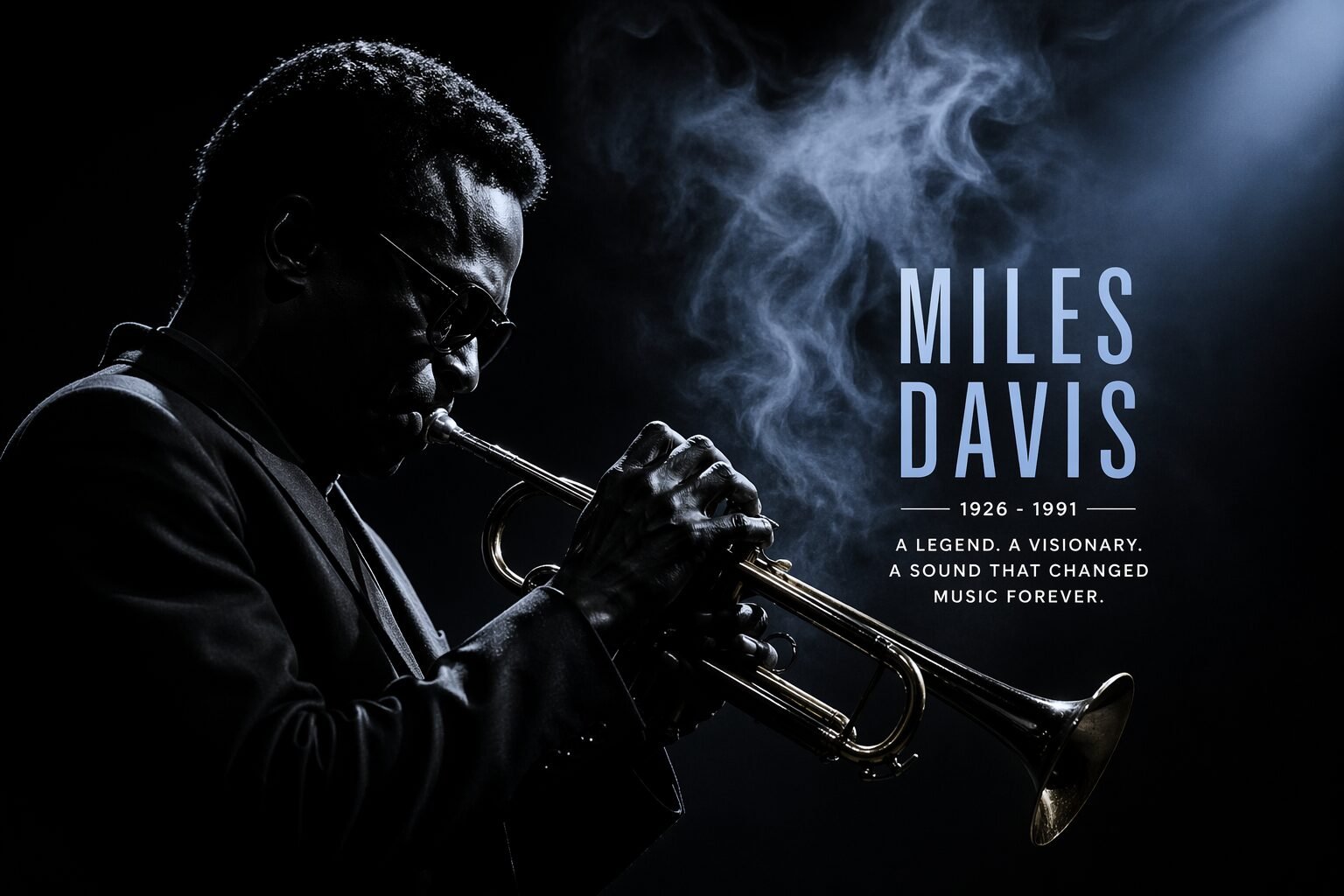
On May 26, 2026, the world celebrates what would have been the 100th birthday of Miles Davis—a name that doesn’t just belong to jazz, but to the very foundation of modern music.
Miles Davis was not simply a musician. He was an innovator, a disruptor, and a visionary who redefined what music could sound like across multiple generations. His influence stretches far beyond jazz into rock, hip-hop, R&B, and beyond.
This blog is a deep, expansive celebration of his life, his evolution, and the legacy he left behind—a legacy that continues to shape music today.
Early Life: The Foundation of a Legend
Miles Dewey Davis III was born on May 26, 1926, in Alton, Illinois, and raised in East St. Louis. Coming from a relatively well-off family, Davis had access to education and opportunity that many musicians of his era did not.
He began playing trumpet at a young age, quickly showing natural ability. By his teenage years, he was already performing with local bands, absorbing the sounds of swing and blues that would later influence his style.
Unlike many musicians who followed traditional paths, Davis showed early signs of independence. He wasn’t interested in simply copying others—he wanted to find his own voice.
The Rise: From Bebop to Breakthrough
In the 1940s, Davis moved to New York City to study at Juilliard, but it didn’t take long for him to leave the classroom behind and immerse himself in the real education—playing alongside legends like Charlie Parker.
During this period, he became part of the bebop movement, a fast-paced and complex style of jazz. However, even then, Davis began to push against the boundaries of what was expected.
His early recordings showed promise, but it was clear he was searching for something different—something more controlled, more emotional, and more innovative.

Birth of Cool: Changing the Sound of Jazz
In the late 1940s and early 1950s, Miles Davis introduced a new direction with what became known as cool jazz.
The album “Birth of the Cool” marked a turning point. Instead of the intense speed of bebop, Davis focused on space, tone, and subtlety.
This approach redefined jazz. It proved that music didn’t need to be loud or fast to be powerful—it could be quiet, controlled, and deeply expressive.
Kind of Blue and the Creation of Modal Jazz
In 1959, Davis released what is widely considered the greatest jazz album of all time: “Kind of Blue.”
This album introduced modal jazz, a style that focused on scales rather than chord progressions. It gave musicians more freedom and created a more open, emotional sound.
Tracks like “So What” and “Freddie Freeloader” remain timeless.
“Kind of Blue” is not just a jazz album—it is a cornerstone of music history. It continues to influence musicians across genres to this day.
Constant Reinvention: Never Standing Still
One of the most remarkable aspects of Miles Davis was his refusal to stay the same.
In the 1960s, he formed his Second Great Quintet, pushing jazz into more abstract and experimental territory.
By the late 1960s and 1970s, he began blending jazz with rock, funk, and electronic elements. Albums like “Bitches Brew” revolutionized music once again, giving birth to jazz fusion.
Each era of his career sounded completely different—and that was intentional.
Davis believed that growth required change, even if it meant leaving audiences behind.

Influence Beyond Jazz
Miles Davis didn’t just influence jazz—he influenced everything.
Hip-hop artists sampled his work. Rock musicians studied his approach. Producers admired his ability to shape sound.
His influence can be heard in artists across decades, proving that his music was never confined to one genre.
He changed how musicians think about creativity, collaboration, and evolution.
The Man Behind the Music
Miles Davis was known for his complex personality.
He could be intense, private, and sometimes difficult—but he was also deeply committed to his art.
He demanded excellence from those around him and wasn’t afraid to challenge norms.
His personality, like his music, was layered—full of contradictions, passion, and purpose.
Legacy: A Sound That Never Fades
Miles Davis passed away in 1991, but his influence has never faded.
His music continues to be studied, played, and celebrated around the world.
He didn’t just create songs—he created movements.
From bebop to cool jazz, modal jazz to fusion, Davis was at the center of it all.

Celebrating 100 Years of Miles Davis
A 100th birthday is more than a milestone—it is a reflection of lasting impact.
Miles Davis changed music not once, but multiple times. Few artists can say that.
As we celebrate his centennial, we are not just looking back—we are recognizing how his work continues to move forward through new generations of artists and listeners.
Lessons from Miles Davis
Miles Davis teaches us:
– Never stop evolving
– Take risks, even when they’re unpopular
– Trust your instincts
– Simplicity can be powerful
– Greatness comes from innovation, not imitation
These lessons extend far beyond music—they apply to life, business, and creativity.
Conclusion
Miles Davis was more than a musician—he was a revolution.
His 100th birthday is a reminder that true greatness is not measured by popularity alone, but by influence, courage, and the ability to change the world.
Miles didn’t follow trends. He created them.
And because of that, his music—and his legacy—will live forever.
Miles Davis Products:
Miles Davis Hope Style Retro Poster Art – T-Shirt
Miles Davis Cool – (simsima_sligita) – T-Shirt